Affiliate disclosure: Some links on this page are affiliate links. If you buy through them, Aribonsai may earn a small commission at no extra cost to you. It doesn’t change what we recommend or how we rank anything.
The $100 cutter that turned orange
It happens more than people admit.
You finally buy a proper Japanese concave cutter. Carbon steel, hand-forged, beautiful. You use it all spring. Then one day you open the drawer and there’s a faint orange bloom along the edge. Or the jaws feel sticky from dried sap. Or a cut that used to be crisp now tears the bark a little.
Nothing broke. The tool just didn’t get looked after.
If you’ve read any of our tool guides, you’ll have noticed the same line in almost every review: carbon steel, so it needs drying and oiling. That’s true, but it’s also a bit vague. Oil with what? How do you get sap off? And at some point, how do you actually sharpen a curved blade?
That’s what this guide covers. Not tools, but the small, cheap things that keep tools working. In my experience, this is the least exciting purchase in bonsai and one of the most useful. A $10 bottle of oil protects a $100 cutter.
Who this article is NOT for
It’s not for you if all your tools are stainless steel and you never sharpen them. Stainless still benefits from cleaning, but you can get by with less. Most of this guide matters most for carbon steel.
It’s not a step-by-step sharpening course. We’ll explain what each stone is for and who should use it. Sharpening curved bonsai blades well takes practice, and for expensive tools, a professional sharpener is a perfectly reasonable choice.
It’s not a tool buying guide. If you’re still choosing the tools themselves, start with our Japanese bonsai starter tool sets guide.
Let’s go.
How we picked these (3 things that actually matter)
1. Which job it does: protect, clean, or sharpen
Tool care breaks down into three jobs, and each needs a different product.
- Protect: a thin coat of oil after use to keep moisture off the steel. This is the one you’ll do most often.
- Clean: removing dried sap, resin and light surface rust. Sap is the sneaky one. It builds up on the blades, makes the jaws stick and attracts moisture.
- Sharpen: restoring the edge. You’ll do this far less often than the other two, especially if you protect and clean regularly.
Most people only need something for the first two jobs at first. Sharpening comes later.
Here’s what a realistic routine looks like for most hobbyists. Nothing fancy.
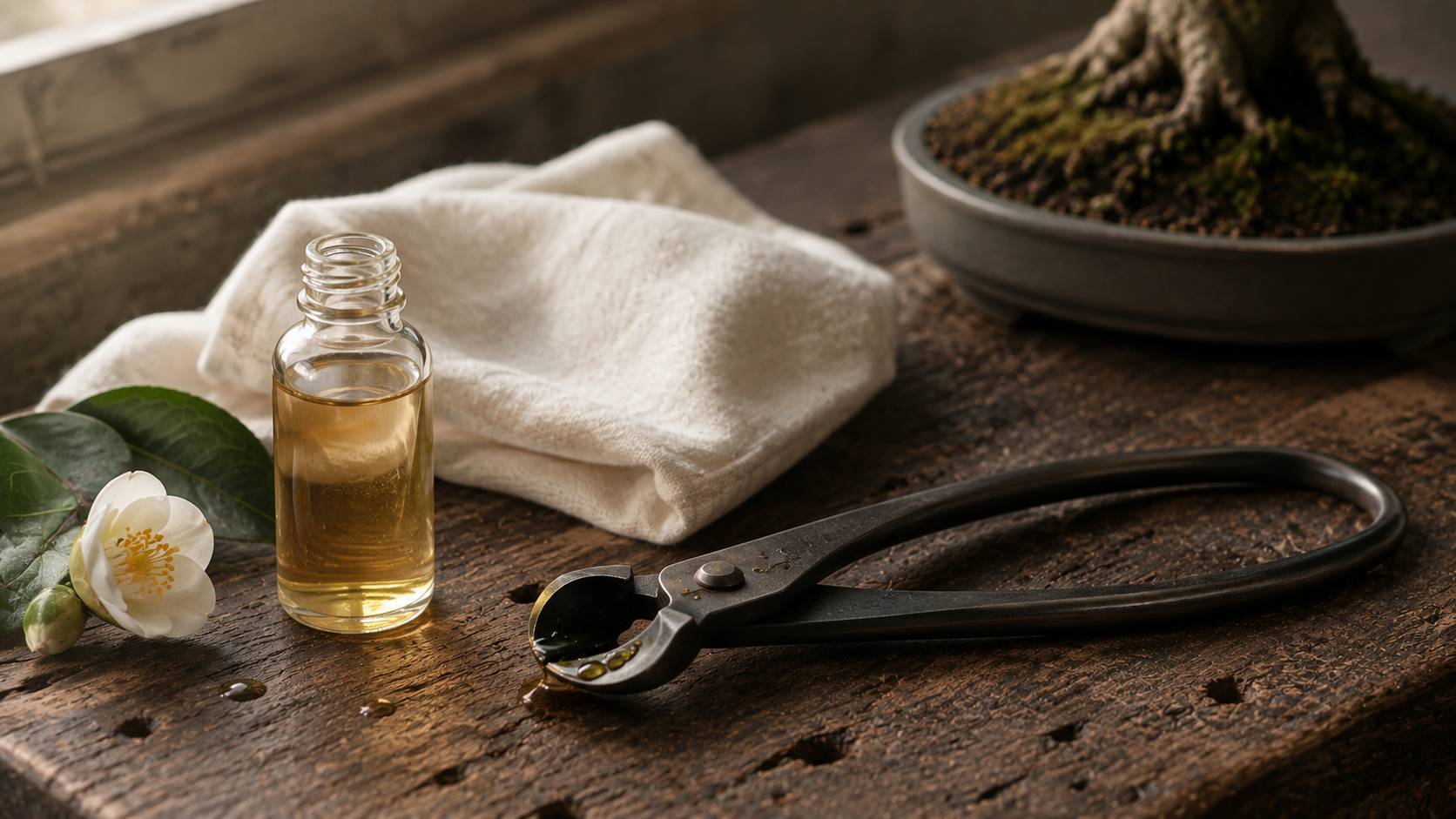
- After every session: wipe the blades with a dry cloth to get soil, water and fresh sap off. Then put a few drops of oil on the cloth and wipe again. It takes about thirty seconds per tool.
- Every few sessions, or after cutting sappy trees: check the jaws and pivot for sticky build-up. If you feel any, clean it off before oiling.
- A few times a year: look closely at the edge. If cuts start crushing instead of slicing, or the blades catch, it’s time to sharpen or send the tool out.
- Storage: keep tools somewhere dry. A tool roll or case is better than a drawer next to a damp potting bench.
The first point does most of the work. If you only build one habit, make it that one.
What about stainless steel? Stainless tools resist rust much better, so the oiling step matters less. Sap still builds up on stainless, though, and stainless edges still dull over time. So cleaning and occasional sharpening still apply. Oiling the pivot now and then also keeps the action smooth.
2. Whether it suits curved blades
This is where bonsai tools differ from kitchen knives. Concave cutters and knob cutters have curved edges. A flat whetstone works for scissors and straight blades, but it can’t reach the inside of a curve properly.
If you plan to sharpen your own cutters, you’ll need a rounded or half-round stone, not just a flat one.
3. Price and how long it lasts
Almost everything here is cheap, and most of it lasts a long time. A 100ml bottle of oil goes a surprisingly long way, because you only use a few drops at a time. A rust eraser lasts for years with occasional use.
So the real question isn’t cost. It’s whether you’ll actually use it. A simple oil and eraser you reach for every time beat a full sharpening kit you never open.
Prices below are approximate and were checked in October 2026. Yen prices are from Japanese stores before international shipping.
Comparison table
| Product | Job | Approx. price | Best for |
|---|---|---|---|
| Camellia (tsubaki) oil | Protect | ~¥900 / 100ml in Japan; ~$10–16 at Western retailers | Everyone with carbon steel tools |
| Kaneshin Crean Mate rust & sap eraser | Clean | ~¥1,000 (small) / ¥1,400 (large) | Sap build-up and light rust |
| Sandflex tool cleaning blocks | Clean | ~$12.95 for a set of 3 | Heavier cleaning, different grits |
| Combination whetstone (250/1000) | Sharpen | ~$24.95 | Shears and straight blades |
| Half-round sharpening stones set | Sharpen | ~£29.75 (UK retail) | Concave and knob cutters |
| Masakuni sharpening oil stone | Sharpen | ~¥5,800 | Masakuni owners, premium kit |
Individual reviews
1. Camellia (Tsubaki) Oil
If you buy one thing from this list, buy this.
Camellia oil is the traditional Japanese oil for protecting carbon steel. Kaneshin sells it in 100ml (about ¥900) and 245ml (about ¥1,800) bottles, and describes it as being for both tools and pots. In the US, Eastern Leaf sells tsubaki oil for $15.95. Niwaki sells a 100ml bottle for $10, or $24 bundled with an oil dispenser. Niwaki’s version is a blend of cold-pressed camellia seed oil and white mineral oil, and they describe it as non-toxic and non-flammable.
The routine is simple: wipe off sap and debris, then put a thin coat of oil on the blades with a lint-free cloth. Kaneshin notes it’s safe to use around trees, but it shouldn’t be applied to the trees themselves.
Pros
- Very cheap, and a little goes a long way
- The standard choice for Japanese carbon steel tools
- Also useful on wooden handles and for bringing back the shine on pots
- Easy to find from Japanese stores and Western retailers
Cons
- Only protects; it won’t remove rust or sap that’s already there
- Easy to forget to use, which is the real problem
- Oil-dispenser bundles cost more than the oil itself
Who it’s for: Anyone who owns even one carbon steel bonsai tool. Honestly, if you only take one thing from this article, make it this bottle.
2. Kaneshin Crean Mate (Rust and Sap Eraser)
This little block is one of those tools that seems unnecessary until you use it.
Crean Mate is a rubber-like eraser made for cleaning cutting tools. It comes in two sizes: small (No.7011, 65×20×20mm, about ¥1,000) and large (No.701, 65×40×20mm, about ¥1,400). It’s also sold by Western retailers and on eBay, usually at a higher price than in Japan.
Kaneshin’s instructions are straightforward. Put a small amount of oil on the eraser first (they recommend vegetable oil, especially camellia oil), then rub it over the dirty area like you’re erasing pencil. It takes off rust, stains and sap. Kaneshin also says to avoid animal oils.
In my experience, sap is the problem more people underestimate. It builds up slowly, and by the time you notice the jaws sticking, there’s a lot of it. A quick rub after each session stops that from happening.
Pros
- Removes sap and light rust without scratching the blade badly
- Cheap, especially from Japanese stores
- Small enough to keep in a tool roll
- Works with the camellia oil you already have
Cons
- Not meant for heavy rust or pitting
- Western retail prices are noticeably higher than in Japan
- Wears down over time, so it’s a consumable
Who it’s for: Anyone who cuts sappy trees like pines and junipers, or who’s noticed their tools getting sticky.
3. Sandflex Tool Cleaning Blocks
A tougher option for when the eraser isn’t enough.
Eastern Leaf sells Sandflex blocks as a set of 3 for $12.95, or individually in medium and coarse grits for $4.50 each. They’re described as an alternative to sandpaper, emery cloth and steel wool for removing residue from tools.
The grits are the useful part. A medium block handles regular cleaning, and a coarse one deals with more stubborn build-up. Go gently, though. Anything abrasive enough to remove heavy rust can also scuff the finish if you’re heavy-handed.
Pros
- Several grits for different levels of cleaning
- Cheap, and available individually
- Handles build-up that a softer eraser struggles with
- Easy to find from a US retailer
Cons
- More abrasive, so it’s easier to scratch the finish
- Not specifically made for bonsai tools
- Overkill for everyday cleaning if you keep up with the eraser
Who it’s for: Growers dealing with an older, neglected tool, or heavier build-up than Crean Mate handles.
4. Combination Whetstone (250/1000 grit)
Now we’re into sharpening.
Eastern Leaf sells a Japanese combination whetstone with a 250 grit side and a 1000 grit side for $24.95. The coarse side is for repairing a damaged or very dull edge. The fine side is for regular sharpening. They also list a double-sided whetstone with fine and diamond grains at the same price.
A flat stone like this works well for scissors and straight blades. It’s the natural partner to the shears in our Japanese bonsai shears guide. It won’t properly reach the curved inner edge of a concave or knob cutter, though.
Pros
- Two grits in one stone, for repair and regular sharpening
- Reasonably priced
- Good for scissors and other straight edges
- Also useful for kitchen and garden knives
Cons
- Can’t sharpen the curved edges of concave or knob cutters properly
- Takes some practice to hold a consistent angle
- Needs soaking or wetting before use, depending on the stone
Who it’s for: People who want to sharpen their own shears and straight-bladed tools.
5. Half-Round Sharpening Stones Set
This is the stone for the tools a flat stone can’t handle.
Kaizen Bonsai in the UK sells a set of two half-round ceramic aluminium oxide stones for £29.75. One is coarse (P180), one is fine (P600), and each is 100mm × 13mm. The half-round shape is what matters: it fits into the curved blades of knob cutters and concave (branch) cutters, as well as scissors, knives and carving gouges.
A general tip if you’re new to this: follow the angle that’s already on the blade rather than trying to create a new one. Use light strokes, check often, and stop as soon as the edge feels even. Most of the damage people do to good tools while sharpening comes from taking off too much metal, not too little. The fine stone is where you’ll spend most of your time once the coarse one has done its job.
If you own a good concave cutter, this is the type of stone that can actually reach its edge.
Pros
- Shaped for curved blades, which flat stones can’t reach
- Coarse and fine grits in one set
- Works across most bonsai tools
- Small and easy to store
Cons
- Sharpening curved blades well takes patience and practice
- UK retailer, so shipping elsewhere may add cost
- Finer grits than 600 aren’t included if you want a polished edge
Who it’s for: Intermediate and advanced growers who want to sharpen their own cutters.
6. Masakuni Sharpening Oil Stone
The premium, brand-matched option.
Masakuni sells its own sharpening oil stone at about ¥5,800 from a Japanese export store. It’s 200mm long and weighs 75g. The listing we checked didn’t state the grit, so ask the seller if that matters to you.
This makes the most sense if you’ve already invested in Masakuni tools and want a stone from the same maker. For most people, the half-round set or a combination whetstone covers the same ground for less.
Pros
- Made by the same maker as Masakuni tools
- Long, slim shape that’s easy to handle
- Light and easy to store with your tools
Cons
- Grit isn’t listed on the page we checked
- Pricier than the other stones here
- Not clearly better for a hobbyist than cheaper options
Who it’s for: Masakuni owners who want a matching sharpening stone.
Recommendation by use case
“I just bought my first carbon steel tool.” Camellia oil. That’s all you need to start.
“My tools are getting sticky from sap.” Crean Mate with a few drops of camellia oil.
“I’ve got an old tool with real rust build-up.” Sandflex blocks, used gently, then oil.
“I want to sharpen my own shears.” Combination whetstone (250/1000).
“I want to sharpen my concave and knob cutters.” Half-round sharpening stones set.
“I own Masakuni tools and want a matching stone.” Masakuni sharpening oil stone.
“I just want the basics in one go.” Camellia oil plus Crean Mate. Under ¥2,000 in Japan, and it covers most of what your tools need.
Conclusion: oil every time, clean often, sharpen rarely
Here’s the short version.
Wipe and oil your carbon steel tools after every session. Clean off sap before it builds up. Do those two things and you won’t need to sharpen nearly as often as you think.
When you do need to sharpen, use a flat stone for scissors and a half-round stone for curved cutters. And if a tool is expensive and you’re not confident, there’s no shame in sending it to a professional.
One more thing worth saying. A lot of people put off tool care because it feels like a chore that needs a special setup. It doesn’t. A cloth, a small bottle of oil and an eraser fit in a shoebox. Keep them right next to where you work, not in a cupboard somewhere else, and the habit mostly takes care of itself.
If you’re unsure where to start, start small. Oil this week. Add the eraser when you notice sap. Buy a stone the first time a cut feels wrong. There’s no need to buy the whole list on day one.
Ready to stock up?
Leave a Reply