Affiliate disclosure: Some links on this page are affiliate links. If you buy through them, Aribonsai may earn a small commission at no extra cost to you. It doesn’t change what we recommend or how we rank anything.
The tree is ready. The pot isn’t.
There’s a point most growers hit after a few years.
The tree has come along. The trunk has some movement, the branches are starting to look like branches, and you’ve finally stopped second-guessing the front. Then you look down, and it’s still sitting in a plastic training pot. Or a generic glazed pot from a garden center that’s the wrong color, the wrong depth, and somehow makes the whole tree look smaller.
That’s usually when people start looking at Japanese pots. And that’s when it gets confusing, because it doesn’t work like buying tools.
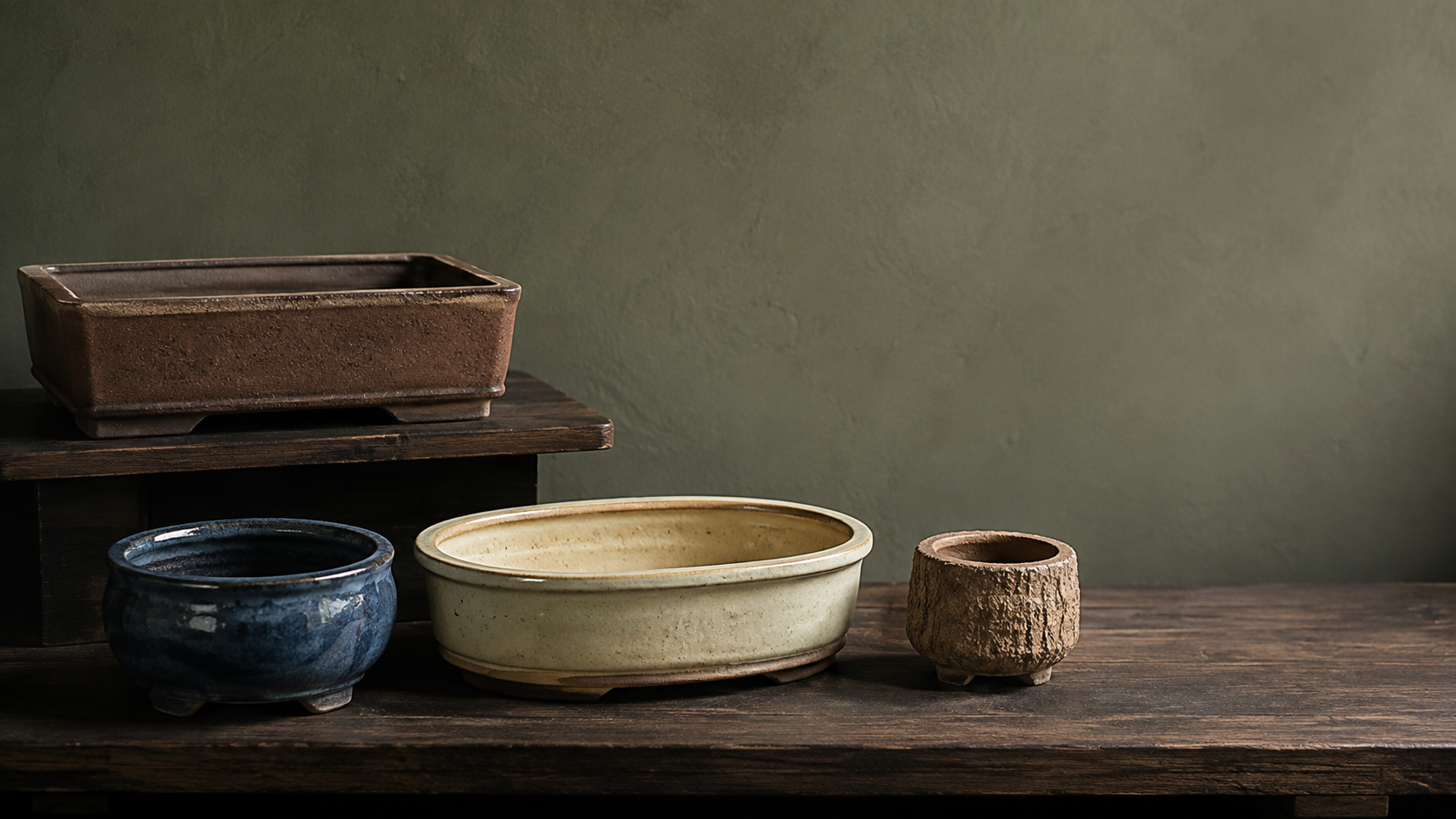
With a concave cutter, you pick a brand and a size. With a pot, you’re looking at dozens of kilns and individual makers, mostly from one town (Tokoname, in Aichi Prefecture), with names like Bigei, Yamaaki, Shibakatsu and Reiho. Many pots are one of a kind. Prices go from under $30 to well over $400 for something that looks, at first glance, like a brown rectangle.
In my experience, the most common mistake isn’t overspending. It’s buying a beautiful pot that doesn’t suit the tree. A great pot in the wrong color or depth looks worse than a plain one that fits.
So this guide is built around makers, not individual SKUs, because the specific pot you see today will probably be gone tomorrow. What stays the same is each maker’s style, quality and price range.
Who this article is NOT for
It’s not for you if your tree is still in development. If you’re still growing out the trunk or thickening branches, a training pot or a colander does the job better and cheaper. A good Japanese pot is for a tree that’s close to its final shape.
It’s not for you if you’re looking for antiques or investment pieces. Old signed pots from makers like the first-generation Shuho can run into the hundreds or thousands. We’ll mention where that tier starts, but this guide is about pots you’d actually plant a tree in.
It’s not about tools. If you’re still putting together your kit, our guide to Japanese bonsai starter tool sets covers that.
Still here? Let’s get into it.
How we picked these (3 things that actually matter)
1. Glazed or unglazed, matched to the tree
This is the big one, and it’s mostly tradition rather than hard rules, but the tradition exists for good reasons.
Unglazed pots (brown, gray, dark red clay) are the usual choice for conifers: pines, junipers, spruces. The muted, earthy finish suits evergreen foliage and makes an old tree look older.
Glazed pots (blue, green, cream, white, celadon) tend to go with deciduous, flowering and fruiting trees: maples, azaleas, quince, crabapple. The color can pick up the flowers, fruit or autumn leaves.
You can break this rule. Plenty of good trees do. But if you’re unsure, following it is the safest way not to end up with a pot that fights the tree.
2. Size and depth
A rough guide many growers use: the pot’s length is around two-thirds of the tree’s height (or spread, for wider trees), and its depth is roughly the thickness of the trunk at the base.
Shallow pots make a tree look older and more refined, but they dry out faster and hold less root mass. Deeper pots are more forgiving and suit cascades and trees that still need some vigor. If your tree has only recently come out of a training container, going a little deeper than “ideal” for the first repot is a sensible move.
Also check the practical stuff: drainage holes big enough to screen, and wire holes for tying the tree in. Almost every proper Japanese bonsai pot has both, but cheap decorative pots sometimes don’t.
3. Maker, handwork and price
Tokoname pots range from small-workshop and semi-production pieces up to fully handmade pots from named artists with signatures stamped on the bottom.
You pay more for the name, but not only for the name. Better pots tend to have cleaner lines, more consistent walls, better feet and rims, and clay that’s been fired well. In the mid-range, those differences are visible when you put two pots side by side.
At the top end, you’re paying for reputation and collectibility as much as for anything you’d notice on the bench.
A quick note on buying one-off pots online. Because so many of these pots are unique, the listing photos are all you get. A few habits help:
- Check whether the size is measured outside or inside. Most retailers give outside dimensions, which means the soil space is smaller than the number suggests.
- Look at the photo of the bottom. You want to see the drainage holes, wire holes and feet clearly.
- Look at the glaze in more than one photo if you can. Colors shift a lot under different lighting.
- Factor in shipping. Pots are heavy and fragile, so a “cheap” pot from overseas can cost a lot more once it’s packed and sent.
None of this is complicated. It just saves you from a pot that arrives looking nothing like you expected.
Prices below are approximate retail ranges seen at US bonsai retailers and maker stores in September 2026. Many pots are one-offs, so exact listings change constantly. Treat these as price bands, not fixed prices.
Comparison table
| Maker | Style | Typical size range | Approx. price | Best for |
|---|---|---|---|---|
| Wazakura Tokoname Series | Glazed and unglazed, simple shapes | ~105–175mm | ~$54–70 | First real Japanese pot, small trees |
| Seizan (Kataoka family, incl. Reiho) | Traditional, glazed and unglazed | Small to large | ~$29–109 (Reiho signed pieces higher) | Best value handmade Tokoname |
| Hattori | Compact, simple | Small / shohin | ~$47–75 | Shohin and mame on a budget |
| Shibakatsu | Mostly glazed, rectangles and cascades | Small to medium | ~$91–135 | Mid-range glazed pots |
| Bigei | Mostly unglazed, textured and classic shapes | Tiny to large | ~$135–425 | Conifers, shohin displays |
| Yamaaki | Glazed and unglazed, refined | Small to large | ~$118–446 | Premium pots for finished trees |
Individual reviews
1. Wazakura Tokoname Series
The most approachable way to own a genuine handmade Tokoname pot.
Wazakura, the same Japan-based store we’ve recommended for tools, also sells a small line of pots made by Tokoname artisans. Recent listings included a 135mm olive green glazed rectangle ($63.99), a 135mm glazed rectangle ($53.99), a 160mm rustic tatara pot ($59.99), a 174mm fan-shaped pot ($69.99) and a 105mm striped square ($53.99). Free shipping applies to a number of regions, including the US.
The catch: stock is small and sells out. When we checked, every pot in the series was marked sold out. If one fits your tree, don’t wait too long.
Pros
- Real handmade Tokoname pots at a low price
- Simple, clean shapes that are hard to get wrong
- Free shipping to several regions
- Easy to buy if you already order tools from Wazakura
Cons
- Small range, mostly sized for small trees
- Frequently sold out
- No named artist, so less collectible than signed pots
Who it’s for: Someone moving their first small tree out of a training pot and into something real.
2. Seizan (Kataoka family) and Reiho
Seizan is one of the better-value names you’ll see in Tokoname listings.
At US retailers, Seizan pots show up between about $29 and $109. That’s very low for handmade Tokoname work, and it covers a wide spread of traditional shapes. Pots signed Reiho, also listed by retailers as coming from the Kataoka family’s Seizan kiln, sit higher. One retailer listed a 12.25″ Reiho shallow oval at $300 and a 13.5″ dark blue glazed rectangle at $375.
So you get two tiers from the same kiln family: everyday Seizan pots at a friendly price, and signed Reiho pieces for when you want something special.
In my experience, this is the name people point to most often when someone asks “where do I start with Tokoname pots without spending a lot?”
Pros
- Low prices for handmade Tokoname
- Wide range of traditional shapes and sizes
- A clear step up within the same kiln (Reiho) when you want it
- Both glazed and unglazed options
Cons
- Quality and finish vary more at the bottom of the range
- Reiho pieces jump significantly in price
- Name spellings (Reiho / Reihou) vary between retailers, which can make searching annoying
Who it’s for: Pretty much anyone buying their first few Japanese pots, plus people who want a signed Reiho pot without going into the top price tier.
3. Hattori
Small pots, small prices.
Hattori pots listed at a US retailer ran roughly $47–75, mostly in compact sizes. That makes them a good fit for shohin and mame trees, where finding a decent small pot at a sensible price is harder than it sounds.
Small pots are their own challenge. Walls and feet are proportionally thicker, and badly made ones look clumsy fast. A reliable maker in this size range is useful.
Pros
- Affordable handmade pots in small sizes
- Good for shohin and mame collections where you need several pots
- Lower risk for experimenting with shape and color
Cons
- Limited to smaller sizes
- Less information online about the maker than the bigger names
- Not the place to look for statement pots
Who it’s for: Shohin and mame growers, or anyone who needs several small pots without spending a lot.
4. Shibakatsu
Shibakatsu sits in the middle of the market, both in price and style.
Listings at a US retailer ran about $91–135, mostly rectangular and cascade designs. Shibakatsu is often associated with glazed pots, which makes it a natural choice for deciduous and flowering trees. Pots also show up on eBay through Japanese sellers, including small glazed pieces around $90.
If Seizan is “good value” and Yamaaki is “premium,” Shibakatsu is the comfortable middle. It’s a noticeable step up in finish without getting into the price range where every pot feels like an investment.
Pros
- Strong glazed options for deciduous and flowering trees
- Cascade pots, which are harder to find in good quality
- Mid-range price with a clear step up in finish
- Available through both US retailers and Japanese sellers
Cons
- Fewer unglazed options if you’re potting conifers
- Mostly small to medium sizes
- Glaze colors vary, so check photos carefully
Who it’s for: Growers with maples, azaleas or other flowering trees who want a well-made glazed pot without going premium.
5. Bigei
If you’ve seen a small unglazed pot with a carved or textured surface at a bonsai show, there’s a fair chance it was Bigei.
US retailers list Bigei pots from about $135 for tiny 2–3″ pieces up to around $425 for a 12″ rectangle. One retailer had a 3″ hand-carved wicker texture pot at $135, a 3″ basketweave at $180, a 10″ round with a beaded rim at $325 and a 12″ rectangle with a flared rim at $425.
Bigei is mostly unglazed, which makes it a strong fit for conifers. The detail work on the small pots is a big part of why shohin growers like them.
Pros
- Excellent unglazed pots for pines and junipers
- Detailed, textured small pots that suit shohin displays
- Covers a wide size range, from tiny to large
- Strong reputation among serious hobbyists
Cons
- Expensive, especially for the size on the smallest pots
- Few glazed options
- Popular pots sell quickly
Who it’s for: Intermediate and advanced growers with conifers, and shohin growers who care about display.
6. Yamaaki
The premium pick on this list.
US retailers list Yamaaki pots between roughly $118 and $446, in both glazed and unglazed finishes. Yamaaki pots are known for refined lines and careful finishing, and they’re common choices for trees that are close to show-ready.
This is not a first-pot purchase for most people. It’s the pot you buy once a tree has earned it.
In my experience, the people happiest with a Yamaaki pot are the ones who held off until they knew exactly what the tree needed. Size, depth, color, shape. Buying a premium pot “just in case” usually ends with it sitting empty on a shelf.
Pros
- Top-tier finish and proportions
- Both glazed and unglazed options
- Wide size range, including larger pots
- Well regarded among experienced growers
Cons
- Expensive, especially for larger pieces
- Overkill for trees still in development
- Easy to overspend if you haven’t settled on what the tree needs
Who it’s for: Advanced growers with a finished or nearly finished tree, ready for a pot that matches it.
Recommendation by use case
“I’m moving my first small tree out of a training pot.” Wazakura Tokoname Series if something’s in stock. If not, a Seizan pot in the right size.
“I want good handmade pots without spending much, and I need a few.” Seizan for general sizes, Hattori for small trees.
“I grow shohin and mame.” Hattori on a budget. Bigei when you want a pot that people actually notice.
“I have a maple, azalea or flowering tree.” Shibakatsu for a mid-range glazed pot. Yamaaki glazed if the tree is close to finished.
“I have a pine or juniper that’s starting to look properly old.” Bigei or Yamaaki unglazed. A signed Reiho pot is a good middle option.
“I want something special for my best tree.” Yamaaki, or a signed Reiho. Take your time choosing the size and depth.
Conclusion: fit the tree first, then the name
Here’s the short version.
Pick the type first: unglazed for most conifers, glazed for most deciduous and flowering trees. Then get the size and depth right. Only after that does the maker matter.
A $60 Seizan pot that suits the tree will look better than a $400 Yamaaki that doesn’t. And a pot that’s a little too deep for now is easy to fix at the next repot. A pot that’s too shallow for a tree that isn’t ready can set it back a season. Start with a value maker, learn what you like, and save the premium pots for the trees that have earned them.
Ready to look?
Leave a Reply