Affiliate disclosure: Some links on this page are affiliate links. If you buy through them, Aribonsai may earn a small commission at no extra cost to you. It doesn’t change what we recommend or how we rank anything.
Your trees deserve to get off the ground
Most bonsai collections start the same way. One tree on the patio table. Then three on the steps. Then a dozen scattered across the ground, the wall and an old garden chair.
At some point, you need a proper bonsai bench.
A good bench does far more than hold pots. It lifts trees off the ground, away from slugs, splashing soil and curious pets. It improves air circulation around the pots. It puts trees at a height where you can actually see them, water them and work on them without bending over all day. And it makes your collection look like a collection, not a pile of pots.
The choices range from a few cinder blocks and boards to custom timber benches and galvanized steel nursery benches. Some growers swear by cheap wire shelving; others build something that looks like garden furniture.
In my experience, the biggest bench mistakes are getting the height wrong and choosing something that can’t take the weight of wet pots and soil. This guide explains what matters, then compares six bonsai bench options, from the cheapest DIY build to sturdy metal benches.
Who this bonsai bench guide is NOT for
It’s not about indoor display stands. For displaying a single tree indoors or at a show, see our bonsai display stand guide.
It’s not about work turntables. A turntable sits on top of a bench to help you work on a tree.
It’s not a full carpentry tutorial. We’ll cover simple builds, but check detailed plans if you’re building something large.
Still with us? Let’s go.
How we picked these (3 things that actually matter)
1. Height
Bench height affects how you see your trees, how easily you water them and how comfortable you are working on them.
On the Bonsai Mirai forum, growers suggest around 35 to 40 inches (about 90 to 100 cm) for a general bench. One points out that show tables are about 2.5 feet high, with trees often raised further on stands, so a bench around 3 feet gives a similar viewing height. On Bonsai Nut, members suggest about 30 to 36 inches for most trees, around 36 inches as a working height, and around 48 inches for display benches that bring trees closer to eye level.
Taller growers may prefer slightly higher benches. Larger, heavier trees often suit lower, wider benches, while small shohin can go higher.
2. Strength and width
Wet bonsai pots are heavy. A bench must carry the weight of pots, soil and water without sagging.
Bench tops of around 17 to 24 inches deep are common, according to forum members, though some growers use wider benches to maximize space. Long benches need extra support: one Bonsai Mirai forum member points out that an 8-foot bench needs a center set of legs.
3. Material and weather
- Treated or stained timber looks natural and suits a Japanese-style garden, but needs refinishing every few years.
- Galvanized steel resists rust and pests and lasts a long time.
- Wire or plastic shelving is cheap and easy, but less attractive.
- Concrete blocks are almost indestructible and very cheap.
A few bench habits that matter more than the bench
None of these cost anything.
- Place benches where trees get the right light. Most outdoor bonsai want plenty of sun, with some shade for sensitive species.
- Leave space between pots for air circulation and easy watering.
- Keep heavier trees low. It’s safer and easier to lift them.
- Secure tall or top-heavy trees against wind.
- Allow water to drain freely. Slatted tops dry faster than solid ones.
- Leave room to walk around. You’ll want to see trees from all sides.
- Plan for winter. Benches you can move or empty easily make winter protection simpler.
Bonsai bench comparison table
| Bench / shelf | Type | Best for | Durability | Approx. cost |
|---|---|---|---|---|
| Cinder blocks + boards | DIY bench | Cheapest sturdy bench | Very high (blocks), boards need replacing | Very low |
| DIY timber bench (Douglas fir) | DIY bench | Attractive garden display | High with refinishing | Moderate |
| Chrome wire shelving | Shelving | Budget, small trees | Moderate | ~$40 per set (forum estimate) |
| Heavy-duty plastic shelving | Shelving | Movable, weatherproof | Good | Low to moderate |
| vidaXL Galvanized Steel Plant Stand | Metal stand | Small collections, patios | High | Check price |
| Galvanized tiered nursery bench | Metal nursery bench | Large collections | Very high | Higher, quote-based |
Costs are approximate and depend on size, materials and location.
The 6 best bonsai bench options, reviewed
1. Cinder blocks and boards – the cheapest sturdy bench
This is the classic beginner bonsai bench, and plenty of experienced growers still use it.
On Bonsai Nut, one member describes a simple design: concrete blocks stacked two high, a 2×4 crosspiece, and deck boards on top, for a total height of about 34.5 inches. It’s cheap, quick to build, and the blocks will last essentially forever.
The downsides are appearance and flexibility. It looks utilitarian, and the boards will eventually need replacing. But for a growing collection on a budget, it’s hard to beat.
Pros
- Very cheap
- Extremely sturdy
- Quick to build, no tools needed for the blocks
- Easy to adjust height and length
Cons
- Utilitarian look
- Boards need replacing over time
- Heavy to move
Best for: beginners and anyone expanding a collection on a budget.
Search deck boards and concrete blocks at your local hardware store, or on Amazon
2. DIY timber bench – the best-looking option
If your bonsai area is part of your garden, a timber bench makes it look intentional and beautiful.
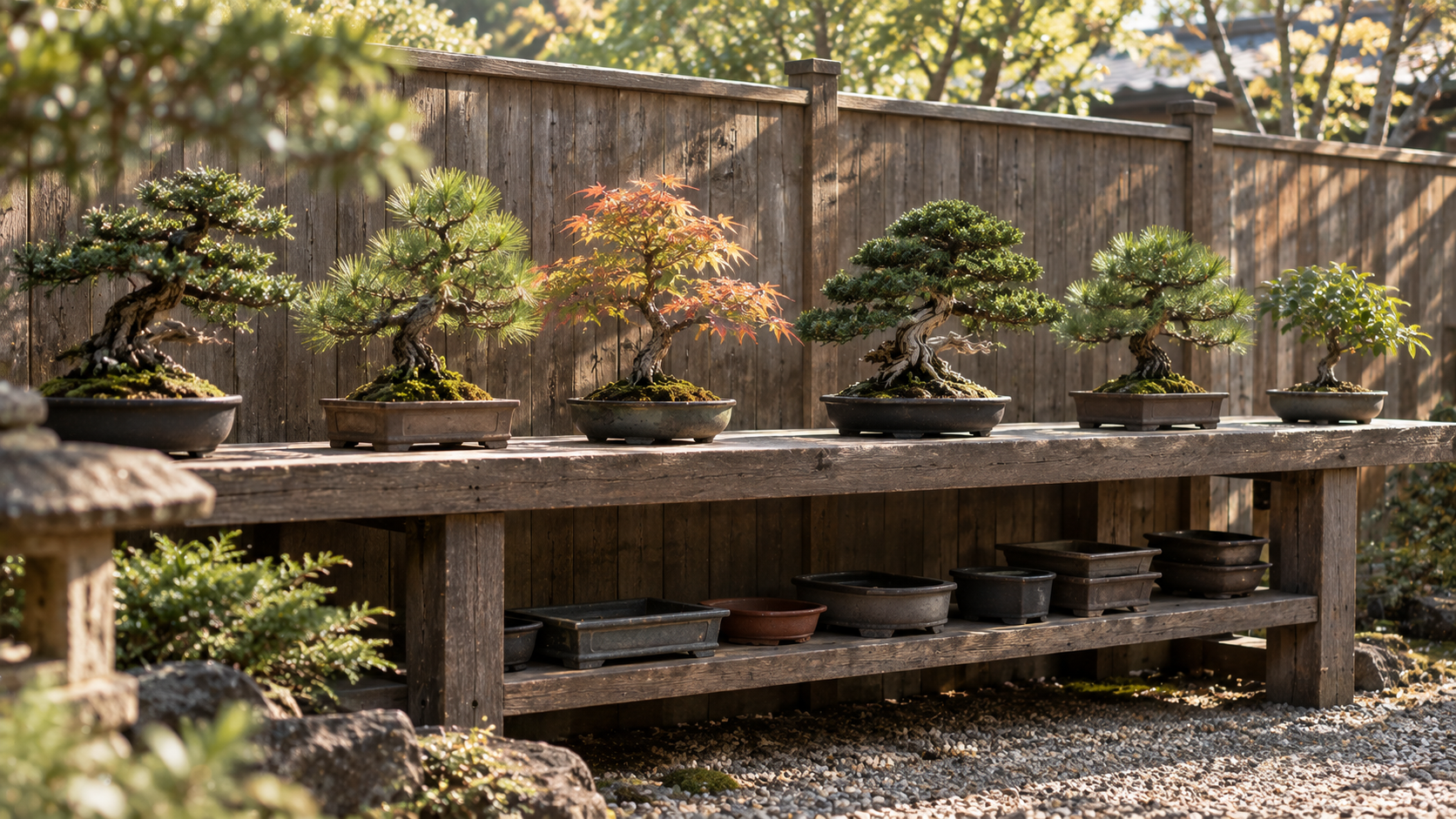
Bonsai Empire shares a DIY bench built from Douglas fir and finished with a rosewood stain, about 8 feet wide. Its advice includes using screws with an anti-rust coating, pre-drilling all holes so the wood doesn’t crack, applying two coats of stain before assembly and one after, and expecting to restain about every five years. The design includes a lower level, which adds stability and gives storage for pots plus a shaded spot for accent plants.
On forums, growers also mention pressure-treated lumber as a practical choice.
Pros
- Attractive, natural look
- Lower shelf adds stability and storage
- Can be built to any size
- Suits a Japanese-style garden
Cons
- Needs tools and time to build
- Wood needs restaining every few years
- Long benches need center supports
Best for: growers who want a bench that looks like part of the garden.
Read Bonsai Empire’s DIY bench guide
3. Chrome wire shelving – the budget shelf for small trees
Wire shelving units are a popular quick solution, especially for smaller trees and shohin.
On Bonsai Nut, one member describes chrome-plated wire shelving as inexpensive, at roughly $40 per set, and decent for the price. The open wire design lets water drain and air circulate, and multiple shelves let you fit more trees into a small space.
Make sure lower shelves still get enough light, and check the weight rating, since wet pots add up quickly.
Pros
- Cheap and easy to assemble
- Open design drains well
- Multiple levels save space
Cons
- Lower shelves may get too little light
- Can rust over time outdoors
- Less attractive than wood
Best for: small trees, shohin and tight spaces.
Search chrome wire shelving on Amazon
4. Heavy-duty plastic shelving – the weatherproof, movable option
Plastic shelving doesn’t look like a traditional bonsai bench, but it has practical advantages.
On Bonsai Nut, one member notes that heavy-duty plastic shelving doesn’t need painting and won’t rot, and can be moved into a garage for winter. Another grower points out that movable shelving also makes winter protection and pet safety easier.
It’s less attractive than wood, but for growers who move trees seasonally, it’s very convenient. Our bonsai winter protection guide covers winter storage options.
Pros
- Won’t rot or rust
- Light and movable
- No painting or maintenance
Cons
- Less attractive
- Lower weight capacity than steel
- Can become brittle in strong sun over time
Best for: growers who move trees into a garage or shed for winter.
Search heavy-duty plastic shelving on Amazon
5. vidaXL Galvanized Steel Plant Stand – a ready-made metal stand
If you’d rather buy than build, a galvanized steel plant stand is a sturdy, low-maintenance option.
vidaXL’s 2-tier plant stand in anthracite measures about 75.5 × 54.5 × 100 cm and is made from galvanized steel, which the retailer describes as strong, stable and better protected against corrosion, making it suitable for outdoor use. Two tiers let you display trees of different sizes.
The listing doesn’t give a weight capacity, so check that before loading it with large, heavy pots.
Pros
- Galvanized steel resists corrosion
- Ready-made, no carpentry
- Two tiers for different sizes
Cons
- Weight capacity not listed
- Fixed size
- Industrial look
Best for: patios and small collections where you want a ready-made metal stand.
Search vidaXL galvanized plant stands on Amazon
6. Galvanized tiered nursery bench – best for large collections
For a serious collection, a nursery-grade bench is built to last.
Australian manufacturer Sage Horticultural makes a galvanized steel three-tier bench designed to withstand daily nursery use, with no plastic parts. It stands 1,100 mm high, with tiers at 400, 750 and 1,100 mm, and comes in widths from 610 mm to 3,020 mm. The retailer lists bonsai among the plants it suits, and notes that the open design improves air circulation. Optional lockable casters make it movable. Price is by quote, with freight quoted separately.
Tiered benches suit mixed collections well: larger trees low, smaller trees higher.
Pros
- Nursery-grade galvanized steel
- Three tiers for mixed collections
- Many widths
- Optional casters
Cons
- Price by quote
- Mainly available in Australia
- Industrial appearance
Best for: large collections and serious growers in Australia, or anyone wanting a nursery-grade bench.
Search galvanized tiered nursery benches on Amazon
Which bonsai bench should you buy? (By situation)
You’re on a tight budget: cinder blocks and boards.
You want a beautiful garden display: a DIY timber bench.
You grow shohin or small trees in a small space: wire shelving.
You move trees indoors for winter: heavy-duty plastic shelving.
You want a ready-made, low-maintenance stand: a galvanized steel plant stand.
You have a large collection: a galvanized tiered nursery bench.
A practical setup
Many growers combine benches: a sturdy main bench at about 3 feet for most trees, a higher display bench for favorite trees, and a lower bench for heavy specimens. A bonsai turntable on the main bench makes working on trees much easier.
Bonsai benches in Japan
In Japan, bonsai benches are often called tana, a word that simply means shelf or rack. Visit a bonsai nursery there and you’ll usually see long rows of simple, sturdy benches, often made of wood or concrete, holding trees at a comfortable working height with plenty of air around each pot.
The style is practical rather than decorative. Trees are grouped by species and needs, sun-loving pines in the open and more delicate trees where they get some shade. Benches are built strong, kept clean and spaced so growers can walk around and water easily.
That’s a useful model for any home bonsai area. A bonsai bench doesn’t need to be fancy. It needs to be strong, at the right height, in the right light, and easy to work around. A few well-placed, simple benches will do more for your trees than one elaborate piece of furniture.
Bench layout ideas for small spaces
Not everyone has a large garden. If your space is a balcony, patio or small yard, these ideas help.
- Go vertical. Tiered stands and shelving let you fit more trees into a small footprint. Keep the sunniest top level for sun-loving trees.
- Use a narrow bench along a wall or railing. A depth of around 17 inches is often enough for small and medium trees.
- Mix heights. A low bench for heavy trees and a taller shelf for shohin can share the same space.
- Check balcony weight limits. Wet soil and ceramic pots are heavy. If you’re on a balcony, keep the load sensible.
- Secure everything against wind. Balconies and rooftops can be very windy. Tie down or anchor tall shelves and top-heavy trees.
- Leave a little space between pots. Even in a small area, airflow matters.
A small, well-organized bonsai bench area can hold more trees than you’d expect, and it’s much easier to care for than pots scattered across the ground.
How to plan a bonsai bench
- Count your trees, and add room to grow.
- Measure your space, including walking room around the benches.
- Choose the height, usually between about 30 and 40 inches for most trees.
- Decide the depth, often 17 to 24 inches.
- Check sun and shade throughout the day.
- Plan for watering. If you use automatic watering, run lines along the bench. Our bonsai automatic watering system guide covers options.
- Build or buy with strength in mind, including center supports on long benches.
Common bonsai bench mistakes
Building too low. You’ll bend constantly and won’t see your trees well.
Building too high. Watering and lifting heavy pots become awkward.
Ignoring weight. Wet pots are heavy; benches sag or collapse.
Skipping center supports. Long boards bow over time.
Crowding trees. Poor airflow encourages pests and disease.
Placing benches in the wrong light. Sun-loving trees struggle in shade.
Conclusion: the right height, strong enough, in the right place
A bonsai bench is one of the best investments you can make for your collection. It protects trees, improves airflow, makes watering easier and lets you actually enjoy what you’ve grown.
For most beginners, cinder blocks and boards are the simplest start. For a beautiful garden, a timber bench is worth building. And for large collections, a galvanized nursery bench will last for decades.
Aim for around 3 feet high, build it strong enough for wet pots, and place it where your trees get the light they need.
Ready to build or buy? Read Bonsai Empire’s DIY bench guide, or compare galvanized plant stands on Amazon.
Leave a Reply