Tag: beginner bonsai tools

  • Bonsai Tools for Beginners in 2026: The 6 Japanese Tools to Buy First, and in What Order

    Bonsai Tools for Beginners in 2026: The 6 Japanese Tools to Buy First, and in What Order

    Affiliate disclosure: Some links on this page are affiliate links. If you buy through them, Aribonsai may earn a small commission at no extra cost to you. It doesn’t change what we recommend or how we rank anything.


    Do you really need all those tools?

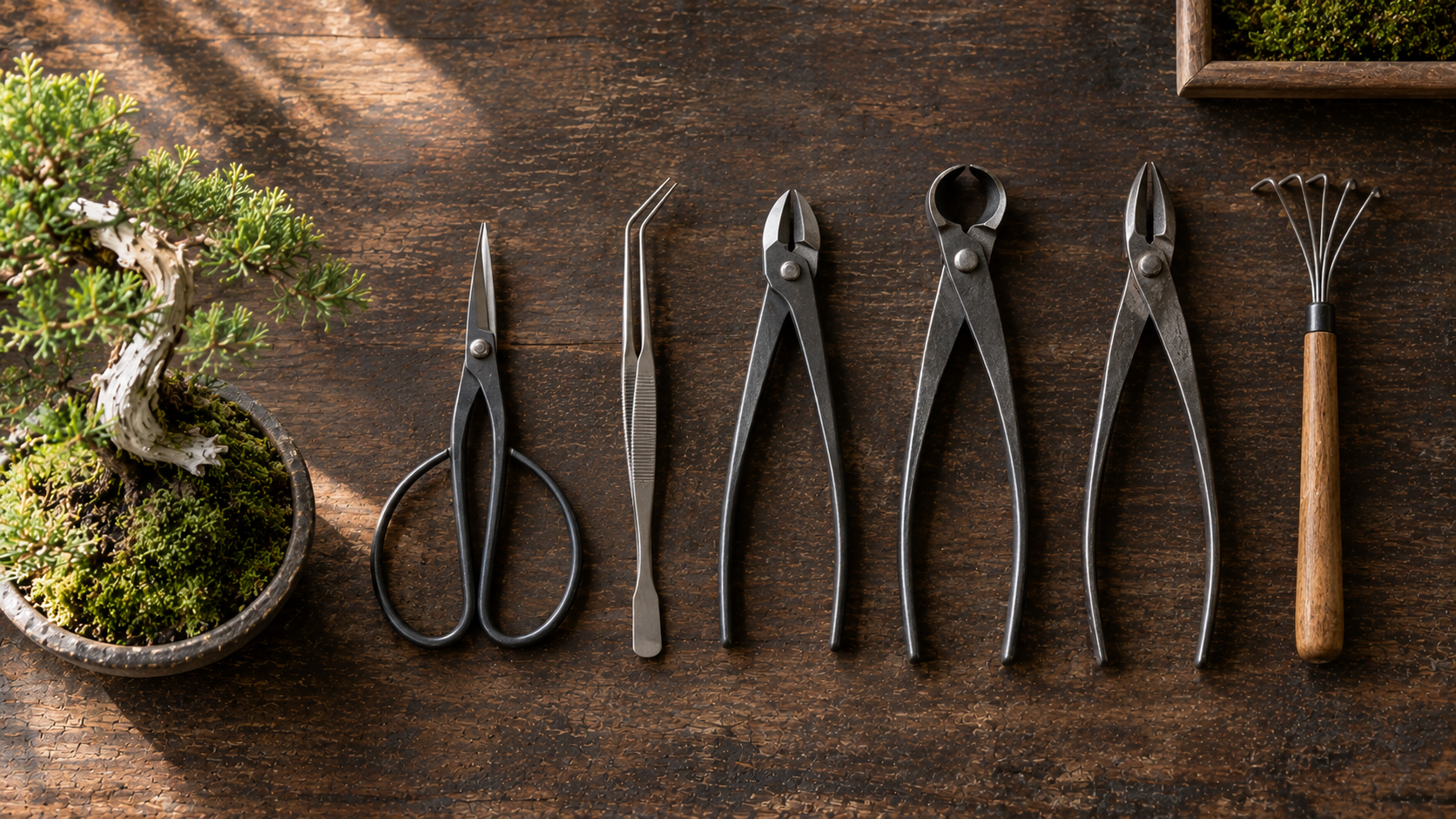
    Search for bonsai tools for beginners and you’ll quickly feel overwhelmed. There are concave cutters, knob cutters, root cutters, wire cutters, jin pliers, three kinds of scissors, tweezers, root rakes, brooms, saws, carving knives and more. A full Japanese tool roll can easily run to several hundred dollars.

    Then there’s the question of brands. Kaneshin, Masakuni, Wazakura, Yagimitsu. Carbon steel or stainless. Black finish or polished.

    It’s no surprise many beginners either buy a cheap 12-piece kit that falls apart, or freeze and buy nothing at all, trimming their first tree with kitchen scissors.

    Here’s the good news: you don’t need everything at once. Most bonsai work in the first year or two needs only a handful of tools. The rest can wait until your trees, and your skills, actually call for them.

    In my experience, the best way to build a tool kit isn’t to buy a big set on day one. It’s to buy the right tool when you first need it, and buy one good one instead of three cheap ones. This guide explains which six Japanese tools beginners need, in what order, and roughly what each should cost.


    Who this bonsai tools for beginners guide is NOT for

    It’s not for experienced growers. If you already own several Japanese tools, our individual buying guides will be more useful.

    It’s not a starter set comparison. If you’d rather buy several tools in one box, our bonsai starter tool set guide compares Japanese kits.

    It’s not about advanced work. Carving, heavy bending and collected trees need specialist tools. We’ll mention them at the end, but this guide focuses on the basics.

    Still with us? Let’s go.


    How we picked these (3 things that actually matter)

    1. How often you’ll use it

    The first tools you buy should be the ones you’ll pick up every week. For most beginners, that’s scissors for trimming and something to handle wire. Tools for repotting come next, since you’ll usually repot once every year or few. Specialist tools come last.

    2. What a cheap version costs you

    Some tools are fine to buy cheaply. Others aren’t.

    A budget pair of tweezers is fine. A budget concave cutter that crushes branches instead of cutting them can leave wounds that take years to heal. A cheap wire cutter with misaligned jaws can damage bark. So it makes sense to spend more on cutting tools and less on simple ones.

    3. Japanese quality at a beginner price

    You don’t need Masakuni on day one. Japanese brands like Wazakura offer hand-forged tools at prices close to cheap imported kits, and Kaneshin’s carbon steel range is the long-time standard for serious hobbyists. Both are good places to start. If you’re curious about the premium end, our Kaneshin vs Masakuni comparison explains the difference.

    A few beginner habits that matter more than any tool

    None of these cost anything.

    • Use each tool only for its job. Cutting wire with scissors, or roots with a concave cutter, damages edges quickly.
    • Clean tools after every session. Sap and soil cause rust and dull edges.
    • Oil carbon steel occasionally. A light coat prevents rust.
    • Store tools dry. A tool roll or drawer is fine. A damp shed is not.
    • Don’t force a cut. If a tool struggles, the branch is too thick for it.
    • Learn on one tree before buying more tools. Your needs will become clear quickly.

    Bonsai tools for beginners: comparison table

    Prices below come from our individual buying guides, checked in September and October 2026. They’re approximate and vary by seller and exchange rate.

    OrderToolWhat it doesWhen you need itBeginner price range
    1Bonsai shearsTrimming shoots, leaves and fine branchesFrom day one~$40–85
    2TweezersWeeding, removing dead leaves, moss workFrom day one~$10–30
    3Wire cutterCutting and removing wire safelyWhen you start wiring~$56–97
    4Concave cutterRemoving branches with clean, healing cutsFirst structural pruning~$60–140
    5Jin pliersBending, tightening and removing wireWhen you wire regularly~$46–97
    6Root rakeLoosening soil and roots when repottingFirst repot~$15–40

    The 6 bonsai tools beginners need, reviewed in order

    1. Bonsai shears – the first tool everyone needs

    If you buy only one Japanese bonsai tool, make it a pair of shears. You’ll use them for trimming new shoots, cutting off leaves and thin twigs, and generally keeping the tree in shape. Most beginners use them almost every time they touch a tree.

    The classic beginner style is the satsuki-style scissor: long, narrow blades with comfortable round handles. It reaches into the tree easily and handles most light pruning.

    In our bonsai shears guide, the Wazakura Satsuki Bonsai Scissors (around $40) are our first-pair pick, while Kaneshin’s carbon satsuki scissors (around $60–65) are a reliable everyday step up.

    Pros

    • Used constantly, so excellent value
    • Affordable Japanese options
    • Handles most everyday pruning

    Cons

    • Not for thick branches, wire or roots
    • Carbon steel needs drying and oiling

    Best first pick: Wazakura Satsuki Bonsai Scissors. Step up: Kaneshin carbon satsuki scissors.

    Search Japanese satsuki bonsai scissors on Amazon


    2. Tweezers – the cheapest tool you’ll use every week

    Tweezers are easy to overlook, but they’re one of the most-used tools in any kit. You’ll use them to pull weeds, remove dead leaves and old needles, pick off pests, and place or tidy moss. Many have a small spatula on the other end for pressing down soil after repotting.

    The good news is that quality Japanese tweezers are very affordable. Kaneshin’s No.61A bent-nose tweezers with a spatula, made in Japan from stainless steel, cost about $10 at a US retailer. That’s our top beginner pick.

    Pros

    • Very cheap for a Japanese tool
    • Used on every tree, every week
    • Spatula end helps with repotting and moss

    Cons

    • Easy to damage the tips by prying with them

    Best first pick: Kaneshin No.61A Bent Nose Tweezers.

    Search Kaneshin bonsai tweezers on Amazon


    3. Wire cutter – the tool that protects your bark

    Most beginners start wiring branches within the first year. And the first time you remove wire, you’ll see why a proper wire cutter matters.

    Bonsai wire cutters have short, rounded jaws that cut wire right against the branch without digging into the bark. Ordinary hardware-store wire cutters have pointed jaws and often leave marks. Unwinding wire by hand can also tear bark, especially once the branch has thickened.

    In our bonsai wire cutter guide, the Wazakura Hand Forged Wire Cutter (around $56) is our first dedicated cutter pick, and Kaneshin’s No.22A (around $67) is a dependable general-purpose choice.

    Pros

    • Removes wire without damaging bark
    • Works with aluminum and copper wire
    • Affordable Japanese options

    Cons

    • Not for cutting branches
    • One more tool to buy if you’re not wiring yet

    Best first pick: Wazakura Hand Forged Wire Cutter. Step up: Kaneshin No.22A.

    Search Japanese bonsai wire cutters on Amazon


    4. Concave cutter – the most important “real” bonsai tool

    If bonsai has a signature tool, it’s the concave cutter. It removes a branch so the cut is slightly hollow, rather than flat. That shallow hollow lets the wound heal over more smoothly, leaving a much less visible scar.

    You won’t need one on day one. But once you start removing branches to shape a tree, it becomes essential. This is also the tool where quality matters most, because a poor cutter crushes wood instead of cutting it.

    In our bonsai concave cutter guide, the Wazakura Hand Forged Concave Cutter (around $60) is the first serious cutter pick, and Kaneshin’s carbon concave cutter (around $65–90) is the best long-term value.

    Pros

    • Leaves cuts that heal smoothly
    • Essential for structural pruning
    • Good Japanese options under $100

    Cons

    • Not for wire, roots or very thick branches
    • Worth spending a little more on

    Best first pick: Wazakura Hand Forged Concave Cutter. Step up: Kaneshin carbon concave cutter.

    Search Japanese concave cutters on Amazon


    5. Jin pliers – the wiring helper

    Despite the name, jin pliers aren’t just for deadwood. For most beginners, they’re a wiring tool: tightening wire ends, bending wire into place, pulling wire off, and tightening tie-down wire when repotting.

    They’re not the first tool you need. But once you start wiring regularly, they make the job much easier on your fingers and give you more control.

    In our bonsai jin pliers guide, the Wazakura Hand Forged Wire & Jin Pliers (around $46) are our first-pair pick, and Kaneshin’s No.49 (around $60) is a strong choice for more leverage and heavier wire.

    Pros

    • Makes wiring easier and neater
    • Useful for repotting too
    • Later useful for deadwood work

    Cons

    • Not essential on day one
    • Carbon steel needs basic care

    Best first pick: Wazakura Hand Forged Wire & Jin Pliers. Step up: Kaneshin No.49.

    Search Japanese bonsai jin pliers on Amazon


    6. Root rake – the repotting tool you’ll be glad you bought

    Repotting is one of the most stressful moments for a beginner, and a root rake makes it much gentler. Its curved prongs comb old soil away from the roots and untangle circling roots, without tearing the fine roots you want to keep.

    You only need one when you first repot, which is often in your first or second spring. Japanese root hooks start at around $15 at US retailers, and Kaneshin’s handmade 2-prong root hook costs around $40.

    Pros

    • Gentle on fine roots
    • Affordable
    • Lasts for years

    Cons

    • Only used at repotting time

    Best first pick: a simple Japanese root hook from a bonsai retailer. Step up: Kaneshin 2 Prong Root Hook.

    Search Japanese bonsai root rakes on Amazon


    Which bonsai tools should beginners buy? (By stage)

    You’ve just bought your first tree: shears and tweezers. That’s it for now.

    You’re starting to wire: add a wire cutter, plus some aluminum wire.

    You’re starting to shape the tree: add a concave cutter.

    You’re wiring regularly: add jin pliers.

    You’re about to repot: add a root rake, pot mesh and a couple of bamboo chopsticks.

    You’d rather buy everything at once: a starter set can save money, as long as it contains the tools you’ll actually use.

    A realistic first-year budget

    Buying one good Japanese tool at a time, a beginner can build the six-tool kit above for roughly $230–490, depending on whether you choose budget Japanese tools or step-up Kaneshin models. Spread over a year or two, that’s very manageable, and every tool will last for many years with basic care.


    Carbon steel or stainless: which is better for beginners?

    This question comes up with almost every Japanese tool, so it’s worth answering once.

    Carbon steel is the traditional choice. It’s what most Japanese bonsai tools are made from, it takes a sharp edge, and it’s usually cheaper. The downside is rust. If you leave a carbon tool wet or covered in sap, it can rust within days.

    Stainless steel resists rust much better, which makes it attractive for beginners, for humid climates, and for anyone who knows they won’t always clean their tools straight away. It usually costs noticeably more for the same tool.

    For most beginners, carbon steel is perfectly fine as long as you build one small habit: wipe the tool dry after use and oil it now and then. If you already know that won’t happen, or you live somewhere very humid, stainless is worth the extra money for the tools you use most, like shears and a concave cutter.

    Where to buy Japanese bonsai tools for beginners

    You don’t need to import tools from Japan yourself. Many specialist bonsai retailers in the US, UK and Europe stock Kaneshin and other Japanese brands, and some Japanese brands like Wazakura ship internationally. Amazon also carries many Japanese bonsai tools, but check the brand and seller carefully, because similar-looking tools from other makers are common. When in doubt, buy from a bonsai specialist.


    Tools beginners can wait for

    These are excellent tools, but most beginners don’t need them yet.

    • Knob cutter: for removing stubs and very flush cuts. Useful once you’re doing more structural work.
    • Root cutter: for thick roots on bigger trees.
    • Bonsai saw: for branches too thick for a concave cutter.
    • Carving tools: for creating jin and shari.
    • Branch bender or jack: for heavy bends on mature conifers.
    • Turntable: makes working on a tree easier, but it’s a comfort, not a necessity.

    How to care for your first bonsai tools

    • Wipe them after every use. Sap and soil cause rust.
    • Dry them completely. Especially carbon steel.
    • Oil them lightly from time to time. A drop of tool oil on blades and joints.
    • Use a rust eraser for light rust. Remove it early, before it pits the steel.
    • Store them in a roll or drawer. Protect edges from knocking against each other.

    Common beginner tool mistakes

    Buying a big cheap kit. Many pieces go unused, and the important ones may be poor quality.

    Cutting wire with scissors. It ruins the edge quickly.

    Using a concave cutter on thick wood. If it doesn’t cut easily, use a saw.

    Skipping a proper wire cutter. Ordinary cutters and unwinding by hand can damage bark.

    Never cleaning tools. Rust is the most common reason good tools wear out early.


    Conclusion: buy the right tool when you need it

    The best bonsai tools for beginners aren’t the most expensive ones, and you don’t need a huge kit to start. Begin with shears and tweezers. Add a wire cutter when you start wiring, a concave cutter when you start shaping, jin pliers when wiring becomes regular, and a root rake for your first repot.

    Choose affordable Japanese tools like Wazakura to start, or Kaneshin if you’d like to buy once and keep them for decades. Clean them, keep them dry, and use each one only for its job.

    Do that, and your first six tools will serve you for years, long after your first tree has become a real bonsai.

    Ready to start? Compare Japanese bonsai shears for your very first tool, or search Japanese bonsai tools on Amazon.
  • Best Bonsai Turntables in 2026: 6 Japanese Picks, From Simple Spinners to Pro Work Stands

    Best Bonsai Turntables in 2026: 6 Japanese Picks, From Simple Spinners to Pro Work Stands

    Affiliate disclosure: Some links on this page are affiliate links. If you buy through them, Aribonsai may earn a small commission at no extra cost to you. It doesn’t change what we recommend or how we rank anything.


    Walking around the tree gets old fast

    Most bonsai work happens from every angle.

    You prune the front, then step around to check the side. You wire a branch, then lift the pot to see how it looks from the back. You set it down. Pick it up again. Turn it a quarter. Scrape the pot on the bench. Turn it back.

    On a small tree, that’s mildly annoying. On a heavy one in a big pot, it’s hard work, and every time you lift and turn it, you risk bumping a branch you just wired or chipping the pot.

    A turntable fixes that. You put the tree on it once, and then you spin the tree instead of moving yourself. That’s really all it does. But in my experience, it’s one of those simple pieces of kit that changes how a work session feels. You look at the tree from more angles, more often, because it’s easy. And that tends to lead to better decisions.

    The surprising part is how wide the range is. You can buy a simple plastic Japanese turntable for under ¥3,000. You can also buy a cast-iron professional work stand for ¥78,000. This guide covers the useful options in between and explains who actually needs which.


    Who this article is NOT for

    It’s not for you if you only have one or two small trees on a windowsill. You can turn a small pot by hand easily enough. A turntable starts to pay off when you have several trees, heavier pots, or long wiring and pruning sessions.

    It’s not about display stands. Wooden display tables (shoku) for showing a finished tree are a different thing. This guide is about turntables you work on.

    It’s not about benches. If you’re building outdoor benches for your collection, that’s a separate project. Some of the turntables here can sit on a bench, but we’re not comparing benches themselves.

    Still here? Let’s go.


    How we picked these (3 things that actually matter)

    1. Size and load capacity

    This is the main decision.

    A turntable needs to be wide enough for the pot to sit on it securely, and strong enough to hold the tree, pot and wet soil. Wet soil is heavier than people think.

    • Small (around 18–23cm): for shohin and mame.
    • Medium (around 30cm round or 40×30cm rectangle): handles most hobby trees.
    • Large (around 60×40cm or 40–50cm round heavy stands): for big trees, big pots and collected material.

    Load ratings vary a lot. Kaneshin’s simple round KURUKURU turntable is rated for around 40–50kg, while its large rectangular version is rated for up to 100kg. Eastern Leaf lists its 12″ round turntable as supporting up to 150 lb. Check the rating against your heaviest tree, with wet soil.

    2. Height and tilt

    Most turntables are low, flat discs that sit on a bench or table, about 5–7cm tall. That’s fine for most work.

    Some small-tree stands are taller and bring the tree closer to eye level, which is useful for detailed work on shohin. A few also tilt. Kaneshin’s No.1464, for example, tilts the top plate by about 20 degrees, which makes it easier to reach the inside and underside of a small tree without bending over it.

    Heavy professional stands are a different category. They’re built more like a piece of workshop equipment than a disc on a table.

    3. Material and where you’ll use it

    Plastic and resin turntables are light, cheap and weather-resistant. Several of the ones here are fine to leave outside and water on directly. Metal and cast-iron stands are heavier and more stable, which matters with large trees, but they’re expensive and heavy to ship.

    Shipping is worth thinking about. A turntable that costs very little in Japan can cost more to send overseas than the item itself, because it’s bulky. That’s the main reason some readers will be better off buying from a local retailer, even at a higher listed price.

    A few habits that make any turntable work better. None of this is complicated, but it’s easy to skip.

    • Put it on a solid surface. A turntable on a wobbly table just moves the wobble up to the tree. A sturdy bench or a heavy table makes a bigger difference than the turntable itself.
    • Center the pot. An off-center pot makes the turntable spin unevenly and puts more strain on one side. With tall or heavy trees, it can also make the whole thing tip.
    • Secure small pots. Light pots can slide when you push on a branch. Some stands have a rubber top for this. Otherwise, a non-slip mat or a loop of string around the pot helps.
    • Don’t spin and cut at the same time. Turn the tree, stop, then make your cut. It sounds obvious, but it’s easy to do without thinking, and a moving tree is how branches get nicked.
    • Think about wet weight. A freshly watered tree in a big pot can weigh a lot more than it looks. Use your heaviest tree, watered, as your guide when choosing a load rating.

    Prices below are approximate and were checked in October 2026. Yen prices are from Japanese stores before international shipping, which can be high for bulky items.


    Comparison table

    TurntableSizeLoad / weightApprox. priceBest for
    Kaneshin KURUKURU Circle No.147729.5cm round, 5.5cm tall40–50kg load; 1.5kg~¥2,800Cheapest way to start, multiples
    Kaneshin KURUKURU Rectangle No.1479 / No.147860×40cm (large) / small versionUp to 100kg (large); 5.5kg~¥5,800 (large) / ~¥3,600 (small)Bigger trees, wide pots
    Eastern Leaf Bonsai Turntable (Japan-made)12″ round or 15.75″ rectangleUp to 150 lb (round); 3.2 lb~$65 (round) / ~$69 (rectangle)US buyers, outdoor use
    Kaneko Heavy Duty Rectangle Turntable40×30cm, 6cm tallAround 20kg~$65Medium trees, US retailer
    Kaneshin Small Turntable No.1463 / Tilt No.146423cm round, ~13cm tall2.8kg (No.1464)~¥10,000 / ~¥14,000Shohin and detailed work
    Kaneshin heavy-duty work stands (cast iron, A/B type)27–33cm (cast) / 40–50cm (A/B)Not listed~¥32,000 / ~¥65,000–78,000Professional and large-tree work

    Individual reviews

    1. Kaneshin KURUKURU Circle Turntable No.1477

    The simplest and cheapest option, and honestly enough for a lot of people.

    It’s a round turntable, 29.5cm across and 5.5cm tall, weighing 1.5kg. Kaneshin rates it for around 40–50kg. On a Japanese tool store it’s about ¥2,800, or ¥8,300 for a set of five.

    Kaneshin describes it as working both as a work surface and as an easy way to turn a tree toward the sun. That second use is worth noting. If you keep several trees on a bench, a turntable under each one makes rotating them for even light much easier.

    Pros

    • Very cheap
    • Light but rated for a good load
    • Works as a daily stand, not just during work sessions
    • Set of five available for a collection

    Cons

    • Shipping from Japan may cost more than the turntable itself
    • Low and flat, so no height or tilt
    • Basic design with no locking

    Who it’s for: Anyone who wants a turntable without spending much, or who wants several to keep under trees on a bench. If you’re not sure a turntable will change how you work, this is the low-risk way to find out.


    2. Kaneshin KURUKURU Rectangle No.1479 (large) / No.1478 (small)

    The same idea, bigger.

    The large No.1479 is 60×40cm and 6.5cm tall, weighs 5.5kg and is rated for up to 100kg. It’s about ¥5,800, or ¥15,700 for a set of four. A smaller rectangular version, No.1478, is about ¥3,600.

    A rectangular top is handy for long, shallow pots and forest plantings, where a round turntable can leave the ends hanging over the edge.

    In my experience, rectangular turntables are the ones people wish they’d bought first once their trees get bigger. A wide, stable base just feels safer under a heavy pot.

    Pros

    • High load rating
    • Rectangular shape suits long and wide pots
    • Still low cost for its size
    • Small version available

    Cons

    • Bulky and heavy to ship overseas
    • Takes up more bench space
    • Low and flat, no tilt

    Who it’s for: Growers with larger trees, forest plantings or wide pots. It also doubles nicely as a general work surface on a bench.


    3. Eastern Leaf Bonsai Turntable (12″ round / 15.75″ rectangle)

    The easiest option for US buyers.

    Eastern Leaf sells a 12″ round turntable for $65 and a 15.75″ rectangular one for $69. Both are listed as made in Japan. The round one is made of dense plastic, 2.25″ tall, weighs 3.2 lb and is rated for up to 150 lb. Eastern Leaf says it’s weather-resistant, can be watered on directly, and works as both a turntable and a stand.

    Being able to leave it outside matters more than it might seem. A turntable you can keep under a tree all season, rain or shine, gets used far more than one that lives in a cupboard and comes out only for styling sessions.

    The price is higher than ordering a similar turntable directly from Japan. But you’re not paying international shipping on a bulky item, and returns are much simpler.

    Pros

    • Made in Japan, sold by a US retailer
    • High load rating on the round version
    • Weather-resistant, fine to leave outside
    • Round and rectangular options

    Cons

    • Costs more than buying a similar item from Japan before shipping
    • Simple design without tilt or height adjustment
    • Mainly useful for buyers in the US

    Who it’s for: US growers who want a solid Japanese turntable without international shipping.


    4. Kaneko Heavy Duty Rectangle Turntable (40×30cm)

    Another US-available option, in a medium rectangular size.

    House of Bonsai sells this Japanese-made turntable for $65. It’s black ABS resin, 400×300×60mm, and rated for around 20kg. The description is simple: set the tree down and nudge the sides to spin it.

    Its load rating is lower than the others here, so it’s best for small to medium trees rather than big, heavy ones.

    Pros

    • Japanese-made and available from a US retailer
    • Medium rectangular size fits a lot of hobby pots
    • Simple and easy to use

    Cons

    • Lower load rating (around 20kg) than other options
    • Similar price to Eastern Leaf’s turntables
    • No tilt or height adjustment

    Who it’s for: US growers with small to medium trees who prefer a rectangular top.


    5. Kaneshin Small Turntable No.1463 / Tilt Type No.1464

    The specialist shohin stands.

    Both have a 23cm round top. The No.1463 stands about 13cm tall and costs around ¥10,000. The No.1464 adds a top plate that tilts by about 20 degrees, plus a 2mm rubber surface that helps protect pots and stop them sliding. It weighs 2.8kg and costs around ¥14,000. Kaneshin says you can secure the pot with rubber or string while you work, and the stand folds for storage.

    These raise the tree off the bench, which brings small trees closer to eye level. The tilt on the No.1464 is the bigger deal. Being able to angle a small tree toward you makes it much easier to see inside it and work on the back branches.

    Pros

    • Raised height for detailed work on small trees
    • Tilt function on the No.1464
    • Rubber top helps protect pots
    • Folds down for storage

    Cons

    • Only suits small trees
    • Much more expensive than the simple KURUKURU turntables
    • Shipping from Japan adds cost

    Who it’s for: Shohin and mame growers who do a lot of detailed pruning and wiring.


    6. Kaneshin Heavy-Duty Work Stands (Cast Iron, A Type, B Type)

    The professional end of the market.

    Kaneshin lists a cast-iron turntable in 270mm and 330mm sizes for about ¥32,000, and A Type and B Type rotating stands in 40cm and 50cm sizes for about ¥65,000–78,000. We couldn’t confirm full specs like height, load rating or tilt from the listings, so check with the seller before buying.

    These are tools for serious, heavy work: large trees, collected trees, and long styling sessions where stability really matters. Shipping heavy cast metal from Japan will also be expensive.

    Pros

    • Built for heavy trees and serious work
    • Very stable compared to plastic turntables
    • From a well-known bonsai tool maker

    Cons

    • Expensive, especially with shipping
    • Full specs aren’t clearly listed
    • Overkill for most hobby collections

    Who it’s for: Advanced growers, professionals, and anyone working regularly on large or collected trees.


    Recommendation by use case

    “I just want something simple and cheap.” Kaneshin KURUKURU Circle No.1477. Under ¥3,000. Check shipping before ordering.

    “I’m in the US and want to avoid international shipping.” Eastern Leaf turntable (round or rectangle), or the Kaneko 40×30cm for medium trees.

    “My trees are big or my pots are wide.” Kaneshin KURUKURU Rectangle No.1479.

    “I grow shohin and do detailed work.” Kaneshin No.1464 tilt type. The No.1463 if you don’t need tilt.

    “I want a turntable under every tree on my bench.” KURUKURU Circle 5-piece set.

    “I work on large or collected trees regularly.” Kaneshin heavy-duty work stands. Confirm specs and shipping first.


    Conclusion: a small purchase that changes how you work

    Here’s the short version.

    A turntable doesn’t make you a better grower on its own. It just makes it easy to see your tree from every side, every few minutes. That’s what leads to better pruning and wiring decisions.

    Most people only need a simple, sturdy turntable sized for their trees. Go for the shohin tilt stand if you work small, a large rectangle if you work big, and only consider the heavy-duty stands if you’re doing serious work on big material.

    And it really does help during long sessions. Wiring a whole tree is a lot less tiring when you spin the tree instead of walking around it. If that’s where you’re headed next, our bonsai wire cutter guide covers the tool you’ll use at the end of every wiring session. And a sturdy turntable makes repotting easier too, alongside a good root cutter.

    Ready to choose?

  • Best Bonsai Jin Pliers in 2026: 5 Japanese Picks for Wiring and Deadwood Work

    Best Bonsai Jin Pliers in 2026: 5 Japanese Picks for Wiring and Deadwood Work

    Affiliate disclosure: Some links on this page are affiliate links. If you buy through them, Aribonsai may earn a small commission at no extra cost to you. It doesn’t change what we recommend or how we rank anything.


    The tool you don’t think you need, until you try wiring without it

    Here’s a scene a lot of growers know.

    You’re wiring a branch. The wire’s on, the bend looks right, and now you just need to finish the end. So you grab the wire with your fingers and try to twist it tight. It slips. You try again. Your fingertips start to hurt. Eventually you go and find some hardware-store pliers, which do the job, but the ridged jaws chew into the bark when you get close to the trunk.

    Or it’s a few months later, and the wire needs to come off. Some people cut it all off in short pieces. Others unwind it carefully. Either way, there’s a lot of fiddly gripping and pulling involved.

    And then there’s deadwood. If you’ve ever tried to create a jin (a stripped, bleached branch stub) on a juniper or pine, you’ll know you need something that can grip a thin strip of bark or wood and pull it away cleanly.

    That’s what jin pliers are for. In Japanese they’re often called yattoko. Retailers describe them as tools for twisting, winding and removing wire, and for creating jins by tearing.

    What they actually do on the bench

    It helps to be specific, because “pliers” sounds like a hardware tool, and these are used in a few different ways.

    • Finishing wire ends. After wrapping a branch, you grip the end of the wire and give it a final twist so it sits tight and doesn’t spring loose.
    • Tightening as you go. On longer runs of wire, a small twist here and there helps the wire hold the branch where you want it.
    • Removing wire. When it’s time to take wire off, you can grip and unwind it, which avoids leaving dozens of short cut pieces stuck in the foliage. Long-handled pliers make this much easier on wire that has started to bite in.
    • Making jins. For deadwood, the pliers grip the bark and fibers of a branch so you can peel and tear them away, leaving a more natural-looking stub than a clean cut would.

    Most people use them for the first three far more often than the last one. Jin work is the reason they’re called jin pliers, but wiring is where they earn their keep.

    In my experience, this is the tool that gets added to a kit later than it should. People buy cutters and shears first, then wonder why wiring feels so awkward. Once you have a decent pair, it’s hard to go back.


    Who this article is NOT for

    It’s not for you if you rarely wire. If you do most of your styling by pruning, a pair of jin pliers will spend a lot of time in the drawer.

    It’s not for you if you want a wire cutter. Jin pliers grip, twist and pull. For snipping wire close to the bark, you want a dedicated cutter. Our bonsai wire cutter guide covers those.

    It’s not a deadwood carving guide. Jin pliers are one part of creating deadwood. Power tools, carving knives and gravers are a separate topic, and carving on a live tree needs care and experience.

    Still here? Let’s get into it.


    How we picked these (3 things that actually matter)

    1. Length and leverage

    Jin pliers come in a range of sizes, usually around 170mm to 230mm.

    • Shorter pliers (around 170–180mm) are easier to use inside small or dense trees and on fine wire. They’re a good match for shohin and for careful work.
    • Longer pliers (around 210–230mm) give you more leverage. That helps when you’re twisting thick wire, pulling off heavy wire that’s been on for a while, or tearing tougher material for a jin.

    One UK retailer notes that Kaneshin’s long-handle No.49 is particularly useful for removing heavy twisted wire and offers more leverage than smaller versions. That’s the general pattern across brands: longer pliers do the heavy work more easily.

    2. Weight and grip

    You’ll often hold jin pliers for a long time, especially during a wiring session. Weight matters more than you’d expect. A light pair is comfortable for finishing dozens of wire ends. A heavier pair feels more solid when you’re pulling hard.

    Grip shape matters too. Most Japanese jin pliers have rounded or smooth jaws designed not to chew up bark, which is a big part of why they’re better than hardware-store pliers.

    One small but useful note from a retailer: on Kaneshin’s No.49, force should only be applied in line with the handles, not twisted sideways. That’s good advice for any pliers. They’re strong in one direction, not every direction.

    3. Carbon or stainless

    Same choice as with every bonsai tool.

    Carbon steel costs less and is perfectly fine for pliers, as long as you wipe and oil them now and then. Stainless steel handles moisture better but costs roughly twice as much.

    Pliers don’t have a cutting edge to keep sharp in the same way cutters do, so rust is the main concern. The pivot is the part to watch. If it gets stiff or gritty, the pliers become tiring to use. A wipe after each session and a drop of oil on the pivot now and then keeps the action smooth for years. If you wire outdoors, in a humid climate, or just tend to leave tools lying around, stainless might be worth it.

    Prices below are approximate and were checked in October 2026. Yen prices are from Japanese stores before international shipping.


    Comparison table

    Jin pliersSteelLengthWeightApprox. priceBest for
    Wazakura Hand Forged Wire & Jin PliersS55C carbon (black coated)210mm230g~$46First pair, general wiring
    Kaneshin Bonsai Pliers No.49Carbon230mm~305g (incl. packing)~¥9,300 (about $60); ~£44 at a UK retailerLeverage, heavy wire, jin tearing
    Kaneshin Stainless Pliers No.818 / No.819Stainless180 / 215mm~202g (No.818, incl. packing)~¥19,200 (No.818); ~£120 (No.819, UK)Low maintenance
    Masakuni Jin Pliers No.0017Carbon200mm190g~¥11,800 (about $78)Light, premium everyday pair
    Masakuni Jin Pliers No.0117 (L)Carbon220mm230g~¥14,800 (about $97)Premium pair with more reach

    Individual reviews

    1. Wazakura Hand Forged Bonsai Wire and Jin Pliers (210mm)

    The cheapest real Japanese jin pliers on this list, and a sensible first pair.

    It’s S55C carbon steel with a black coating, 210mm long and 230g, hand-forged in Sanjo, Niigata. Wazakura sells it for $45.99, with free shipping to the US, Canada, the UK, the EU and other regions. Import tax may still apply.

    Wazakura describes it as being for shaping training wire, styling, and safely removing wire. The ends are rounded to protect the tree, and the handles are designed to reduce hand fatigue during long sessions.

    At 210mm, it sits in the middle of the size range. It has enough leverage for most wire, without being clumsy in smaller trees.

    Pros

    • Lowest price for Japanese-made jin pliers here
    • Free shipping to several regions
    • Good all-round length
    • Rounded ends that are kind to bark

    Cons

    • Only one size
    • Carbon steel, so it needs occasional oiling
    • Less long-term feedback than Kaneshin or Masakuni

    Who it’s for: Anyone buying their first pair of jin pliers, especially if they already order other tools from Wazakura. It’s also a sensible backup pair to keep in a second tool roll.


    2. Kaneshin Bonsai Pliers No.49 (230mm)

    The classic long-handled jin pliers.

    Kaneshin’s No.49 is 230mm long and weighs about 305g including packing. On a Japanese tool store it’s about ¥9,300, though it was marked as sold out when we checked. Kaizen Bonsai in the UK lists it at £43.95, describing it as SK steel and as useful for “creating deadwood jins by tearing or wire work,” especially for removing heavy twisted wire. It’s also part of Kaneshin’s 8-piece tool set, which we covered in our starter tool sets guide.

    Kaneshin also lists other pliers in smaller sizes, including No.48A (180mm), No.50A (175mm) and No.49B (210mm). We couldn’t confirm current prices for those, so we’ve kept them out of the table. But if 230mm feels too long for your trees, it’s worth knowing they exist.

    In my experience, long-handled pliers like the No.49 are the ones people reach for when wire has bitten in a little and needs some real force to unwind. The extra length makes that much less of a struggle.

    Pros

    • Long handles for real leverage
    • Well-suited to heavy wire and jin work
    • Reasonable price for a Kaneshin tool
    • Smaller sizes available within the same brand

    Cons

    • Heavier and longer than you need for fine work
    • Stock can be patchy at Japanese stores
    • Carbon steel, so it needs basic care

    Who it’s for: Growers who wire medium to large trees, remove a lot of thick wire, or do jin work.


    3. Kaneshin Stainless Pliers No.818 (180mm) / No.819 (215mm)

    The stainless option, in two sizes.

    The No.818 is 180mm and about 202g including packing, at around ¥19,200 on a Japanese tool store. The No.819 is the larger 215mm version, listed at £120 by a UK retailer. Both are described as being for twisting, winding and removing wire.

    That’s roughly double the carbon price. You’re paying for rust resistance. Wiring often happens with damp hands, outdoors, or right after watering, so pliers do get wet more than you might think.

    The 180mm No.818 is also a nice size for smaller trees. It’s lighter and easier to handle in tight spaces than the 230mm No.49.

    Pros

    • Stainless steel, much better in damp conditions
    • Two useful sizes
    • The 180mm version is good for shohin and fine wiring
    • Same Kaneshin build quality

    Cons

    • About twice the price of the carbon No.49
    • UK and Japanese prices vary a lot
    • Mostly sold direct from Japan or in the UK

    Who it’s for: Growers in humid climates, people who wire outdoors a lot, or anyone tired of keeping carbon steel tools oiled.


    4. Masakuni Jin Pliers No.0017 (200mm)

    A light, premium everyday pair.

    The No.0017 is 200mm and just 190g, listed at about ¥11,800 on a Japanese export store. That’s lighter than every other pair on this list, despite being a mid-length tool.

    As with Masakuni’s knob cutters, the price is closer to Kaneshin than most people expect. You’re not paying collector prices here. You’re paying a bit more for Masakuni’s finish and feel.

    In my experience, weight is one of the things you notice most with pliers once a wiring session goes past half an hour. A lighter pair just tires your hand out less.

    Pros

    • The lightest pair on this list
    • Mid-length size that handles most jobs
    • Masakuni build quality at a reasonable price
    • Comfortable for long wiring sessions

    Cons

    • Carbon steel, so it needs the usual care
    • Less leverage than longer pliers for very heavy wire
    • Harder to buy outside Japan

    Who it’s for: Intermediate and advanced growers who wire often and value comfort over raw leverage.


    5. Masakuni Jin Pliers No.0117 (L) (220mm)

    The larger Masakuni option.

    The No.0117 (L) is 220mm and 230g, at about ¥14,800 on a Japanese export store. It’s longer than the No.0017 but still the same weight as Wazakura’s 210mm pliers, and lighter than Kaneshin’s 230mm No.49.

    So it gives you most of the reach of a long-handled pair without much extra weight. That’s a nice balance for growers who work on a mix of tree sizes.

    Pros

    • Longer reach than the No.0017 for heavier wire
    • Still fairly light for its length
    • Masakuni finish and reputation
    • A good single pair if you want premium and versatile

    Cons

    • The most expensive carbon pair on this list
    • Carbon steel, so it needs basic care
    • Harder to buy outside Japan

    Who it’s for: Growers who want one premium pair that can handle both everyday wiring and heavier work. If you can only justify one Masakuni pair, this is probably the more flexible of the two, unless most of your trees are small.


    Recommendation by use case

    “I’ve never owned jin pliers and want a good first pair.” Wazakura Hand Forged Wire & Jin Pliers. About $46, a sensible 210mm length, and free shipping to several regions.

    “I wire bigger trees and remove a lot of heavy wire.” Kaneshin No.49. Long handles, plenty of leverage.

    “I want to start making jins on junipers or pines.” Kaneshin No.49 for its leverage when tearing. Masakuni No.0117 (L) if you want a lighter premium option.

    “I mostly work on small trees and fine wire.” Kaneshin No.818 (180mm stainless), or Masakuni No.0017 if you prefer carbon steel.

    “I wire outdoors in a humid climate.” Kaneshin No.818 or No.819 stainless.

    “I want the most comfortable pair for long sessions.” Masakuni No.0017. At 190g, it’s the lightest here.


    Conclusion: get the leverage right, and your hands will thank you

    Here’s the short version.

    Jin pliers aren’t flashy, but they make wiring faster, easier on your fingers, and kinder to the bark. If you wire regularly, they’re one of the most useful tools you can add after a concave cutter and shears.

    Pick the length based on the wire you use most. Shorter for fine work and small trees. Longer for heavy wire, big trees and jin work. Go stainless if your tools get wet a lot, and carbon if you don’t mind a quick wipe and some oil now and then.

    If you’re unsure about size, it’s hard to go wrong with something around 200–210mm. That’s long enough for most wire, short enough for most trees, and it’s where the Wazakura and the Masakuni No.0017 both sit. You can always add a longer or shorter pair later once you know where your first one falls short.

    And remember: pliers grip and pull, they don’t cut. Pair them with a proper wire cutter, and wiring gets a lot less frustrating.

    Ready to pick a pair?

  • Best Bonsai Root Cutters in 2026: 6 Japanese Picks for Cleaner, Faster Repotting

    Best Bonsai Root Cutters in 2026: 6 Japanese Picks for Cleaner, Faster Repotting

    Affiliate disclosure: Some links on this page are affiliate links. If you buy through them, Aribonsai may earn a small commission at no extra cost to you. It doesn’t change what we recommend or how we rank anything.


    Repotting day, and the wrong tool for the job

    Most growers know the feeling.

    It’s spring. The buds are swelling, the tree’s been in its pot for two or three years, and it’s time. Maybe it’s even moving into a new Japanese pot. You slide the root ball out and find a dense mat of roots circling the bottom. A few are thick and woody. Some are wrapped around old wire. Somewhere in the middle there’s a big downward root you’ve been meaning to deal with for a while.

    So you reach for whatever’s on the bench. Your good shears, maybe. Or your concave cutter.

    That’s where things go wrong. Roots are full of grit and soil. They dull blades fast. Shears made for soft shoots get nicked or knocked out of alignment. A concave cutter you paid good money for starts tearing branches a month later, and you can’t figure out why.

    A root cutter exists so your other tools don’t have to do this job. It’s a heavy, simple, tough tool that you don’t mind getting dirty. Retailers also point out that it doubles for thicker branches and, in some cases, for splitting smaller trunks or light jin work.

    Root cutter vs your other cutters

    Here’s the quick version, because these tools get mixed up a lot.

    • A concave cutter removes branches flush to the trunk and leaves a neat hollow. It’s a precision tool. You want to keep it clean and sharp.
    • A knob cutter takes small, deep bites to remove knobs and stubs. It can also be used on roots, but it’s still a fairly fine tool.
    • A root cutter has strong, straight jaws built to push through tough, gritty material. It doesn’t leave a pretty wound, and it doesn’t need to. Roots go back under the soil.

    So the root cutter is the one you use when looks don’t matter and toughness does. That’s exactly why it protects the others.

    In my experience, it’s one of the most underrated tools in a bonsai kit. It’s not glamorous, but once you own one, your expensive cutters and shears stay sharp a lot longer.


    Who this article is NOT for

    It’s not for you if you only repot one or two small trees a year. A pair of old scissors you don’t care about can handle a few fine roots. A dedicated root cutter starts to pay off when you’re repotting several trees, or larger ones.

    It’s not for you if you’re looking for a root hook or root rake. Those tools tease roots apart. Root cutters cut them. Both are useful, but this guide only covers cutters.

    It’s not for you if you want a tool for wire or deadwood. Some retailers specifically say their root cutters shouldn’t be used on wire or deadwood. Check the listing before using a root cutter on anything other than roots and branches.

    Still with us? Let’s go.


    How we picked these (3 things that actually matter)

    1. Size, matched to your trees and roots

    Like knob cutters, root cutters come in a wide range of sizes, and picking the right one matters more than the brand.

    • Small (about 150mm): fine for shohin, mame and small trees with thin roots.
    • Medium (about 180–210mm): the most versatile size. Handles most repotting on typical hobby trees.
    • Large (270mm and up): for big trees, collected trees (yamadori) and thick, woody roots. Kaneshin even makes 360mm and 450mm models weighing around 1.5kg, which are really for nursery and landscape work.

    If you’re not sure, a 180mm cutter is a safe starting point.

    2. Weight and leverage

    Root cutters are heavier than most bonsai tools, and that’s partly the point. Weight and longer handles give you leverage on tough roots without needing much grip strength.

    The trade-off is fatigue. A 370g cutter feels great on a thick root and tiring after an hour of fine trimming. That’s why some people keep a smaller one for detail work and a larger one for the heavy cuts.

    3. Carbon or stainless

    Repotting is dirty, wet work. Roots are damp, soil is gritty and you often water the tree right afterwards. That’s hard on carbon steel.

    Carbon steel root cutters cost less and cut well, but they need cleaning and oiling after every repotting session. Stainless steel costs more but handles moisture much better. If there’s one tool where stainless really makes sense, it’s this one.

    A note on using it. A good root cutter makes cutting easy. That can be a trap. How much root to remove, and when, depends a lot on the species, the tree’s health and the time of year. Some trees handle heavy root work well. Others don’t. If you’re unsure, take less rather than more, and check the timing for your species before you start. A sharp tool is no substitute for knowing how much to cut.

    Also, clean the tool as soon as you finish. Soil left drying on the blades is what causes most rust and dulling on root cutters, not the cutting itself. A quick rinse, a wipe and a few drops of oil on carbon steel is enough. Our bonsai tool maintenance guide covers the oil and cleaning products.

    Prices below are approximate and were checked in October 2026. Yen prices are from Japanese stores before international shipping.


    Comparison table

    Root cutterSteelLengthWeightApprox. priceBest for
    Wazakura Hand Forged Root CutterS55C carbon (black coated)210mm (225mm overall)274g~$60First root cutter, medium trees
    Kaneshin Root Cutter No.13BCarbon150mm187g+~¥12,000 (about $80)Small trees and fine roots
    Kaneshin Root Cutter No.13 / No.13ACarbon180 / 210mm305g+ / 370g+~¥12,000 each; ~$89 at a US retailerEveryday repotting
    Kaneshin Stainless Root Cutter No.812 / No.813Stainless180 / 210mm216g+ / 300g+~¥22,100 each (about $145)Low maintenance, frequent repotting
    Kaneshin Root Cutter No.14Carbon270mm818g+~¥16,100 (about $105)Large and collected trees
    Masakuni Root Cutter No.0015 (S)Carbon250mm560g~¥29,800 (about $195)Premium heavy-duty root work

    Individual reviews

    1. Wazakura Hand Forged Bonsai Root Cutter (210mm)

    The cheapest way into a proper Japanese root cutter.

    It’s S55C carbon steel with a black coating, 210mm (225mm overall) and 274g. Wazakura sells it for $59.99, with free shipping to the US, Canada, the UK, the EU and Hong Kong. Import tax may still apply.

    Wazakura describes it as a dual-purpose tool for root pruning, trimming thick branches and splitting thinner trunks. The listing quotes the maker, Yusuke Ogawa, saying it works “for thick branches, root processing, and jin work.”

    At 274g, it’s lighter than Kaneshin’s 210mm carbon model (370g+), which makes it easier to use for longer sessions.

    Pros

    • Lowest price for a Japanese-made root cutter on this list
    • Free shipping to several regions
    • Light for a 210mm root cutter
    • Usable for roots, thick branches and some jin work

    Cons

    • Only one size
    • Carbon steel, so it needs cleaning and oiling after repotting
    • Less long-term feedback than Kaneshin

    Who it’s for: Anyone buying their first root cutter for medium-sized trees.


    2. Kaneshin Root Cutter No.13B (150mm)

    The small one.

    At 150mm and around 187g, the No.13B is Kaneshin’s smallest standard root cutter. It’s about ¥12,000 from a Japanese tool store. There’s also a No.13C at the same length for about ¥13,700.

    Small root cutters make sense for shohin and mame, where the roots are thin and the root ball is tiny. A big root cutter is clumsy in a small pot. You end up nudging the tree around just to get the jaws into position, which is the last thing you want when the roots are already exposed.

    Pros

    • Light and easy to control in small pots
    • Good for fine roots on small trees
    • Same Kaneshin build as the larger sizes
    • Leaves your shears free for foliage work

    Cons

    • Too small for thick, woody roots
    • Carbon steel, so it needs the usual care
    • Ordering direct from Japan adds shipping time

    Who it’s for: Shohin and mame growers, or anyone with mostly small trees. It also works well as a second, lighter root cutter alongside a bigger one.


    3. Kaneshin Root Cutter No.13 (180mm) / No.13A (210mm)

    The standard Kaneshin root cutter, and the size most people end up using.

    On a Japanese tool store, the No.13 is 180mm and 305g+, and the No.13A is 210mm and 370g+. Both are about ¥12,000. Eastern Leaf in the US sells a Kaneshin carbon root cutter for $89. Niwaki in the UK lists a 7.1″ (about 180mm) Kaneshin carbon root cutter at $130 before VAT. It says it’s for root pruning and repotting, can handle roots and small branches up to around 5mm, and shouldn’t be used on deadwood or wire.

    Eastern Leaf adds that the root cutter is “an often under utilized tool,” also used in place of a trunk splitter on smaller branches.

    In my experience, the 180mm No.13 is the size that suits most hobbyists best. The 210mm is worth it if your trees are a bit bigger or you deal with thicker roots often.

    Pros

    • Two practical sizes for most hobby trees
    • Widely available from Western retailers
    • Good weight for leverage on thicker roots
    • Strong reputation and plenty of user feedback

    Cons

    • Heavier than Wazakura’s 210mm cutter
    • Prices vary a lot between retailers
    • Carbon steel, so cleaning after repotting is a must

    Who it’s for: Most growers who want one reliable root cutter for regular repotting.


    4. Kaneshin Stainless Root Cutter No.812 (180mm) / No.813 (210mm)

    If you only buy one stainless tool, this is a strong candidate.

    The No.812 is 180mm and 216g+. The No.813 is 210mm and 300g+. Both are about ¥22,100 on a Japanese tool store, a little under twice the carbon price. Interestingly, the stainless versions are listed as lighter than the carbon models of the same length.

    The reason to go stainless here is simple. Repotting is wet. Roots are damp, soil sticks to everything, and you’re often working outside. A carbon root cutter left dirty for a day can start to rust. Stainless gives you a lot more room for error.

    Pros

    • Handles wet soil and damp roots much better than carbon
    • Lighter than the carbon versions at the same length
    • Two useful sizes
    • Same Kaneshin quality

    Cons

    • Nearly twice the price of carbon
    • Stainless is harder to resharpen well at home
    • Mostly available direct from Japan

    Who it’s for: Growers who repot a lot of trees each spring, or who know they won’t clean tools straight away.


    5. Kaneshin Root Cutter No.14 (270mm)

    A big tool for big jobs.

    The No.14 is 270mm and 818g+, about ¥16,100 from a Japanese tool store. That’s more than double the weight of the 210mm No.13A. Above it, Kaneshin also lists No.15A (360mm) and No.15 (450mm), both around 1,500g and roughly ¥41,700–44,900.

    You don’t need this for typical hobby trees. You need it when you’re dealing with collected material, large field-grown stock, or roots as thick as your thumb.

    Pros

    • Real leverage for thick, woody roots
    • Still reasonably priced for its size
    • Useful for collected trees and large stock
    • Even larger models available if you need them

    Cons

    • Heavy and tiring for normal repotting
    • Too big for small or medium trees
    • Carbon steel, so maintenance still applies

    Who it’s for: Advanced growers working with yamadori, large trees or field-grown material.


    6. Masakuni Root Cutter No.0015 (S)

    Masakuni’s root cutters are heavy-duty tools, even the “small” one.

    The No.0015 (S) is 250mm and 560g, and lists at about ¥29,800 on a Japanese export store. Masakuni also sells a larger No.0014 and a root cutter specifically for satsuki azaleas (No.0040), but we couldn’t confirm their current specs or prices, so we’ve left them out of the table.

    Note the size. Masakuni’s “small” root cutter is longer and much heavier than Kaneshin’s standard sizes. It’s built for serious root work, not light trimming.

    Pros

    • Masakuni build quality
    • Heavy and solid for thick roots
    • A specialist satsuki version exists if you grow azaleas

    Cons

    • The most expensive root cutter on this list
    • Heavy for everyday repotting of smaller trees
    • Harder to find outside Japan

    Who it’s for: Experienced growers who already use Masakuni tools and want a heavy-duty root cutter to match.


    Recommendation by use case

    “I want my first root cutter without spending much.” Wazakura Hand Forged Root Cutter. About $60, light for its size, with free shipping to several regions.

    “I mostly grow shohin and mame.” Kaneshin No.13B (150mm).

    “I want one root cutter for normal repotting.” Kaneshin No.13 (180mm), or the No.13A (210mm) for slightly bigger trees.

    “I repot a lot, and I don’t always clean my tools right away.” Kaneshin stainless No.812 or No.813.

    “I work with collected trees or big, woody roots.” Kaneshin No.14 (270mm), or Masakuni No.0015 if you prefer Masakuni.


    Conclusion: protect your other tools first

    Here’s the short version.

    A root cutter isn’t exciting. It’s mostly there so your shears and concave cutter don’t get dulled by grit and soil. That alone makes it worth owning if you repot more than a couple of trees a year.

    It’s also one of the few bonsai tools where buying a cheaper option first makes a lot of sense. A root cutter takes more abuse than anything else on the bench. If you’re going to learn how to look after tools, this is a forgiving one to learn on. You can always move up to stainless or a bigger size once you know how you actually use it.

    Pick the size that matches your trees. Go stainless if you repot a lot, or if you know you won’t clean tools straight away. And keep it for roots and thicker branches, so your good cutters stay good.

    If you’re working on old stubs and knobs during repotting, a knob cutter is the better tool for those. Our knob cutter guide covers the options.

    Ready to choose?

  • Best Bonsai Tool Maintenance Products in 2026: Oil, Erasers and Stones That Keep Japanese Tools Sharp

    Best Bonsai Tool Maintenance Products in 2026: Oil, Erasers and Stones That Keep Japanese Tools Sharp

    Affiliate disclosure: Some links on this page are affiliate links. If you buy through them, Aribonsai may earn a small commission at no extra cost to you. It doesn’t change what we recommend or how we rank anything.


    The $100 cutter that turned orange

    It happens more than people admit.

    You finally buy a proper Japanese concave cutter. Carbon steel, hand-forged, beautiful. You use it all spring. Then one day you open the drawer and there’s a faint orange bloom along the edge. Or the jaws feel sticky from dried sap. Or a cut that used to be crisp now tears the bark a little.

    Nothing broke. The tool just didn’t get looked after.

    If you’ve read any of our tool guides, you’ll have noticed the same line in almost every review: carbon steel, so it needs drying and oiling. That’s true, but it’s also a bit vague. Oil with what? How do you get sap off? And at some point, how do you actually sharpen a curved blade?

    That’s what this guide covers. Not tools, but the small, cheap things that keep tools working. In my experience, this is the least exciting purchase in bonsai and one of the most useful. A $10 bottle of oil protects a $100 cutter.


    Who this article is NOT for

    It’s not for you if all your tools are stainless steel and you never sharpen them. Stainless still benefits from cleaning, but you can get by with less. Most of this guide matters most for carbon steel.

    It’s not a step-by-step sharpening course. We’ll explain what each stone is for and who should use it. Sharpening curved bonsai blades well takes practice, and for expensive tools, a professional sharpener is a perfectly reasonable choice.

    It’s not a tool buying guide. If you’re still choosing the tools themselves, start with our Japanese bonsai starter tool sets guide.

    Let’s go.


    How we picked these (3 things that actually matter)

    1. Which job it does: protect, clean, or sharpen

    Tool care breaks down into three jobs, and each needs a different product.

    • Protect: a thin coat of oil after use to keep moisture off the steel. This is the one you’ll do most often.
    • Clean: removing dried sap, resin and light surface rust. Sap is the sneaky one. It builds up on the blades, makes the jaws stick and attracts moisture.
    • Sharpen: restoring the edge. You’ll do this far less often than the other two, especially if you protect and clean regularly.

    Most people only need something for the first two jobs at first. Sharpening comes later.

    Here’s what a realistic routine looks like for most hobbyists. Nothing fancy.

    • After every session: wipe the blades with a dry cloth to get soil, water and fresh sap off. Then put a few drops of oil on the cloth and wipe again. It takes about thirty seconds per tool.
    • Every few sessions, or after cutting sappy trees: check the jaws and pivot for sticky build-up. If you feel any, clean it off before oiling.
    • A few times a year: look closely at the edge. If cuts start crushing instead of slicing, or the blades catch, it’s time to sharpen or send the tool out.
    • Storage: keep tools somewhere dry. A tool roll or case is better than a drawer next to a damp potting bench.

    The first point does most of the work. If you only build one habit, make it that one.

    What about stainless steel? Stainless tools resist rust much better, so the oiling step matters less. Sap still builds up on stainless, though, and stainless edges still dull over time. So cleaning and occasional sharpening still apply. Oiling the pivot now and then also keeps the action smooth.

    2. Whether it suits curved blades

    This is where bonsai tools differ from kitchen knives. Concave cutters and knob cutters have curved edges. A flat whetstone works for scissors and straight blades, but it can’t reach the inside of a curve properly.

    If you plan to sharpen your own cutters, you’ll need a rounded or half-round stone, not just a flat one.

    3. Price and how long it lasts

    Almost everything here is cheap, and most of it lasts a long time. A 100ml bottle of oil goes a surprisingly long way, because you only use a few drops at a time. A rust eraser lasts for years with occasional use.

    So the real question isn’t cost. It’s whether you’ll actually use it. A simple oil and eraser you reach for every time beat a full sharpening kit you never open.

    Prices below are approximate and were checked in October 2026. Yen prices are from Japanese stores before international shipping.


    Comparison table

    ProductJobApprox. priceBest for
    Camellia (tsubaki) oilProtect~¥900 / 100ml in Japan; ~$10–16 at Western retailersEveryone with carbon steel tools
    Kaneshin Crean Mate rust & sap eraserClean~¥1,000 (small) / ¥1,400 (large)Sap build-up and light rust
    Sandflex tool cleaning blocksClean~$12.95 for a set of 3Heavier cleaning, different grits
    Combination whetstone (250/1000)Sharpen~$24.95Shears and straight blades
    Half-round sharpening stones setSharpen~£29.75 (UK retail)Concave and knob cutters
    Masakuni sharpening oil stoneSharpen~¥5,800Masakuni owners, premium kit

    Individual reviews

    1. Camellia (Tsubaki) Oil

    If you buy one thing from this list, buy this.

    Camellia oil is the traditional Japanese oil for protecting carbon steel. Kaneshin sells it in 100ml (about ¥900) and 245ml (about ¥1,800) bottles, and describes it as being for both tools and pots. In the US, Eastern Leaf sells tsubaki oil for $15.95. Niwaki sells a 100ml bottle for $10, or $24 bundled with an oil dispenser. Niwaki’s version is a blend of cold-pressed camellia seed oil and white mineral oil, and they describe it as non-toxic and non-flammable.

    The routine is simple: wipe off sap and debris, then put a thin coat of oil on the blades with a lint-free cloth. Kaneshin notes it’s safe to use around trees, but it shouldn’t be applied to the trees themselves.

    Pros

    • Very cheap, and a little goes a long way
    • The standard choice for Japanese carbon steel tools
    • Also useful on wooden handles and for bringing back the shine on pots
    • Easy to find from Japanese stores and Western retailers

    Cons

    • Only protects; it won’t remove rust or sap that’s already there
    • Easy to forget to use, which is the real problem
    • Oil-dispenser bundles cost more than the oil itself

    Who it’s for: Anyone who owns even one carbon steel bonsai tool. Honestly, if you only take one thing from this article, make it this bottle.


    2. Kaneshin Crean Mate (Rust and Sap Eraser)

    This little block is one of those tools that seems unnecessary until you use it.

    Crean Mate is a rubber-like eraser made for cleaning cutting tools. It comes in two sizes: small (No.7011, 65×20×20mm, about ¥1,000) and large (No.701, 65×40×20mm, about ¥1,400). It’s also sold by Western retailers and on eBay, usually at a higher price than in Japan.

    Kaneshin’s instructions are straightforward. Put a small amount of oil on the eraser first (they recommend vegetable oil, especially camellia oil), then rub it over the dirty area like you’re erasing pencil. It takes off rust, stains and sap. Kaneshin also says to avoid animal oils.

    In my experience, sap is the problem more people underestimate. It builds up slowly, and by the time you notice the jaws sticking, there’s a lot of it. A quick rub after each session stops that from happening.

    Pros

    • Removes sap and light rust without scratching the blade badly
    • Cheap, especially from Japanese stores
    • Small enough to keep in a tool roll
    • Works with the camellia oil you already have

    Cons

    • Not meant for heavy rust or pitting
    • Western retail prices are noticeably higher than in Japan
    • Wears down over time, so it’s a consumable

    Who it’s for: Anyone who cuts sappy trees like pines and junipers, or who’s noticed their tools getting sticky.


    3. Sandflex Tool Cleaning Blocks

    A tougher option for when the eraser isn’t enough.

    Eastern Leaf sells Sandflex blocks as a set of 3 for $12.95, or individually in medium and coarse grits for $4.50 each. They’re described as an alternative to sandpaper, emery cloth and steel wool for removing residue from tools.

    The grits are the useful part. A medium block handles regular cleaning, and a coarse one deals with more stubborn build-up. Go gently, though. Anything abrasive enough to remove heavy rust can also scuff the finish if you’re heavy-handed.

    Pros

    • Several grits for different levels of cleaning
    • Cheap, and available individually
    • Handles build-up that a softer eraser struggles with
    • Easy to find from a US retailer

    Cons

    • More abrasive, so it’s easier to scratch the finish
    • Not specifically made for bonsai tools
    • Overkill for everyday cleaning if you keep up with the eraser

    Who it’s for: Growers dealing with an older, neglected tool, or heavier build-up than Crean Mate handles.


    4. Combination Whetstone (250/1000 grit)

    Now we’re into sharpening.

    Eastern Leaf sells a Japanese combination whetstone with a 250 grit side and a 1000 grit side for $24.95. The coarse side is for repairing a damaged or very dull edge. The fine side is for regular sharpening. They also list a double-sided whetstone with fine and diamond grains at the same price.

    A flat stone like this works well for scissors and straight blades. It’s the natural partner to the shears in our Japanese bonsai shears guide. It won’t properly reach the curved inner edge of a concave or knob cutter, though.

    Pros

    • Two grits in one stone, for repair and regular sharpening
    • Reasonably priced
    • Good for scissors and other straight edges
    • Also useful for kitchen and garden knives

    Cons

    • Can’t sharpen the curved edges of concave or knob cutters properly
    • Takes some practice to hold a consistent angle
    • Needs soaking or wetting before use, depending on the stone

    Who it’s for: People who want to sharpen their own shears and straight-bladed tools.


    5. Half-Round Sharpening Stones Set

    This is the stone for the tools a flat stone can’t handle.

    Kaizen Bonsai in the UK sells a set of two half-round ceramic aluminium oxide stones for £29.75. One is coarse (P180), one is fine (P600), and each is 100mm × 13mm. The half-round shape is what matters: it fits into the curved blades of knob cutters and concave (branch) cutters, as well as scissors, knives and carving gouges.

    A general tip if you’re new to this: follow the angle that’s already on the blade rather than trying to create a new one. Use light strokes, check often, and stop as soon as the edge feels even. Most of the damage people do to good tools while sharpening comes from taking off too much metal, not too little. The fine stone is where you’ll spend most of your time once the coarse one has done its job.

    If you own a good concave cutter, this is the type of stone that can actually reach its edge.

    Pros

    • Shaped for curved blades, which flat stones can’t reach
    • Coarse and fine grits in one set
    • Works across most bonsai tools
    • Small and easy to store

    Cons

    • Sharpening curved blades well takes patience and practice
    • UK retailer, so shipping elsewhere may add cost
    • Finer grits than 600 aren’t included if you want a polished edge

    Who it’s for: Intermediate and advanced growers who want to sharpen their own cutters.


    6. Masakuni Sharpening Oil Stone

    The premium, brand-matched option.

    Masakuni sells its own sharpening oil stone at about ¥5,800 from a Japanese export store. It’s 200mm long and weighs 75g. The listing we checked didn’t state the grit, so ask the seller if that matters to you.

    This makes the most sense if you’ve already invested in Masakuni tools and want a stone from the same maker. For most people, the half-round set or a combination whetstone covers the same ground for less.

    Pros

    • Made by the same maker as Masakuni tools
    • Long, slim shape that’s easy to handle
    • Light and easy to store with your tools

    Cons

    • Grit isn’t listed on the page we checked
    • Pricier than the other stones here
    • Not clearly better for a hobbyist than cheaper options

    Who it’s for: Masakuni owners who want a matching sharpening stone.


    Recommendation by use case

    “I just bought my first carbon steel tool.” Camellia oil. That’s all you need to start.

    “My tools are getting sticky from sap.” Crean Mate with a few drops of camellia oil.

    “I’ve got an old tool with real rust build-up.” Sandflex blocks, used gently, then oil.

    “I want to sharpen my own shears.” Combination whetstone (250/1000).

    “I want to sharpen my concave and knob cutters.” Half-round sharpening stones set.

    “I own Masakuni tools and want a matching stone.” Masakuni sharpening oil stone.

    “I just want the basics in one go.” Camellia oil plus Crean Mate. Under ¥2,000 in Japan, and it covers most of what your tools need.


    Conclusion: oil every time, clean often, sharpen rarely

    Here’s the short version.

    Wipe and oil your carbon steel tools after every session. Clean off sap before it builds up. Do those two things and you won’t need to sharpen nearly as often as you think.

    When you do need to sharpen, use a flat stone for scissors and a half-round stone for curved cutters. And if a tool is expensive and you’re not confident, there’s no shame in sending it to a professional.

    One more thing worth saying. A lot of people put off tool care because it feels like a chore that needs a special setup. It doesn’t. A cloth, a small bottle of oil and an eraser fit in a shoebox. Keep them right next to where you work, not in a cupboard somewhere else, and the habit mostly takes care of itself.

    If you’re unsure where to start, start small. Oil this week. Add the eraser when you notice sap. Buy a stone the first time a cut feels wrong. There’s no need to buy the whole list on day one.

    Ready to stock up?

  • Best Japanese Bonsai Pots in 2026: 6 Tokoname Makers, From First Real Pot to Collector Piece

    Best Japanese Bonsai Pots in 2026: 6 Tokoname Makers, From First Real Pot to Collector Piece

    Affiliate disclosure: Some links on this page are affiliate links. If you buy through them, Aribonsai may earn a small commission at no extra cost to you. It doesn’t change what we recommend or how we rank anything.


    The tree is ready. The pot isn’t.

    There’s a point most growers hit after a few years.

    The tree has come along. The trunk has some movement, the branches are starting to look like branches, and you’ve finally stopped second-guessing the front. Then you look down, and it’s still sitting in a plastic training pot. Or a generic glazed pot from a garden center that’s the wrong color, the wrong depth, and somehow makes the whole tree look smaller.

    That’s usually when people start looking at Japanese pots. And that’s when it gets confusing, because it doesn’t work like buying tools.

    With a concave cutter, you pick a brand and a size. With a pot, you’re looking at dozens of kilns and individual makers, mostly from one town (Tokoname, in Aichi Prefecture), with names like Bigei, Yamaaki, Shibakatsu and Reiho. Many pots are one of a kind. Prices go from under $30 to well over $400 for something that looks, at first glance, like a brown rectangle.

    In my experience, the most common mistake isn’t overspending. It’s buying a beautiful pot that doesn’t suit the tree. A great pot in the wrong color or depth looks worse than a plain one that fits.

    So this guide is built around makers, not individual SKUs, because the specific pot you see today will probably be gone tomorrow. What stays the same is each maker’s style, quality and price range.


    Who this article is NOT for

    It’s not for you if your tree is still in development. If you’re still growing out the trunk or thickening branches, a training pot or a colander does the job better and cheaper. A good Japanese pot is for a tree that’s close to its final shape.

    It’s not for you if you’re looking for antiques or investment pieces. Old signed pots from makers like the first-generation Shuho can run into the hundreds or thousands. We’ll mention where that tier starts, but this guide is about pots you’d actually plant a tree in.

    It’s not about tools. If you’re still putting together your kit, our guide to Japanese bonsai starter tool sets covers that.

    Still here? Let’s get into it.


    How we picked these (3 things that actually matter)

    1. Glazed or unglazed, matched to the tree

    This is the big one, and it’s mostly tradition rather than hard rules, but the tradition exists for good reasons.

    Unglazed pots (brown, gray, dark red clay) are the usual choice for conifers: pines, junipers, spruces. The muted, earthy finish suits evergreen foliage and makes an old tree look older.

    Glazed pots (blue, green, cream, white, celadon) tend to go with deciduous, flowering and fruiting trees: maples, azaleas, quince, crabapple. The color can pick up the flowers, fruit or autumn leaves.

    You can break this rule. Plenty of good trees do. But if you’re unsure, following it is the safest way not to end up with a pot that fights the tree.

    2. Size and depth

    A rough guide many growers use: the pot’s length is around two-thirds of the tree’s height (or spread, for wider trees), and its depth is roughly the thickness of the trunk at the base.

    Shallow pots make a tree look older and more refined, but they dry out faster and hold less root mass. Deeper pots are more forgiving and suit cascades and trees that still need some vigor. If your tree has only recently come out of a training container, going a little deeper than “ideal” for the first repot is a sensible move.

    Also check the practical stuff: drainage holes big enough to screen, and wire holes for tying the tree in. Almost every proper Japanese bonsai pot has both, but cheap decorative pots sometimes don’t.

    3. Maker, handwork and price

    Tokoname pots range from small-workshop and semi-production pieces up to fully handmade pots from named artists with signatures stamped on the bottom.

    You pay more for the name, but not only for the name. Better pots tend to have cleaner lines, more consistent walls, better feet and rims, and clay that’s been fired well. In the mid-range, those differences are visible when you put two pots side by side.

    At the top end, you’re paying for reputation and collectibility as much as for anything you’d notice on the bench.

    A quick note on buying one-off pots online. Because so many of these pots are unique, the listing photos are all you get. A few habits help:

    • Check whether the size is measured outside or inside. Most retailers give outside dimensions, which means the soil space is smaller than the number suggests.
    • Look at the photo of the bottom. You want to see the drainage holes, wire holes and feet clearly.
    • Look at the glaze in more than one photo if you can. Colors shift a lot under different lighting.
    • Factor in shipping. Pots are heavy and fragile, so a “cheap” pot from overseas can cost a lot more once it’s packed and sent.

    None of this is complicated. It just saves you from a pot that arrives looking nothing like you expected.

    Prices below are approximate retail ranges seen at US bonsai retailers and maker stores in September 2026. Many pots are one-offs, so exact listings change constantly. Treat these as price bands, not fixed prices.


    Comparison table

    MakerStyleTypical size rangeApprox. priceBest for
    Wazakura Tokoname SeriesGlazed and unglazed, simple shapes~105–175mm~$54–70First real Japanese pot, small trees
    Seizan (Kataoka family, incl. Reiho)Traditional, glazed and unglazedSmall to large~$29–109 (Reiho signed pieces higher)Best value handmade Tokoname
    HattoriCompact, simpleSmall / shohin~$47–75Shohin and mame on a budget
    ShibakatsuMostly glazed, rectangles and cascadesSmall to medium~$91–135Mid-range glazed pots
    BigeiMostly unglazed, textured and classic shapesTiny to large~$135–425Conifers, shohin displays
    YamaakiGlazed and unglazed, refinedSmall to large~$118–446Premium pots for finished trees

    Individual reviews

    1. Wazakura Tokoname Series

    The most approachable way to own a genuine handmade Tokoname pot.

    Wazakura, the same Japan-based store we’ve recommended for tools, also sells a small line of pots made by Tokoname artisans. Recent listings included a 135mm olive green glazed rectangle ($63.99), a 135mm glazed rectangle ($53.99), a 160mm rustic tatara pot ($59.99), a 174mm fan-shaped pot ($69.99) and a 105mm striped square ($53.99). Free shipping applies to a number of regions, including the US.

    The catch: stock is small and sells out. When we checked, every pot in the series was marked sold out. If one fits your tree, don’t wait too long.

    Pros

    • Real handmade Tokoname pots at a low price
    • Simple, clean shapes that are hard to get wrong
    • Free shipping to several regions
    • Easy to buy if you already order tools from Wazakura

    Cons

    • Small range, mostly sized for small trees
    • Frequently sold out
    • No named artist, so less collectible than signed pots

    Who it’s for: Someone moving their first small tree out of a training pot and into something real.


    2. Seizan (Kataoka family) and Reiho

    Seizan is one of the better-value names you’ll see in Tokoname listings.

    At US retailers, Seizan pots show up between about $29 and $109. That’s very low for handmade Tokoname work, and it covers a wide spread of traditional shapes. Pots signed Reiho, also listed by retailers as coming from the Kataoka family’s Seizan kiln, sit higher. One retailer listed a 12.25″ Reiho shallow oval at $300 and a 13.5″ dark blue glazed rectangle at $375.

    So you get two tiers from the same kiln family: everyday Seizan pots at a friendly price, and signed Reiho pieces for when you want something special.

    In my experience, this is the name people point to most often when someone asks “where do I start with Tokoname pots without spending a lot?”

    Pros

    • Low prices for handmade Tokoname
    • Wide range of traditional shapes and sizes
    • A clear step up within the same kiln (Reiho) when you want it
    • Both glazed and unglazed options

    Cons

    • Quality and finish vary more at the bottom of the range
    • Reiho pieces jump significantly in price
    • Name spellings (Reiho / Reihou) vary between retailers, which can make searching annoying

    Who it’s for: Pretty much anyone buying their first few Japanese pots, plus people who want a signed Reiho pot without going into the top price tier.


    3. Hattori

    Small pots, small prices.

    Hattori pots listed at a US retailer ran roughly $47–75, mostly in compact sizes. That makes them a good fit for shohin and mame trees, where finding a decent small pot at a sensible price is harder than it sounds.

    Small pots are their own challenge. Walls and feet are proportionally thicker, and badly made ones look clumsy fast. A reliable maker in this size range is useful.

    Pros

    • Affordable handmade pots in small sizes
    • Good for shohin and mame collections where you need several pots
    • Lower risk for experimenting with shape and color

    Cons

    • Limited to smaller sizes
    • Less information online about the maker than the bigger names
    • Not the place to look for statement pots

    Who it’s for: Shohin and mame growers, or anyone who needs several small pots without spending a lot.


    4. Shibakatsu

    Shibakatsu sits in the middle of the market, both in price and style.

    Listings at a US retailer ran about $91–135, mostly rectangular and cascade designs. Shibakatsu is often associated with glazed pots, which makes it a natural choice for deciduous and flowering trees. Pots also show up on eBay through Japanese sellers, including small glazed pieces around $90.

    If Seizan is “good value” and Yamaaki is “premium,” Shibakatsu is the comfortable middle. It’s a noticeable step up in finish without getting into the price range where every pot feels like an investment.

    Pros

    • Strong glazed options for deciduous and flowering trees
    • Cascade pots, which are harder to find in good quality
    • Mid-range price with a clear step up in finish
    • Available through both US retailers and Japanese sellers

    Cons

    • Fewer unglazed options if you’re potting conifers
    • Mostly small to medium sizes
    • Glaze colors vary, so check photos carefully

    Who it’s for: Growers with maples, azaleas or other flowering trees who want a well-made glazed pot without going premium.


    5. Bigei

    If you’ve seen a small unglazed pot with a carved or textured surface at a bonsai show, there’s a fair chance it was Bigei.

    US retailers list Bigei pots from about $135 for tiny 2–3″ pieces up to around $425 for a 12″ rectangle. One retailer had a 3″ hand-carved wicker texture pot at $135, a 3″ basketweave at $180, a 10″ round with a beaded rim at $325 and a 12″ rectangle with a flared rim at $425.

    Bigei is mostly unglazed, which makes it a strong fit for conifers. The detail work on the small pots is a big part of why shohin growers like them.

    Pros

    • Excellent unglazed pots for pines and junipers
    • Detailed, textured small pots that suit shohin displays
    • Covers a wide size range, from tiny to large
    • Strong reputation among serious hobbyists

    Cons

    • Expensive, especially for the size on the smallest pots
    • Few glazed options
    • Popular pots sell quickly

    Who it’s for: Intermediate and advanced growers with conifers, and shohin growers who care about display.


    6. Yamaaki

    The premium pick on this list.

    US retailers list Yamaaki pots between roughly $118 and $446, in both glazed and unglazed finishes. Yamaaki pots are known for refined lines and careful finishing, and they’re common choices for trees that are close to show-ready.

    This is not a first-pot purchase for most people. It’s the pot you buy once a tree has earned it.

    In my experience, the people happiest with a Yamaaki pot are the ones who held off until they knew exactly what the tree needed. Size, depth, color, shape. Buying a premium pot “just in case” usually ends with it sitting empty on a shelf.

    Pros

    • Top-tier finish and proportions
    • Both glazed and unglazed options
    • Wide size range, including larger pots
    • Well regarded among experienced growers

    Cons

    • Expensive, especially for larger pieces
    • Overkill for trees still in development
    • Easy to overspend if you haven’t settled on what the tree needs

    Who it’s for: Advanced growers with a finished or nearly finished tree, ready for a pot that matches it.


    Recommendation by use case

    “I’m moving my first small tree out of a training pot.” Wazakura Tokoname Series if something’s in stock. If not, a Seizan pot in the right size.

    “I want good handmade pots without spending much, and I need a few.” Seizan for general sizes, Hattori for small trees.

    “I grow shohin and mame.” Hattori on a budget. Bigei when you want a pot that people actually notice.

    “I have a maple, azalea or flowering tree.” Shibakatsu for a mid-range glazed pot. Yamaaki glazed if the tree is close to finished.

    “I have a pine or juniper that’s starting to look properly old.” Bigei or Yamaaki unglazed. A signed Reiho pot is a good middle option.

    “I want something special for my best tree.” Yamaaki, or a signed Reiho. Take your time choosing the size and depth.


    Conclusion: fit the tree first, then the name

    Here’s the short version.

    Pick the type first: unglazed for most conifers, glazed for most deciduous and flowering trees. Then get the size and depth right. Only after that does the maker matter.

    A $60 Seizan pot that suits the tree will look better than a $400 Yamaaki that doesn’t. And a pot that’s a little too deep for now is easy to fix at the next repot. A pot that’s too shallow for a tree that isn’t ready can set it back a season. Start with a value maker, learn what you like, and save the premium pots for the trees that have earned them.

    Ready to look?

  • Best Bonsai Starter Tool Sets in 2026: 5 Japanese Kits Worth Buying Together

    Best Bonsai Starter Tool Sets in 2026: 5 Japanese Kits Worth Buying Together

    Affiliate disclosure: Some links on this page are affiliate links. If you buy through them, Aribonsai may earn a small commission at no extra cost to you. It doesn’t change what we recommend or how we rank anything.


    Buying one tool at a time gets expensive fast

    Here’s something that catches a lot of people off guard.

    You decide to get serious about Japanese tools. You price out a concave cutter, a wire cutter, a pair of shears, maybe tweezers. Add them up individually and you’re often at $250–300 before shipping, even sticking to the affordable end of each category.

    A set solves that two ways. First, bundled pricing is almost always cheaper than buying the same pieces separately. Second, and more useful if you’re new to this: someone else already decided which tools belong together for a first kit, so you’re not guessing.

    We’ve written full comparisons of concave cutters, knob cutters, wire cutters, and shears on their own. This article is for the simpler question: if you want several of them at once, in one box, which set actually makes sense?

    In my experience, the mistake people make with starter sets isn’t picking the wrong brand. It’s buying a bigger set than they need before they know what they’ll actually use.


    Who this article is NOT for

    It’s not for you if you already own 3 or more Japanese tools. At that point you know your gaps better than a generic set does, and you’re better off filling them individually using our other guides.

    It’s not for you if you want the absolute cheapest way into bonsai tools. These are all real Japanese-made sets. There are cheaper imported sets out there; this article isn’t comparing those.

    It’s not for you if you’re buying for advanced structural or deadwood work. These kits cover everyday pruning and wiring. A serious knob cutter or spherical concave cutter usually isn’t part of a beginner bundle, and that’s by design.

    Let’s get into it.


    How we picked these (3 things that actually matter)

    1. What’s actually in the box

    The number of pieces matters less than which pieces. A 3-piece set with scissors, tweezers, and a broom is genuinely useful for someone just starting to maintain a tree day to day. A set that skips scissors in favor of two overlapping cutters isn’t as practical, no matter how many pieces it has.

    Look specifically for whether a set includes at least one cutting tool (concave cutter or wire cutter) and one pair of scissors. Tweezers are a nice-to-have, not essential.

    2. Price per tool, not just the sticker price

    A $300 set sounds expensive until you check what seven individual pieces of that quality would cost separately, which is often $450–500+. A $70 set sounds cheap until you realize it’s three tools, not eight.

    Divide the price by the piece count and compare that against buying the same tools individually (our other guides have those prices) before deciding a set is actually a deal.

    3. Whether it matches how far along you are

    A 3-piece set is genuinely enough for someone maintaining one or two young trees. An 8 or 9-piece set makes more sense once you’re working on multiple trees of different sizes and need the range. Buying the bigger set “to be safe” often just means several tools you won’t touch for a year or more.

    Prices below are approximate and were checked in September 2026. Yen prices are from Japanese stores before international shipping, and prices change often with exchange rates.


    Comparison table

    SetPiecesIncludesApprox. priceBest for
    Wazakura 3PCS Starter Kit3Scissors, tweezers w/ rake, broom~$70Absolute first kit
    Kaneshin 4-Piece Beginner Set4Concave cutter, scissors, wire cutter, tweezers~$298Core cutting tools together
    Kaneshin Beginner’s Set (No.173)4Concave cutter, scissors, wire cutter, tweezers~¥31,500 (about $200)Same core kit, better value from Japan
    Kaneshin 8-Piece Set with Case82 shears, pliers, concave cutter, wire cutter, tweezers, knob cutter, case~$380Growing collection, multiple trees
    Masakuni 5-Piece Set (No.0033)5Core cutting and trimming tools, premium finish~¥54,000 (about $355)Premium brand loyalty from the start

    Individual reviews

    1. Wazakura 3PCS Bonsai Garden Tool Starter Kit

    The lightest commitment on this list, and arguably the most sensible first purchase for someone who hasn’t touched a real bonsai tool yet.

    $69.99 gets you Satsuki bonsai scissors (S58C black carbon steel), stainless steel tweezers with a rake end, and a bonsai broom for cleaning soil surfaces. Free shipping to the US, UK, Canada, the EU and more, made in Sanjo, Niigata.

    Notice what’s missing: no concave cutter, no wire cutter. This set assumes you’re maintaining foliage and keeping things tidy, not yet doing structural cuts. That’s a reasonable place to start if your first tree is young or you’re not ready to make bigger cutting decisions yet.

    Pros

    • Lowest price of any set here by a wide margin
    • Covers genuinely everyday tasks: trimming, picking debris, light detail work
    • Free shipping to several regions
    • Low-risk way to try real Japanese tools before spending more

    Cons

    • No cutting tool for branches, so you’ll need a concave cutter separately once you need one
    • Mixed steel (carbon scissors, stainless tweezers) means two different care routines
    • Not enough on its own for someone past the very beginning

    Who it’s for: Someone with their first one or two young trees, doing foliage care rather than structural pruning yet.


    2. Kaneshin 4-Piece Beginner Set

    This is the set that actually matches “I want to start cutting branches and wiring” rather than just tidying foliage.

    At $298 from a US retailer, it includes a concave cutter, trimming scissors, a wire cutter, and tweezers, all around 7–8 inches, described as Kaneshin’s high-grade steel. This is the core kit: one tool for removing branches cleanly, one for trimming, one for wire, and tweezers for picking debris or holding small material.

    Pros

    • Covers the three core jobs (branch removal, trimming, wire) plus tweezers in one purchase
    • Known, trusted brand with a long track record
    • Reasonable savings versus buying all four individually
    • A genuinely complete starter kit, not a token assortment

    Cons

    • At $298, it’s a real investment for someone just starting out
    • No knob cutter, so old stubs and knobs still need a separate tool later
    • US retail pricing is noticeably higher than ordering the same set from Japan (see below)

    Who it’s for: Someone ready to commit to Japanese tools and wanting the core kit in one purchase, buying through a US retailer for convenience and faster shipping.


    3. Kaneshin Beginner’s Set No.173 (same 4 tools, from Japan)

    Here’s the same basic idea as the set above, but sold directly through a Japanese tool store: a 205mm concave cutter (No.3A), 180mm trimming scissors (No.35A), 180mm wire cutter (No.22A), and tweezers (No.59).

    Price is about ¥31,500, roughly $200 before international shipping. That’s meaningfully less than the $298 US retail price for what looks like a comparable set of tools, even after accounting for shipping from Japan.

    The catch is the usual one with ordering direct from Japan: shipping time, potential customs handling, and less convenient returns if something’s wrong with an item.

    Pros

    • Noticeably better price than the equivalent US-retail set
    • Same core four tools: concave cutter, scissors, wire cutter, tweezers
    • Specific named models, so you know exactly what you’re getting
    • Direct from a Japanese bonsai tool specialist

    Cons

    • International shipping adds time and sometimes customs costs not included in the sticker price
    • Returns and support are less convenient than a domestic retailer
    • Site may be less familiar or polished than Western bonsai retailers

    Who it’s for: Buyers comfortable ordering internationally who want the better price and don’t mind the longer wait.


    4. Kaneshin 8-Piece Tool Set with Case

    This is where a set stops being a “starter” kit and starts being a real working collection.

    At $379.95, you get two different shears (a 120mm and a 185mm), jin/wire pliers, a 205mm concave cutter, a 200mm wire cutter, 215mm tweezers, a 210mm knob cutter, and a water-resistant zippered case. That’s genuinely comprehensive: it adds the knob cutter and a second, more specialized pair of shears that the smaller sets skip.

    The case is worth mentioning too. At this point you have enough tools that a dedicated case stops being a nice extra and starts being how you keep from losing or damaging them.

    Pros

    • Adds the knob cutter and jin pliers that smaller sets don’t include
    • Two shear sizes cover both coarse and fine trimming
    • Comes with a proper case, useful once you own this many tools
    • Genuinely good value compared to buying all 8 pieces separately

    Cons

    • Significant upfront cost for someone still deciding if bonsai is for them long-term
    • More tools than a true beginner with one or two trees will use right away
    • Still carbon steel across the line, so maintenance habits matter

    Who it’s for: Someone past the very first stage, with multiple trees or growing ambitions, who wants to stock up once rather than buy piece by piece.


    5. Masakuni 5-Piece Set (No.0033)

    If you want to start with the premium brand rather than work up to it, this is the way in.

    No.0033 is a 5-piece set weighing 900g, priced around ¥54,000 (roughly $355 before shipping). Masakuni also sells larger sets, like a 9-piece at ¥103,900 and an 8-piece at ¥89,100, plus “specially made” versions of the same sets at dramatically higher prices (the 9-piece special edition runs ¥445,900). The No.0033 sits at the accessible end of their set lineup.

    This isn’t a set for someone deciding whether to get into bonsai tools at all. It’s for someone who’s already decided they want Masakuni specifically and would rather buy a matched set than assemble one piece by piece.

    Pros

    • Masakuni’s build quality and reputation across every piece
    • A matched set, so finish and feel are consistent tool to tool
    • Sits well below Masakuni’s higher-tier and “specially made” sets
    • A clear middle option in Masakuni’s own set lineup

    Cons

    • The most expensive set on this list
    • Not meaningfully better for a beginner’s actual needs than the Kaneshin 4-piece set
    • Importing from Japan adds shipping time and potential customs costs

    Who it’s for: Buyers who’ve already decided on Masakuni as their brand and want a complete, matched starting set rather than building one up over time.


    Recommendation by use case

    “I just got my first tree and I’m not ready to cut branches yet.” Wazakura 3PCS Starter Kit. Covers foliage care and tidying for under $70.

    “I want to start cutting and wiring properly, and I’d rather order from a US site.” Kaneshin 4-Piece Beginner Set. The core kit, with faster shipping and easier returns.

    “Same kit, but I don’t mind waiting for a better price.” Kaneshin Beginner’s Set No.173 direct from Japan. Save roughly $100 for the wait.

    “I’ve got a few trees now and want to stock up properly, once.” Kaneshin 8-Piece Set with Case. Adds the knob cutter and a case, genuinely comprehensive.

    “I’ve decided I want Masakuni, and I want it all at once.” Masakuni 5-Piece Set No.0033.


    Conclusion: buy for where you are, not where you’re headed

    The short version: match the set to your current trees, not your eventual ambitions.

    If you’re just starting, a 3 or 4-piece set covers what you’ll actually touch for the first year. The bigger sets are genuinely good value once you’re past that point, but buying one too early just means tools sitting unused in a case. You can always add a knob cutter or a second pair of shears later, using our other guides to pick the right one.

    Ready to pick a set?

  • Best Bonsai Shears in 2026: 6 Japanese Picks for Everyday Pruning

    Best Bonsai Shears in 2026: 6 Japanese Picks for Everyday Pruning

    Affiliate disclosure: Some links on this page are affiliate links. If you buy through them, Aribonsai may earn a small commission at no extra cost to you. It doesn’t change what we recommend or how we rank anything.


    The tool you’ll use most, and think about least

    Out of everything on a bonsai bench, shears get the least attention and the most use.

    You don’t reach for a concave cutter every day. You don’t wire every week. But shears? Those come out almost every time you touch a tree: pinching new growth, thinning foliage, trimming a stray shoot before it gets out of hand. If your cutters are the tools for big decisions, your shears are the ones for the constant small ones.

    Which is exactly why a bad pair is so annoying. Dull shears crush stems instead of cutting them cleanly, which slows healing and looks messy up close. Heavy shears tire your hand out halfway through a session. Cheap shears go out of alignment after a few months and start leaving ragged cuts.

    The good news is that Japanese shears solve most of this at a fairly low price compared to cutters. You don’t need to spend $150 to get something genuinely good here. In my experience, the harder decision isn’t brand, it’s picking the right size and weight for how you actually hold and use them.


    Who this article is NOT for

    It’s not for you if you need heavy-duty pruning shears for thick material. These are refinement tools for foliage, buds and thin shoots, not for cutting branches. For that, you want a concave cutter.

    It’s not for you if you want a huge spread of models compared. Kaneshin alone sells more than 40 different scissors across steel grades, blade shapes and finishes. This guide picks a manageable handful that cover the real decisions: steel, weight, and blade length.

    It’s not a full tool kit guide. If you’re still working out your core kit, we’ve also covered knob cutters and wire cutters.

    Let’s get into it.


    How we picked these (3 things that actually matter)

    1. Steel grade (and why Japanese listings look so confusing)

    This is where bonsai shears get more complicated than cutters. Japanese tool makers, especially Kaneshin, sell the same shape of scissors in several traditional steel grades: plain carbon steel, “white steel” (shirogami), “blue steel” (aogami), and sometimes bronze-plated or chrome-plated versions. Blue steel holds an edge longer than white steel, which holds an edge longer than plain carbon, and the price climbs at each step.

    For most people, this doesn’t need to be a rabbit hole. Plain carbon steel is genuinely good for regular use. White or blue steel is worth it once you’re doing enough fine, repetitive trimming that edge retention actually matters to you. Stainless steel trades some of that edge quality for much easier upkeep.

    2. Weight and blade length

    Shears you hold for twenty minutes at a stretch need to feel right in the hand. A common trap is buying the biggest, most “serious-looking” pair, when a lighter 150–180mm pair is what actually suits detailed foliage work.

    Blade length matters too: short blades get into dense foliage without disturbing everything around the cut, while longer blades cover more ground per snip on open growth.

    3. Price relative to steel and finish

    Bonsai shears range from about $40 to well over $200, and the gap isn’t really about quality of steel alone. Hand-finishing, polishing, and traditional steel grades (blue steel especially) add cost without necessarily making the tool better for a hobbyist’s day-to-day use.

    Prices below are approximate and were checked in September 2026. Yen prices are from Japanese stores before international shipping, and prices change often with exchange rates.


    Comparison table

    ShearsSteelLengthApprox. priceBest for
    Wazakura Satsuki Bonsai ScissorsS58C carbon180mm~$40First pair, everyday trimming
    Wazakura Yasugi Steel Satsuki ScissorsYasugi specialty steel180mm~$46Better edge retention, still affordable
    Kaneshin Carbon Satsuki HasamiCarbon175–180mm~¥9,600–10,200 (about $60–65)Reliable daily-use pair
    Kaneshin Stainless Satsuki No.827BStainless180mm~¥12,900 (about $85)Low maintenance, humid climates
    Kaneshin Blue Steel SatsukiBlue steel (aogami)180–190mm~¥15,600–22,000 (about $100–140)Edge retention for frequent, fine work
    Masakuni Trimming Shears No.0001Carbon180mm~¥12,800 (about $85)Premium everyday feel and reputation

    Individual reviews

    1. Wazakura Satsuki Bonsai Scissors (180mm)

    The budget entry point, and a genuinely solid one.

    Specs: S58C black carbon steel, 180mm overall, 40mm blade, just 84g. At $39.99 on Wazakura’s own store with free shipping to the US, UK, Canada, the EU and other regions (import tax may still apply), this is the cheapest real Japanese shears on this list.

    At 84g, it’s also the lightest pair here, which matters a lot if you do long sessions of fine trimming.

    Pros

    • Lowest price of any dedicated Japanese pair on this list
    • Very light, easy on the hand during long sessions
    • Free shipping to several major regions
    • Good first pair for anyone new to Japanese tools

    Cons

    • Plain carbon steel needs regular oiling and drying
    • Less edge retention than the steeper-priced steel grades
    • Fewer long-term user reviews than Kaneshin or Masakuni

    Who it’s for: Anyone buying their first pair of real Japanese shears, or who wants a light, everyday pair without spending much.


    2. Wazakura Yasugi Steel Satsuki Scissors (180mm)

    Same shape, upgraded steel.

    This version uses Yasugi specialty steel (YCS3 alloy tool steel), a traditional Japanese steel known for having impurities removed during forging, which Wazakura says makes it “extra strong, wear-resistant and long-lasting sharp.” Length is the same 180mm, blade a bit longer at 45mm, weight 103g. Price is $45.99, only about $6 more than the base version.

    Given how small the price gap is, this is close to a free upgrade if you’re already buying from Wazakura.

    Pros

    • Noticeably better edge retention than the base carbon version
    • Still under $50
    • Same free shipping coverage as the standard model
    • Slightly longer blade for a bit more reach

    Cons

    • Still carbon-based, so it needs the same care as any carbon tool
    • Heavier than the base version, though still light overall
    • Only available in one size

    Who it’s for: Someone who wants a better edge than plain carbon but isn’t ready to spend $100+ on Kaneshin’s blue steel line.


    3. Kaneshin Carbon Satsuki Hasami (175–180mm)

    Kaneshin’s standard carbon scissors, and the most common “default” pick among serious growers.

    Depending on the exact model, you’re looking at around ¥9,600–10,200 on Japanese stores (roughly $60–65). Eastern Leaf in the US sells a comparable Kaneshin carbon Satsuki Hasami at $59, describing it as ideal for everyday pruning, defoliating, and trimming thin branches, with a compact design that gets into deep foliage.

    In my experience, this is the pair that shows up most often in “what do you actually use” threads. Not the cheapest, not the fanciest, just reliably good.

    Pros

    • Strong reputation and widely available through Western retailers
    • Compact size works well in dense foliage
    • Solid middle ground between budget and premium
    • Plain carbon steel is easy to maintain once you have the habit

    Cons

    • Kaneshin’s model numbering across steel grades is genuinely confusing (this guide only scratches the surface)
    • Needs regular oiling like any carbon tool
    • Not the lightest option if hand fatigue is a concern

    Who it’s for: Most growers who want one reliable everyday pair without digging into steel-grade comparisons.


    4. Kaneshin Stainless Satsuki No.827B (180mm)

    The stainless version, for the same reason stainless shows up everywhere else on this site: rust resistance.

    At 180mm and around ¥12,900 (roughly $85), it costs more than the plain carbon version but noticeably less than Kaneshin’s blue steel line. Amazon also lists a similar Kaneshin stainless Satsuki model (No.827) directly.

    Shears get handled constantly, often right after watering, so they’re one of the more rust-prone tools if you’re not diligent about drying them.

    Pros

    • Handles humidity and damp-hand use far better than carbon
    • Priced reasonably between carbon and blue steel options
    • Available directly through Amazon in the US
    • Same Kaneshin build quality

    Cons

    • Doesn’t hold an edge quite as well as carbon or blue steel over time
    • More expensive than the plain carbon version
    • Harder to resharpen to the same sharpness at home

    Who it’s for: Growers who don’t want to think about rust, or who live somewhere humid.


    5. Kaneshin Blue Steel Satsuki (180–190mm)

    This is where the traditional Japanese steel grading shows up directly in the price tag.

    Blue steel (aogami) models run from about ¥15,600 up to ¥22,000 depending on exact length and finish, roughly $100–140. That’s two to three times the plain carbon price for the same basic shape. What you’re paying for is edge retention: blue steel holds a sharp edge longer between sharpenings than white steel, which in turn beats plain carbon.

    Is it worth it? For someone doing fine trimming constantly, yes, noticeably. For occasional pruning, the plain carbon version does the job for a lot less money.

    Pros

    • Best edge retention of any option on this list
    • Stays sharp through more sessions before needing attention
    • Premium feel and finish that matches the price
    • A range of lengths available within the blue steel line

    Cons

    • Significantly more expensive than plain carbon or even stainless
    • Still needs the same rust-prevention care as any carbon steel
    • Overkill for occasional or beginner use

    Who it’s for: Frequent, detail-focused growers who trim often enough that edge retention actually matters to their workflow.


    6. Masakuni Trimming Shears No.0001 (180mm)

    Masakuni’s standard trimming shears, and like their knob cutters, lighter than the price might suggest.

    No.0001 is 180mm and 150g, at about ¥12,800 (roughly $85). That puts it right around Kaneshin’s stainless price point, but in plain carbon steel with Masakuni’s reputation and finish. There’s also No.0002 at 190mm/130g for the same price, and a smaller No.0003 at 170mm/80g for about ¥9,800.

    Masakuni also sells considerably more expensive lines (the 0051/0101/0201/0301/0351 series climb from ¥38,000 to ¥148,000), which are aimed at collectors and professionals rather than everyday hobbyist use. Worth knowing about, not worth chasing for most people.

    Pros

    • Masakuni’s reputation and build quality at a reasonable price point
    • Light for its size, good for extended sessions
    • Multiple sizes available (No.0001, 0002, 0003) at similar pricing
    • Sits in a comfortable middle ground, not the ultra-premium tier

    Cons

    • Plain carbon steel, so the usual maintenance applies
    • Harder to buy outside Japan than Kaneshin
    • The brand’s much pricier lines can make people second-guess whether they’re missing out

    Who it’s for: Growers who want a well-regarded premium brand without paying collector-tier prices.


    Recommendation by use case

    “I want my first real pair of Japanese shears, without spending much.” Wazakura Satsuki Bonsai Scissors. Under $40, light, and genuinely good for everyday trimming.

    “Same idea, but I want a slightly better edge for not much more money.” Wazakura Yasugi Steel Satsuki Scissors. About $6 more, noticeably better steel.

    “I want the pair most people settle on as their daily driver.” Kaneshin Carbon Satsuki Hasami. The reliable middle option.

    “I don’t want to think about rust.” Kaneshin Stainless No.827B.

    “I trim constantly and edge retention actually matters to my routine.” Kaneshin Blue Steel Satsuki. Costs more, stays sharp longer.

    “I want a premium brand without collector-tier pricing.” Masakuni No.0001. Light, well-made, reasonably priced within the Masakuni line.


    Conclusion: don’t overthink the steel grade

    Here’s the short version.

    If you’re buying your first pair, start with plain carbon steel from Wazakura or Kaneshin. It’s affordable, it works well, and it teaches you what you actually want from a pair of shears before you spend more.

    Move up to stainless if rust is a real problem for you, or to blue steel if you’re trimming often enough that staying sharp between sharpenings genuinely saves you time. Most people never need to go past that.

    And if your shears are the only tool you own so far, the concave cutter guide is the natural next stop.

    Ready to pick a pair?

  • Best Bonsai Wire Cutters in 2026: 6 Japanese Picks That Won’t Scar Your Trees

    Best Bonsai Wire Cutters in 2026: 6 Japanese Picks That Won’t Scar Your Trees

    Affiliate disclosure: Some links on this page are affiliate links. If you buy through them, Aribonsai may earn a small commission at no extra cost to you. It doesn’t change what we recommend or how we rank anything.


    The scar that wasn’t the wire’s fault

    If you’ve been wiring trees for a while, you’ve probably done this at least once.

    You reach for whatever’s closest, usually a side cutter or a pair of household pliers, to snip off wire after a session. It gets the job done. Then a few weeks later you notice a thin scrape on the bark, right where the jaws sat while you cut. Nothing dramatic, but it’s there, and it wasn’t the wire that did it.

    That’s the actual problem a proper bonsai wire cutter solves. It’s not really about cutting power. Aluminum and copper wire are soft; almost anything will cut them. It’s about the shape of the tip. A real wire cutter has a short, blunt nose so you can slide it flat against the branch and snip close, without the jaws digging into bark on either side.

    Once you know that, the shopping question gets simpler. It’s less “which brand cuts best” and more “which size and shape fits how thick your wire usually is, and how close you need to get.”

    In my experience, this is one of the cheaper tools on a serious grower’s bench, but it’s also one of the most-used. You’ll reach for it every single session you wire.


    Who this article is NOT for

    It’s not for you if you rarely wire your trees. If most of your work is pruning and you wire once in a while, a decent all-purpose cutter is fine, and you don’t need to chase a specialist tool.

    It’s not for you if you work mostly with thick guy wire or heavy-gauge material. These are built for the aluminum and copper training wire used on branches and trunks, not for cutting rebar-thick anchoring wire. That’s a different tool entirely.

    It’s not a full tool kit guide. This covers wire cutters specifically. If you haven’t sorted out a concave cutter or knob cutter yet, those guides are next door.

    Still here? Let’s get into it.


    How we picked these (3 things that actually matter)

    1. Nose shape and cutting point

    This is the whole reason these tools exist. A wire cutter’s jaws taper to a short, rounded point rather than a long blade. That lets you get the tip right up against the branch and cut the wire flush, instead of leaving a stub sticking out or squeezing the jaws’ full length against the bark.

    Some models go further with a slightly domed or “safety” tip specifically designed to slide under a wire loop without catching skin or bark. Worth noticing if you do a lot of fine wiring on delicate branches.

    2. Wire gauge it’s actually built for

    Every cutter has a practical ceiling. A small, light cutter handles fine wire on twigs and shohin work all day, but it’ll struggle or wear out fast on thick anchoring wire. A larger cutter has the leverage for 4–6mm aluminum wire but feels clumsy threading between small branches.

    If you work across a range of tree sizes, this is the argument for owning two: a small one for delicate work and a larger one for trunks and heavier branches.

    3. Steel and how much upkeep you’ll do

    Carbon steel is the default across most of these brands and cuts wire cleanly with a sharp edge, but it needs drying and light oiling like any carbon tool. Stainless steel trades a bit of edge life for much better rust resistance, which matters here because wire cutters often get used with wet hands during watering-day wiring sessions.

    Prices below are approximate and were checked in September 2026. Yen prices are from Japanese stores before international shipping, and prices change often with exchange rates.


    Comparison table

    Wire cutterSteelLengthApprox. priceBest for
    Wazakura Hand Forged Wire CutterS55C carbon (black coated)195mm~$56First dedicated wire cutter
    Kaneshin Wire Cutter No.22ACarbon180mm~¥10,600 (about $67)General-purpose everyday use
    Kaneshin Wire Cutter No.511Carbon200mm~¥10,600 (about $67)Thicker wire, more leverage
    Kaneshin Stainless Wire Cutter No.815Stainless200mm~¥21,200 (about $135)Low maintenance, wet hands
    Yagimitsu Wire CutterCarbon180 / 210mm~£70–77 (UK retail)UK/EU buyers, size choice
    Masakuni Wire Cutter No.0088Carbon205mm~¥14,800 (about $97)Premium everyday tool

    Individual reviews

    1. Wazakura Hand Forged Bonsai Wire Cutter (195mm)

    Wazakura’s wire cutter comes from the same Sanjo, Niigata workshops as their other tools, and it’s the cheapest dedicated wire cutter on this list.

    Specs: S55C carbon steel with a black coating, 195mm long, 12mm blade, 220g. It’s $55.99 on their own store with free shipping to the US, Canada, the UK, the EU, and other regions, though import tax may still apply. Reviewers mention it handles up to roughly gauge 4 copper wire comfortably, even though the maker doesn’t state an official cutting capacity.

    It also comes bundled with bonsai pliers in a two-tool set, which is a reasonable way to cover both wire cutting and wire application at once.

    Pros

    • Cheapest dedicated Japanese wire cutter here
    • Rounded ends specifically meant to protect bark
    • Free shipping to several major regions
    • Available as a set with pliers

    Cons

    • Only one size, so it’s a compromise between fine and thick wire work
    • Carbon steel needs the usual drying and oiling
    • Less forum history than Kaneshin or Masakuni

    Who it’s for: Anyone doing their first serious wiring work who wants a real Japanese tool without spending $80+.


    2. Kaneshin Wire Cutter No.22A (carbon steel, 180mm)

    This is Kaneshin’s standard, general-purpose wire cutter, and it’s the one most people land on.

    At 180mm and around 300g, it sits comfortably in the middle: not too small for everyday branch wiring, not so large it’s clumsy on smaller trees. On a Japanese store it runs about ¥10,600. Eastern Leaf in the US sells a similar Kaneshin carbon wire cutter at $89, though listings and exact model numbers vary by retailer.

    In my experience, this size is the one that ends up as someone’s only wire cutter if they only buy one. It’s the safe middle ground.

    Pros

    • Balanced size for most wiring work
    • Strong, well-known brand with plenty of user feedback
    • Sold through several Western retailers
    • Reasonable weight for long wiring sessions

    Cons

    • Not ideal at the extremes: too big for very fine wire, not quite enough leverage for thick gauge
    • Carbon steel, so it needs regular care
    • Kaneshin’s model numbering (511, 22A, 20-series) is inconsistent across shops

    Who it’s for: Most growers who want one solid all-purpose wire cutter.


    3. Kaneshin Wire Cutter No.511 (carbon steel, 200mm)

    A step up in size from the No.22A, at 200mm and 260g.

    The extra length gives more leverage on thicker aluminum wire, which matters once you’re wiring heavier branches or trunk sections. Price is comparable to the 180mm version, around ¥10,600 on Japanese stores.

    Kaneshin also sells several smaller carbon variants below this (No.20N at 160mm, No.20P at 135mm, and a compact No.18 at 120mm for about ¥3,000), so if 200mm feels too large for your usual work, there’s room to go smaller within the same brand.

    Pros

    • Better leverage on thick wire than the 180mm version
    • Same reasonable price point as the smaller Kaneshin cutter
    • Part of a wide size range, so you can size down if needed
    • Solid carbon edge for clean cuts

    Cons

    • Bigger and heavier, less nimble on delicate work
    • Still carbon steel, still needs maintenance
    • Easy to end up buying the wrong size if you don’t check the mm carefully

    Who it’s for: Growers who mostly work on medium to large trees and want more cutting leverage than the standard-size cutter offers.


    4. Kaneshin Stainless Wire Cutter No.815 (200mm)

    The stainless version of Kaneshin’s larger wire cutter, at 200mm and 255g, priced around ¥21,200 (roughly double the carbon equivalent). A smaller stainless model, No.814, is available at 180mm for the same price.

    Wiring sessions are wet work more often than people expect: watering the tree beforehand, handling wire with damp hands, working outdoors. Stainless just shrugs that off.

    Pros

    • Handles moisture and damp-hand use without rust concerns
    • Available in both 180mm and 200mm stainless
    • Same Kaneshin fit and quality as the carbon line
    • Good for growers who wire frequently and don’t always dry tools right after

    Cons

    • About double the price of the carbon version
    • Stainless doesn’t hold quite as sharp an edge over time
    • Harder to resharpen well at home

    Who it’s for: Frequent wirers, humid-climate growers, or anyone tired of maintaining carbon steel.


    5. Yagimitsu Wire Cutter (180mm / 210mm, carbon steel)

    Yagimitsu shows up more at UK and European bonsai shops than in the US, similar to their knob cutters.

    Available in two sizes: 180mm (rated for up to 4mm aluminum wire) and 210mm (up to 6mm). UK retailers price these around £70–77. The blade shape is described as specifically designed to avoid tree damage when cutting close.

    If you’re shopping from the UK or Europe and want a size choice without ordering from Japan directly, this is a convenient option alongside Kaneshin.

    Pros

    • Clear stated wire-gauge capacity for each size, which is rare
    • Two sizes to choose from depending on your typical wire thickness
    • Easy to find at UK and European retailers
    • Respected Japanese maker, similar tier to Kaneshin

    Cons

    • Less common in the US, so shipping costs may be higher for American buyers
    • Carbon steel only for this line; no stainless version widely listed
    • Slightly less brand recognition than Kaneshin or Masakuni in forums

    Who it’s for: UK and European growers who want a clearly sized cutter without importing from Japan.


    6. Masakuni Wire Cutter No.0088 (205mm)

    Masakuni’s mid-range wire cutter, 205mm and 220g, at about ¥14,800.

    That puts it above Kaneshin’s carbon cutters but well below Masakuni’s more specialized (and considerably pricier) models. There’s also a smaller No.0009 at 110mm and just 60g, which is genuinely tiny and suited to fine work on small trees, priced around ¥9,800.

    In my experience, Masakuni’s wire cutters don’t get talked about as much as their shears or concave cutters, but the fit and finish are consistent with the rest of the line. It’s a “you get what you pay for” tool rather than a flashy one.

    Pros

    • Solid mid-weight size good for general wiring
    • Very light small version (No.0009) available for fine work
    • Masakuni’s build quality and reputation
    • Reasonable pricing relative to their other tool lines

    Cons

    • Carbon steel only in this range; no stainless wire cutter widely available
    • Harder to find outside Japan compared to Kaneshin
    • Not dramatically better than Kaneshin at a noticeably higher price

    Who it’s for: Growers who already buy into the Masakuni line and want a matching wire cutter, or anyone wanting the very light No.0009 for fine wire work.


    Recommendation by use case

    “I need my first dedicated wire cutter and don’t want to overspend.” Wazakura Hand Forged Wire Cutter. Under $60, real Japanese steel, and it comes in a set with pliers if you want both tools at once.

    “I want one all-purpose wire cutter for regular sessions.” Kaneshin No.22A (180mm). The safe, balanced choice most people end up with.

    “I work on bigger trees with thicker wire.” Kaneshin No.511 (200mm), or the Yagimitsu 210mm if you’re shopping from the UK or Europe.

    “I wire often and I’m tired of rust.” Kaneshin No.815 stainless. Costs more, but it stops being a maintenance chore.

    “I only do fine wiring on small or shohin trees.” Masakuni No.0009. Small, light, and precise.

    “I’m in the UK or Europe and want a clearly sized option.” Yagimitsu, in whichever size matches your usual wire gauge.


    Conclusion: match it to your wire, not your ego

    The short version: a wire cutter doesn’t need to be the most expensive tool on your bench, but it should fit the wire you actually use.

    Fine wire on small trees wants a small, light cutter. Thick wire on trunks wants length and leverage. And if you wire often, whether in a humid climate or just with damp hands from watering first, stainless will save you the maintenance headache.

    Once this one’s sorted, the other tools on the bench are worth a look too: our guides to concave cutters and knob cutters cover the rest of a core Japanese tool kit.

    Ready to pick one?

  • Best Bonsai Knob Cutters in 2026: 6 Japanese Picks for Clean, Flush Cuts

    Best Bonsai Knob Cutters in 2026: 6 Japanese Picks for Clean, Flush Cuts

    Affiliate disclosure: Some links on this page are affiliate links. If you buy through them, Aribonsai may earn a small commission at no extra cost to you. It doesn’t change what we recommend or how we rank anything.


    The stub that won’t go away

    Here’s a situation a lot of growers know too well.

    You remove a branch. You use a decent concave cutter, you get in close, and it looks fine. Then a year later there’s a little swelling right there. Maybe it’s a stub you didn’t quite get. Maybe it’s an old knob from years of pruning in the same spot. Either way, it’s sitting on the trunk line you’ve been working on for a long time, and it’s not going anywhere on its own.

    That’s the job a knob cutter is for.

    It isn’t a fancier concave cutter. The jaws are rounder, almost like a ball, and they bite deeper into the wood. You can take out a knob, clean up an old stub, or hollow a spot slightly below the bark so it heals flat instead of bulging.

    Knob cutter vs concave cutter, quickly

    People mix these two up all the time, so here’s the plain version.

    A concave cutter has straight or slightly curved jaws that meet at an angle. It’s built to take a branch off flush with the trunk and leave a shallow hollow. It’s the tool you’ll use most.

    A knob cutter has rounded jaws that close in a cupped shape. It takes a smaller, deeper bite. Because of that shape, you can nibble away at something bit by bit: a knob, a stub, a swollen old wound. You can also use it on roots, which a lot of people don’t realise at first.

    So they’re partners, not replacements. Most growers who do any structural work end up with both. The concave cutter does the first cut. The knob cutter cleans up what’s left.

    The trouble is picking one. Kaneshin alone sells around ten knob cutters in different sizes and blade widths. Masakuni has straight, spherical, long-handle and tilted versions. Prices go from about $60 to well over $120 before shipping.

    In my experience, the mistake people make most often here isn’t choosing the “wrong brand.” It’s choosing the wrong size for their trees. So size gets a lot of attention in this guide.


    Who this article is NOT for

    A quick filter before you read the whole thing.

    It’s not for you if you don’t own a concave cutter yet. For most people, a concave cutter is the first serious cutting tool, and the knob cutter comes after. If you’re still deciding on that one, start with our guide to the best bonsai concave cutters and come back here later.

    It’s not for you if you want a budget tool. Everything below is made in Japan. There are cheaper knob cutters out there, and some of them work. They’re just not what this article covers.

    It’s not for you if you only keep small indoor trees and never do structural work. A knob cutter earns its keep on trunks, thick branches and roots. If your pruning is mostly twigs and leaves, you probably won’t reach for it much.

    Still with us? Let’s go.


    How we picked these (3 things that actually matter)

    1. Size, matched to your trees

    This matters more with knob cutters than with almost any other bonsai tool.

    A small cutter (around 145–150mm) gets into tight spaces on shohin and mame trees. A medium one (around 175–180mm) is the most flexible. A large one (210mm and up) gives you the leverage for thick branches and big trunks, but it’s awkward on small work.

    If most of your trees are under about 30cm (12 in), go small or medium. If you work on larger trees or collected material, you’ll want something in the 210mm range, and plenty of growers end up owning two sizes.

    2. Steel: carbon, stainless, or coated

    Same story as with other cutters.

    Carbon steel is sharper, cuts cleaner, and costs less. It also rusts if you don’t wipe and oil it. Stainless steel handles humidity and the occasional lazy day much better, but it usually costs about twice as much. A few makers also sell carbon steel with a black coating that helps a bit with rust, without changing the edge.

    Knob cutters often get used near soil, on roots, or on wet wood during repotting. That’s worth thinking about if you tend to put tools away dirty.

    3. Jaw shape: standard or spherical

    A standard knob cutter has rounded jaws that leave a hollow wound. It’s the general-purpose version.

    A spherical knob cutter has jaws that are more fully rounded, closer to a half-ball. It takes a deeper, rounder bite. That’s useful for large knobs and for work near deadwood, but it’s more than most people need on small trees.

    Some makers also sell long-handle and angled (“tilt”) versions. These are specialist tools for reaching into the middle of a dense tree or cutting at an awkward angle. Nice to have. Rarely your first knob cutter.

    Prices below are approximate and were checked in September 2026. Yen prices are from Japanese stores before international shipping. Always check the final total at checkout.


    Comparison table

    Knob cutterSteelJaw typeLengthApprox. priceBest for
    Wazakura Hand Forged Knob CutterS55C carbon (black coated)Standard210mm~$60First Japanese knob cutter
    Kaneshin Knob Cutter No.9 / No.10 / No.11CarbonStandard150 / 175 / 210mm~¥10,600 each (about $70)Matching size to your trees
    Kaneshin Stainless Knob Cutter No.810StainlessStandard210mm~¥21,200 (about $135)Low maintenance, larger trees
    Yagimitsu Stainless Knob CutterStainlessStandard180mm~£125 (UK retail)Shohin and small trees in stainless
    Masakuni Knob Cutter No.0035CarbonStandard180mm~¥12,800 (about $85)A lightweight premium everyday tool
    Masakuni Spherical Knob Cutter No.0335CarbonSpherical210mm~¥17,800 (about $115)Advanced work on big knobs and trunks

    Individual reviews

    1. Wazakura Hand Forged Knob Bonsai Branch Cutter (210mm)

    Wazakura’s knob cutter comes from the same town as its concave cutter: Sanjo in Niigata, which has a long metalworking history.

    The specs are simple. S55C carbon steel with a black coating, 210mm long, 15mm blade, 230g. It’s $59.99 on Wazakura’s own store, with free shipping to the US, Canada, the UK, the EU and some other regions. Import tax may still apply depending on where you live.

    There’s also a version with an asymmetrical handle at the same price. Wazakura says it gives a more balanced grip and less hand fatigue on detailed work.

    Pros

    • Lowest price on this list for a Japanese-made knob cutter
    • Free shipping to a lot of countries from their own store
    • 210mm length gives good leverage on thicker wood
    • Asymmetrical handle option if grip comfort matters to you

    Cons

    • Only one size, and 210mm is on the large side for shohin
    • Less long-term feedback in forums than Kaneshin or Masakuni
    • Carbon steel, so it still needs oiling

    Who it’s for: Someone who already has a concave cutter, mostly works on medium to large trees, and wants a real Japanese knob cutter without spending $100+.


    2. Kaneshin Knob Cutter (carbon steel) — No.9, No.10, No.11

    If you want to match the tool to your trees, Kaneshin makes it easy.

    The carbon knob cutters come in a spread of sizes. On a Japanese store, No.9 is 150mm, No.10 is 175mm and No.11 is 210mm, all at about ¥10,600. There are also “B” versions (like No.9B and No.10B) with a thinner blade for tighter spots, at around ¥12,500. At the very top, the No.12 is a 300mm, 750g tool for really heavy work.

    Eastern Leaf in the US sells a Kaneshin carbon knob cutter for $79 and lists it as an advanced-level tool.

    In my experience, the Kaneshin line is where the size question gets answered most cleanly. You’re not stuck picking one length and hoping it fits.

    Pros

    • Wide range of sizes, so you can buy exactly what your trees need
    • Thin-blade “B” versions for dense or refined trees
    • Solid reputation built over a long time
    • Good value for a well-known Japanese brand

    Cons

    • The model numbering can be confusing across different shops
    • Carbon steel, so drying and oiling are part of the deal
    • Prices and available sizes vary a lot between retailers

    Who it’s for: Pretty much anyone who knows their typical tree size. Small trees: No.9 or 9B. Mixed collection: No.10. Larger trees: No.11.


    3. Kaneshin Stainless Knob Cutter No.810 (210mm)

    This is the stainless version of Kaneshin’s large knob cutter.

    It’s 210mm and around 345g, which is noticeably heavier than the carbon No.11 at around 250g. On a Japanese store it’s about ¥21,200, so roughly double the carbon price. There’s also a smaller stainless model, No.808, at 180mm for the same price.

    Why pay double? Mostly rust. Knob cutters tend to see dirty, wet work: roots during repotting, damp wood, soil. Stainless deals with that a lot better.

    Pros

    • Much more forgiving if you don’t clean tools right away
    • Good for root work during repotting
    • Extra weight helps on thick material
    • A 180mm version (No.808) exists if you want stainless in a medium size

    Cons

    • Roughly twice the price of the carbon model
    • Heavier, which you’ll feel on long sessions
    • Stainless is harder to resharpen well at home

    Who it’s for: Growers in humid climates, people who do a lot of root work, or anyone who’s honest that their tool care is hit and miss.


    4. Yagimitsu Stainless Steel Knob Cutter (180mm)

    Yagimitsu shows up more often at UK and European retailers than in the US.

    The 180mm stainless knob cutter sells for around £125 at UK bonsai shops. One retailer describes it as aimed at smaller shohin and mame trees, with clean cuts that help healing.

    So this is the stainless option for people with smaller trees. Kaneshin’s stainless range starts at 180mm too, so the two are close. Where you live and which shops you trust may decide it.

    Pros

    • Stainless steel in a size that suits smaller trees
    • Easy to find in UK and European shops
    • Premium build from a respected Japanese maker

    Cons

    • Less information available online in English than the big two brands
    • Similar price to Kaneshin stainless, without the wide size range
    • Harder to find in the US

    Who it’s for: Shohin growers, especially in the UK or Europe, who want stainless and a smaller cutter.


    5. Masakuni Knob Cutter No.0035 (180mm)

    Masakuni’s standard knob cutter is lighter than you might expect.

    No.0035 is 180mm and 150g. There’s a small version, No.0036, at 145mm and just 80g. Both list at about ¥12,800 on a Japanese export store. That’s not far above Kaneshin, which surprises people who assume every Masakuni tool is expensive.

    In my experience, low weight is one of the more underrated things in a knob cutter. You often hold it at odd angles, inside the tree, for a while. A lighter tool makes that easier.

    Pros

    • Very light for its size, comfortable for long or fiddly work
    • Price is closer to Kaneshin than most people expect
    • Masakuni’s reputation among professionals and collectors
    • Small version (No.0036) for mame and shohin

    Cons

    • Carbon steel, so it needs the usual care
    • Harder to buy locally outside Japan, and prices overseas vary
    • Lighter build may feel less planted on very thick wood

    Who it’s for: Intermediate and advanced growers who want a premium, lightweight everyday knob cutter.


    6. Masakuni Spherical Knob Cutter No.0335 (210mm)

    This is the specialist pick on the list.

    No.0335 is a spherical knob cutter, 210mm and 210g, at about ¥17,800 on a Japanese store. There’s a smaller No.0336 at 170mm for the same price. The fully rounded jaws take a deeper, rounder bite than a standard knob cutter.

    Masakuni also sells a long-handle version (No.0135, 230mm) and a tilted one (No.0235, 230mm) for reaching into the middle of a tree or cutting at an angle. If you already know you need one of those, you probably don’t need this guide.

    Pros

    • Deep, round cuts for large knobs and old wounds
    • Useful for trunk work and cleaning up near deadwood
    • Fairly light for a 210mm spherical cutter
    • Small version available

    Cons

    • The most expensive knob cutter here
    • The deep bite is too much for a lot of everyday cuts
    • Probably not the right only knob cutter for most people

    Who it’s for: Advanced growers who already own a standard knob cutter and regularly work on thick trunks, collected trees or big old knobs.


    Recommendation by use case

    “I’ve got a concave cutter. Now I want my first knob cutter, without overspending.” Wazakura Hand Forged Knob Cutter if your trees are medium to large. At 210mm it’s a bit big for shohin, though.

    “I want the right size for my trees, and I don’t mind looking after carbon steel.” Kaneshin carbon. No.9 for small trees, No.10 for a mixed collection, No.11 for larger ones.

    “I live somewhere humid, or I do a lot of root work.” Kaneshin No.810 stainless for larger trees. Kaneshin No.808 or Yagimitsu 180mm for smaller ones.

    “I mostly grow shohin and mame.” Kaneshin No.9B (thin blade) or Masakuni No.0036 if you’re happy with carbon steel. Yagimitsu 180mm if you want stainless.

    “I want a premium tool I’ll reach for every week.” Masakuni No.0035. Light, well made, and not as expensive as you’d guess.

    “I work on big collected trees and old knobs.” Masakuni Spherical No.0335, ideally alongside a standard knob cutter.


    Conclusion: pick the size first, then the brand

    Here’s the short version.

    Get the size right before anything else. A great 210mm knob cutter is still the wrong tool for a mame juniper, and a small one will struggle on a thick trunk.

    Then think about how you’ll actually use it. If it’s mostly cleaning up after the concave cutter, a standard knob cutter is plenty. If you’re working on old, lumpy trunks, that’s when a spherical one starts to make sense.

    After that, it’s the same choice as with any bonsai cutter. Carbon if you’ll look after it. Stainless if you won’t, or if your tools see a lot of wet soil and roots.

    And if you haven’t picked a concave cutter yet, do that first. Our concave cutter comparison covers the options.

    Ready to choose?