Affiliate disclosure: Some links on this page are affiliate links. If you buy through them, Aribonsai may earn a small commission at no extra cost to you. It doesn’t change what we recommend or how we rank anything.
Do you really need all those tools?
Search for bonsai tools for beginners and you’ll quickly feel overwhelmed. There are concave cutters, knob cutters, root cutters, wire cutters, jin pliers, three kinds of scissors, tweezers, root rakes, brooms, saws, carving knives and more. A full Japanese tool roll can easily run to several hundred dollars.
Then there’s the question of brands. Kaneshin, Masakuni, Wazakura, Yagimitsu. Carbon steel or stainless. Black finish or polished.
It’s no surprise many beginners either buy a cheap 12-piece kit that falls apart, or freeze and buy nothing at all, trimming their first tree with kitchen scissors.
Here’s the good news: you don’t need everything at once. Most bonsai work in the first year or two needs only a handful of tools. The rest can wait until your trees, and your skills, actually call for them.
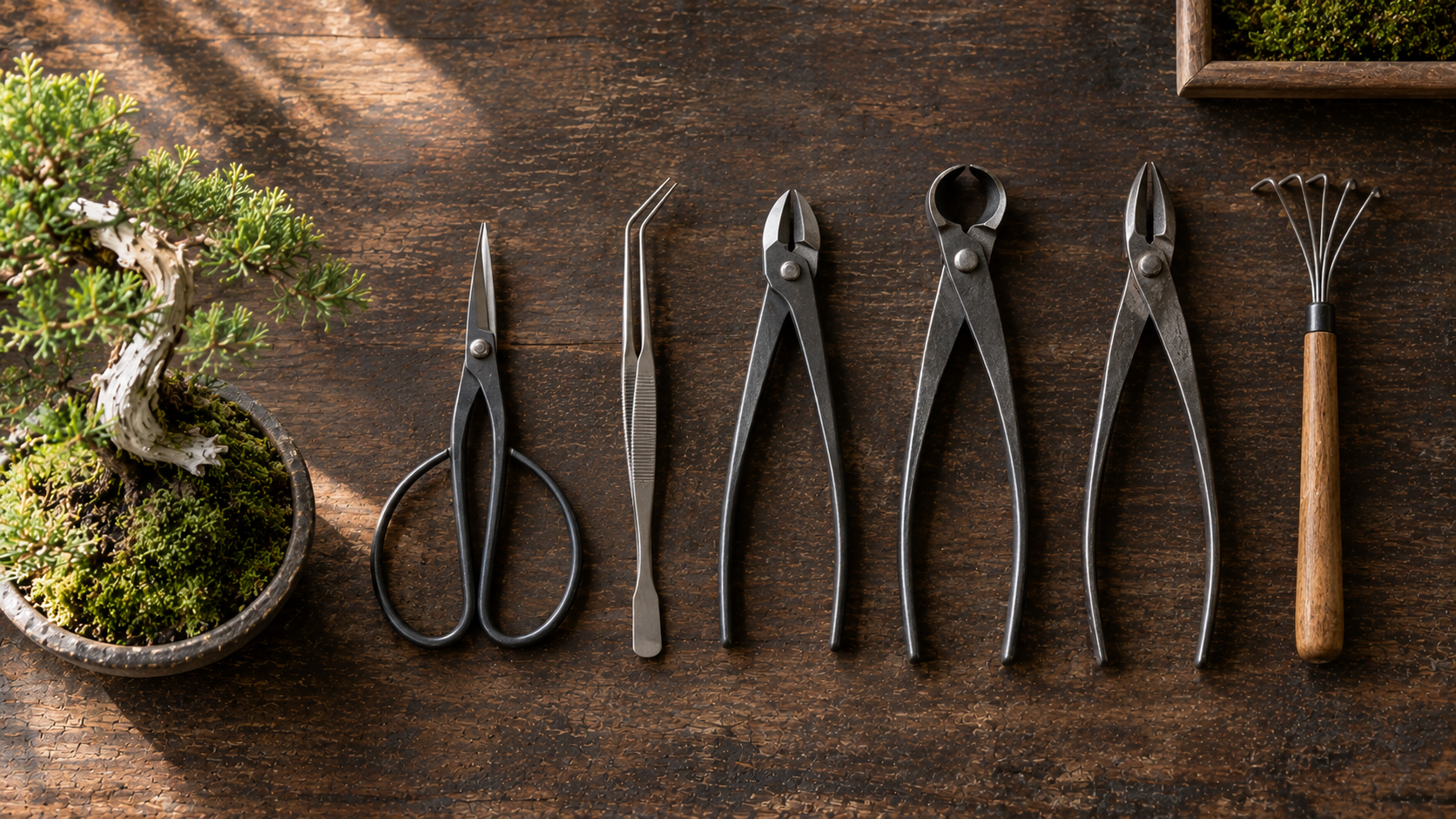
In my experience, the best way to build a tool kit isn’t to buy a big set on day one. It’s to buy the right tool when you first need it, and buy one good one instead of three cheap ones. This guide explains which six Japanese tools beginners need, in what order, and roughly what each should cost.
Who this bonsai tools for beginners guide is NOT for
It’s not for experienced growers. If you already own several Japanese tools, our individual buying guides will be more useful.
It’s not a starter set comparison. If you’d rather buy several tools in one box, our bonsai starter tool set guide compares Japanese kits.
It’s not about advanced work. Carving, heavy bending and collected trees need specialist tools. We’ll mention them at the end, but this guide focuses on the basics.
Still with us? Let’s go.
How we picked these (3 things that actually matter)
1. How often you’ll use it
The first tools you buy should be the ones you’ll pick up every week. For most beginners, that’s scissors for trimming and something to handle wire. Tools for repotting come next, since you’ll usually repot once every year or few. Specialist tools come last.
2. What a cheap version costs you
Some tools are fine to buy cheaply. Others aren’t.
A budget pair of tweezers is fine. A budget concave cutter that crushes branches instead of cutting them can leave wounds that take years to heal. A cheap wire cutter with misaligned jaws can damage bark. So it makes sense to spend more on cutting tools and less on simple ones.
3. Japanese quality at a beginner price
You don’t need Masakuni on day one. Japanese brands like Wazakura offer hand-forged tools at prices close to cheap imported kits, and Kaneshin’s carbon steel range is the long-time standard for serious hobbyists. Both are good places to start. If you’re curious about the premium end, our Kaneshin vs Masakuni comparison explains the difference.
A few beginner habits that matter more than any tool
None of these cost anything.
- Use each tool only for its job. Cutting wire with scissors, or roots with a concave cutter, damages edges quickly.
- Clean tools after every session. Sap and soil cause rust and dull edges.
- Oil carbon steel occasionally. A light coat prevents rust.
- Store tools dry. A tool roll or drawer is fine. A damp shed is not.
- Don’t force a cut. If a tool struggles, the branch is too thick for it.
- Learn on one tree before buying more tools. Your needs will become clear quickly.
Bonsai tools for beginners: comparison table
Prices below come from our individual buying guides, checked in September and October 2026. They’re approximate and vary by seller and exchange rate.
| Order | Tool | What it does | When you need it | Beginner price range |
|---|---|---|---|---|
| 1 | Bonsai shears | Trimming shoots, leaves and fine branches | From day one | ~$40–85 |
| 2 | Tweezers | Weeding, removing dead leaves, moss work | From day one | ~$10–30 |
| 3 | Wire cutter | Cutting and removing wire safely | When you start wiring | ~$56–97 |
| 4 | Concave cutter | Removing branches with clean, healing cuts | First structural pruning | ~$60–140 |
| 5 | Jin pliers | Bending, tightening and removing wire | When you wire regularly | ~$46–97 |
| 6 | Root rake | Loosening soil and roots when repotting | First repot | ~$15–40 |
The 6 bonsai tools beginners need, reviewed in order
1. Bonsai shears – the first tool everyone needs
If you buy only one Japanese bonsai tool, make it a pair of shears. You’ll use them for trimming new shoots, cutting off leaves and thin twigs, and generally keeping the tree in shape. Most beginners use them almost every time they touch a tree.
The classic beginner style is the satsuki-style scissor: long, narrow blades with comfortable round handles. It reaches into the tree easily and handles most light pruning.
In our bonsai shears guide, the Wazakura Satsuki Bonsai Scissors (around $40) are our first-pair pick, while Kaneshin’s carbon satsuki scissors (around $60–65) are a reliable everyday step up.
Pros
- Used constantly, so excellent value
- Affordable Japanese options
- Handles most everyday pruning
Cons
- Not for thick branches, wire or roots
- Carbon steel needs drying and oiling
Best first pick: Wazakura Satsuki Bonsai Scissors. Step up: Kaneshin carbon satsuki scissors.
Search Japanese satsuki bonsai scissors on Amazon
2. Tweezers – the cheapest tool you’ll use every week
Tweezers are easy to overlook, but they’re one of the most-used tools in any kit. You’ll use them to pull weeds, remove dead leaves and old needles, pick off pests, and place or tidy moss. Many have a small spatula on the other end for pressing down soil after repotting.
The good news is that quality Japanese tweezers are very affordable. Kaneshin’s No.61A bent-nose tweezers with a spatula, made in Japan from stainless steel, cost about $10 at a US retailer. That’s our top beginner pick.
Pros
- Very cheap for a Japanese tool
- Used on every tree, every week
- Spatula end helps with repotting and moss
Cons
- Easy to damage the tips by prying with them
Best first pick: Kaneshin No.61A Bent Nose Tweezers.
Search Kaneshin bonsai tweezers on Amazon
3. Wire cutter – the tool that protects your bark
Most beginners start wiring branches within the first year. And the first time you remove wire, you’ll see why a proper wire cutter matters.
Bonsai wire cutters have short, rounded jaws that cut wire right against the branch without digging into the bark. Ordinary hardware-store wire cutters have pointed jaws and often leave marks. Unwinding wire by hand can also tear bark, especially once the branch has thickened.
In our bonsai wire cutter guide, the Wazakura Hand Forged Wire Cutter (around $56) is our first dedicated cutter pick, and Kaneshin’s No.22A (around $67) is a dependable general-purpose choice.
Pros
- Removes wire without damaging bark
- Works with aluminum and copper wire
- Affordable Japanese options
Cons
- Not for cutting branches
- One more tool to buy if you’re not wiring yet
Best first pick: Wazakura Hand Forged Wire Cutter. Step up: Kaneshin No.22A.
Search Japanese bonsai wire cutters on Amazon
4. Concave cutter – the most important “real” bonsai tool
If bonsai has a signature tool, it’s the concave cutter. It removes a branch so the cut is slightly hollow, rather than flat. That shallow hollow lets the wound heal over more smoothly, leaving a much less visible scar.
You won’t need one on day one. But once you start removing branches to shape a tree, it becomes essential. This is also the tool where quality matters most, because a poor cutter crushes wood instead of cutting it.
In our bonsai concave cutter guide, the Wazakura Hand Forged Concave Cutter (around $60) is the first serious cutter pick, and Kaneshin’s carbon concave cutter (around $65–90) is the best long-term value.
Pros
- Leaves cuts that heal smoothly
- Essential for structural pruning
- Good Japanese options under $100
Cons
- Not for wire, roots or very thick branches
- Worth spending a little more on
Best first pick: Wazakura Hand Forged Concave Cutter. Step up: Kaneshin carbon concave cutter.
Search Japanese concave cutters on Amazon
5. Jin pliers – the wiring helper
Despite the name, jin pliers aren’t just for deadwood. For most beginners, they’re a wiring tool: tightening wire ends, bending wire into place, pulling wire off, and tightening tie-down wire when repotting.
They’re not the first tool you need. But once you start wiring regularly, they make the job much easier on your fingers and give you more control.
In our bonsai jin pliers guide, the Wazakura Hand Forged Wire & Jin Pliers (around $46) are our first-pair pick, and Kaneshin’s No.49 (around $60) is a strong choice for more leverage and heavier wire.
Pros
- Makes wiring easier and neater
- Useful for repotting too
- Later useful for deadwood work
Cons
- Not essential on day one
- Carbon steel needs basic care
Best first pick: Wazakura Hand Forged Wire & Jin Pliers. Step up: Kaneshin No.49.
Search Japanese bonsai jin pliers on Amazon
6. Root rake – the repotting tool you’ll be glad you bought
Repotting is one of the most stressful moments for a beginner, and a root rake makes it much gentler. Its curved prongs comb old soil away from the roots and untangle circling roots, without tearing the fine roots you want to keep.
You only need one when you first repot, which is often in your first or second spring. Japanese root hooks start at around $15 at US retailers, and Kaneshin’s handmade 2-prong root hook costs around $40.
Pros
- Gentle on fine roots
- Affordable
- Lasts for years
Cons
- Only used at repotting time
Best first pick: a simple Japanese root hook from a bonsai retailer. Step up: Kaneshin 2 Prong Root Hook.
Search Japanese bonsai root rakes on Amazon
Which bonsai tools should beginners buy? (By stage)
You’ve just bought your first tree: shears and tweezers. That’s it for now.
You’re starting to wire: add a wire cutter, plus some aluminum wire.
You’re starting to shape the tree: add a concave cutter.
You’re wiring regularly: add jin pliers.
You’re about to repot: add a root rake, pot mesh and a couple of bamboo chopsticks.
You’d rather buy everything at once: a starter set can save money, as long as it contains the tools you’ll actually use.
A realistic first-year budget
Buying one good Japanese tool at a time, a beginner can build the six-tool kit above for roughly $230–490, depending on whether you choose budget Japanese tools or step-up Kaneshin models. Spread over a year or two, that’s very manageable, and every tool will last for many years with basic care.
Carbon steel or stainless: which is better for beginners?
This question comes up with almost every Japanese tool, so it’s worth answering once.
Carbon steel is the traditional choice. It’s what most Japanese bonsai tools are made from, it takes a sharp edge, and it’s usually cheaper. The downside is rust. If you leave a carbon tool wet or covered in sap, it can rust within days.
Stainless steel resists rust much better, which makes it attractive for beginners, for humid climates, and for anyone who knows they won’t always clean their tools straight away. It usually costs noticeably more for the same tool.
For most beginners, carbon steel is perfectly fine as long as you build one small habit: wipe the tool dry after use and oil it now and then. If you already know that won’t happen, or you live somewhere very humid, stainless is worth the extra money for the tools you use most, like shears and a concave cutter.
Where to buy Japanese bonsai tools for beginners
You don’t need to import tools from Japan yourself. Many specialist bonsai retailers in the US, UK and Europe stock Kaneshin and other Japanese brands, and some Japanese brands like Wazakura ship internationally. Amazon also carries many Japanese bonsai tools, but check the brand and seller carefully, because similar-looking tools from other makers are common. When in doubt, buy from a bonsai specialist.
Tools beginners can wait for
These are excellent tools, but most beginners don’t need them yet.
- Knob cutter: for removing stubs and very flush cuts. Useful once you’re doing more structural work.
- Root cutter: for thick roots on bigger trees.
- Bonsai saw: for branches too thick for a concave cutter.
- Carving tools: for creating jin and shari.
- Branch bender or jack: for heavy bends on mature conifers.
- Turntable: makes working on a tree easier, but it’s a comfort, not a necessity.
How to care for your first bonsai tools
- Wipe them after every use. Sap and soil cause rust.
- Dry them completely. Especially carbon steel.
- Oil them lightly from time to time. A drop of tool oil on blades and joints.
- Use a rust eraser for light rust. Remove it early, before it pits the steel.
- Store them in a roll or drawer. Protect edges from knocking against each other.
Common beginner tool mistakes
Buying a big cheap kit. Many pieces go unused, and the important ones may be poor quality.
Cutting wire with scissors. It ruins the edge quickly.
Using a concave cutter on thick wood. If it doesn’t cut easily, use a saw.
Skipping a proper wire cutter. Ordinary cutters and unwinding by hand can damage bark.
Never cleaning tools. Rust is the most common reason good tools wear out early.
Conclusion: buy the right tool when you need it
The best bonsai tools for beginners aren’t the most expensive ones, and you don’t need a huge kit to start. Begin with shears and tweezers. Add a wire cutter when you start wiring, a concave cutter when you start shaping, jin pliers when wiring becomes regular, and a root rake for your first repot.
Choose affordable Japanese tools like Wazakura to start, or Kaneshin if you’d like to buy once and keep them for decades. Clean them, keep them dry, and use each one only for its job.
Do that, and your first six tools will serve you for years, long after your first tree has become a real bonsai.
Ready to start? Compare Japanese bonsai shears for your very first tool, or search Japanese bonsai tools on Amazon.
Leave a Reply