Affiliate disclosure: Some links on this page are affiliate links. If you buy through them, Aribonsai may earn a small commission at no extra cost to you. It doesn’t change what we recommend or how we rank anything.
Repotting day, and the wrong tool for the job
Most growers know the feeling.
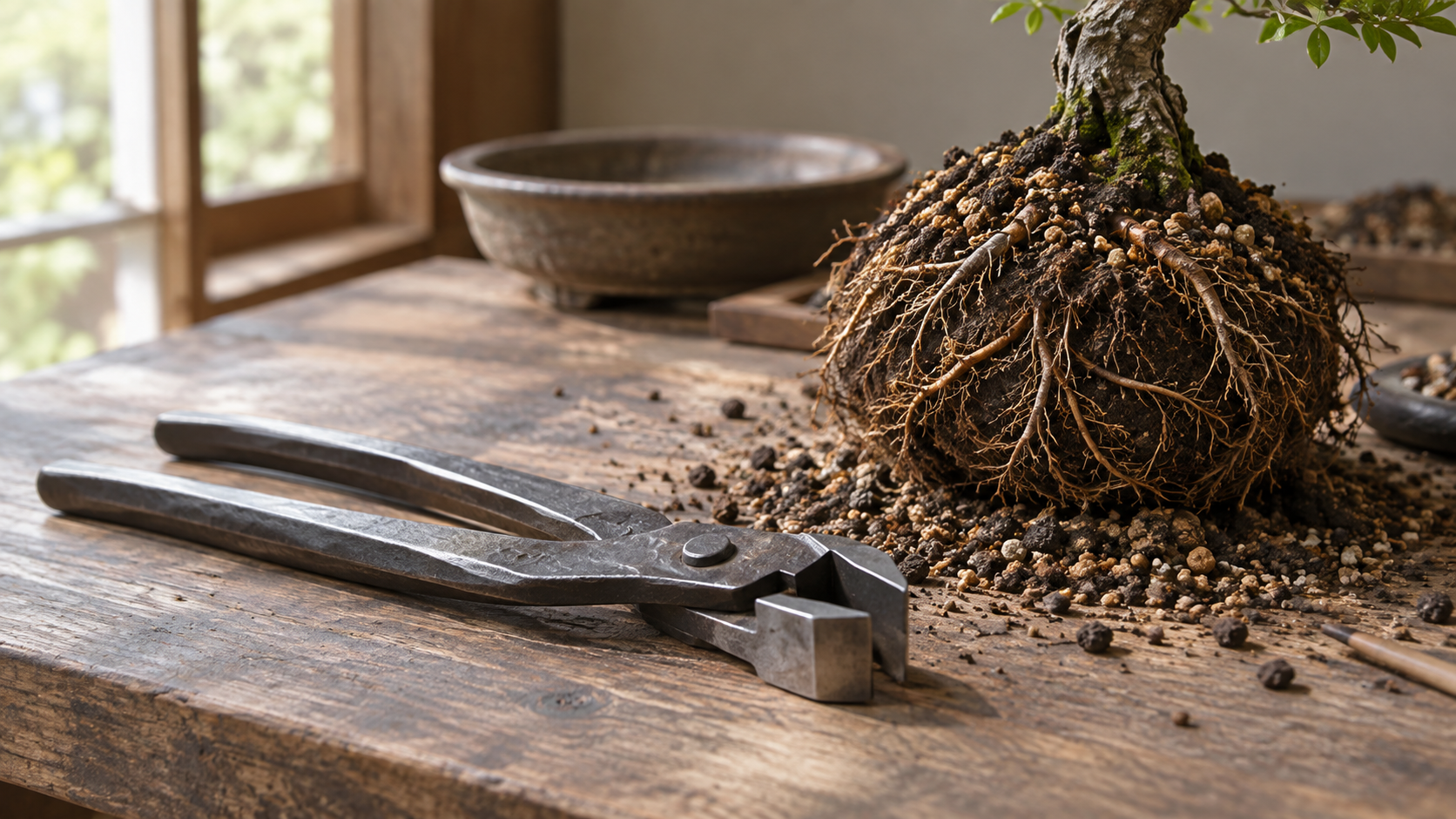
It’s spring. The buds are swelling, the tree’s been in its pot for two or three years, and it’s time. Maybe it’s even moving into a new Japanese pot. You slide the root ball out and find a dense mat of roots circling the bottom. A few are thick and woody. Some are wrapped around old wire. Somewhere in the middle there’s a big downward root you’ve been meaning to deal with for a while.
So you reach for whatever’s on the bench. Your good shears, maybe. Or your concave cutter.
That’s where things go wrong. Roots are full of grit and soil. They dull blades fast. Shears made for soft shoots get nicked or knocked out of alignment. A concave cutter you paid good money for starts tearing branches a month later, and you can’t figure out why.
A root cutter exists so your other tools don’t have to do this job. It’s a heavy, simple, tough tool that you don’t mind getting dirty. Retailers also point out that it doubles for thicker branches and, in some cases, for splitting smaller trunks or light jin work.
Root cutter vs your other cutters
Here’s the quick version, because these tools get mixed up a lot.
- A concave cutter removes branches flush to the trunk and leaves a neat hollow. It’s a precision tool. You want to keep it clean and sharp.
- A knob cutter takes small, deep bites to remove knobs and stubs. It can also be used on roots, but it’s still a fairly fine tool.
- A root cutter has strong, straight jaws built to push through tough, gritty material. It doesn’t leave a pretty wound, and it doesn’t need to. Roots go back under the soil.
So the root cutter is the one you use when looks don’t matter and toughness does. That’s exactly why it protects the others.
In my experience, it’s one of the most underrated tools in a bonsai kit. It’s not glamorous, but once you own one, your expensive cutters and shears stay sharp a lot longer.
Who this article is NOT for
It’s not for you if you only repot one or two small trees a year. A pair of old scissors you don’t care about can handle a few fine roots. A dedicated root cutter starts to pay off when you’re repotting several trees, or larger ones.
It’s not for you if you’re looking for a root hook or root rake. Those tools tease roots apart. Root cutters cut them. Both are useful, but this guide only covers cutters.
It’s not for you if you want a tool for wire or deadwood. Some retailers specifically say their root cutters shouldn’t be used on wire or deadwood. Check the listing before using a root cutter on anything other than roots and branches.
Still with us? Let’s go.
How we picked these (3 things that actually matter)
1. Size, matched to your trees and roots
Like knob cutters, root cutters come in a wide range of sizes, and picking the right one matters more than the brand.
- Small (about 150mm): fine for shohin, mame and small trees with thin roots.
- Medium (about 180–210mm): the most versatile size. Handles most repotting on typical hobby trees.
- Large (270mm and up): for big trees, collected trees (yamadori) and thick, woody roots. Kaneshin even makes 360mm and 450mm models weighing around 1.5kg, which are really for nursery and landscape work.
If you’re not sure, a 180mm cutter is a safe starting point.
2. Weight and leverage
Root cutters are heavier than most bonsai tools, and that’s partly the point. Weight and longer handles give you leverage on tough roots without needing much grip strength.
The trade-off is fatigue. A 370g cutter feels great on a thick root and tiring after an hour of fine trimming. That’s why some people keep a smaller one for detail work and a larger one for the heavy cuts.
3. Carbon or stainless
Repotting is dirty, wet work. Roots are damp, soil is gritty and you often water the tree right afterwards. That’s hard on carbon steel.
Carbon steel root cutters cost less and cut well, but they need cleaning and oiling after every repotting session. Stainless steel costs more but handles moisture much better. If there’s one tool where stainless really makes sense, it’s this one.
A note on using it. A good root cutter makes cutting easy. That can be a trap. How much root to remove, and when, depends a lot on the species, the tree’s health and the time of year. Some trees handle heavy root work well. Others don’t. If you’re unsure, take less rather than more, and check the timing for your species before you start. A sharp tool is no substitute for knowing how much to cut.
Also, clean the tool as soon as you finish. Soil left drying on the blades is what causes most rust and dulling on root cutters, not the cutting itself. A quick rinse, a wipe and a few drops of oil on carbon steel is enough. Our bonsai tool maintenance guide covers the oil and cleaning products.
Prices below are approximate and were checked in October 2026. Yen prices are from Japanese stores before international shipping.
Comparison table
| Root cutter | Steel | Length | Weight | Approx. price | Best for |
|---|---|---|---|---|---|
| Wazakura Hand Forged Root Cutter | S55C carbon (black coated) | 210mm (225mm overall) | 274g | ~$60 | First root cutter, medium trees |
| Kaneshin Root Cutter No.13B | Carbon | 150mm | 187g+ | ~¥12,000 (about $80) | Small trees and fine roots |
| Kaneshin Root Cutter No.13 / No.13A | Carbon | 180 / 210mm | 305g+ / 370g+ | ~¥12,000 each; ~$89 at a US retailer | Everyday repotting |
| Kaneshin Stainless Root Cutter No.812 / No.813 | Stainless | 180 / 210mm | 216g+ / 300g+ | ~¥22,100 each (about $145) | Low maintenance, frequent repotting |
| Kaneshin Root Cutter No.14 | Carbon | 270mm | 818g+ | ~¥16,100 (about $105) | Large and collected trees |
| Masakuni Root Cutter No.0015 (S) | Carbon | 250mm | 560g | ~¥29,800 (about $195) | Premium heavy-duty root work |
Individual reviews
1. Wazakura Hand Forged Bonsai Root Cutter (210mm)
The cheapest way into a proper Japanese root cutter.
It’s S55C carbon steel with a black coating, 210mm (225mm overall) and 274g. Wazakura sells it for $59.99, with free shipping to the US, Canada, the UK, the EU and Hong Kong. Import tax may still apply.
Wazakura describes it as a dual-purpose tool for root pruning, trimming thick branches and splitting thinner trunks. The listing quotes the maker, Yusuke Ogawa, saying it works “for thick branches, root processing, and jin work.”
At 274g, it’s lighter than Kaneshin’s 210mm carbon model (370g+), which makes it easier to use for longer sessions.
Pros
- Lowest price for a Japanese-made root cutter on this list
- Free shipping to several regions
- Light for a 210mm root cutter
- Usable for roots, thick branches and some jin work
Cons
- Only one size
- Carbon steel, so it needs cleaning and oiling after repotting
- Less long-term feedback than Kaneshin
Who it’s for: Anyone buying their first root cutter for medium-sized trees.
2. Kaneshin Root Cutter No.13B (150mm)
The small one.
At 150mm and around 187g, the No.13B is Kaneshin’s smallest standard root cutter. It’s about ¥12,000 from a Japanese tool store. There’s also a No.13C at the same length for about ¥13,700.
Small root cutters make sense for shohin and mame, where the roots are thin and the root ball is tiny. A big root cutter is clumsy in a small pot. You end up nudging the tree around just to get the jaws into position, which is the last thing you want when the roots are already exposed.
Pros
- Light and easy to control in small pots
- Good for fine roots on small trees
- Same Kaneshin build as the larger sizes
- Leaves your shears free for foliage work
Cons
- Too small for thick, woody roots
- Carbon steel, so it needs the usual care
- Ordering direct from Japan adds shipping time
Who it’s for: Shohin and mame growers, or anyone with mostly small trees. It also works well as a second, lighter root cutter alongside a bigger one.
3. Kaneshin Root Cutter No.13 (180mm) / No.13A (210mm)
The standard Kaneshin root cutter, and the size most people end up using.
On a Japanese tool store, the No.13 is 180mm and 305g+, and the No.13A is 210mm and 370g+. Both are about ¥12,000. Eastern Leaf in the US sells a Kaneshin carbon root cutter for $89. Niwaki in the UK lists a 7.1″ (about 180mm) Kaneshin carbon root cutter at $130 before VAT. It says it’s for root pruning and repotting, can handle roots and small branches up to around 5mm, and shouldn’t be used on deadwood or wire.
Eastern Leaf adds that the root cutter is “an often under utilized tool,” also used in place of a trunk splitter on smaller branches.
In my experience, the 180mm No.13 is the size that suits most hobbyists best. The 210mm is worth it if your trees are a bit bigger or you deal with thicker roots often.
Pros
- Two practical sizes for most hobby trees
- Widely available from Western retailers
- Good weight for leverage on thicker roots
- Strong reputation and plenty of user feedback
Cons
- Heavier than Wazakura’s 210mm cutter
- Prices vary a lot between retailers
- Carbon steel, so cleaning after repotting is a must
Who it’s for: Most growers who want one reliable root cutter for regular repotting.
4. Kaneshin Stainless Root Cutter No.812 (180mm) / No.813 (210mm)
If you only buy one stainless tool, this is a strong candidate.
The No.812 is 180mm and 216g+. The No.813 is 210mm and 300g+. Both are about ¥22,100 on a Japanese tool store, a little under twice the carbon price. Interestingly, the stainless versions are listed as lighter than the carbon models of the same length.
The reason to go stainless here is simple. Repotting is wet. Roots are damp, soil sticks to everything, and you’re often working outside. A carbon root cutter left dirty for a day can start to rust. Stainless gives you a lot more room for error.
Pros
- Handles wet soil and damp roots much better than carbon
- Lighter than the carbon versions at the same length
- Two useful sizes
- Same Kaneshin quality
Cons
- Nearly twice the price of carbon
- Stainless is harder to resharpen well at home
- Mostly available direct from Japan
Who it’s for: Growers who repot a lot of trees each spring, or who know they won’t clean tools straight away.
5. Kaneshin Root Cutter No.14 (270mm)
A big tool for big jobs.
The No.14 is 270mm and 818g+, about ¥16,100 from a Japanese tool store. That’s more than double the weight of the 210mm No.13A. Above it, Kaneshin also lists No.15A (360mm) and No.15 (450mm), both around 1,500g and roughly ¥41,700–44,900.
You don’t need this for typical hobby trees. You need it when you’re dealing with collected material, large field-grown stock, or roots as thick as your thumb.
Pros
- Real leverage for thick, woody roots
- Still reasonably priced for its size
- Useful for collected trees and large stock
- Even larger models available if you need them
Cons
- Heavy and tiring for normal repotting
- Too big for small or medium trees
- Carbon steel, so maintenance still applies
Who it’s for: Advanced growers working with yamadori, large trees or field-grown material.
6. Masakuni Root Cutter No.0015 (S)
Masakuni’s root cutters are heavy-duty tools, even the “small” one.
The No.0015 (S) is 250mm and 560g, and lists at about ¥29,800 on a Japanese export store. Masakuni also sells a larger No.0014 and a root cutter specifically for satsuki azaleas (No.0040), but we couldn’t confirm their current specs or prices, so we’ve left them out of the table.
Note the size. Masakuni’s “small” root cutter is longer and much heavier than Kaneshin’s standard sizes. It’s built for serious root work, not light trimming.
Pros
- Masakuni build quality
- Heavy and solid for thick roots
- A specialist satsuki version exists if you grow azaleas
Cons
- The most expensive root cutter on this list
- Heavy for everyday repotting of smaller trees
- Harder to find outside Japan
Who it’s for: Experienced growers who already use Masakuni tools and want a heavy-duty root cutter to match.
Recommendation by use case
“I want my first root cutter without spending much.” Wazakura Hand Forged Root Cutter. About $60, light for its size, with free shipping to several regions.
“I mostly grow shohin and mame.” Kaneshin No.13B (150mm).
“I want one root cutter for normal repotting.” Kaneshin No.13 (180mm), or the No.13A (210mm) for slightly bigger trees.
“I repot a lot, and I don’t always clean my tools right away.” Kaneshin stainless No.812 or No.813.
“I work with collected trees or big, woody roots.” Kaneshin No.14 (270mm), or Masakuni No.0015 if you prefer Masakuni.
Conclusion: protect your other tools first
Here’s the short version.
A root cutter isn’t exciting. It’s mostly there so your shears and concave cutter don’t get dulled by grit and soil. That alone makes it worth owning if you repot more than a couple of trees a year.
It’s also one of the few bonsai tools where buying a cheaper option first makes a lot of sense. A root cutter takes more abuse than anything else on the bench. If you’re going to learn how to look after tools, this is a forgiving one to learn on. You can always move up to stainless or a bigger size once you know how you actually use it.
Pick the size that matches your trees. Go stainless if you repot a lot, or if you know you won’t clean tools straight away. And keep it for roots and thicker branches, so your good cutters stay good.
If you’re working on old stubs and knobs during repotting, a knob cutter is the better tool for those. Our knob cutter guide covers the options.
Ready to choose?
Leave a Reply