Affiliate disclosure: Some links on this page are affiliate links. If you buy through them, Aribonsai may earn a small commission at no extra cost to you. It doesn’t change what we recommend or how we rank anything.
Your deadwood is carved. Now it needs to last.
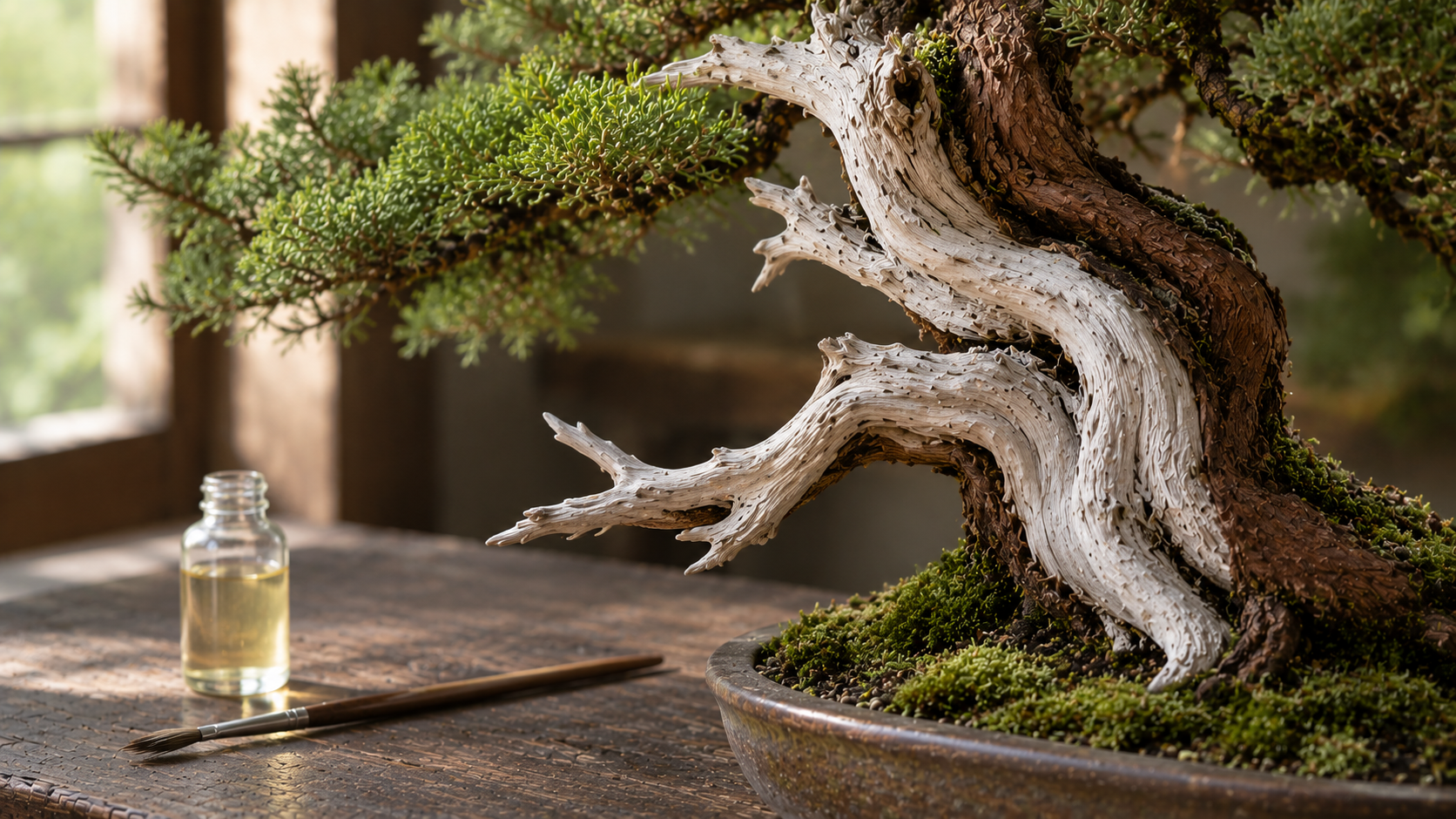
Lime sulfur for bonsai is the step that turns freshly stripped wood into deadwood that looks like it’s been weathering on a mountain for decades.
You’ve made a jin. Maybe you’ve carved a long shari down the trunk. It looks great for a week. Then the wood starts to look dull, a bit dirty, maybe a little green where algae creeps in. On a tree that sits outside in the rain, untreated deadwood can also start to rot over time.
That’s why most bonsai growers treat jin and shari with lime sulfur. It does two jobs at once: it helps protect the wood from rot and pests, and it bleaches it to that pale, silvery color you see on old junipers in exhibitions.
The tricky part is buying it. Lime sulfur comes as bonsai-specific bottles, as “Jin Seal” brush-on liquids, as concentrated animal dips, and in big agricultural containers. It’s restricted for horticultural use in some places. And some growers skip it completely in favor of wood hardeners or ink-tinted finishes.
In my experience, most people’s first lime sulfur job looks too white. It’s a common surprise, and an easy one to fix next time. This guide explains what matters, then compares six options for treating bonsai deadwood, from simple bonsai bottles to alternatives for growers who don’t want the bright white look.
Who this lime sulfur for bonsai guide is NOT for
It’s not a pest-control guide. Lime sulfur is also used as a dormant spray against fungus and pests on some plants. That’s a different use with different dilutions and rules. This guide covers deadwood treatment only.
It’s not a carving guide. Lime sulfur goes on after the wood is shaped. If you’re still stripping bark, our bonsai jin pliers guide covers the tools for that stage.
It’s not for every tree. Lime sulfur deadwood is most associated with junipers and other conifers. On some species, many growers prefer a more natural, darker finish, or no whitening at all.
Still with us? Let’s go.
How we picked these (3 things that actually matter)
1. Strength and how you’ll dilute it
Lime sulfur products vary a lot in concentration.
- Bonsai-specific bottles are sold for deadwood and are usually ready to use or easy to dilute.
- “Jin Seal” style liquids are brush-on deadwood treatments containing lime sulfur. They can be used undiluted or diluted with water.
- Animal dips and agricultural lime sulfur are often stronger. Bonsai forum users point out that animal-dip products can be more concentrated than bonsai-grade products, so the strength should be checked before use.
Full strength whitens deadwood a lot. Lower strength, built up over several coats, gives more control.
2. The finish you want
Fresh lime sulfur doesn’t look the way it ends up. Growers describe it going on yellow, then drying and fading over time toward a bleached, pale color.
If you want a softer, grayer look, many growers add a colorant. India ink or Japanese sumi ink is a common choice for toning down chalky white deadwood. Others skip lime sulfur entirely and use a clear wood hardener, which preserves the wood without bleaching it.
3. Safety, storage and where you can buy it
Lime sulfur is a pesticide-type product with a strong sulfur smell. Treat it with respect: work outside, wear gloves and eye protection, and keep it off foliage and away from children and pets. Read the label of whatever you buy.
Availability is the other issue. Some bonsai forum members report that lime sulfur is restricted for horticultural use in some US states, and registration rules have affected supply in the past. Rules vary by country and state, so check what’s allowed where you live.
Storage matters too. Growers recommend buying only what you’ll use in a season, because opened lime sulfur can settle and lose quality over time.
A few lime sulfur habits that matter more than the brand
None of these cost anything.
- Finish carving first. Treat the wood only once it’s shaped.
- Clean and wet the wood. Many growers wet deadwood and let it dry slightly before applying, so the solution soaks in instead of sitting on top.
- Protect the pot and soil. Lime sulfur can stain pots and shouldn’t soak into the soil. Cover the soil surface and the pot with plastic or paper. Our Japanese bonsai pots guide shows the kind of pot you’ll want to protect.
- Keep it off living bark and foliage. Use a small brush and work carefully along the lifeline.
- Go light, then add more. Thin coats give more control than one heavy coat.
- Wait before judging. The color changes as it dries and over the following days and weeks.
- Practice on scrap. A dead branch from the garden is a free test piece.
Lime sulfur for bonsai comparison table
| Product | Type | Best for | Finish | Availability | Approx. price |
|---|---|---|---|---|---|
| Wigert’s Lime Sulfur (4 oz) | Bonsai lime sulfur | US growers, small jobs | Bleached, pale | US | ~$10 |
| Jin Seal (100 ml) | Brush-on deadwood liquid | Easy application, EU growers | Gray to white | EU | ~€7.50 |
| Lime sulfur animal dip | Concentrated liquid | Large collections, value | Very white at full strength | US (varies) | ~$12 |
| Eutrema Lime Sulphur | Agricultural lime sulfur | Clubs, nurseries (UK) | Bleached, pale | UK | From ~£69 (5 L) |
| PC Petrifier | Wood hardener | Preserving without whitening | Natural, can be shiny | US | Varies |
| Japanese sumi ink | Colorant | Toning down white deadwood | Gray, weathered | Widely available | Low |
Prices are approximate and vary by country and seller. Always check the current price and local rules before buying.
The 6 best lime sulfur options for bonsai, reviewed
1. Wigert’s Lime Sulfur (4 oz) – the easiest choice for US growers
If you’re in the US and just want lime sulfur sold specifically for bonsai, this is the simplest option.
Wigert’s Bonsai, a long-established Florida bonsai nursery, sells a 4 oz bottle for about $10, described simply as being for bleaching and preserving deadwood on bonsai. It’s a small size, which is actually a good thing: most hobbyists only treat a few trees a year, and lime sulfur is best used within a season.
The listing doesn’t give a concentration, so start with a light coat and build up.
Pros
- Sold specifically for bonsai deadwood
- Small, affordable bottle
- Easy to buy in the US
Cons
- Concentration not stated
- Small size won’t go far on large collections
Best for: beginners and US hobbyists treating a few trees.
Check Lime Sulfur at Wigert’s Bonsai
2. Jin Seal – the classic brush-on deadwood treatment
“Jin Seal” is a name many bonsai growers know. It’s a liquid made for preserving jin and shari, and it contains lime sulfur, which gives treated wood a gray or white look.
Bonsai Plaza sells a 100 ml bottle for around €7.50. The product description says it helps against fungus and algae and slows rot. The suggested method is to clean the wood with water, let it dry slightly, and brush it on, either undiluted or diluted with water. It recommends allowing 24 hours to dry, using it in a well-ventilated area, and avoiding eye contact.
Historically, Jin Seal was also associated with the Hô Yoku bonsai care line in the US and UK, so you may see it under slightly different names and sellers. The maker isn’t stated on the Bonsai Plaza listing.
Pros
- Made for jin and shari
- Brush-on liquid is easy to control
- Clear usage instructions
- Inexpensive
Cons
- Maker and origin not stated
- Mainly sold in Europe today
Best for: European growers who want a ready-made deadwood treatment.
Check Jin Seal at Bonsai Plaza
3. Lime sulfur animal dip – best value for large collections
This is the open secret of the bonsai world. Many growers buy lime sulfur sold as a pet or livestock dip, because it’s easy to find and inexpensive.
Bonsai forum members describe it as essentially the same material used in bonsai, sold for around $12 in the US. The catch is concentration: they warn that animal dips are often stronger than bonsai-grade products, so you should check the strength and dilute it with water before using it on deadwood.
It’s also worth being clear: this is an off-label use. The product is labeled for animals, not plants, so read the label carefully, follow its safety instructions, and check your local rules.
Pros
- Inexpensive and widely available
- Plenty of product for many trees
- Can be diluted to suit your finish
Cons
- Often more concentrated than bonsai products
- Labeled for animals, not plants
- Strong smell and needs careful handling
Best for: experienced growers with larger collections who are comfortable diluting.
Search lime sulfur dip on Amazon
4. Eutrema Lime Sulphur – the UK bulk option
If you run a club, a nursery or a large collection in the UK, buying bonsai-sized bottles adds up quickly. Eutrema sells lime sulphur (a calcium polysulphide solution) in much larger quantities.
Its jin page describes lime sulphur, also called Jin Fluid, as giving deadwood an aged patina. The product is listed in 5-litre containers, with larger packs for commercial users, starting at around £69.
That’s far more than most hobbyists will ever use. But for a bonsai club that runs deadwood workshops, or a professional with many trees, it can make sense. Remember that opened lime sulfur doesn’t keep forever, so only buy what you’ll realistically use.
Pros
- Large quantities for clubs and nurseries
- Sold in the UK
- Proper horticultural product
Cons
- Far too much for most hobbyists
- Higher upfront cost
- Storage and shelf life need managing
Best for: UK clubs, nurseries and professional growers.
5. PC Petrifier – best if you don’t want white deadwood
Not every tree suits bright white deadwood. Some growers want to preserve the wood but keep its natural color, especially on deciduous trees and some pines.
That’s where wood hardeners come in. On bonsai forums, PC Petrifier is one of the most-recommended alternatives to lime sulfur. Growers describe it as safe and effective, though it can look shiny when dry, especially with heavy coats. Several report that the shine fades over days or weeks, and that one or two light coats avoid the problem.
It isn’t lime sulfur, and it doesn’t bleach the wood. But if your goal is “keep this deadwood from rotting without turning it white,” it’s worth considering.
Pros
- Preserves wood without bleaching
- Often described as safer and easier to handle than lime sulfur
- Good for species where white deadwood looks unnatural
Cons
- Can look shiny if overapplied
- Not a bonsai-specific product
- No bleached, aged look
Best for: growers who want natural-colored deadwood.
6. Japanese sumi ink – the secret to natural-looking deadwood
This isn’t a preservative. It’s the finishing trick that makes lime sulfur look less like paint and more like nature.
Many growers mix a little India ink or Japanese sumi ink into their lime sulfur, or apply a light ink wash afterward, to tone down chalky white deadwood toward a more natural gray. Some use a light black wash on new deadwood to get a weathered look before applying a preservative.
Sumi ink is the traditional black ink used in Japanese calligraphy, so it’s easy to find in art stores and online. You only need a few drops. Test the mix on scrap wood first, because a little goes a long way.
Pros
- Turns bright white deadwood into natural gray
- Very inexpensive
- Easy to find
- Fits the Japanese aesthetic
Cons
- Not a preservative on its own
- Easy to overdo, so test first
Best for: anyone whose lime sulfur looks too white, and anyone preparing a tree for display.
Search Japanese sumi ink on Amazon
Which lime sulfur for bonsai should you buy? (By situation)
You’re in the US and treating a few trees: Wigert’s Lime Sulfur.
You’re in Europe: Jin Seal from Bonsai Plaza.
You have a large collection and know how to dilute: a lime sulfur animal dip, checked for concentration.
You run a UK club or nursery: Eutrema Lime Sulphur.
You want to preserve deadwood without whitening it: PC Petrifier.
Your deadwood looks too white: add Japanese sumi ink to your lime sulfur, or use a light ink wash.
You’re preparing a tree for a show: freshen the deadwood with a light lime sulfur coat a few weeks before, tone it with ink if needed, and set the tree on a bonsai display stand that suits it.
A simple deadwood finishing kit
For most hobbyists, a bottle of bonsai lime sulfur, a small bottle of sumi ink, a couple of small brushes, gloves and some plastic sheeting to protect the pot and soil is everything you need.
How to apply lime sulfur to bonsai deadwood (the basics)
Every product has its own instructions, so always read the label. But the general process growers describe looks like this:
- Finish carving. Remove loose fibers and debris with a brush.
- Protect the tree. Cover the soil surface and pot. Keep foliage out of the way.
- Wet the wood. Lightly wet the deadwood and let it dry slightly so the solution soaks in.
- Apply a thin coat. Use a small brush, working carefully along the edge of the living bark.
- Let it dry. The color changes as it dries. Some products suggest allowing about 24 hours.
- Assess and repeat. Add another coat if needed, or tone it with ink.
- Refresh occasionally. Many growers reapply lightly once a year or before shows.
Lime sulfur safety and storage
- Work outdoors. The sulfur smell is strong and unpleasant.
- Wear gloves and eye protection. Avoid skin and eye contact.
- Keep it off foliage and living bark. It can damage living tissue.
- Keep it away from metal you care about. Many growers find it stains and corrodes.
- Store it sealed, cool and out of reach of children and pets.
- Buy small. Opened lime sulfur can settle and degrade within a season or so.
- Check local rules. Availability and permitted uses vary by country and state.
Common lime sulfur mistakes
Making deadwood too white. The most common mistake. Use lighter coats or add ink.
Applying before carving is finished. You’ll just expose fresh wood again.
Getting it on living bark. Work slowly near the lifeline.
Forgetting to protect the pot. Stains on a good pot are hard to remove.
Using concentrated products undiluted. Check strength first, especially with animal dips.
Conclusion: preserve first, then make it look natural
Lime sulfur for bonsai isn’t glamorous, but it’s what makes deadwood last, and what gives jin and shari that aged, weathered look.
For most US hobbyists, Wigert’s small bottle is the easiest place to start. In Europe, Jin Seal is a simple brush-on option. If you have many trees, a diluted animal dip is the value choice, as long as you check its strength. And whichever you use, a few drops of Japanese sumi ink can turn harsh white into a natural silver-gray.
Work outside, protect the pot, go light, and let the color settle before you judge it.
Ready to finish your deadwood? Check Lime Sulfur at Wigert’s Bonsai, or check Jin Seal at Bonsai Plaza before your next carving session.
Leave a Reply