Affiliate disclosure: Some links on this page are affiliate links. If you buy through them, Aribonsai may earn a small commission at no extra cost to you. It doesn’t change what we recommend or how we rank anything.
Akadama isn’t the whole story
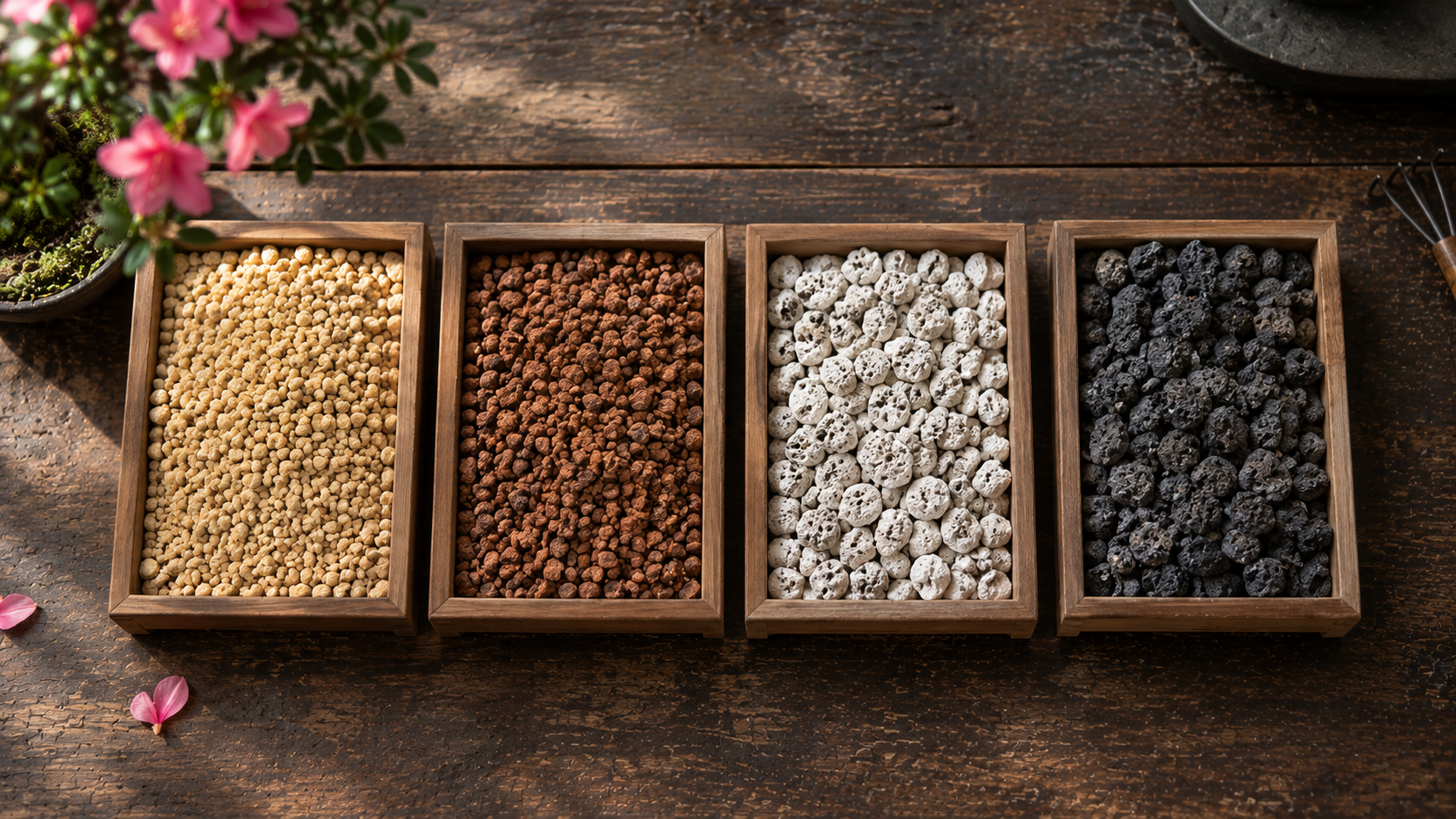
Most bonsai growers learn about akadama first. It’s the famous Japanese clay that appears in almost every soil mix you read about. But walk into a serious bonsai nursery in Japan and you’ll see bags of other soils stacked right next to it: pale yellow kanuma, rusty brown kiryu, white hyuga pumice, black volcanic rock.
Each one exists for a reason. Kanuma bonsai soil is the classic choice for satsuki azaleas. Kiryu drains fast and suits pines and junipers. Hyuga pumice adds air and lightness. Black lava rock gives structure that lasts for years.
The confusing part is knowing which one you actually need, and in what proportion. A mix that’s perfect for an azalea can be wrong for a pine. A soil that works in Japan’s humid summers may stay too wet in a cold, rainy climate.
In my experience, most people only need one or two of these beyond akadama, and the right choice depends almost entirely on the species they grow. This guide explains what each soil does, then compares six Japanese soils and mixes you can buy outside Japan, starting with kanuma.
Who this kanuma bonsai soil guide is NOT for
It’s not an akadama guide. Akadama has its own article: our akadama and Japanese bonsai soil guide compares the main brands.
It’s not for indoor tropical trees in potting compost. If your tree lives in a garden-center potting mix and you’re happy with it, this guide may be more than you need.
It’s not a fertilizer guide. These soils are mostly inorganic. Feeding is a separate topic.
Still with us? Let’s go.
How we picked these (3 things that actually matter)
1. What each soil does
Japanese bonsai soils aren’t interchangeable. Here’s the quick version.
- Kanuma is a soft, pale yellow, acidic volcanic soil. It holds water and air well and is the traditional soil for satsuki azaleas and other acid-loving plants. It’s usually described as darkening when wet, which helps you see when it needs watering.
- Kiryu is a harder, iron-rich granular soil. It drains freely and keeps its structure longer than akadama, which makes it popular for pines, junipers and other conifers.
- Hyuga pumice is a light Japanese pumice. It adds aeration and drainage while holding some water.
- Fuji rock (black lava) is a durable volcanic rock. It adds structure, drainage and aeration, and doesn’t break down.
2. Your species
This decides almost everything.
- Satsuki and other azaleas: kanuma, often on its own or as most of the mix.
- Pines and junipers: kiryu, pumice and lava, usually mixed with akadama.
- Deciduous trees: akadama-based mixes, sometimes with pumice and lava.
- Many other species: the common “equal thirds” mix of akadama, pumice and lava.
3. Grain size, dust and durability
Grain size should match the pot. Smaller particles (around 2–4 mm) suit shohin and small pots. Medium grains (about 3–6 mm) suit most bonsai. Larger grains suit big trees and the bottom drainage layer.
Dust matters too. Fine particles clog the gaps between grains and slow drainage. Sifting before use makes a real difference. Our bonsai soil sieve guide covers the tools.
And durability varies. Kanuma and akadama are softer and break down over time. Kiryu, pumice and lava last much longer.
A few soil habits that matter more than the brand
None of these cost anything.
- Sift everything. Remove dust before you repot.
- Match soil to species. Don’t put a pine in pure kanuma, or an azalea in pure lava.
- Use a coarser bottom layer. Many growers put larger particles at the bottom of the pot for drainage.
- Watch how fast the pot dries. Adjust the mix if it stays wet too long or dries out too quickly.
- Think about your climate. In wet, cold areas, a mix with more pumice and lava drains better. In hot, dry areas, more akadama or kanuma holds water longer.
- Store soil dry. Wet, frozen soil can break down in the bag.
Kanuma bonsai soil and other Japanese soils: comparison table
| Soil | Type | Best for | Bag size | Seller | Approx. price |
|---|---|---|---|---|---|
| Japanese Kanuma | Acidic volcanic soil | Satsuki, azaleas | 16 L | Bonsai Learning Center (US) | ~$45–69 |
| Kanuma (UK / Canada) | Acidic volcanic soil | Satsuki, azaleas | ~14–17 L | Herons, Canada Bonsai | ~£25 / CAD $42 |
| Kiryu | Iron-rich volcanic grit | Pines, junipers | 2 L | Bonsai Direct (UK) | ~£12 |
| Hyuga Pumice | Japanese pumice | Aeration in any mix | 18 L | Bonsai Learning Center (US) | ~$45–69 |
| Fuji Rock (Black Lava) | Volcanic rock | Structure, drainage | 18 L | Bonsai Learning Center (US) | ~$45–69 |
| Premium Japanese Mix | Akadama + Fuji rock + Hyuga | Ready-to-use mix | ~24–25 lb | Bonsai Learning Center (US) | ~$70–94 |
Prices are approximate, often include shipping in a price range, and vary by country and seller. Always check the current price before buying.
The 6 best Japanese bonsai soils beyond akadama, reviewed
1. Japanese Kanuma (Bonsai Learning Center) – the classic azalea soil in the US
If you grow satsuki azaleas in the US, this is the soil you’re looking for. Bonsai Learning Center sells Japanese kanuma in 16-liter bags, with shipped and local pickup options, priced at about $45–69 depending on the option.
The seller describes it as an excellent drainage component for bonsai soil, recommended for azaleas and other acid-loving plants. Kanuma’s natural acidity and its soft, water-holding structure are exactly why satsuki growers in Japan have used it for generations.
It was listed as out of stock when we checked, which is common for imported soils. Check back, or look at other US bonsai nurseries.
Pros
- Traditional Japanese soil for azaleas
- Acidic, which suits acid-loving plants
- Holds water and air well
- Shipping option available
Cons
- Stock is inconsistent
- Grain size not listed
- Softer than other soils, so breaks down over time
Best for: US satsuki and azalea growers.
Check Japanese Kanuma at Bonsai Learning Center
2. Kanuma from Herons and Canada Bonsai – best options outside the US
If you’re in the UK or Canada, kanuma is easier to find than you might think.
Herons Bonsai in the UK sells kanuma for around £25, in two grades: standard (3–6 mm) and large (6–11 mm). The listing describes the bag as approximately 14 liters, though the title says 17 liters, so confirm the size if it matters. Herons describes kanuma as great for acid-loving plants like azaleas and camellias, and useful as an additive in other mixes.
In Canada, Canada Bonsai sells 17-liter bags of 3–5 mm kanuma, describing it as the substrate to use for satsuki azaleas and for producing satsuki cuttings. It was listed at around CAD $42.
Neither listing states the country of origin, though kanuma is traditionally a Japanese soil.
Pros
- Easy to buy in the UK and Canada
- Two grain sizes at Herons
- Good for cuttings and azaleas
Cons
- Origin not stated
- Bag size wording inconsistent at Herons
Best for: UK and Canadian growers of azaleas and camellias.
Check Kanuma at Herons · Check Kanuma at Canada Bonsai
3. Kiryu (Bonsai Direct) – best for pines and junipers
Kiryu is the soil many conifer growers reach for. Bonsai Direct describes it as a natural granular material mined in Japan, formed from weathered volcanic deposits and rich in iron minerals.
It’s harder than akadama and keeps its structure longer. That’s why it’s popular for pines, junipers and other conifers that dislike soggy roots, and for older trees that are repotted less often. Bonsai Direct notes that it’s often mixed roughly 50/50 with akadama.
The 2-liter bag (around £12) is small, which makes it a good way to try kiryu before buying larger quantities.
Pros
- Mined in Japan
- Free-draining and long-lasting
- Ideal for conifers
- Small bag for trying it out
Cons
- 2-liter bag doesn’t go far
- Mainly available in the UK and Europe
Best for: pine and juniper growers.
4. Hyuga Pumice (Bonsai Learning Center) – best for lighter, airier mixes
Pumice is one of the most useful bonsai soil components, and Japanese hyuga pumice is a premium version. Bonsai Learning Center sells it in 18-liter bags for about $45–69.
The seller describes it as a drainage component that also retains water and provides good aeration. It’s usually mixed with akadama and lava to make a complete bonsai soil. Because it doesn’t break down like akadama or kanuma, it helps a mix keep its structure between repottings.
Pros
- Japanese pumice
- Adds aeration and drainage while holding some water
- Long-lasting
- Works with almost any species
Cons
- Not a complete soil on its own
- Grain size not listed
Best for: anyone building their own mix.
Check Hyuga Pumice at Bonsai Learning Center
5. Fuji Rock Black Lava (Bonsai Learning Center) – best for structure
Black lava rock gives a soil mix its backbone. Bonsai Learning Center sells Japanese Fuji Rock in 18-liter bags for about $45–69.
It’s described as a durable volcanic rock that adds aeration and drainage while holding some moisture, and that releases trace minerals and supports microbial life. Like pumice, it doesn’t break down, so it helps keep the mix open as akadama gradually softens. The seller says it’s typically mixed with akadama and pumice in equal thirds.
Pros
- Japanese volcanic rock
- Very durable
- Adds drainage and aeration
- Supports a long-lasting mix
Cons
- Heavier than pumice
- Grain size not listed
Best for: conifers and any mix that needs to stay open for years.
Check Fuji Rock at Bonsai Learning Center
6. Premium Japanese Mix (Bonsai Learning Center) – best ready-to-use option
Don’t want to buy three bags and mix them yourself? This is the shortcut.
Bonsai Learning Center’s Premium Japanese Mix is made from equal thirds of Double Line akadama, black Fuji rock and hyuga pumice. It’s hand-sifted through window screen to remove most of the dust, and the seller says it’s the same mix it uses on its own trees. A bag of around 24–25 pounds costs about $70–94.
The equal-thirds mix is a widely used all-purpose bonsai soil. It drains well, holds water and nutrients, and keeps its structure for a good while. It isn’t ideal for satsuki azaleas, which prefer kanuma, but it suits a wide range of other species.
Pros
- Ready to use, no mixing
- All Japanese components
- Pre-sifted
- Suits many species
Cons
- More expensive than mixing your own
- Not ideal for azaleas
Best for: growers who want a high-quality Japanese mix without the work.
Check the Premium Japanese Mix at Bonsai Learning Center
Which kanuma bonsai soil or mix should you buy? (By species)
Satsuki and other azaleas: kanuma. Many growers use it alone or as most of the mix. Many satsuki growers also top it with Japanese mountain moss to hold moisture at the surface.
Pines and junipers: kiryu mixed with akadama, or an akadama, pumice and lava mix.
Deciduous trees: an akadama-based mix, with some pumice and lava.
Most other species: the Premium Japanese Mix, or your own equal thirds of akadama, pumice and lava.
Cuttings of azaleas: small-grain kanuma.
Cold, wet climates: more pumice and lava, less akadama or kanuma.
Hot, dry climates: a little more akadama or kanuma to hold water.
Simple starting mixes
These are starting points, not rules. Adjust them to your trees and climate.
- Azalea mix: mostly kanuma, with a little pumice if you want faster drainage.
- Conifer mix: akadama and kiryu, roughly half and half.
- All-purpose mix: equal thirds akadama, pumice and lava.
Kanuma vs akadama: what’s the difference?
This is one of the most common questions, because the two look a little alike in the bag. Both are soft Japanese volcanic soils that hold water and air, and both gradually break down over time.
The main differences are color, acidity and use. Kanuma bonsai soil is pale yellow and noticeably acidic, which is why it’s the go-to soil for satsuki azaleas and other acid-loving plants. Akadama is reddish-brown, closer to neutral, and used across a much wider range of species.
In practice, that means kanuma is usually a specialist soil and akadama is a general one. If you grow mostly pines, maples and junipers, you may never need kanuma at all. If you grow satsuki, it’s likely to become the main soil on your bench.
A useful side benefit, often mentioned by azalea growers, is that kanuma visibly darkens when wet and lightens as it dries. That makes it easy to see at a glance which pots need water, which is helpful for azaleas that dislike drying out.
How to use kanuma and other Japanese soils when repotting
- Sift each soil. Remove dust and separate grain sizes.
- Mix in a tray. Combine components evenly before you start.
- Prepare the pot. Mesh over drainage holes and tie-down wire in place. Our bonsai repotting supplies guide lists everything.
- Add a coarse base layer.
- Position and tie in the tree.
- Fill and work in the soil with a chopstick.
- Water until it runs clear.
Common Japanese bonsai soil mistakes
Using kanuma for everything. It’s excellent for azaleas, but its acidity and softness don’t suit every tree.
Skipping sifting. Dust clogs the pot and slows drainage.
Ignoring climate. A mix that works in Japan may stay too wet in a cooler, rainier place.
Mixing grain sizes randomly. Similar-sized particles drain more evenly.
Leaving soil bags out in the rain and frost. Soft soils like kanuma and akadama can break down in the bag.
Conclusion: choose soil by species, then by climate
Akadama gets most of the attention, but Japanese bonsai soil is a whole family. Kanuma bonsai soil is the classic choice for satsuki azaleas. Kiryu suits pines and junipers. Hyuga pumice and Fuji lava rock keep any mix airy and durable.
For most growers, the simplest approach is this: kanuma for azaleas, kiryu or an akadama-pumice-lava mix for conifers, and the equal-thirds mix for almost everything else. If you’d rather not mix at all, a ready-made Japanese mix saves time.
Sift your soil, match it to your trees, and adjust for your climate.
Ready to repot? Check Japanese Kanuma at Bonsai Learning Center, or try the Premium Japanese Mix for an all-purpose option.
Leave a Reply