Affiliate disclosure: Some links on this page are affiliate links. If you buy through them, Aribonsai may earn a small commission at no extra cost to you. It doesn’t change what we recommend or how we rank anything. Wazakura has also given us a discount code for readers, which we share below.
Wiring looks simple until you try it
Wiring is the technique that turns a bush into a bonsai. A coil of wire around a branch lets you bend it, hold it there for a few weeks or months, and set a new shape. It’s one of the first real skills every grower learns.
Then you sit down to do it. You realize the wire you bought is the wrong thickness. Your kitchen scissors won’t cut it cleanly. Unwinding old wire tears off buds. And a branch you bent with confidence snaps at the base.
Most wiring problems come down to two things: technique, and having the wrong supplies. Technique takes practice. The supplies part is easy to fix, and much cheaper than most people think.
In my experience, beginners tend to overbuy in some areas and underbuy in others. They buy one big roll of a single thickness and no proper wire cutter, when what they really need is several small rolls and one good cutter.
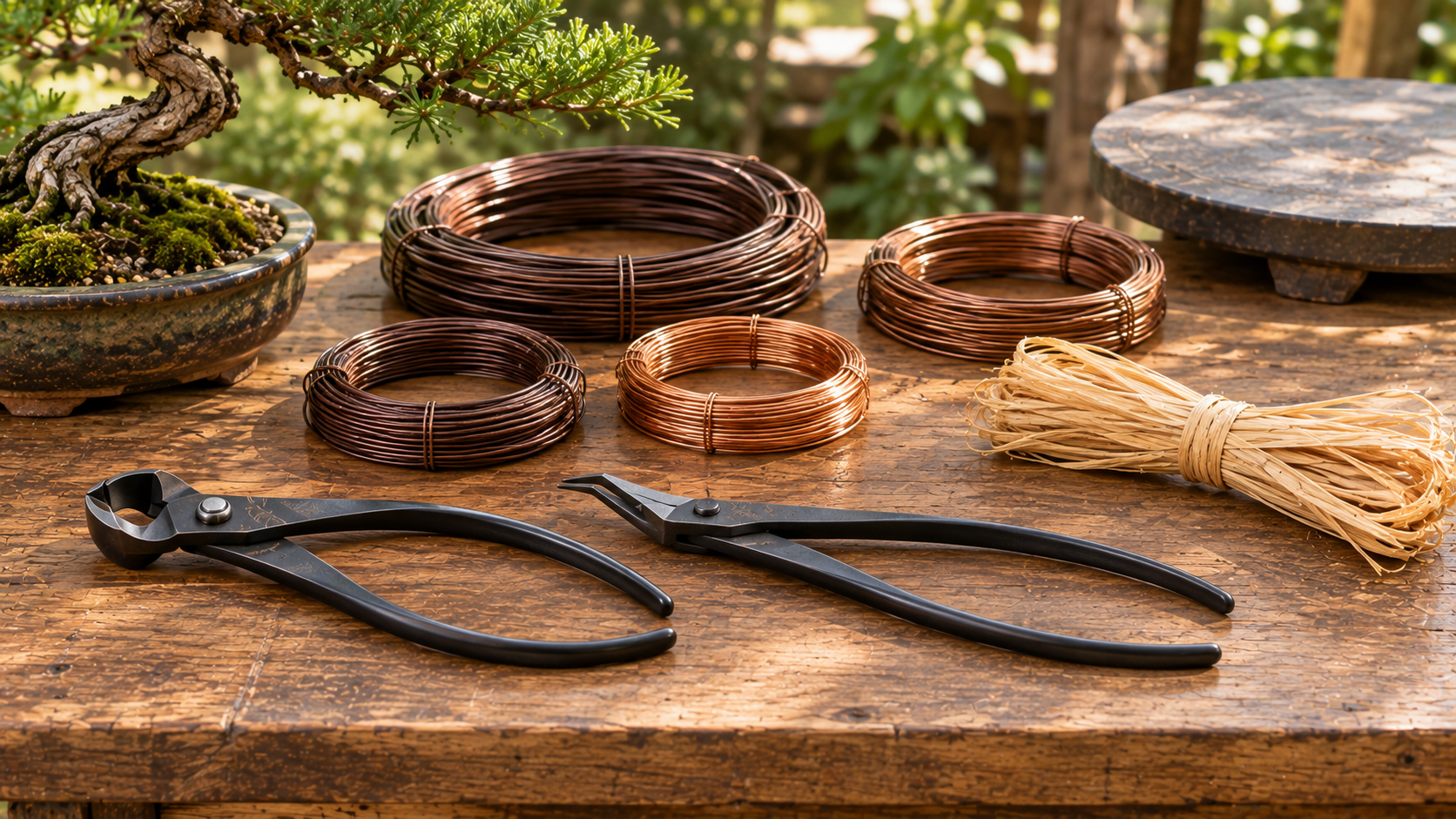
This guide covers the six things you need to wire a bonsai tree, from wire and cutters to raffia and a turntable, with clear picks at each step. It also covers what you can safely skip, and the basic technique to get started.
Who this bonsai wiring supplies guide is NOT for
It’s not a deep dive into any one product. We have separate guides for bonsai wire, wire cutters, jin pliers and raffia. This guide pulls them together into one kit.
It’s not an advanced styling course. We cover the basics of technique, not advanced design.
It’s not for heavy trunk bending. For that, you’ll need jacks or splitters, which we mention briefly at the end.
Still with us? Let’s go.
How we picked these (3 things that actually matter)
1. Does it solve a real wiring problem?
Every item here does a specific job: shaping branches, cutting wire safely, protecting branches during big bends, or making the work easier. No gadgets.
2. The right size and gauge
Wire is useless if it’s the wrong thickness. Tools are awkward if they’re the wrong size. Eastern Leaf’s wiring guide suggests wire about “1/3 the size of the branch,” and Bonsai4me gives the same one-third rule, noting that copper holds well at thinner gauges while aluminum needs to be thicker. For aluminum specifically, Eastern Leaf has suggested 1/3 to 1/2 the branch thickness.
3. Value for a beginner kit
Most wiring supplies are inexpensive. The one place it’s worth spending a little more is the wire cutter, because it protects the tree when you remove wire.
A few wiring habits that matter more than the supplies
None of these cost anything.
- Let the tree dry out a little first. Eastern Leaf notes that freshly watered branches are more likely to break when bent, and suggests letting the tree dry for a day.
- Wire at about 45 degrees. Both Eastern Leaf and Bonsai4me recommend roughly a 45-degree angle to the branch.
- Anchor the wire well. Eastern Leaf suggests using one wire to hold two branches, anchored around the trunk.
- Cut wire off, don’t unwind it. Bonsai4me says unwinding can dislodge buds, tear leaves or break branches.
- Check for wire biting in. On fast-growing trees, check every few days.
Bonsai wiring supplies comparison table
| Item | Our pick | Approx. price | Essential? |
|---|---|---|---|
| Aluminum wire | Eastern Leaf 500g rolls / Wazakura 150g rolls | ~$19.95 / ~$19.99 | Yes |
| Copper wire | Wazakura annealed copper, 300g | ~$29.99 | Optional (conifers) |
| Wire cutter | Wazakura Hand Forged Wire Cutter | ~$55.99 | Yes |
| Jin pliers | Wazakura Wire & Jin Pliers | ~$45.99 | Very useful |
| Raffia | Natural raffia (Bonsai Plaza, Herons, Bonsai Mirai) | ~€4.30–£5 per bundle | For big bends |
| Turntable | Eastern Leaf 12″ round / Kaneshin KURUKURU | ~$65 / ~¥2,800 | Nice to have |
Prices are approximate, from when we checked between September and November, and change often. Use code ARIBONSAI for 10% off at Wazakura.
The 6 bonsai wiring supplies, reviewed
1. Aluminum wire – the essential starting point
Every grower should start with aluminum wire. It’s soft, easy to bend and forgiving if you need to reposition.
Eastern Leaf aluminum wire comes in 500g rolls for $19.95 each, in sizes including 1.0mm, 1.5mm, 3.0mm, 3.5mm, 4.0mm and 4.5mm. The 1.5mm roll is about 350 feet. The listing states the country of origin as China. It’s good, inexpensive bulk wire for US buyers.
Wazakura brown aluminum wire comes in 150g rolls for $19.99, in sizes from 1mm to 6mm, listed in Wazakura’s “Made in Japan” training wire collection. Brown blends in with bark, and smaller rolls are a good way to try several sizes. There’s also a black version.
Bonsai4me suggests starting with 1mm, 1.5mm, 2.5mm and 4mm reels. That’s a sensible first set for most trees.
Pros
- Easy for beginners
- Inexpensive
- Can be repositioned
Cons
- Needs to be thicker than copper
- Bulk rolls of one size can be wasteful
Best for: everyone, especially beginners and deciduous trees.
Check Eastern Leaf aluminum wire · Check Wazakura training wire
2. Copper wire – for conifers, once you’re confident
Copper holds more firmly than aluminum at thinner gauges, which is why it’s traditionally used on pines and junipers. Bonsai4me notes that copper holds more firmly but is harder to apply, and that it can’t be reused.
Wazakura annealed copper wire is made by artisans in Sanjo, Niigata, according to the store. It comes in 1.2mm (about 95 feet per 300g) and 1.6mm (about 52.5 feet per 300g) at $29.99 per roll. Wazakura says it fades to a dull brown that blends with bark.
Only two sizes are offered, both on the thin side, so it suits fine work on conifers.
Pros
- Holds well at thin gauges
- Fades to a natural color
- Japanese-made
Cons
- Harder for beginners
- Not reusable
- Only two sizes
Best for: fine wiring on pines and junipers.
3. Wire cutter – the one tool worth paying for
A dedicated bonsai wire cutter is the most important wiring tool. It has rounded jaws that cut wire close to the bark without damaging it, which is essential when you remove wire turn by turn.
Bonsai4me notes that ordinary wire cutters can work if you cut with the very ends of the jaws. But a proper bonsai wire cutter makes it much easier to avoid nicking the branch.
Wazakura’s Hand Forged Bonsai Wire Cutter is S55C carbon steel with a black coating, 195mm long with a 12mm blade, 220g, at $55.99. Reviewers mention it handles up to roughly gauge 4 copper wire comfortably. It was the cheapest dedicated Japanese wire cutter in our wire cutter guide. If you want a well-known alternative, Bonsai Outlet lists Kaneshin’s No. 511 at $67.95.
Pros
- Protects bark when removing wire
- Japanese-made at a fair price
- Also sold as a set with pliers
Cons
- Carbon steel needs oiling
- Only one size
Best for: anyone who wires trees regularly.
Check the Wazakura Wire Cutter
4. Jin pliers – for tightening, unwinding and deadwood
Jin pliers help you bend wire ends, tighten coils, pull wire into place and remove stubborn wire. They’re also used for stripping bark on deadwood.
Wazakura’s Hand Forged Wire & Jin Pliers are S55C carbon steel with a black coating, 210mm long and 230g, for $45.99. Wazakura describes them as for shaping training wire, styling and safely removing wire, with rounded ends to protect the tree. Our jin pliers guide compares more options, including Kaneshin.
Pros
- Makes wiring neater and faster
- Useful for deadwood work
- Good all-round size
Cons
- Not strictly essential for your first wiring session
- Carbon steel needs care
Best for: anyone wiring more than a few trees.
Check the Wazakura Wire & Jin Pliers
5. Raffia – protection for bigger bends
For ordinary branch wiring, you don’t need raffia. But for big bends on thick branches, it’s very helpful.
Raffia is natural palm fiber. Bonsai Mirai notes that it provides compression and protection while still letting oxygen move through to the tree’s vascular system. Bonsai Plaza recommends soaking raffia for a couple of hours, wrapping it firmly in overlapping turns, and applying it before wire, clamps or guy wires, especially for heavy bending or older, thicker branches.
Options include Bonsai Plaza natural raffia in 50g bundles for about €4.30, Herons natural raffia for about £5, and Bonsai Mirai raffia, which Mirai describes as the widest, longest and most consistent available. Our bonsai raffia guide covers all of these.
Pros
- Protects branches during big bends
- Inexpensive
- Breathable natural fiber
Cons
- Only needed for heavy bends
- Needs soaking first
Best for: bending thick or older branches.
Check Natural Raffia at Bonsai Plaza
6. Turntable – the comfort upgrade
A turntable isn’t essential, but wiring involves working on every side of a tree. Being able to rotate it easily makes the job faster and more comfortable.
Eastern Leaf sells a 12″ round turntable for $65, listed as made in Japan, rated for up to 150 lb and weather-resistant. In Japan, Kaneshin’s KURUKURU Circle Turntable No.1477 is about ¥2,800, 29.5cm across and rated for around 40–50kg, though international shipping on bulky items can add a lot.
Pros
- Makes wiring faster and easier
- Doubles as a stand
- Useful for rotating trees toward the sun
Cons
- Not essential
- Shipping can be expensive from Japan
Best for: growers who wire regularly or have larger trees.
Search bonsai turntables on Amazon
Which wiring supplies should you buy? (By situation)
You’re wiring for the first time: aluminum wire in three or four sizes, plus a wire cutter.
You’ve wired a few trees and want to be neater: add jin pliers.
You grow pines or junipers: add copper wire once you’re comfortable.
You’re making big bends on thick branches: add raffia.
You wire a lot of trees: add a turntable.
A simple starter kit
- Aluminum wire: 1mm, 1.5mm, 2.5mm and 4mm
- Wazakura Wire Cutter ($55.99)
- Wazakura Wire & Jin Pliers ($45.99)
That’s a complete, practical wiring kit. With the ARIBONSAI code, you get 10% off the Wazakura tools and wire.
What you can skip
Huge rolls of one size. You’ll need several sizes, not a kilogram of one.
Cheap plastic-handled “bonsai kits.” The wire cutters in them often don’t cut cleanly.
Copper wire as a beginner. Start with aluminum.
Raffia for everyday wiring. It’s only needed for heavy bends.
Basic wiring technique in 7 steps
- Let the tree dry slightly for a day before wiring, as Eastern Leaf suggests, so branches are less brittle.
- Choose wire about one-third the thickness of the branch.
- Anchor the wire around the trunk, or use one wire for two branches.
- Wrap at about 45 degrees, from the base of the branch to the tip.
- Finish with a final turn, leaving the end pointing up so the wire doesn’t slip.
- Bend gently to the new position.
- Check regularly, and cut off the wire before it bites in.
How long to leave wire on
It depends on the tree and the season. Bonsai4me says deciduous branches wired in spring or summer may set in two to three weeks, while autumn or winter wiring can take months, and conifers often need wire over winter. Eastern Leaf says that after a few months the wire sets and can be removed, and sooner if the tree grows around the wire.
A quick wire size guide
Using the one-third rule as a starting point, here’s roughly what that looks like in practice:
| Branch thickness | Wire (about 1/3) |
|---|---|
| 3mm | 1mm |
| 4.5mm | 1.5mm |
| 7.5mm | 2.5mm |
| 12mm | 4mm |
These match the 1mm, 1.5mm, 2.5mm and 4mm starter set Bonsai4me suggests. Remember that aluminum may need to be a little thicker than this, and copper can often be a little thinner. The real test is simple: if the branch springs back after you bend it, go up a size.
When to wire
Timing matters as much as the supplies. Bonsai4me suggests:
- Deciduous trees: autumn after leaf fall works well in warmer climates, as does midsummer after defoliation.
- Conifers: late midsummer to early autumn.
- Winter: protect wired trees from frost below about -10°C.
It also notes a practical point about anchoring: the author avoids anchoring wire into the soil and roots, since the wire can loosen and disturb them, and keeps the coil above the soil unless the base of the trunk needs to move.
In my experience, the best time to wire is simply when you have an unhurried hour. Rushed wiring is where most broken branches come from.
When you need more than wire
Some branches and trunks are too thick for wire alone. For those, growers use bending jacks, trunk splitters and guy wires. For example, Bonsai Tonight sells the Kikuwa Bonsai Jack (small) at around $125. Our bonsai branch bender guide covers these tools.
Common wiring mistakes
Using wire that’s too thin. The branch won’t hold.
Wiring right after watering. Branches are more likely to snap.
Unwinding wire instead of cutting it. It can damage buds and bark.
Leaving wire on too long. It can bite in and scar the branch.
Crossing wires. Plan the route to keep it neat.
Buying only one wire size. Different branches need different thicknesses, so a few small rolls beat one big one.
Skipping the wire cutter. Kitchen scissors and household pliers make it much harder to remove wire without damaging the bark.
Conclusion: a small kit goes a long way
You don’t need much to wire a bonsai well. A few sizes of aluminum wire and a proper wire cutter cover the essentials. Jin pliers make the work neater, copper suits conifers once you’re confident, raffia protects big bends, and a turntable makes everything more comfortable.
Start small, wire at about 45 degrees, check often, and cut the wire off before it bites in.
Ready to start wiring? Shop Wazakura wiring tools and wire → and use code ARIBONSAI for 10% off, or check the Wazakura Wire Cutter →.