Affiliate disclosure: Some links on this page are affiliate links. If you buy through them, Aribonsai may earn a small commission at no extra cost to you. It doesn’t change what we recommend or how we rank anything.
The wire you buy decides how the branch ends up
Most people spend a lot of time choosing wiring tools and almost none choosing the wire.
Then they wire a branch, bend it into position, and come back the next morning to find it’s sprung halfway back. Or they use wire so thick it looks like scaffolding. Or they use copper for the first time, try to adjust a bend, and find the wire has stiffened and won’t move the way it did a minute ago.
Wire seems like a simple consumable. In practice, the type and thickness you choose decide whether a branch holds its new shape, how much the wire shows, and how easy it is to correct mistakes.
The good news is that the decision is fairly simple once you understand two things: the difference between aluminum and copper, and how to pick the right thickness. That’s what this guide is mostly about. Then we compare five wires you can actually buy, including Japanese-made options and one practical budget pick.
In my experience, most beginners would get better results if they bought fewer tools and a better selection of wire sizes.
Who this article is NOT for
It’s not for you if you’re looking for guy wire or anchoring wire. This guide is about training wire that wraps around branches. Wire for tying trees into pots or pulling branches down with anchors is a separate topic.
It’s not a full wiring tutorial. We’ll cover choosing wire and some basic rules of thumb. How to wrap a branch well takes practice, and there are good video tutorials for that.
It’s not for you if you never wire. Some growers style mostly by pruning (“clip and grow”). That works, and if it’s your approach, wire isn’t a priority.
Still here? Let’s get into it.
How we picked these (3 things that actually matter)
1. Aluminum or copper
This is the main choice, and it depends on your trees and your experience.
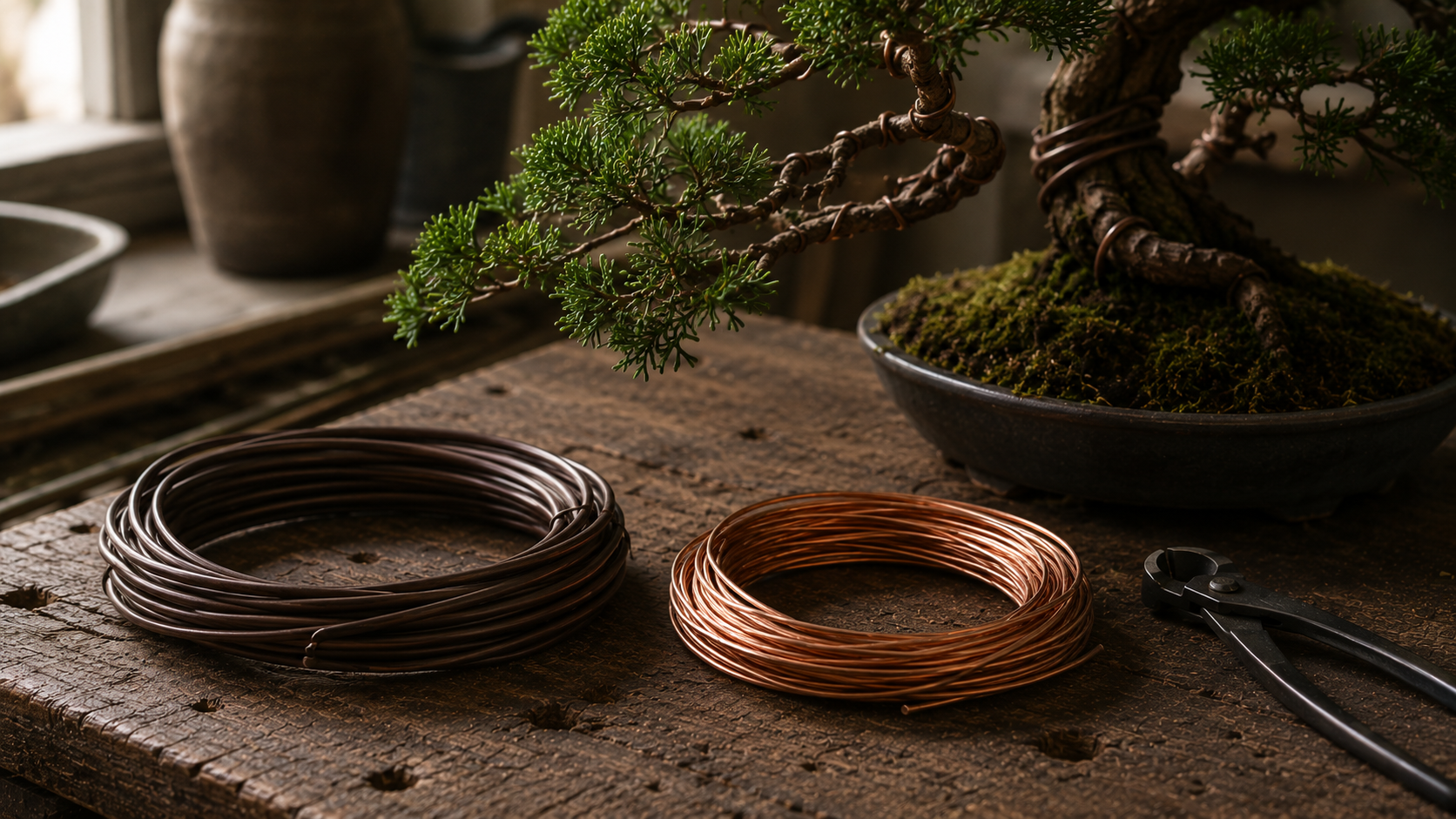
Aluminum wire is soft and easy to bend. You can adjust it, unwind it and rewrap it without much trouble. It doesn’t hold as strongly as copper for the same thickness, so you generally need thicker aluminum to hold a branch. It’s the standard choice for beginners, and for deciduous and tropical trees. Anodized aluminum often comes in brown or black so it blends with the bark.
Annealed copper wire has been heat-treated to make it soft enough to wrap. Once you bend it, it stiffens up, which is why it holds so well. That also makes it harder to reposition. One UK retailer calls copper “the preferred choice of bonsai professionals when wiring coniferous species,” but also warns that it’s “more difficult to reposition than aluminium wire and therefore not recommended for beginners.” Because it holds better for its thickness, you can use thinner copper, which shows less on a finished tree. Wazakura notes that its copper wire fades to a dull brown that blends with bark.
A simple way to decide: start with aluminum. Move to copper when you’re working on conifers and are confident with your wiring.
2. Thickness (gauge)
Too thin and the branch won’t hold. Too thick and it’s hard to wrap neatly, looks heavy, and can damage bark.
The rules of thumb differ by material:
- For aluminum, Eastern Leaf suggests wire about 1/3 to 1/2 the thickness of the branch.
- For copper, Wazakura suggests about 1/3 of the branch thickness, and a UK retailer suggests about 1/4.
So copper is generally used thinner than aluminum for the same branch. These are starting points, not exact rules. The real test is whether the branch holds after you bend it.
Most people need several sizes. A small tree might use 1mm, 1.5mm and 2mm. A larger tree might need 2.5mm to 4mm for the main branches. Buying a few sizes is more useful than a lot of one size.
3. Price per length and where it comes from
Wire is sold by weight, which can be misleading. Copper is much denser than aluminum, so a 300g roll of copper is a lot shorter than a 500g roll of aluminum. For example, Wazakura’s 300g roll of 1.2mm copper is about 95 feet, while Eastern Leaf’s 500g roll of 1.5mm aluminum is about 350 feet.
Origin is worth checking too. Some well-known wires are made in Japan. Plenty of good, cheap aluminum wire is made elsewhere. We include both and label them clearly.
A few habits that matter as much as the wire. These apply whichever wire you buy.
- Test the size before you wrap. Bend a short piece of wire alongside the branch you’re about to wire. If the wire feels flimsy next to it, go up a size. If it’s hard to bend by hand, go down.
- Keep a range of sizes in reach. Most trees need several thicknesses, from thick wire on the main branches to thin wire on the tips. Having them all on the bench saves you from “making do” with the wrong size.
- Store copper carefully. Annealed copper starts to stiffen as it’s bent and handled. Keep rolls coiled and don’t straighten more than you need for the branch you’re working on.
- Unwind rather than rip. When wire comes off, cutting it into short pieces or unwinding it carefully is far kinder to the bark than pulling it off in one go.
- Write down when you wired. A quick note or a photo with the date helps you remember to check for wire cutting in, especially in spring and summer when branches thicken quickly.
Prices below are approximate and were checked in October 2026. Yen prices are from Japanese stores before international shipping.
Comparison table
| Wire | Material | Sizes | Roll | Approx. price | Best for |
|---|---|---|---|---|---|
| Wazakura Brown Aluminum Wire | Aluminum, brown | 1–6mm | 150g | ~$20 | Small trees, Japanese option |
| Wazakura Annealed Copper Wire | Annealed copper, made in Sanjo, Japan | 1.2mm, 1.6mm | 300g (about 95 ft at 1.2mm) | ~$30 | Fine conifer work |
| Kaneshin Aluminum Wire | Aluminum | 0.8–5mm | 100g / 500g / 1kg | ~¥1,100 per 100g (most sizes) | Buying many sizes in small amounts |
| Kaneshin Copper Wire | Copper | 0.5–4mm (1kg) | 1kg / 2kg | ~¥9,600 (1kg) / ~¥18,500 (2kg) | Serious conifer wiring |
| Eastern Leaf Aluminum Wire | Aluminum, made in China | 1–4.5mm | 500g (about 350 ft at 1.5mm) | ~$20 per roll | Budget bulk wire, US buyers |
Individual reviews
1. Wazakura Brown Aluminum Bonsai Training Wire (150g)
A small roll of brown aluminum wire from Wazakura, the same Japan-based store we’ve recommended for tools. It’s listed in Wazakura’s “Made in Japan” training wire collection, in sizes from 1mm to 6mm, at $19.99 for 150g. There’s also a black version.
At 150g, this is a small roll. That’s fine if you have a few small trees, but it gets expensive per meter for larger work. When we checked, Wazakura’s wire collection was showing as sold out, so check stock before planning around it.
Pros
- Brown color blends with bark
- Wide range of sizes from 1mm to 6mm
- Convenient to add to a Wazakura tool order
- Small rolls are good for trying several sizes
Cons
- Small roll for the price
- Stock can run out
- Expensive per meter compared to bulk rolls
Who it’s for: Growers with a few small trees who want Japanese wire in a range of sizes. It’s also a handy top-up when you only need a little of one thickness.
2. Wazakura Annealed Copper Bonsai Training Wire (300g)
Wazakura’s copper wire is annealed and, according to the store, made by artisans in Sanjo, Niigata. It comes in 1.2mm (about 95 feet per 300g) and 1.6mm (about 52.5 feet per 300g), at $29.99 per roll. Free shipping to the US, Canada, the UK and Hong Kong is listed.
Wazakura describes it as better suited to thick branches and trunk shaping than aluminum, and says it fades to a dull brown that blends with bark.
Only two sizes are offered, both on the thin side. That makes it a good fit for fine branches on conifers, but you’ll need another source for thicker copper.
Pros
- Japanese-made annealed copper
- Holds well at thin sizes, so it shows less
- Fades to a natural brown
- Free shipping to several regions
Cons
- Only two sizes, both fairly thin
- Short roll length for the price
- Copper is harder to reposition, so not ideal for beginners
If you’ve never used copper before, this is a sensible way to try it. A single roll in one of the thinner sizes is enough to wire a few fine branches and get a feel for how differently it behaves from aluminum. You’ll notice quickly that you need to get the bend right the first time.
Who it’s for: Growers moving to copper for fine work on pines and junipers.
3. Kaneshin Aluminum Wire (100g / 500g / 1kg)
Kaneshin, the tool maker based in Seki, Gifu, also sells aluminum wire through its Japanese online store.
The 100g rolls come in sizes from 0.8mm to 5mm. Most sizes are about ¥1,100 per 100g, with 0.8mm at about ¥1,600. Larger 500g and 1kg rolls are also listed. The store notes that some larger sizes will stop being sold once current stock runs out.
The 100g option is the useful part. It’s an inexpensive way to get several sizes without committing to big rolls of each.
In my experience, a set of small rolls in four or five sizes teaches you more about wiring than one big roll of a single size. You learn what each thickness can actually hold.
Pros
- Very wide size range, including 0.8mm
- Small 100g rolls make it easy to collect several sizes
- Larger rolls available once you know what you use most
- From a well-known Japanese tool maker
Cons
- Shipping from Japan adds cost, especially for small orders
- Color isn’t specified on the listing
- Some large sizes are being discontinued
Who it’s for: Anyone who wants a range of aluminum sizes and is already ordering from Kaneshin’s store. Adding a handful of 100g rolls to a tool order is an easy way to spread the shipping cost.
4. Kaneshin Copper Wire (1kg / 2kg)
The serious copper option.
Kaneshin sells copper wire in 1kg rolls in 16 sizes from 0.5mm to 4.0mm, and 2kg rolls in 12 sizes from 0.9mm to 4.0mm. Every 1kg roll is about ¥9,600, and every 2kg roll about ¥18,500, regardless of thickness. The listing doesn’t say whether the wire is annealed, so check with the seller if that matters for your work.
This is a lot of wire. A 1kg roll is more than most hobbyists need of any single size, so it makes the most sense if you wire a lot of conifers or work with larger trees.
Pros
- Huge range of sizes, from very fine to thick
- Good value per kilogram
- Large rolls for growers who wire a lot
Cons
- Large commitment per size
- Annealing isn’t stated on the listing
- Heavy to ship internationally
Who it’s for: Experienced growers who wire conifers regularly and know which sizes they use most. If you share wire with a club or a friend, splitting a roll is a good way to get the bulk price without a kilo of each size.
5. Eastern Leaf Aluminum Bonsai Wire (500g)
The practical budget pick, and the only non-Japanese wire on this list.
Eastern Leaf sells 500g rolls of aluminum wire for $19.95 each, in sizes including 1.0mm, 1.5mm, 3.0mm, 3.5mm, 4.0mm and 4.5mm. The 1.5mm roll is about 350 feet. The listing states the country of origin as China.
We’re including it because, for a lot of growers, wire is a consumable that gets used up quickly, and buying it locally in big rolls makes sense. It’s roughly the same price as Wazakura’s 150g roll, but over three times the weight.
Pros
- Much more wire for the money
- Easy to buy in the US without international shipping
- Several useful sizes
- Good for practice and everyday wiring
Cons
- Not made in Japan
- Large rolls are a lot of any single size
- Color isn’t specified on the listing
Wire is one place where “made in Japan” matters less than with tools. A cutter’s steel and heat treatment make a real difference. A roll of aluminum wire mostly needs to bend smoothly and hold its shape. If a cheaper roll does that for your trees, it’s a perfectly good choice.
Who it’s for: US growers who wire a lot and want affordable bulk aluminum.
Recommendation by use case
“I’m new to wiring.” Aluminum. Kaneshin 100g rolls in several sizes, or Eastern Leaf 500g rolls if you’re in the US.
“I wire pines and junipers and want the wire to show less.” Copper. Wazakura copper for fine branches, Kaneshin copper for a full range of sizes.
“I want Japanese-made wire specifically.” Wazakura (aluminum or copper) or Kaneshin.
“I wire a lot and want the best value.” Eastern Leaf 500g aluminum, or Kaneshin 1kg copper if you work with conifers.
“I just want to try a few sizes before committing.” Kaneshin 100g aluminum rolls.
Conclusion: start with aluminum, collect sizes, then add copper
Here’s the short version.
Start with aluminum in several sizes. It’s forgiving, easy to adjust and cheap, which is exactly what you want while you’re still learning. Learn what each size can hold. Once you’re comfortable and working on conifers, add copper for the branches where you want thinner, less visible wire with a stronger hold.
Whatever you use, check your wire regularly. As branches thicken, wire can start to cut into the bark. Removing it before that happens is much easier than fixing the scars afterward.
You’ll also want the right tools at the end of each session. Our wire cutter guide covers cutting wire off cleanly, and our jin pliers guide covers twisting and unwinding it.
Ready to stock up?