Affiliate disclosure: Some links on this page are affiliate links. If you buy through them, Aribonsai may earn a small commission at no extra cost to you. It doesn’t change what we recommend or how we rank anything.
The quiet layer behind every dramatic bend
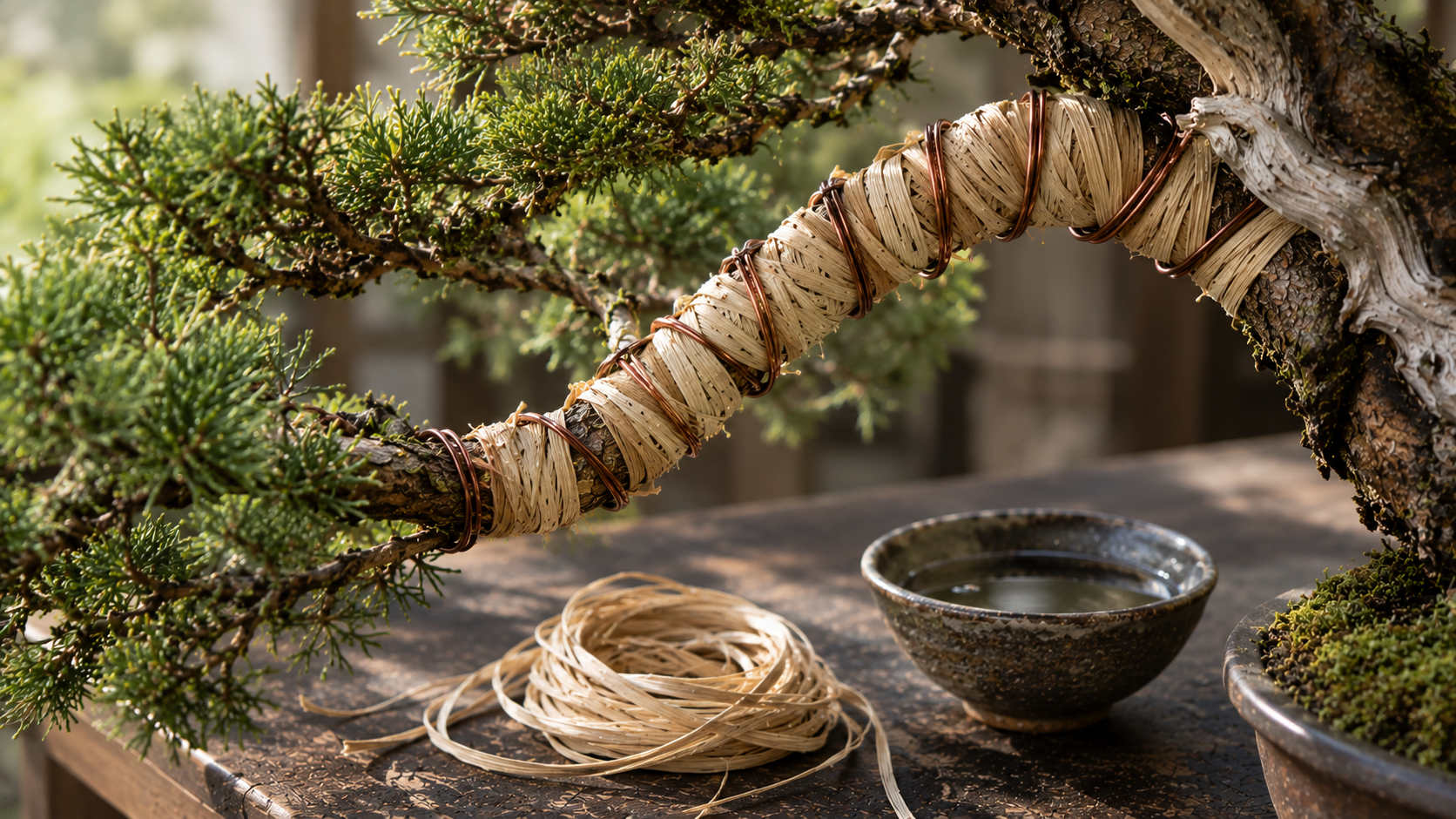
Watch a professional bonsai artist make a big bend on an old juniper and you’ll notice something before the wire even goes on. They wrap the branch, round and round, in pale strips of what looks like dried grass.
That’s bonsai raffia. It’s one of the cheapest supplies in bonsai, and one of the most important for heavy work.
Raffia does two jobs. It compresses the branch, holding the outer wood and bark together so they’re less likely to split when you bend. And it protects the bark from the wire, clamps and guy wires that go on top. When a big bend goes wrong, it’s often because the branch wasn’t supported well enough before the force was applied.
The confusing part is that “raffia” covers a lot of products. There’s bonsai-specific raffia, garden raffia, craft-store raffia, and a whole range of alternatives people swear by: electrical tape, vet wrap, nylon cord. Some work well. Some leave sticky residue on your bark for a year.
In my experience, most beginners skip raffia entirely, then wonder why a branch cracked during a bend that looked easy. This guide explains what matters, then compares six bonsai raffia options and alternatives, from premium bonsai raffia to the wraps experienced growers use on top of it.
Who this bonsai raffia guide is NOT for
It’s not for light wiring. Thin branches that bend easily with wire alone don’t usually need raffia.
It’s not a wiring guide. Wire choice and gauges have their own article: our bonsai wire guide covers aluminum and copper.
It’s not about decorative raffia. Gift-wrapping and craft raffia in bright colors is a different use, although natural craft raffia can work for bonsai, as we’ll see.
Still with us? Let’s go.
How we picked these (3 things that actually matter)
1. Strand length and width
This matters more than people expect.
Longer, wider strands cover more of the branch in one pass and need fewer joins. On a thick trunk, short strands mean constant splicing, which is slow and creates weak points. Bonsai forum members note that craft-store raffia often has shorter strands than bonsai-specific raffia, which means more knots and more joining.
2. Natural fiber that breathes
Natural raffia is made from palm leaf fiber. Once soaked, it’s flexible enough to wrap tightly around a branch. As it dries, it tightens and grips.
Bonsai Mirai makes an important point about why natural raffia is preferred: unlike electrical tape or horse wrap, it lets oxygen move through so the tree’s vascular system keeps working. Raffia also breaks down over time rather than strangling the branch.
3. Grip and how easy it is to remove
Wet raffia that dries on the branch grips tightly. That’s what you want for support. But it also makes it harder to remove later. Some growers wrap electrical tape over raffia to keep it moist and hold everything together, while others leave it exposed.
You’ll eventually remove raffia once the bend has set, so think about that when you wrap.
A few raffia habits that matter more than the product
None of these cost anything.
- Soak it first. Retailers and experienced growers recommend soaking raffia in water before use, from around 20 minutes to a couple of hours, so it’s flexible and won’t snap when pulled tight.
- Wrap tightly, with overlap. Each turn should overlap the last, covering the whole area you’ll bend.
- Use several layers for big bends. Thick branches often get two or more layers.
- Wrap before you wire. Raffia goes on first, then wire, clamps or guy wires on top.
- Keep it away from new buds. Leave growth points uncovered where you can.
- Bend in the right season. Many growers avoid heavy bending in summer and prefer late winter or early spring.
- Remove it once the bend holds. Leaving it on forever can hide problems in the bark.
Bonsai raffia comparison table
| Product | Type | Best for | Size | Seller | Approx. price |
|---|---|---|---|---|---|
| Bonsai Mirai Raffia | Premium bonsai raffia | Big bends, professional work | Not stated | Bonsai Mirai | Check price |
| Herons Natural Raffia (Cream) | Natural raffia | UK growers | Not stated | Herons | ~£5 (UK) |
| Bonsai Plaza Natural Raffia | Natural raffia | EU growers | 50 g | Bonsai Plaza | ~€4.30 (EU) |
| Natural craft raffia | Natural raffia | Budget, light work | Varies | Craft stores, Amazon | Low |
| Electrical tape | Outer wrap | Holding raffia moist and in place | Rolls | Hardware stores | Low |
| Vet wrap | Self-adhesive wrap | Experiments only | Rolls | Farm stores | Low |
Prices are approximate and vary by seller. Always check the current price before buying.
The 6 best bonsai raffia options, reviewed
1. Bonsai Mirai Raffia – the premium choice for big bends
Bonsai Mirai, the well-known Oregon bonsai studio, sells its own raffia. It describes it as the widest, longest and most consistent raffia available, and says it constantly searches for and tests the highest-quality raffia for its trees.
Mirai calls raffia essential for major design work on many bonsai species, because it provides compression and protection while still letting oxygen move through to the tree’s vascular system.
The listing doesn’t give a size or price, so check the shop directly. But if you’re working on a large juniper or pine and making serious bends, long, wide, consistent strands save a lot of time and splicing.
Pros
- Long, wide, consistent strands
- Chosen by a professional bonsai studio
- Fewer joins on thick branches
Cons
- Price and size not listed on the page
- More expensive than craft raffia
Best for: serious growers doing heavy bends on large trees.
2. Herons Natural Raffia (Cream) – the simple UK option
Herons Bonsai sells natural raffia in cream for around £5. It’s described as a protective wrap: wrapping raffia around a branch before you put wire on can help protect the branch.
The listing is short, without weight or origin details, but at this price it’s an easy add-on to any order. Herons also includes 50 g of raffia in its large branch bending kit, alongside a bender, clamp, trunk splitter and heavy wire.
Pros
- Inexpensive
- Sold by an established UK bonsai nursery
- Easy to add to a tool or soil order
Cons
- Weight and origin not stated
- Mainly available in the UK
Best for: UK growers who need raffia for occasional bends.
Check Natural Raffia at Herons
3. Bonsai Plaza Natural Raffia – the best-documented budget pick
Bonsai Plaza’s natural raffia comes in 50 g bundles for around €4.30, and its listing has clearer instructions than most.
It recommends soaking the raffia in water for a couple of hours so it can be pulled tight without breaking, then wrapping it firmly around the branch or trunk in overlapping turns before bending. It also says raffia should go on before wire, clamps or guy wires, especially for heavier bending, brittle material, or older, thicker branches.
The product is unbranded, and origin isn’t stated. But for European growers, it’s an inexpensive and well-explained option.
Pros
- Clear usage instructions
- Inexpensive 50 g bundles
- Good for EU buyers
Cons
- Unbranded, origin not stated
- Strand length not listed
Best for: European growers who want an affordable, reliable bundle.
Check Natural Raffia at Bonsai Plaza
4. Natural craft raffia – the budget workaround
You don’t always need bonsai-branded raffia. On bonsai forums, growers say craft-store raffia and bonsai-specific raffia are largely interchangeable, and some use both.
The main difference is strand length. Craft raffia tends to have shorter strands, so you’ll make more joins on a thick branch. Make sure you buy natural raffia, not synthetic or colored decorative ribbon. US bonsai retailers also sell raffia at modest prices, so compare before buying lots of small craft bundles, which can add up.
Pros
- Cheap and easy to find
- Works well for small and medium branches
- Good for practice
Cons
- Shorter strands mean more joins
- Quality varies a lot
- Avoid synthetic or dyed versions
Best for: beginners, practice bends, and small to medium branches.
Search natural raffia on Amazon
5. Electrical tape – the outer layer that holds it all together
Electrical tape isn’t a replacement for raffia, but many experienced growers use it alongside it.
On bonsai forums, a common method is to wrap the branch in raffia, then cover the raffia with electrical tape. The tape holds everything in place and helps keep the raffia moist. Some growers add aluminum or copper wire under the tape for extra support. One suggestion is to leave small gaps in the tape so you can rewet the raffia underneath.
The downside is that a taped branch looks black and untidy for a while, and tape doesn’t breathe the way raffia does, which is exactly why Mirai recommends raffia as the layer against the bark.
Pros
- Holds raffia tightly in place
- Helps keep raffia moist
- Cheap and widely available
Cons
- Doesn’t breathe, so not ideal directly on bark
- Looks messy during training
- Needs careful removal
Best for: experienced growers making very heavy bends who want an extra outer layer.
Search vinyl electrical tape on Amazon
6. Vet wrap – the alternative most growers regret
Vet wrap is the stretchy, self-sticking bandage used on horses and pets. Some well-known bonsai artists have used it, and it’s sometimes described as breathable, so it’s worth discussing.
On bonsai forums, though, opinions are mostly negative. Growers report that it gets sticky, leaves residue on the bark, gums up rough bark, and degrades in sun. One grower who used it on pines and junipers said the leftover bits disappeared within a year, but several others said they wouldn’t use it again.
We’ve included it because people often ask. For most growers, natural raffia is the better choice.
Pros
- Easy and fast to apply
- Stretchy, so it compresses well
Cons
- Can leave sticky residue
- Degrades in sunlight
- Many growers report bad experiences
Best for: experimenters only. Most growers should use raffia.
Which bonsai raffia should you buy? (By situation)
You’re making big bends on large conifers: Bonsai Mirai Raffia.
You’re in the UK: Herons Natural Raffia.
You’re in Europe: Bonsai Plaza Natural Raffia.
You’re practicing or bending smaller branches: natural craft raffia.
You want extra hold on a very heavy bend: raffia underneath, electrical tape on top.
You’re tempted by vet wrap: try raffia first.
A typical heavy-bend wrap
For a thick conifer branch, many growers use this order: soaked raffia wrapped tightly in several layers, then heavy wire over the raffia, sometimes electrical tape over everything, and finally guy wires or a jack to make the bend. Good bonsai jin pliers help tighten wire neatly over the raffia.
How to wrap a branch with bonsai raffia
The basic technique is simple, but a little care makes a big difference.
- Soak the raffia. Put a bundle in a bucket of water before you start. Wet strands are softer and can be pulled tight without snapping.
- Prepare a few strands at a time. Take two or three strands together for thicker branches. This gives a wider, stronger band.
- Anchor the start. Begin a little below the area you’ll bend. Lay the end of the raffia along the branch and wrap over it to lock it in place.
- Wrap tightly with overlap. Pull firmly as you wrap, overlapping each turn by about half its width. Gaps leave weak spots.
- Join new strands neatly. When a strand runs out, lay the new one over the old end and keep wrapping over both. No knots needed.
- Cover past the bend. Finish a little beyond the area that will bend, then tuck the end under the last turn.
- Add more layers if needed. On heavy bends, many growers wrap a second layer in the opposite direction.
- Wire over the raffia. Apply wire while the raffia is still damp, then bend slowly.
The first time takes a while. After a few branches, it becomes quick and natural.
Other uses for raffia in bonsai
Raffia isn’t only for bending. Bonsai growers also use it to:
- Tie a weak tree upright in its pot when it has few roots.
- Anchor a tree temporarily during repotting. Our bonsai repotting supplies guide covers tie-down methods.
- Hold soil in place in group plantings and landscape displays.
- Protect bark under guy wires where they touch the trunk.
One article from Bonsai Clubs International notes that raffia breaks down over time without harming the tree, unlike stretchy rubber tape, which can strangle roots.
How to remove bonsai raffia
Raffia should come off once the bend has set, which can take a growing season or longer on heavy bends.
- Check the bend. Make sure it holds before removing support.
- Remove outer layers first. Tape and wire come off before the raffia.
- Cut, don’t unwind forcefully. Dried raffia grips tightly. Cutting it carefully with scissors is often easier than pulling.
- Check the bark. Look for cracks or wounds. Seal any open wounds; our bonsai cut paste guide compares sealants.
- Rewire if needed. If the branch starts to spring back, rewire lightly.
Common bonsai raffia mistakes
Using dry raffia. It snaps and doesn’t grip properly.
Wrapping too loosely. Loose raffia gives no compression.
Using synthetic ribbon. Plastic raffia doesn’t breathe or break down.
Leaving it on too long. Check regularly, and remove it when the bend has set.
Skipping it on brittle wood. Old, thick or brittle branches need support most.
Conclusion: wrap first, bend second
Bonsai raffia isn’t glamorous, but it’s one of the main reasons professionals can make dramatic bends without snapping branches. It compresses the wood, protects the bark, and still lets the branch breathe.
For heavy work on large conifers, a premium raffia like Bonsai Mirai’s is worth it. For most hobbyists, an inexpensive natural raffia from a bonsai shop works well. And if you need extra hold, electrical tape over the raffia is a proven combination.
Soak it, wrap it tightly with overlap, bend slowly, and remove it once the branch holds its new shape.
Ready for your next bend? Check Raffia at Bonsai Mirai, or check Natural Raffia at Bonsai Plaza.