Affiliate disclosure: Some links on this page are affiliate links. If you buy through them, Aribonsai may earn a small commission at no extra cost to you. It doesn’t change what we recommend or how we rank anything.
The question every bonsai forum keeps asking
Spend any time in bonsai forums and you’ll see the same thread over and over.
Someone asks which brand to buy. One person says, “Just get Masakuni and you’ll never need another tool.” Another replies, “Masakuni is overpriced. Kaneshin is 90% of it for half the money.” A third posts a photo of a rusty cutter and says neither matters if you don’t oil your tools.
All three have a point. That’s what makes it hard.
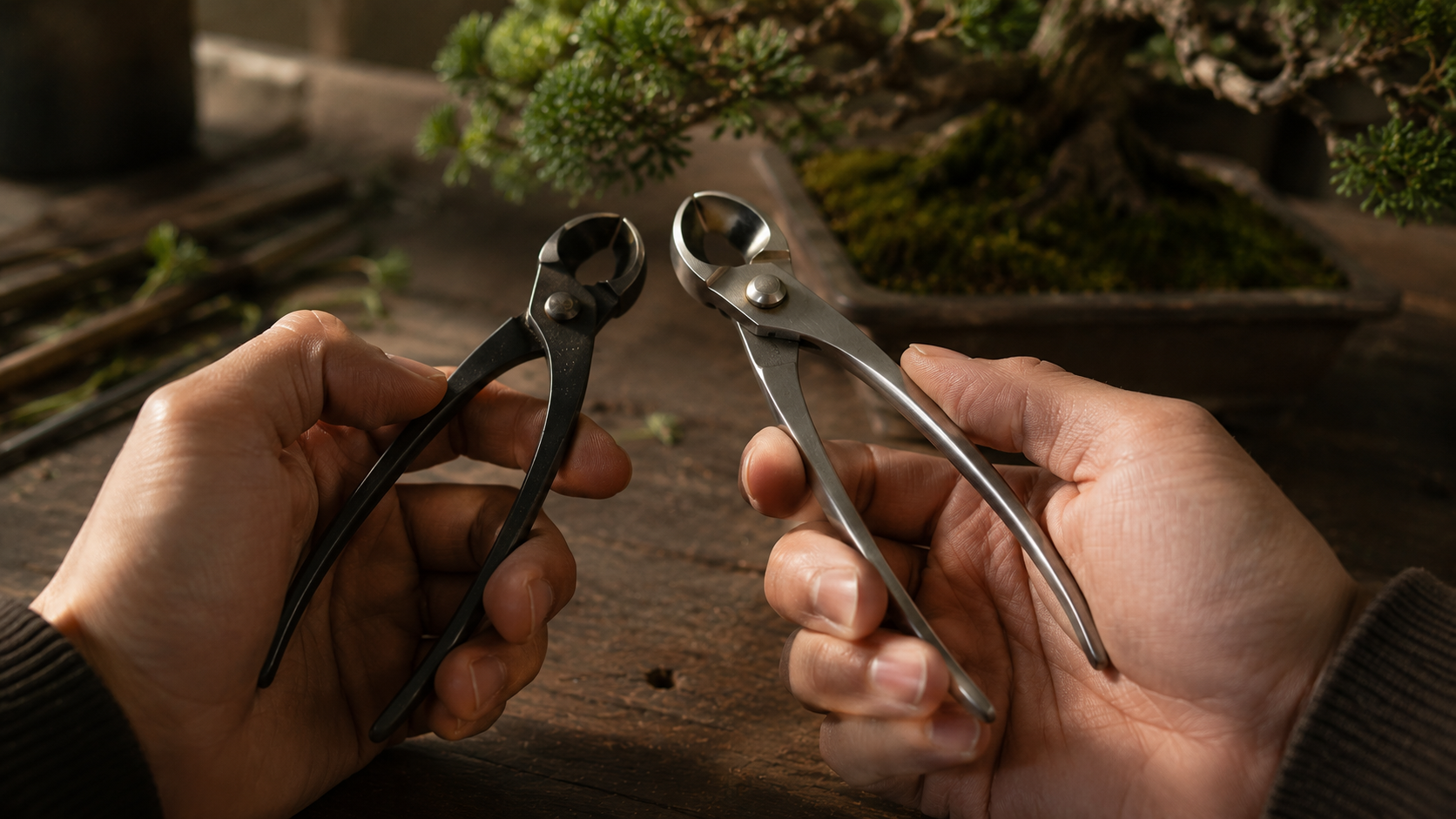
We’ve now compared Kaneshin and Masakuni side by side across seven types of bonsai tools on this site: concave cutters, knob cutters, wire cutters, shears, root cutters, jin pliers and tool sets. So instead of repeating the forum argument, this guide puts the actual numbers next to each other. Prices, weights, sizes and steel options, category by category.
In my experience, once you see it laid out like this, the answer stops being “which brand is better” and becomes “which brand is better for this particular tool, for you.”
Who this article is NOT for
It’s not for you if you’re still choosing your first tool type. If you don’t know yet whether you need a concave cutter or a knob cutter, start with our individual guides. This article assumes you already know what tool you want and are deciding between two makers.
It’s not for you if you’re looking for budget tools. Both brands are proper Japanese tools. If you want something under $30, neither is the answer.
It’s not a guide to custom or collector pieces. Masakuni in particular has made-to-order and specially finished lines costing several times more than its standard tools. We’ll mention where they start, but this comparison focuses on the standard tools most people actually buy.
Let’s get into it.
How we compared them (3 things that actually matter)
1. Price for the same job
The forum claim is that Masakuni costs about twice as much. Across standard tools, the real picture is more mixed. In some categories the gap is small. In others it’s large. We compare like for like, using prices from Japanese tool stores so the comparison isn’t skewed by different retailer markups.
2. Weight and size
This turned out to be one of the clearest differences. In several categories, Masakuni’s tools are noticeably lighter than Kaneshin’s at a similar length. That matters during long sessions. But it isn’t true for every tool.
3. Range and availability
How many sizes, steel types and finishes can you choose from? And can you actually buy the tool where you live? A great tool you can’t easily get, or can’t return, is a real downside.
Kaneshin is widely stocked by Western bonsai retailers. In the course of our guides, we found it at Eastern Leaf and Bonsai Outlet in the US, and at Kaizen Bonsai and Niwaki in the UK. Masakuni is more often bought from Japanese export stores, though some Western retailers carry it too.
That matters more than it sounds. Ordering from Japan usually means lower list prices, but you add international shipping, possible import tax, a longer wait and harder returns. Buying locally costs more upfront but is simpler if something’s wrong. For a $60 tool, the local markup can feel steep. For a $150 tool, easy returns are worth a lot.
Prices below are approximate, checked in September and October 2026, mostly from Japanese tool stores before international shipping. Western retail prices are higher and vary a lot.
Comparison table
| Tool | Kaneshin (example) | Masakuni (example) | Quick verdict |
|---|---|---|---|
| Concave cutter | Carbon, 170–205mm, ~¥9,600–10,400; stainless No.802 ~¥19,200 | 8000 series, 220mm, 220g, ~¥18,800 | Kaneshin for value |
| Knob cutter | No.10 (175mm, 187g+) ~¥10,600 | No.0035 (180mm, 150g) ~¥12,800 | Close; Masakuni lighter |
| Wire cutter | No.22A (180mm, 300g+) ~¥10,600 | No.0088 (205mm, 220g) ~¥14,800 | Masakuni lighter; Kaneshin cheaper |
| Shears | Carbon ~¥9,600–10,200; stainless No.827B ~¥12,900 | No.0001 (180mm, 150g) ~¥12,800 | Close on price; Kaneshin more options |
| Root cutter | No.13 (180mm, 305g+) ~¥12,000 | No.0015 (250mm, 560g) ~¥29,800 | Kaneshin for most people |
| Jin pliers | No.49 (230mm) ~¥9,300 | No.0017 (200mm, 190g) ~¥11,800 | Kaneshin for leverage, Masakuni for comfort |
| Tool set | 4-piece beginner set ~¥31,500 | 5-piece No.0033 ~¥54,000 | Kaneshin for value |
The two brands in brief
Kaneshin is listed among Gifu Prefecture’s cutlery makers, and several retailers describe it as handcrafting tools in Japan since 1919. It uses Yasuki steel for many tools and sells the same basic shapes in several steel grades: plain carbon, traditional white and blue steel, plated finishes and stainless. That range is one of its biggest strengths.
Masakuni traces its bonsai tools back to Shichinosuke Kawasumi, the first Masakuni, who made flower-arranging scissors and medical cutting tools. According to UK retailer Kaizen Bonsai’s history of the brand, he created what it describes as the first shears in Japan made specifically for bonsai, and later developed tools with bonsai master Kyuzo Murata. Masakuni sells a standard range, a silver 8000 series with an anti-rust coating over high-carbon steel, and much more expensive specially finished and made-to-order lines.
A few buying tips for each brand.
- Kaneshin model numbers vary between shops. The same tool can be listed under slightly different numbers or names depending on the retailer. Check the length in millimeters and the steel type, not just the model number.
- Masakuni’s 8000 series is the silver one. A retailer answer on Amazon describes the 8000 series as the same high-carbon steel as the black tools, with an amorphous stainless coating that makes it easier to clean and more rust resistant. A forum post quoting a Japanese distributor put the 8000 series at roughly 10% more than the matching black tool.
- Buy Masakuni from reputable sellers. It’s a premium, well-known name, and that makes it a target for questionable listings. A known bonsai retailer or an established Japanese export store is the safer route.
Category-by-category reviews
1. Concave cutters
This is where the price gap is clearest.
Kaneshin’s carbon concave cutters sit around ¥9,600–10,400 on a Japanese store, in 170mm and 205mm sizes. Its stainless No.802 is about ¥19,200. Masakuni’s 8000 series concave cutter is 220mm and 220g, at about ¥18,800 on a Japanese export store.
So Masakuni’s coated carbon cutter costs roughly the same as Kaneshin’s stainless one, and nearly twice Kaneshin’s plain carbon one. One 2026 brand review put it this way: Masakuni’s performance gain over Kaneshin is “perhaps 10-15% while the price difference often exceeds 100%.”
Kaneshin pros: cheaper, more sizes, stainless available. Masakuni pros: anti-rust coating on carbon steel, strong professional reputation, slightly longer for leverage.
Verdict: Kaneshin for most people. Masakuni if you specifically want the coated 8000 series. Full comparison in our concave cutter guide.
2. Knob cutters
Much closer than you’d expect.
Kaneshin’s carbon knob cutters (No.9, No.10, No.11, from 150mm to 210mm) are each about ¥10,600. Masakuni’s No.0035 (180mm, 150g) and No.0036 (145mm, 80g) are each about ¥12,800. That’s only around 20% more.
Weight is the bigger difference. Masakuni’s 180mm knob cutter is 150g. Kaneshin’s 175mm No.10 is listed at 187g or more.
Masakuni also has a spherical knob cutter (No.0335, 210mm, ¥17,800). Kaneshin has more size options, including thin-blade “B” versions and a stainless line.
Kaneshin pros: more sizes, thin-blade versions, stainless options. Masakuni pros: lighter, a small model for mame, a spherical option.
Verdict: Genuinely close. Masakuni if you want a lighter tool. Kaneshin if you want more sizes or stainless. See our knob cutter guide for all six picks.
3. Wire cutters
Another category where weight stands out.
Kaneshin’s No.22A is 180mm and around 300g, at about ¥10,600. Masakuni’s No.0088 is 205mm and 220g, at about ¥14,800. So Masakuni’s cutter is longer but lighter.
Masakuni also makes a tiny No.0009 wire cutter, just 110mm and 60g, at about ¥9,800. That’s very handy for fine wire on small trees.
Interestingly, the same 2026 review mentioned above said the author’s Masakuni wire cutters were the one tool that “justify their cost,” while the others were “excellent but not transformatively better than good Kaneshin equivalents.”
Kaneshin pros: lower price, a wide spread of sizes, stainless versions (No.814 and No.815). Masakuni pros: lighter at a longer length, a very small model for fine work.
Verdict: One of the better cases for Masakuni, especially if you wire a lot. Kaneshin still wins on price and stainless options. More in our wire cutter guide.
4. Shears
Close on price at the standard level, very different above it.
Kaneshin’s plain carbon shears are around ¥9,600–10,200, its stainless No.827B around ¥12,900, and its blue steel models from about ¥15,600 to ¥22,000. Masakuni’s standard No.0001 (180mm, 150g) and No.0002 (190mm, 130g) are about ¥12,800.
Above that, Masakuni’s higher lines get expensive fast, with listed prices from around ¥38,000 up to ¥148,000. Those are aimed at collectors and professionals.
In my experience, shears are where people overthink brand the most. Both brands’ standard shears are good. Weight, size and steel matter more than the name.
Kaneshin pros: many steel grades to choose from, stainless options, widely sold in the West. Masakuni pros: light standard models, consistent finish, several sizes at the same price.
Verdict: A draw at the standard level. Kaneshin for the wider choice of steel grades. Masakuni for a light, well-finished standard pair. Our shears guide has the details.
5. Root cutters
The one category where Masakuni is clearly heavier.
Kaneshin’s No.13 is 180mm and 305g+, at about ¥12,000. It also has 150mm, 210mm and larger sizes, plus stainless versions. Masakuni’s No.0015 “small” root cutter is 250mm and 560g, at about ¥29,800.
So Masakuni’s smallest listed root cutter is longer, nearly twice as heavy and more than twice the price of Kaneshin’s standard size. It’s a heavy-duty tool rather than an everyday one.
Root cutters also take the most abuse of any tool. They go through grit, soil and wet roots. That makes them a poor place to spend premium money for most people.
Kaneshin pros: wide size range, stainless versions, far lower price. Masakuni pros: heavy and solid for serious root work.
Verdict: Kaneshin for almost everyone. Masakuni only if you specifically want a heavy-duty root cutter. More in our root cutter guide.
6. Jin pliers
A different trade-off: leverage versus comfort.
Kaneshin’s long-handled No.49 is 230mm, at about ¥9,300 on a Japanese store. It’s known for leverage on heavy wire and jin work. Masakuni’s No.0017 is 200mm and just 190g, at about ¥11,800. Its larger No.0117 is 220mm and 230g, at about ¥14,800.
This is a good example of why “which brand is better” is the wrong question. The Kaneshin is longer and built for force. The Masakuni is shorter and built for comfort. They’re good at different things. Kaneshin also offers stainless pliers (No.818 at 180mm and No.819 at 215mm), which Masakuni doesn’t appear to list.
Kaneshin pros: more leverage, lower price, stainless versions. Masakuni pros: much lighter, a nice middle length, a larger version if you want more reach.
Verdict: Kaneshin No.49 if you remove heavy wire or tear jins often. Masakuni No.0017 if comfort over long wiring sessions matters most.
7. Tool sets
Kaneshin’s 4-piece beginner set (concave cutter, scissors, wire cutter, tweezers) is about ¥31,500 on a Japanese store. Masakuni’s 5-piece set No.0033 is about ¥54,000. Masakuni’s larger sets go up to around ¥103,900 for nine pieces, and specially made versions cost much more.
Sets are where the price gap adds up. A small difference on each tool becomes a big difference across five or eight tools. Kaneshin also sells larger sets, including an 8-piece set with a case at around $380 from a US retailer, which makes it easier to buy locally.
There’s also a practical point. A set locks you into one brand for every tool, including the ones where, as we’ve seen, the other brand might suit you better. Building your own mixed kit takes longer, but it often ends up both cheaper and better matched to how you work.
Verdict: Kaneshin for value. Masakuni if you’ve already decided on the brand and want a matched set.
Recommendation by use case
“I want good Japanese tools without overspending.” Kaneshin, across the board.
“I wire a lot and my hands get tired.” Masakuni wire cutter and jin pliers. Their lighter weights make a real difference over long sessions.
“I live somewhere humid and don’t want to fight rust.” Kaneshin stainless for most tools, or the Masakuni 8000 series concave cutter if you want coated carbon steel.
“I mostly grow shohin.” A mix: Masakuni’s small, light knob and wire cutters, with Kaneshin’s small root cutter and thin-blade options.
“I want one premium brand for everything.” Masakuni, but expect to pay a lot more for the root cutter and sets than you would with Kaneshin.
“I’m in the US or UK and want easy returns.” Kaneshin is much easier to find at Western bonsai retailers.
Conclusion: buy the tool, not the logo
Here’s the short version.
Kaneshin is the better value in most categories, has a wider range of sizes and steels, and is easier to buy outside Japan. Masakuni is excellent, often lighter, and has a long professional reputation, but the price gap is larger than the performance gap for most tools.
The good news is you don’t have to pick one brand. Plenty of experienced growers mix them: Kaneshin for workhorse tools like root cutters and everyday shears, Masakuni for the one or two tools where lighter weight makes a real difference to them.
If you’re starting from nothing, a sensible path looks like this. Begin with Kaneshin for the core tools: a concave cutter, a pair of shears and a wire cutter. Use them for a season or two. Notice which tool you reach for most, and which one tires your hand or frustrates you. That’s the tool worth upgrading, and it’s often the one where Masakuni’s lighter weight is noticeable. Upgrading one tool at a time based on real use is almost always better than buying a premium brand for everything on day one.
And whichever you buy, look after it. A well-oiled Kaneshin will outperform a neglected Masakuni every time.
Ready to look?
- Browse Kaneshin tools at Eastern Leaf →
- See the Masakuni lineup at Bonsai Network Japan →
- Compare Masakuni prices on Amazon →
Sources: Kaizen Bonsai: The History of Masakuni; Wabi Bonsai: Bonsai Tools Review 2026
Leave a Reply