Affiliate disclosure: Some links on this page are affiliate links. If you buy through them, Aribonsai may earn a small commission at no extra cost to you. It doesn’t change what we recommend or how we rank anything.
Why your young tree shouldn’t be in a beautiful pot yet
When most people picture bonsai, they picture a small tree in an elegant, shallow ceramic pot. That’s the finished look. But most bonsai don’t spend their early years in pots like that.
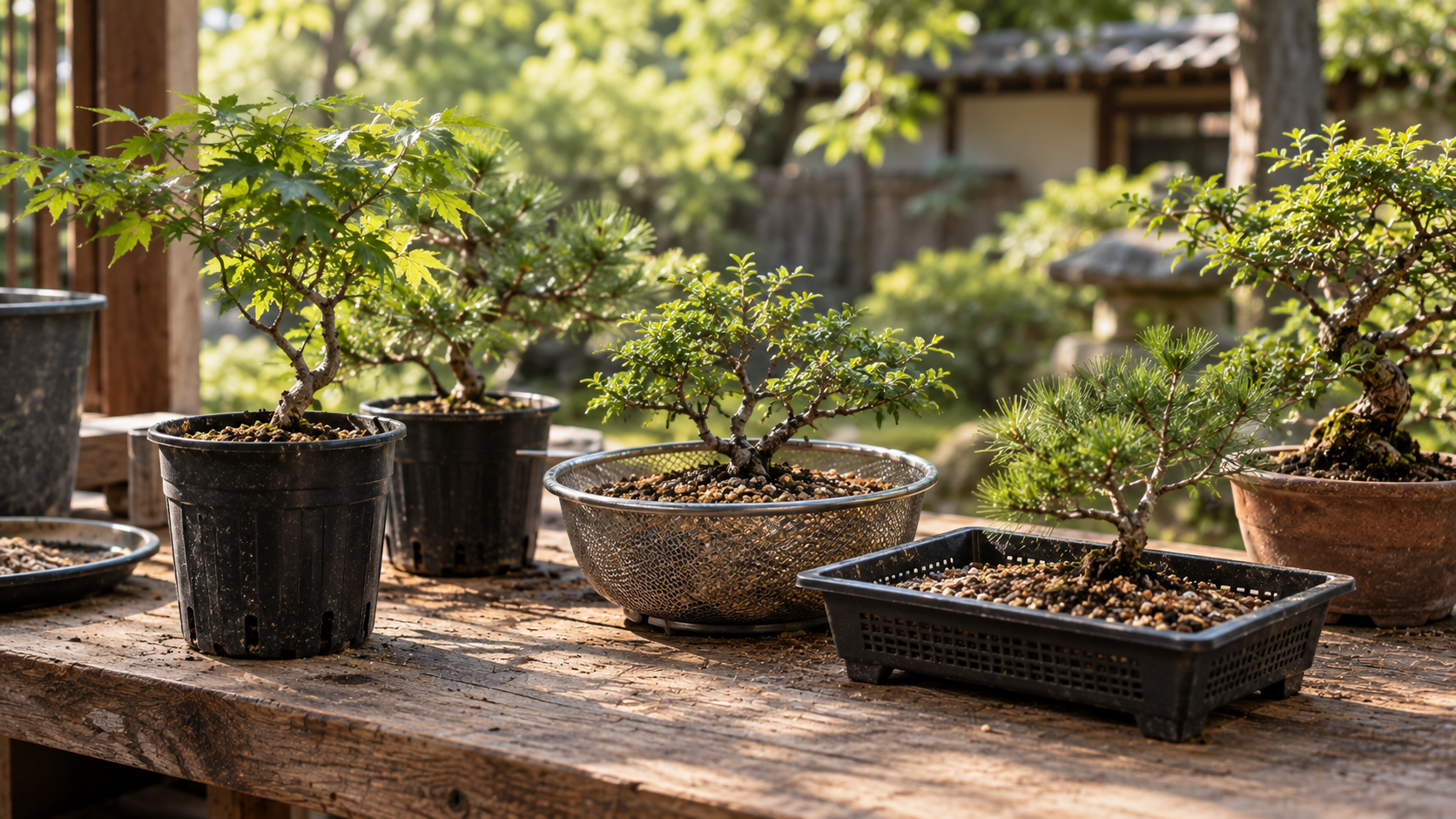
Young trees, pre-bonsai and freshly collected material usually grow in bonsai training pots: plastic containers, simple clay pots, colanders, mesh baskets and wooden boxes. They’re cheap, practical and often deeper or wider than a display pot. Their job isn’t to look good. It’s to help the tree grow faster and build a dense, healthy root system that will one day fit comfortably into a shallow bonsai pot.
Putting a young tree straight into a small, shallow display pot is one of the most common beginner mistakes. Growth slows, trunks thicken very slowly, and roots have little room to develop.
The challenge is choosing among training pots. Plastic, clay, colanders, air-pruning pots, nursery flats, mica: each has strengths and weaknesses, and experienced growers often disagree.
In my experience, the best training pot is the one that matches the tree’s stage and your watering habits. A pot that dries out fast is great in a cool climate and a problem in a hot one. This guide explains what matters, then compares six types of bonsai training pots, from cheap plastic to air-pruning pots.
Who this bonsai training pots guide is NOT for
It’s not about display pots. For finished trees, our Japanese bonsai pots guide covers Tokoname makers.
It’s not for trees in the ground. Field growing is another way to develop trunks fast, but it’s a different method.
It’s not a repotting tutorial. We’ll touch on technique, but focus on the containers.
Still with us? Let’s go.
How we picked these (3 things that actually matter)
1. Root development
The main reason to use a training pot is to build a better root system.
On bonsai forums, many growers report that colanders, mesh baskets and air-pruning pots encourage fine, fibrous roots instead of long, circling ones. Roots that reach the air at the edge of the container stop growing there and branch, creating a denser root mass that’s easier to fit into a bonsai pot later. Most forum members consider air pots better than standard nursery pots for growing roots.
2. How fast it dries out
The same open sides that help roots also dry the soil faster. Forum members warn that mesh baskets dry out quickly, especially with inorganic soil, and that air pots need more watering attention. Solid plastic and clay pots hold moisture longer.
If you live somewhere hot, can’t water often, or grow moisture-loving trees like maples, choose a pot that dries more slowly. One forum member notes that air baskets dry out more slowly than pond baskets, which suits maples.
3. Cost, size and durability
You’ll often need many training pots, in several sizes, and you’ll replace them as trees grow. Cheap, durable pots in a range of sizes are ideal. Very large trees and collected material may need big, shallow containers, which can be expensive unless you choose nursery flats or build wooden boxes.
A few training pot habits that matter more than the pot
None of these cost anything.
- Use free-draining bonsai soil. Our akadama guide covers good mixes.
- Water more often in open pots. Colanders and air pots dry fast.
- Don’t bury mesh pots in the ground. Forum members warn roots grow through and bind the mesh into the root mass.
- Tie trees in firmly. Movement tears new roots.
- Match pot size to the tree’s stage. Bigger for growth, smaller as you refine.
- Repot on schedule. Even good training pots fill up eventually.
Bonsai training pots comparison table
| Pot type | Example | Best for | Dries out | Approx. price |
|---|---|---|---|---|
| Plastic training pots | Pöppelmann (Germany) at Wigert’s | Most pre-bonsai | Moderately | ~$2 and up per pot |
| High-fired clay training pots | Bonsai Tonight | A step toward bonsai pots | Moderately | ~$2.80–115 each |
| Colanders and mesh baskets | Kitchen colanders, pond baskets | Fibrous roots, fast development | Fast | Low |
| Nursery flats | Anderson Flats | Developing nebari, collected trees | Moderately | Low to moderate |
| Air-pruning pots | Rootmaker | Root development in warm climates | Fast | Moderate |
| Mica pots | Wigert’s mica pots | Training pots that look like ceramic | Moderately | Moderate |
Prices are approximate and vary by size, quantity and retailer. Always check current prices.
The 6 best bonsai training pot options, reviewed
1. Pöppelmann plastic training pots – the reliable everyday choice
If you need a dependable, affordable training pot for most young trees, plastic is the place to start.
Wigert’s Bonsai sells plastic training pots made by Pöppelmann in Germany, described as quality plastic training pots for pre-bonsai training. Sizes range from 6 inches across and 2¾ inches deep up to 13¼ inches across and 5½ inches deep. They’re sold singly or in sets of 5 or 10, with prices from about $2 up to $85 depending on size and quantity.
Plastic is light, cheap, durable and holds moisture better than mesh, which makes it forgiving for beginners and hot climates.
Pros
- Affordable, especially in sets
- Wide range of sizes
- Light and durable
- Holds moisture well
Cons
- Less root air-pruning than mesh or air pots
- Plain look
- Colors vary
Best for: most pre-bonsai and young trees.
Check Pöppelmann training pots at Wigert’s Bonsai
2. High-fired clay training pots – a step toward bonsai pots
High-fired clay training pots sit between a plastic pot and a finished bonsai pot. They’re sturdier and more attractive than plastic, but inexpensive enough to use for development.
Bonsai Tonight sells high-fired training pots in a wide range of sizes, from about 3¾ × 1½ inches up to 18¼ × 7½ inches, sold in bundles. Prices range from about $2.80 each for the smallest to about $115 each for the largest. They’re available for local pickup only from that store.
Clay pots are heavier and more stable than plastic, which helps with top-heavy trees, and their more traditional shape suits trees in later development.
Pros
- More stable and attractive than plastic
- Very wide size range
- Good value in bundles
Cons
- Heavier
- Local pickup only at this retailer
- Can break if dropped
Best for: trees in later development, and growers near the store.
Check high-fired training pots at Bonsai Tonight
3. Colanders and mesh baskets – the cheap route to fibrous roots
Many bonsai growers use ordinary kitchen colanders or pond baskets as training pots.
On Bonsai Nut, growers report that mesh baskets encourage fibrous root systems through air pruning. One said every tree he repotted from them was completely filled with fibrous roots, and they prevent the long, circling roots common in regular containers. Inexpensive colanders from Asian supermarkets or IKEA are popular, and some growers make DIY baskets from plastic canvas. Colanders have been used for pines, too.
The trade-off is watering. They dry out quickly, especially with inorganic soil. And forum members advise against putting them in the ground, because roots grow through and bind the mesh into the root mass.
Pros
- Very cheap
- Encourage fine, fibrous roots
- Widely available
Cons
- Dry out quickly
- Results vary between growers
- Not for planting in the ground
Best for: fast root development in cooler climates, and growers who can water often.
Search plastic colanders on Amazon
4. Anderson Flats – best for nebari and collected trees
Anderson Flats are shallow, square nursery containers, and they’re a favorite for developing surface roots (nebari).
On Bonsai Nut, one grower calls Anderson flats great for bonsai in development, and another says they suit collected trees. The “Flat Five” is about 14 × 14 × 5.5 inches. A forum member notes that Anderson trays have a grid bottom that helps develop nebari.
Their wide, shallow shape encourages roots to spread outward rather than down, exactly what you want for a broad, attractive root base.
Pros
- Wide, shallow shape for nebari
- Grid bottom
- Good for collected trees
- Affordable for the size
Cons
- Square, utilitarian look
- Large sizes take up bench space
Best for: developing nebari and growing collected or larger trees.
Search Anderson Flats on Amazon
5. Rootmaker air-pruning pots – the hard-sided air pot
Air-pruning pots are designed specifically to stop circling roots. Their sides have openings that let roots reach the air, where they stop and branch.
In a Bonsai Nut discussion, members say air pots produce denser, more fibrous root systems than standard nursery pots, and hard-sided Rootmaker-style pots were the most favored option, followed by net fabric bags. One member notes Rootmaker pots have fewer side holes and need watering less often than mesh baskets. The same discussion stresses that results depend heavily on soil, watering and feeding, and one poster notes some science disputes whether air pots improve top growth.
Some air pots cost over $8 each, so they’re best used selectively.
Pros
- Designed to prevent circling roots
- Hard sides are durable
- Fewer side holes than mesh, so less frequent watering
Cons
- More expensive than plastic or colanders
- Still dry faster than solid pots
- Results depend on soil and care
Best for: serious growers developing trees for the long term.
Search Rootmaker air pruning pots on Amazon
6. Mica pots – training pots that look like ceramic
Sometimes you want a training pot that doesn’t look like one, especially for a tree you display while it develops.
Wigert’s sells mica pots in rectangular, oval and drum shapes. A Bonsai Nut member says they “pass for ceramic at 10 feet,” and suggests sanding the edges with 220-grit sandpaper and fine steel wool to make them look even more like ceramic.
Mica pots are lighter and more durable than ceramic, so they’re a good compromise for trees that are developing but also on show.
Pros
- Looks like ceramic from a distance
- Lighter than ceramic
- Several shapes
- Durable
Cons
- More expensive than plastic
- Edges may need finishing
Best for: developing trees that are also on display.
Check mica pots at Wigert’s Bonsai
Which bonsai training pot should you buy? (By situation)
You have a few young trees and want a simple start: Pöppelmann plastic training pots.
Your trees are close to bonsai pots: high-fired clay training pots.
You want fibrous roots cheaply and can water often: colanders or mesh baskets.
You’re developing nebari or collected trees: Anderson Flats.
You want the best root development long-term: Rootmaker air-pruning pots.
Your developing tree is also on display: mica pots.
You live somewhere hot and dry: plastic or clay, which hold moisture longer.
A practical progression
Many growers move trees through stages: colander or air pot for fast root growth, then a plastic or clay training pot, then a shallow Japanese display pot when the tree is refined. Each step gets shallower and smaller as the root system becomes denser.
How big should a training pot be?
There’s no single right size, but a few simple rules help.
For growth, go a little bigger. A tree that’s still building its trunk and branches needs room for roots. A training pot somewhat larger than the current root ball gives it space to grow without leaving a huge volume of soil that stays wet in the middle.
Don’t jump too far at once. A small root ball in a very large pot can sit in soggy soil, because the roots can’t use all that water. Moving up gradually is usually safer than going straight to the biggest pot you own.
Go shallower as you refine. As the trunk gets close to the size you want, you’ll start reducing roots and moving into shallower containers. That’s when wide, shallow options like Anderson Flats start to make more sense than deep pots.
Think about your bench space. Training pots add up fast. Ten young trees in mid-size pots take up a lot more room than you’d expect, so plan your layout before you buy a set.
In my experience, the most useful habit is simply writing down when each tree went into its pot. It sounds small, but it makes it much easier to know when a tree is due for a check, especially once you have more than a handful.
If you’re buying young material to fill those pots, our guide to where to buy bonsai trees online covers nurseries that sell pre-bonsai.
Wooden boxes: the DIY option for big trees
For very large or collected trees, training pots in the right size can be hard to find or expensive. Many growers build simple wooden boxes instead. On Bonsai Nut, one grower says building boxes to the exact size needed is more cost-effective than buying a huge pot for a few years of use.
Use untreated, rot-resistant wood if possible, drill plenty of drainage holes, and add tie-down holes before you plant.
How to repot into a training pot
- Choose the right size, larger than the root ball for growth.
- Cover drainage holes with mesh. Our bonsai repotting supplies guide covers what you need.
- Thread tie-down wire through the pot.
- Comb out the roots gently. A bonsai root rake helps.
- Position and tie in the tree.
- Fill with free-draining soil, working it in with a chopstick.
- Water thoroughly, and keep a close eye on watering in open pots.
Common bonsai training pot mistakes
Putting young trees in small display pots too early. Growth slows dramatically.
Underwatering colanders and air pots. They dry fast.
Burying mesh pots in the ground. Roots grow through the mesh.
Using heavy garden soil. Roots need free-draining bonsai soil.
Leaving trees too long without repotting. Even training pots fill up.
Conclusion: the right pot for the right stage
Bonsai training pots aren’t glamorous, but they’re where most bonsai are really made. They let young trees grow faster and build the dense, fibrous root systems that make a beautiful bonsai possible later.
For most growers, plastic training pots like Pöppelmann’s are the simplest start. Colanders and air-pruning pots are excellent for root development if you can water often, Anderson Flats suit nebari and collected trees, and mica or clay training pots bridge the gap to display pots.
Match the pot to the tree’s stage and your climate, water carefully, and move trees toward shallower pots as their roots improve.
Ready to grow? Check Pöppelmann training pots at Wigert’s, or search Anderson Flats on Amazon.