Affiliate disclosure: Some links on this page are affiliate links. If you buy through them, Aribonsai may earn a small commission at no extra cost to you. It doesn’t change what we recommend or how we rank anything.
Every bag says “akadama.” They’re not all the same.
If you’ve started looking at proper bonsai soil, you’ve probably hit this.
Every bonsai book and video mentions akadama. So you search for it, and suddenly there are bags called Double Line, Triple Red Line, Ryusen, Ho Yoku, Gun Poh and “super hard.” Prices range from about $30 to $70 a bag. Some say heat-treated. Some come in “shohin grain.” Some are mixed with something called kiryu. And then someone in a forum tells you akadama turns to mud after a year and you should just use lava rock.
Soil is the one part of bonsai you can’t see once the tree is potted. But it affects everything: how often you water, how well the roots grow, and how long you can go between repots.
In my experience, the biggest mistakes with Japanese soil aren’t about brand. They’re about grain size, about using akadama in a climate where it breaks down quickly, and about buying one bag and expecting it to suit every tree.
This guide explains what the main Japanese soils actually do, then compares six bags you can buy from retailers outside Japan.
Who this article is NOT for
It’s not for you if you want to order soil straight from Japan. Soil is restricted for import in many countries, so Japanese stores generally won’t ship it overseas. Every product here is sold by a retailer outside Japan.
It’s not for you if you grow only indoor tropical trees in a dry home. Akadama can work indoors, but many indoor growers prefer mixes based on pumice, lava or other inorganic materials. That’s a different discussion.
It’s not a complete soil science guide. We’ll cover the basics you need to choose a bag. Detailed mixes for every species are beyond one article.
Still with us? Let’s go.
How we picked these (3 things that actually matter)
1. What the soil is, and what it’s for
There are three Japanese soils you’ll see most often outside Japan.
Akadama is a Japanese clay soil that’s dug, dried and sorted into grains. Bonsai Tonight describes it as something that can “hold and release water, hold and release fertilizer, and support root growth over very long periods.” Roots can also grow into the grains, which is part of why it’s so popular.
Kanuma is a soft, pale yellow volcanic soil. House of Bonsai describes it as “highly acidic (pH level about 5.5)” and best for acid-loving plants like azaleas and camellias. It’s usually mixed with other soils, not used alone.
Kiryu (kiryuzuna) is a volcanic aggregate from Japan, often mixed with akadama to improve drainage and aeration.
Most growers use akadama as part of a mix, not on its own. One commonly shared formula, quoted by Bonsai Empire, is roughly one part lava rock, one part pumice and one part akadama. Deciduous trees are often given more akadama, and conifers less.
2. Hardness and how long it lasts
This is the big one. Akadama breaks down over time. Bonsai Empire says it “breaks down over 1 to 2 years, depending on the quality of the akadama, freeze/thaw cycle in your climate and frequency of watering.” As it breaks down, it compacts, drains worse and can hold too much water.
Harder akadama lasts longer. That’s why you see labels like “hard,” “super hard” and “double line” or “triple line,” which are used to signal quality grades. A simple home test that Bonsai Tonight mentions: soft akadama “crumbles easily between pinched fingers,” while hard grains don’t.
If you live somewhere with cold, wet winters and frequent freezing and thawing, hardness matters even more.
3. Grain size and bag price
Grain size should match your trees. Small grains suit shohin and small pots. Larger grains suit bigger pots and help with drainage. Many bags come in several grain sizes, so check before you buy.
Price per liter varies a lot. The bags here range from 13 to 18 liters, so compare by volume, not just by price.
One more thing: most akadama sold outside Japan is heat-treated. Bonsai Tonight notes that heat-treated akadama (around 300°C) is primarily for import compliance, and that it’s different from fully baked akadama, which is fired much hotter and becomes more ceramic-like. Some heat-treated products also produce a bit of dust in shipping, so sifting before use is a good idea.
A few habits that get more out of any bag.
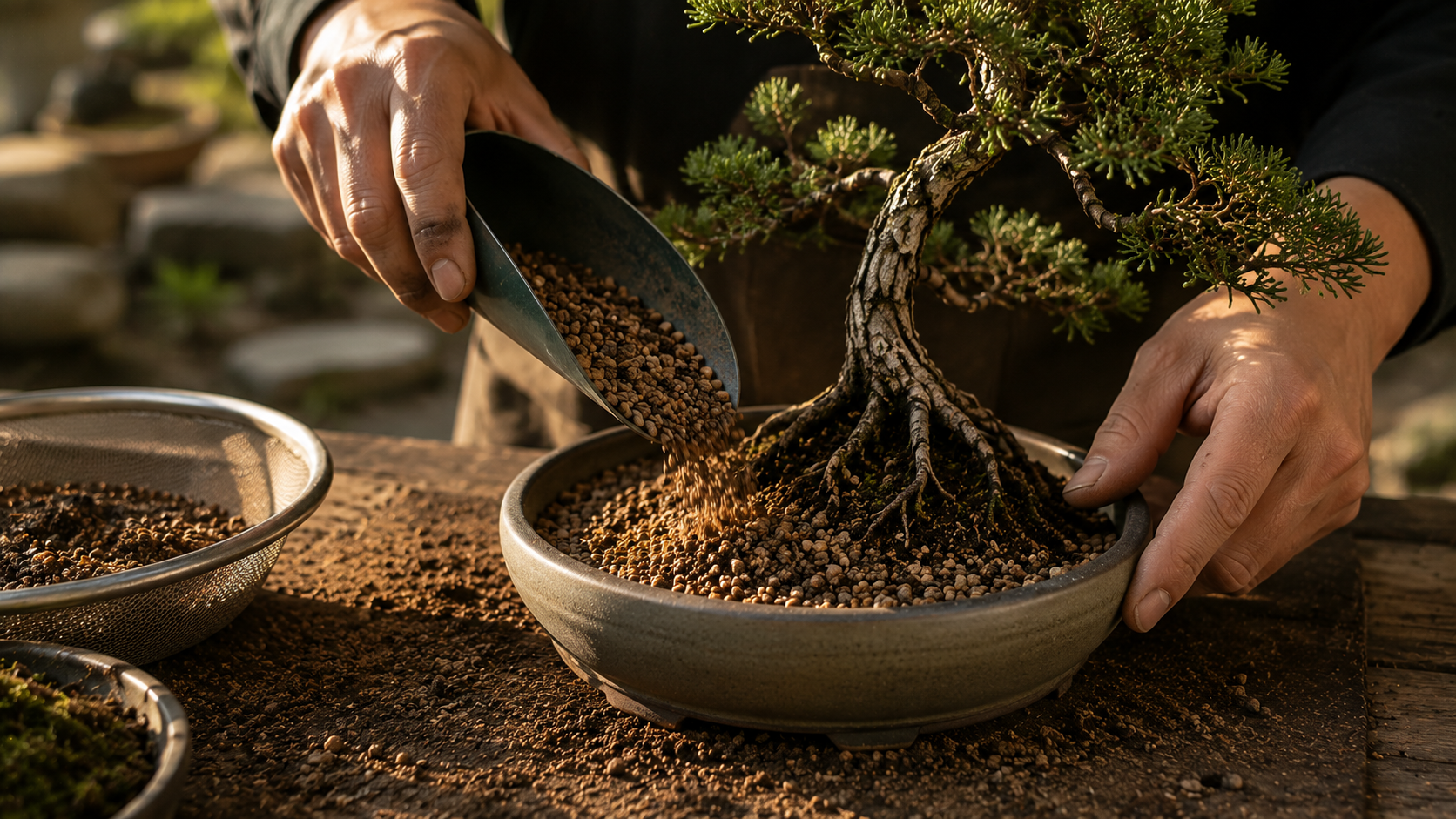
- Sift before you use it. Shake the soil through a sieve to remove dust and broken fines. Fine particles fill the gaps between grains and are a big part of why akadama mixes stop draining well.
- Store it dry. Keep opened bags out of the rain and off damp ground. Akadama that sits wet for months starts breaking down before it ever reaches a pot.
- Do the pinch test. Before using a new bag, squeeze a few grains between your fingers. If they crumble easily, use a lower percentage in your mix, or save that bag for trees you repot often.
- Label your mixes. If you blend your own, write the ratio on the bag or bucket. It’s surprisingly easy to forget what’s in a mix by the next repotting season.
- Watch how it behaves. After a season, check how quickly the soil dries out and whether the surface has started to look muddy. That tells you more about whether a bag suits your climate than any label does.
Prices below are approximate and were checked at US retailers in October 2026. Prices and stock in other countries will differ.
Comparison table
| Soil | Type | Bag | Grain sizes | Approx. price | Best for |
|---|---|---|---|---|---|
| Double Line Ibaraki Akadama | Hard akadama, heat-treated | 14L | Small (~6mm), Shohin | ~$59 | All-round quality akadama |
| Ryusen Akadama | Akadama | 14L | Small (~6mm) | ~$59 | Alternative premium brand |
| Ho Yoku Hard Premium Akadama | Hard akadama, heat-treated | 18L | 1–3mm, 3–5mm, 5–7mm | ~$55 | Choice of grain sizes, larger bag |
| Gun Poh Super Hard Akadama | Super hard akadama, heat-treated | 14L | 3–6mm, 6–10mm, 10–18mm | ~$32 | Best value |
| Double Line Akadama + Kiryu Blend | ~70% akadama, ~30% kiryu | 13L | 8–10mm+ | ~$46 | Ready-to-use mix |
| Kanuma | Acidic volcanic soil | 18L | 6–7mm+ | ~$42 | Azaleas and acid-loving trees |
Individual reviews
1. Double Line Ibaraki Akadama (14L)
One of the best-known hard akadama brands sold outside Japan.
Eastern Leaf sells the small grain (about 6mm) for $59 per 14L bag, roughly 20 lbs. It’s made in Japan and heat-treated. Eastern Leaf describes it as having “bonsai level hardness that prevents deterioration and compaction.” A finer shohin grain is also available at the same price.
Eastern Leaf also lists Triple Red Line akadama at $69, which it positions as a premium grade above Double Line, and a “Japanese Super Hard Akadama” at $59.
Pros
- Well-known brand with a reputation for hardness
- Shohin grain available for small trees
- Easy to buy from a US retailer
- Heat-treated for import
Cons
- One of the pricier options per liter
- Limited grain sizes compared to some brands
- Like all akadama, it will still break down eventually
Who it’s for: Growers who want a reliable, well-known hard akadama for general use. If you only buy one bag of akadama this year, this is a safe choice.
2. Ryusen Akadama (14L)
Ryusen is another premium akadama brand, also sold by Eastern Leaf.
The small grain (about 6mm) is $59 per 14L bag. Eastern Leaf says it’s made by the same company that produces Double Red Line akadama. It was out of stock when we checked.
Eastern Leaf notes it’s often blended with fine lava rock or similar materials to improve drainage and root growth, which is good general advice for any akadama.
Pros
- Premium brand from a known producer
- Same price as Double Line
- Good for mixing with lava or pumice
Cons
- Stock can be patchy
- Only one grain size listed
- Similar price per liter to other premium bags
Who it’s for: Growers who want a premium akadama and are happy to use Ryusen or Double Line, depending on what’s in stock.
3. Ho Yoku Hard Premium Akadama (18L)
The pick if you want a bigger bag and more grain sizes.
Bonsai Outlet sells Ho Yoku hard premium akadama for $54.95 per 18L bag. It’s imported from Japan and comes in three grain sizes: small (1–3mm) for shohin, standard (3–5mm) for general use, and large (5–7mm) for bigger trees.
Bonsai Outlet says it has been heat-treated to about 400 degrees, which makes it more durable, but that it can produce some dust during shipping. They suggest sifting before use, especially for small pots or fine mixes.
In my experience, having the same brand in three grain sizes is more useful than it sounds. You can build mixes for different trees without your soil behaving differently from bag to bag.
Pros
- Larger 18L bag for a similar price
- Three grain sizes, including very fine for shohin
- Heat-treated for durability
Cons
- Can arrive with dust, so sifting is recommended
- Less brand recognition than Double Line
- Grain sizes are on the small side for very large trees
Who it’s for: Growers with a mix of tree sizes who want consistent akadama in several grains.
4. Gun Poh “Super Hard Quality” Akadama (14L)
The value pick.
Wigert’s Bonsai sells Gun Poh super hard akadama for $32 per 14L bag. It’s imported from Japan and heat-treated, and it comes in small (3–6mm), medium (6–10mm) and large (10–18mm) grains.
That’s roughly half the price of the premium brands for the same volume. And it covers larger grain sizes than most, which is useful for big trees and for improving drainage.
Pros
- Much cheaper per liter than the premium brands
- Wide range of grain sizes, including large
- Labeled super hard and heat-treated
Cons
- Less widely known than Double Line or Ryusen
- Mainly sold by one US retailer
- Quality can vary between batches with any akadama
A cheaper bag is also a sensible way to find out whether akadama suits your climate at all. If it breaks down too fast where you live, you’ll know after a season without having spent premium money to learn it.
Who it’s for: Growers who use a lot of akadama, or who want to try it without paying premium prices.
5. Double Line Hard Akadama + Kiryuzuna Blend (13L)
The easiest option if you don’t want to mix your own.
House of Bonsai sells this blend for $46 per 13L bag (about 20 lbs). It’s roughly 70% Double Line akadama and 30% kiryuzuna, in a medium 8–10mm grain. The retailer calls it “a great all purpose blend that’s ready to use on all sizes of bonsai trees,” though the medium grain is better suited to standard trees than tiny ones.
It also changes color as it dries, from reddish brown when wet to a lighter golden brown when dry, which makes it easier to see when it’s time to water.
Pros
- Ready to use, no mixing needed
- Kiryu adds drainage to the akadama
- Color change helps with watering
Cons
- Only one grain size
- Too coarse for shohin
- You can’t adjust the ratio for different trees
Who it’s for: Growers who want a good Japanese mix without buying several bags and blending.
6. Kanuma (18L)
The specialist soil for azaleas.
House of Bonsai sells kanuma in an 18L bag for $42, in a medium 6–7mm grain. It’s made in Japan and described as soft and highly acidic, with a pH of about 5.5. It’s best for acid-loving plants like azaleas, camellias and gardenias.
The retailer recommends mixing it with akadama or other bonsai soil rather than using it alone. Adding more kanuma increases acidity for plants that need it.
Pros
- The standard soil for satsuki and other azaleas
- Good water retention with drainage
- Large 18L bag
Cons
- Only useful for acid-loving trees
- Soft, so it breaks down over time
- Usually mixed, not used alone
Its pale yellow color also makes it easy to tell apart from akadama in a mix, and House of Bonsai notes it can be used as a decorative top layer.
Who it’s for: Anyone growing azaleas or other acid-loving trees.
Recommendation by use case
“I want one good akadama for most of my trees.” Double Line Ibaraki Akadama (or Ryusen if it’s in stock).
“I have trees of different sizes and need several grain sizes.” Ho Yoku Hard Premium Akadama, in two or three grains.
“I use a lot of soil and want the best value.” Gun Poh Super Hard Akadama.
“I don’t want to mix my own soil.” Double Line Akadama + Kiryu Blend.
“I grow azaleas.” Kanuma, mixed with some akadama.
“I live somewhere with hard freezing winters.” A hard or super hard akadama, used as part of a mix with pumice and lava rather than on its own.
Conclusion: pick hardness and grain size first, then the brand
Here’s the short version.
Akadama is a great part of a bonsai mix, but it isn’t magic, and it doesn’t last forever. Choose a hard grade so it holds up longer. Match the grain size to your trees. And use it in a mix with something that doesn’t break down, like pumice or lava, especially in cold, wet climates.
Kanuma is for azaleas and other acid-loving trees. Kiryu helps drainage. None of them are must-haves on day one. And a ready-made blend is a perfectly good choice if you’d rather not mix your own.
Soil goes hand in hand with repotting. When you’re ready to change it, a dedicated root cutter will save your other tools from the grit. And if the tree is moving into a new home, our Japanese bonsai pots guide covers choosing the right size and depth.
Ready to stock up?
- See Double Line and Ryusen akadama at Eastern Leaf →
- Check Ho Yoku hard akadama at Bonsai Outlet →
- Compare akadama on Amazon →
Sources: Bonsai Empire: To Akadama, or not to Akadama?; Bonsai Tonight: Bonsai soil Q&A