Affiliate disclosure: Some links on this page are affiliate links. If you buy through them, Aribonsai may earn a small commission at no extra cost to you. It doesn’t change what we recommend or how we rank anything.
Your tools aren’t broken. They’re just dull.
It happens slowly. Your scissors start folding soft shoots instead of slicing them. Your concave cutter needs a second squeeze to get through a branch it used to cut cleanly. The wounds look a little rougher than they used to.
Most people assume they need new tools. Usually, they don’t. They need to sharpen the ones they have.
The problem is that bonsai tools are harder to sharpen than kitchen knives. Scissors have a flat back that must stay flat. Concave cutters have curved blades that a flat stone can’t reach. And it’s easy to make things worse by grinding the wrong side, or taking off far more metal than needed.
In my experience, the people who are nervous about sharpening are often the ones who’d be best at it, because they go slowly. You don’t need a workshop or a dozen stones. You need one or two of the right stones, a black marker and a bit of patience.
This guide covers six sharpening stones that suit bonsai tools, how to sharpen each type of tool, and when it’s better to send your tools to a professional.
Who this bonsai tool sharpening guide is NOT for
It’s not about cleaning and oiling. For rust prevention, sap removal and everyday care, see our bonsai tool maintenance guide.
It’s not for badly damaged tools. If a blade is bent, cracked or has a large chip, a professional sharpener is a safer bet.
It’s not a knife sharpening guide. Many of the principles are the same, but bonsai tools have their own quirks.
Still with us? Let’s go.
How we picked these (3 things that actually matter)
1. The right grit for the job
Sharpening stones are rated by grit. Low numbers are coarse and remove metal quickly; high numbers are fine and polish the edge.
Bonsai Tonight’s Jonas Dupuich, in his guide to basic tool care, suggests:
- About 400–600 grit for repairing a broken, bent or damaged tip.
- About 1,000–1,200 grit for regular sharpening.
- About 6,000–8,000 grit for polishing. He notes polishing isn’t always necessary, but he finds the edge “holds better.”
Bonsai Outlet’s sharpening guide uses a similar idea with a 280/1500 combination stone: coarse for dull or nicked edges, fine for finishing.
2. The right shape for the blade
This is where bonsai tools differ from kitchen knives. Scissors and shears have straight bevels, so a flat stone works. Concave and knob cutters have curved blades. Bonsai Outlet warns against using a flat stone on the inside of a concave cutter, and recommends a cylindrical stone that fits the curve instead. Dupuich says he uses cylinders, gouged blocks and small stones for concave cutters, and works slowly.
3. Water stone, oil stone or diamond
Dupuich prefers water stones because they’re “simple and easy to use,” though oil and diamond stones are also options. One commenter on his post switched to diamond-coated files, which cost more but were easier to use.
Whatever you choose, stick with it. Bonsai Tonight’s small sharpening stones, for example, can be used with water or oil, but not both.
A few sharpening habits that matter more than the stone
None of these cost anything.
- Keep the original bevel angle. Don’t invent a new one.
- Remove as little metal as possible. Check your progress often.
- Never grind the flat back of scissors. Only remove the burr with a few light, flat strokes.
- Keep water stones wet. Soak them before use and keep water on the surface.
- Oil the tool afterwards. Freshly sharpened carbon steel rusts easily.
Bonsai sharpening stones comparison table
| Stone | Grit | Shape | Best for | Approx. price |
|---|---|---|---|---|
| 1000/6000 combination water stone | 1000 / 6000 | Flat | Scissors and shears, polishing | Varies by brand |
| 250/1000 combination whetstone | 250 / 1000 | Flat | Repairing dull or nicked edges | ~$24.95 |
| Naniwa GOKEN curved-blade stone | #1000 | Convex, concave and flat faces | Curved and straight blades | ~£9 |
| Okatsune Curved Edge Sharpening Stone | Not listed | Curved edge + flat surface | Concave cutters and shears | ~$19.95 |
| Bonsai Tonight Small Sharpening Stone | 240 or 320 | Small, narrow | Concave cutters and tight spots | ~$35 |
| Diamond files | Varies | Small, various shapes | Quick touch-ups | Varies |
Prices are approximate, from when we checked, and vary by retailer. Always check current prices.
The 6 best sharpening stones for bonsai tools, reviewed
1. 1000/6000 combination water stone – the all-round starting point
If you only buy one stone, a 1000/6000 combination water stone covers most regular sharpening.
The 1,000 side handles everyday sharpening, and the 6,000 side polishes the edge, which matches Dupuich’s suggested ranges almost exactly. Combination stones like the King 1000/6000 are widely sold by Japanese knife and woodworking retailers.
This stone suits scissors, shears and other straight-bladed tools. It won’t reach inside a concave cutter.
Pros
- Covers regular sharpening and polishing
- Widely available
- Works for many other tools in the house
Cons
- Flat, so not for the inside of concave cutters
- Not coarse enough for repairing damage
Best for: anyone starting to sharpen their own scissors and shears.
Search 1000/6000 combination whetstones on Amazon
2. 250/1000 combination whetstone – for repairing dull or damaged edges
If your tools are very dull or have small nicks, you’ll need a coarser stone first.
Eastern Leaf sells a Japanese combination whetstone with a 250-grit side and a 1,000-grit side for $24.95. The coarse side is for repairing a damaged or very dull edge; the fine side is for regular sharpening. Bonsai Outlet’s guide uses a similar 280/1500 stone, starting on the coarse side for dull or nicked edges, then finishing on the fine side with fewer strokes.
Pros
- Coarse side for repair work
- Affordable
- Two grits in one stone
Cons
- Coarse grit removes metal quickly, so go carefully
- Flat, so limited for curved blades
Best for: tools that have been neglected or slightly damaged.
Check the combination whetstone at Eastern Leaf
3. Naniwa GOKEN curved-blade whetstone #1000 – three shapes in one stone
This small stone from Japanese abrasives maker Naniwa is designed specifically for garden tools with curved blades.
Japanese retailer amenoma lists the GOKEN Medium Whetstone #1000 for Gardening Tools at £9. It’s 133mm long, 28mm wide and 20mm high, weighs about 135g, and has three working faces: a convex side for curved cutting edges, a concave side for clam-shaped blades and a flat side for straight blades.
The instructions are clear and useful for bonsai scissors: sharpen only the front of the blade and remove the burr, and avoid grinding the back of the blades, since that can open them so they no longer meet.
Pros
- Three shapes in one small stone
- Very affordable
- Japanese maker with clear instructions
Cons
- Only #1000 grit
- Was backordered when we checked
Best for: growers who want one small stone for several blade shapes.
Check the Naniwa GOKEN curved-blade stone at amenoma
4. Okatsune Curved Edge Sharpening Stone – easy to hold for concave cutters
Okatsune is better known for garden shears, but its sharpening stone is popular with bonsai growers too.
The Okatsune Curved Edge Sharpening Stone is a hand-sized stone with one curved edge and one flat surface. A Stone Lantern listing we checked priced it at $19.95, and described the curved edge as being for concave cutters and other curved blades, and the flat side for flat-bladed tools. The grit isn’t listed.
Because you hold it in your hand and bring it to the tool, it’s easier to control on curved blades than a bench stone.
Pros
- Curved edge for concave cutters
- Flat side for shears
- Easy to hold and control
Cons
- Grit not stated
- One grit only
Best for: sharpening concave cutters without a full stone set.
Search Okatsune sharpening stone on Amazon
5. Bonsai Tonight Small Sharpening Stone – made for concave cutters
Bonsai Tonight sells a small sharpening stone specifically for bonsai tools, especially concave cutters and other tools that need smaller stones.
It’s made in Japan, measures 7¾ × 1 inch and comes in coarse (240 grit) or fine (320 grit), for $35. It can be used with water or oil, but not both, so choose one at first use and stick with it.
Its narrow shape is what makes it useful. It fits into tight spaces that larger stones can’t reach.
Pros
- Made in Japan
- Narrow shape suits concave cutters
- Coarse or fine options
Cons
- Both grits are relatively coarse, so not for polishing
- More expensive than other small stones
Best for: growers who regularly sharpen concave and knob cutters.
Check the Small Sharpening Stone at Bonsai Tonight
6. Diamond files – the quick touch-up option
Diamond files are small, metal files coated with diamond abrasive. They don’t need soaking, and they come in shapes, including round and half-round, that fit curved blades.
A commenter on Bonsai Tonight’s tool care post says they switched to diamond-coated files from a kitchenware shop, finding them more expensive but easier to use. On Bonsai Nut, one poster also mentions a tungsten carbide sharpener for quick clean-up on tools that still have a decent edge.
They’re best for touch-ups rather than full sharpening.
Pros
- No soaking needed
- Small shapes fit curved blades
- Quick for touch-ups
Cons
- Easy to remove too much metal
- Not ideal for polishing
Best for: quick touch-ups between full sharpening sessions.
Search diamond needle files on Amazon
Which sharpening stone should you buy? (By situation)
You mainly want to sharpen scissors and shears: a 1000/6000 combination water stone.
Your tools are very dull or slightly nicked: a 250/1000 combination whetstone.
You want one small stone for several blade shapes: the Naniwa GOKEN curved-blade stone.
You mainly sharpen concave cutters: the Okatsune stone or Bonsai Tonight’s small stone.
You want quick touch-ups: diamond files.
A good starter kit: a 1000/6000 stone for scissors plus one curved stone for cutters.
How to sharpen each type of bonsai tool
Before you start, gather a few simple things: your stone, a bowl of water for soaking, a black permanent marker, an old towel to work on, a clean cloth and tool oil for afterwards. Work somewhere with good light, so you can see the edge clearly.
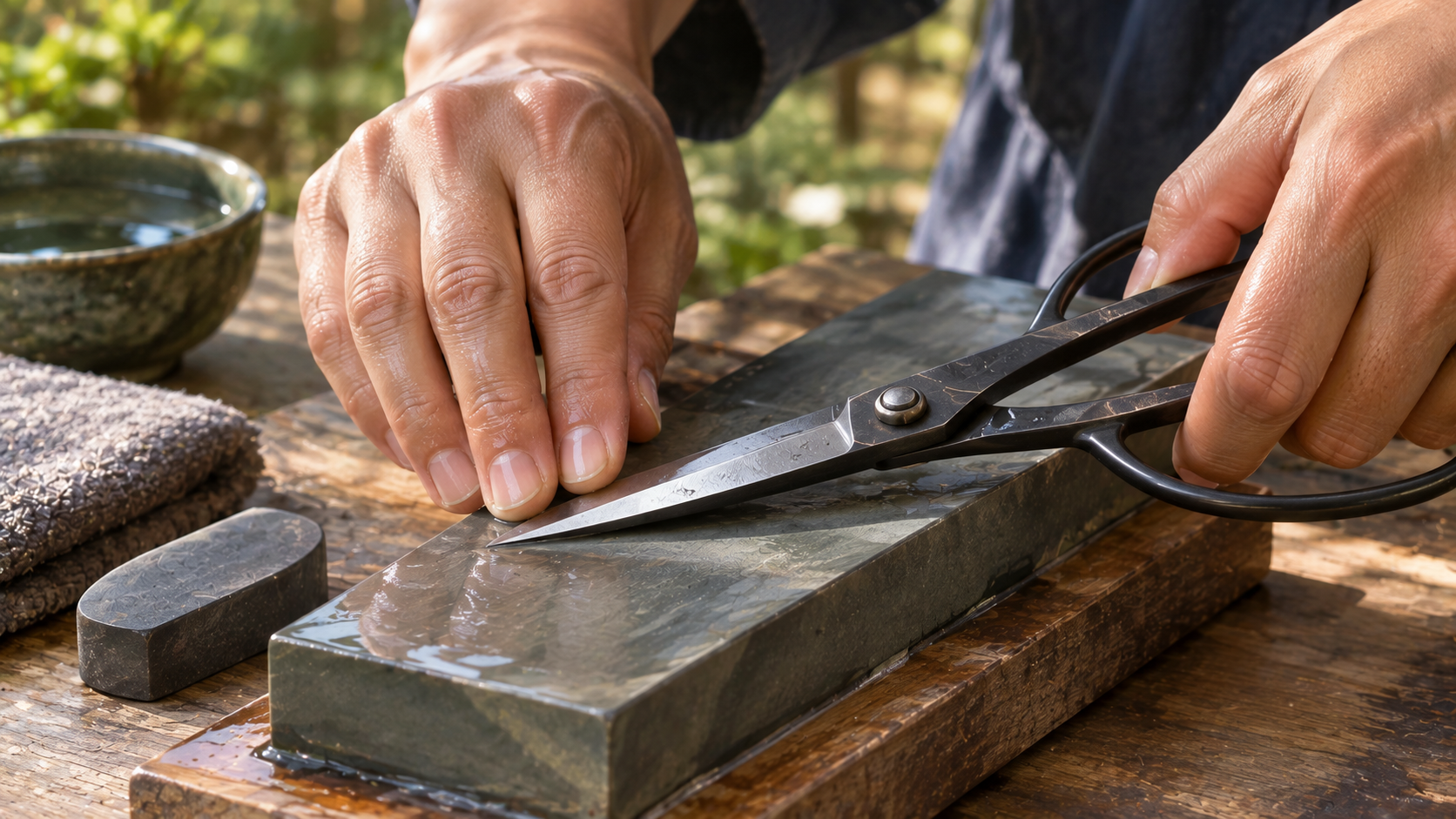
Scissors and shears
Bonsai Outlet’s guide gives a clear method:
- Open the blades fully and color the bevel with a black marker.
- Soak the stone and keep it wet throughout.
- Start on the coarse side if the edge is dull or nicked, using smooth, consistent strokes. Match the number of strokes on both blades.
- Polish on the fine side with fewer strokes.
- Check the marker. If it’s removed along the whole bevel, your angle is right. If only at the tip, the angle is too high. If only at the base, it’s too low.
- Remove the burr by laying the flat back nearly flat on the fine stone and making a few light strokes. Don’t raise the back.
- Test with a light thumb pass across the edge, not along it, or by cutting paper.
Bonsai Outlet notes the bevel is typically around 30 degrees, and stresses keeping the existing angle. Our bonsai shears guide covers the scissors themselves.
Concave and knob cutters
These are the hardest to sharpen.
- Use a cylindrical or curved stone that fits the inside curve. Don’t use a flat stone on the interior.
- Sharpen the inside gently, removing as little material as possible.
- Lightly finish the outside flat face to remove the burr.
Dupuich describes using cylinders, gouged blocks and small stones, and working slowly. On bonsai forums, even experienced growers admit they find concave cutters tricky, so don’t rush. If you’re unsure, practice on an inexpensive cutter first. Our concave cutter guide and knob cutter guide cover these tools.
Wire cutters and jin pliers
Most sharpening guides we found don’t give detailed instructions for these. Wire cutters have short, symmetrical jaws, and getting both edges to meet perfectly is difficult at home. Unless you’re confident, these are good candidates for a professional sharpener.
When to use a professional sharpening service
Sometimes it’s simply better to send tools out.
On Bonsai Nut, one poster says a bonsai Facebook group recommended Bruce’s Sharpening Service in Pennsylvania, and suggests that most reputable local tool sharpening services or bonsai professionals can do the job well, as long as you ask them to keep the original bevel angle. The same poster suggests calling bonsai shops to ask whether they sharpen in-house or send tools out.
Consider a professional if:
- A blade is chipped, bent or badly damaged.
- You have expensive tools like Masakuni and don’t want to risk them.
- You need wire cutters or jin pliers sharpened.
- You simply don’t have the time.
How often should you sharpen bonsai tools?
There’s no fixed schedule. Dupuich sharpens tools “when they dull.” Signs it’s time include:
- Scissors folding or crushing soft shoots.
- Needing extra force to cut.
- Rough or torn cut surfaces.
- Small visible nicks on the edge.
Regular cleaning and oiling make a big difference to how often you need to sharpen. Steel type matters too; our stainless vs carbon steel guide explains the differences.
Common bonsai tool sharpening mistakes
Grinding the flat back of scissors. This can stop the blades meeting.
Using a flat stone inside a concave cutter. It can’t follow the curve.
Changing the bevel angle. Keep the original angle.
Removing too much metal. Check often and go slowly.
Starting with the coarsest stone every time. Only use coarse grits for repair.
Forgetting to oil afterwards. Fresh edges rust quickly.
Conclusion: start simple, go slowly
Sharpening bonsai tools isn’t as hard as it looks. For most growers, a 1000/6000 combination stone for scissors and one curved stone for concave cutters cover almost everything. Add a coarser stone if your tools are damaged, and diamond files for quick touch-ups.
Keep the original angle, remove as little metal as possible, never grind the back of scissors, and oil your tools afterwards. For damaged blades, wire cutters or expensive tools, a professional sharpener is a sensible choice.
Look after your edges, and your tools will make cleaner cuts and healthier trees for years.
Ready to sharpen? Search 1000/6000 combination whetstones on Amazon, or check Bonsai Tonight’s small sharpening stone.