Affiliate disclosure: Some links on this page are affiliate links. If you buy through them, Aribonsai may earn a small commission at no extra cost to you. It doesn’t change what we recommend or how we rank anything.
Watering is the job you do most, and think about least
Ask a bonsai teacher what kills the most trees, and the answer usually isn’t pests or bad pruning. It’s watering.
Too little, too much, or simply done badly. A regular garden hose on full blast blasts soil out of a shallow pot. A cheap watering can with big holes pours a stream that runs straight off the surface and out the drainage holes, leaving the middle of the root ball dry. Moss gets washed away. Fine top dressing ends up on the bench.
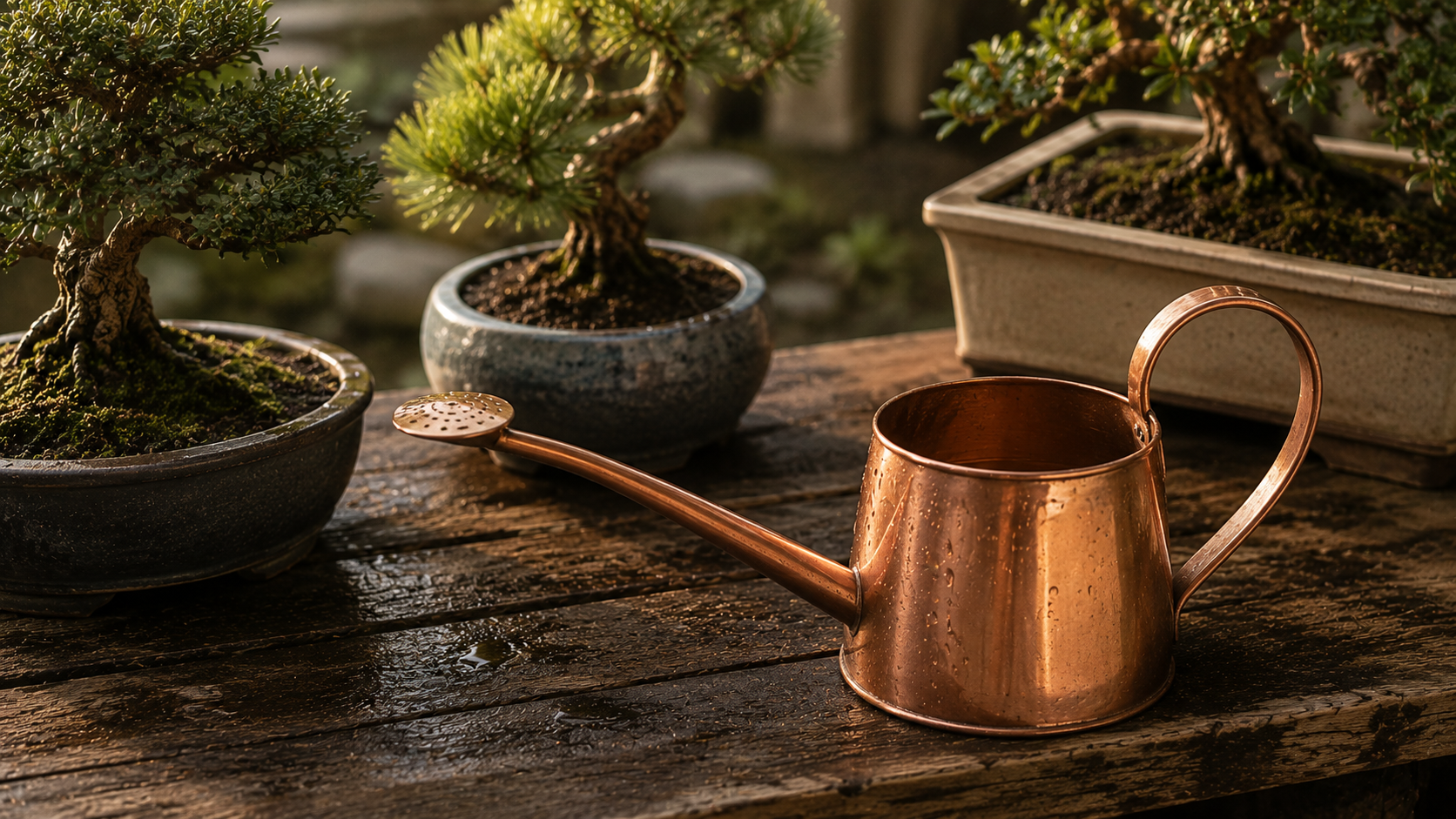
That’s why Japanese bonsai watering tools look the way they do. Long spouts to reach into the middle of a bench. Very fine roses (the perforated head at the end of the spout) that turn water into a soft shower. Copper and brass that last for decades.
The catch is the price. A good Japanese copper watering can easily costs more than a premium concave cutter. So the question is whether you actually need one, or whether something simpler does the job.
In my experience, the right answer depends mostly on how many trees you have. A couple of trees on a windowsill and a full outdoor bench are completely different watering problems.
Who this article is NOT for
It’s not for you if you’re looking for an automatic watering system. Drip lines, timers and misting systems are useful, especially when you travel, but they’re a separate topic.
It’s not a watering schedule guide. How often to water depends on the tree, the soil, the pot, the weather and the season. We’ll talk about tools, not timing.
It’s not for you if you only want the cheapest can that holds water. Plenty of basic cans work. We include one practical option, but most of this guide is about tools made for bonsai.
Still here? Let’s go.
How we picked these (3 things that actually matter)
1. Can or hose nozzle
This is the first decision, and it depends on your collection.
A watering can is best for indoor trees, a few trees on a balcony, or careful watering of small and delicate trees. You control the flow precisely, and you don’t need a tap nearby.
A hose-end watering nozzle (or wand) is how most serious growers water a full bench. Kaneshin sells a whole range of brass and copper watering nozzles that attach to a hose, some with a built-in tap (“cock”) to control the flow. Eastern Leaf in the US also sells Japanese-made watering wands. Once you have more than a dozen trees, carrying a can back and forth gets old quickly.
Many people end up with both: a nozzle for daily watering and a small can for delicate jobs.
2. How fine the water is
This matters more than anything else about the tool.
A fine rose turns the water into a soft shower. It soaks the soil evenly without washing it out of the pot or splashing it around. That’s especially important with granular bonsai soils like akadama, which can be displaced by a heavy stream, and with moss or fine top dressing.
The finest nozzles are remarkable. Kaneshin’s KYOZEN copper nozzle, for example, has 1,261 tiny holes of about 0.18–0.2mm, and the maker says the water is “very soft and gentle on plants” with minimal soil splashing.
3. Material, capacity and weight
Copper is the traditional choice for Japanese watering cans. It’s durable, develops a patina over time and looks beautiful. It’s also expensive and heavier than plastic. One Japanese seller of a Kaneshin copper can claims copper “has a bactericidal action, so you can always keep fresh water in the bonsai.” Treat that as the seller’s description rather than a proven benefit.
Brass is common for hose nozzles. It’s durable and cheaper than copper.
Capacity is a balance. A bigger can means fewer trips to the tap, but water is heavy. A full 4L can holds about 4kg of water before you add the weight of the can itself.
A few habits that matter more than the tool.
- Water in two passes. Give each tree a light watering, move on to the next, then come back for a second, thorough pass. The first pass wets the surface so the second soaks in instead of running off.
- Check the drainage holes. Water should run out of the bottom of the pot. If it doesn’t, the root ball hasn’t been fully soaked.
- Aim at the soil, not the foliage. A fine spray over the leaves can be useful for rinsing dust, but the roots are what need the water.
- Let the tap water sit if you use a can. Many growers fill cans and leave them for a while before watering, so the water isn’t ice-cold from the tap in winter or hot from a sun-baked hose in summer.
- Watch the weather, not the calendar. A hot, windy day can dry a shallow pot far faster than a cool, still one. Checking the soil before watering beats watering on a fixed schedule.
None of this needs expensive equipment. But a fine spray makes every one of these habits easier.
Prices below are approximate and were checked in October 2026. Yen prices are from Japanese stores before international shipping.
Comparison table
| Tool | Type | Material | Size | Approx. price | Best for |
|---|---|---|---|---|---|
| Haws Handy Watering Can | Can | Metal (British brand) | 1 pint | ~$27 | Indoor trees, budget |
| Japanese Copper Watering Can (Eastern Leaf) | Can | Copper, made in Japan | 0.9L | ~$179 | Small collections, a Japanese can at a lower price |
| Japanese Copper Longreach (Eastern Leaf) | Can | Copper, made in Japan | 2L / 4L | ~$429 / ~$529 | Reaching across a bench |
| Masakuni Copper Watering Can No.6 | Can | Copper | About 970mm long, 1,030g | ~¥45,400 | Premium traditional can |
| Kaneshin Brass and Copper Watering Nozzles | Hose nozzle | Brass or copper | 330–610mm | ~¥3,000–14,000 | Watering a full bench |
| Kaneshin KYOZEN Copper Nozzle | Hose nozzle | Copper | Short / medium | ~¥19,000 / ¥21,000 | The finest spray, shohin |
Individual reviews
1. Haws Handy Watering Can (1 pint)
The practical budget pick, and the only one here that isn’t Japanese.
Eastern Leaf sells the Haws Handy watering can in several colors for $26.95. It’s a small metal can holding about a pint. Haws is a British watering can maker, and Bonsai Outlet also carries its Heritage plastic can with a fine brass-faced rose for $26.95.
A small can like this is perfect for a few indoor trees. It’s light, easy to control and doesn’t take up space.
Pros
- Affordable
- Small and easy to control indoors
- From a long-standing watering can maker
- Several colors
Cons
- Small capacity, so not practical for outdoor benches
- Not Japanese, if that matters to you
- No long reach
Who it’s for: Growers with a few indoor or windowsill trees. It also works as a second can for careful jobs, even if you water your bench with a hose.
2. Japanese Copper Watering Can, 0.9L (Eastern Leaf)
The most affordable Japanese copper can we found from a US retailer.
Eastern Leaf lists a 0.9L Japanese copper watering can at $179, made in Japan. That’s a lot for a small can, but it’s far below the price of the long-reach copper cans.
For a small collection, 0.9L is enough to water several small or medium trees in one fill. And it gives you the feel and fine control of a proper Japanese can without the larger investment.
Pros
- Japanese copper can, sold by a US retailer
- Small enough to handle easily
- Much cheaper than long-reach copper cans
- Will last for many years with care
Cons
- Still expensive for its capacity
- Small, so frequent refills for bigger collections
- Copper needs some care to manage patina
A note on copper care: copper darkens and develops a patina over time. That’s normal and many people like it. Niwaki, describing another Japanese copper can, notes that wiping it dry after use slows the process. If you want to keep it bright, dry it after watering. If you like the aged look, just let it be.
Who it’s for: Growers with a small collection who want a real Japanese watering can.
3. Japanese Copper Longreach, 2L / 4L (Eastern Leaf)
The classic long-spouted bonsai can.
Eastern Leaf sells Japanese copper long-reach cans in 2L ($429) and 4L ($529), made in Japan. The long spout lets you reach the back of a bench and water from a distance, without leaning over and knocking branches.
These are serious purchases. But for growers with a full bench who prefer hand watering, a long-reach can is a tool you buy once.
In my experience, the long spout is what people notice most when they switch. You stop reaching over trees, and you start watering more carefully because the flow lands exactly where you aim it.
Pros
- Long spout for reaching across a bench
- Two capacities
- Made in Japan, sold by a US retailer
- A traditional tool that can last decades
Cons
- Very expensive
- Heavy when full, especially the 4L
- Overkill for small collections
Who it’s for: Growers with an outdoor bench who prefer watering by hand, and who see watering as part of the hobby rather than a chore.
4. Masakuni Copper Watering Can No.6
The premium traditional option from Japan.
A Japanese export store lists Masakuni’s copper watering can Size No.6 at about ¥45,400. It’s about 970mm long, weighs 1,030g, and comes with two copper nozzles. Check the capacity with the seller before buying, as the listing we saw didn’t make it clear.
This is the kind of can you see in Japanese bonsai gardens. It’s also bulky, so shipping from Japan will add a fair amount.
Pros
- Masakuni’s craftsmanship and reputation
- Long reach
- Two copper nozzles included
- A tool that can last a lifetime
Cons
- Expensive, plus international shipping
- Large and heavy
- Capacity isn’t clearly stated on the listing we saw
Who it’s for: Serious growers and collectors who want a traditional Japanese can and already trust Masakuni.
5. Kaneshin Brass and Copper Watering Nozzles
The practical choice for anyone watering a full bench.
Kaneshin sells a long list of hose-end watering nozzles. A few examples from its Japanese store:
- Brass nozzle No.125A / No.125B (330mm / 545mm): about ¥3,000
- Brass nozzle with tap No.127C / No.127D (375mm / 580mm): about ¥9,000
- Copper nozzle No.125BS / No.125BL (330mm / 500mm): about ¥9,000
- Copper nozzle with tap No.126BS / No.126BL (350mm / 550mm): about ¥14,000
A built-in tap lets you stop the water between trees without walking back to the tap. Longer models help you reach across a bench.
If you’re in the US, Eastern Leaf also sells Japanese-made watering wands: a chrome-plated version at $39, and brass and copper versions at $129.
Pros
- Much cheaper than a copper can
- No refilling, so ideal for many trees
- Options with a built-in tap
- Wide range of lengths and materials
Cons
- Needs a hose and tap nearby
- Less precise than a can for very delicate work
- Shipping from Japan adds cost; US options cost more
Who it’s for: Anyone with more than a handful of trees outdoors. If you’re unsure where to start, a basic brass nozzle is an inexpensive way to find out how much easier hose watering is.
6. Kaneshin KYOZEN Copper Watering Nozzle
The finest spray on this list.
KYOZEN comes in a short version (No.124, about ¥19,000) and a medium version (No.1241, about ¥21,000). It attaches to a hose. Kaneshin says it’s handcrafted by professional bonsai artists, with 1,261 micropores of about 0.18–0.2mm, and designed for shohin and delicate plants. Replacement mesh is sold separately.
This is a specialist tool. For most trees, a regular fine nozzle is plenty. But for shohin in tiny pots, seedlings, moss or very fine soil, a spray this soft makes a real difference.
Pros
- Extremely fine, gentle spray
- Minimal soil splashing
- Made for shohin and delicate plants
- Replacement mesh available
Cons
- Expensive for a hose nozzle
- Slower to water large trees thoroughly
- Needs a hose connection
It’s also worth thinking about if you’ve recently repotted into fine, freshly sifted soil. That’s when soil is most easily disturbed, and a softer spray helps it settle without washing out of the pot.
Who it’s for: Shohin growers and anyone with very delicate plantings.
Recommendation by use case
“I have a few indoor trees.” Haws Handy Watering Can. Simple, cheap and easy to control.
“I want a real Japanese watering can without spending a fortune.” Japanese Copper Watering Can, 0.9L from Eastern Leaf.
“I have an outdoor bench and like watering by hand.” Japanese Copper Longreach (2L or 4L).
“I have a lot of trees and want to water quickly.” Kaneshin hose nozzle, ideally one with a tap.
“I grow shohin in tiny pots.” Kaneshin KYOZEN nozzle, or a small can with a fine rose.
“I want a lifetime traditional can.” Masakuni Copper Watering Can No.6.
Conclusion: buy for the number of trees you water
Here’s the short version.
The best watering tool is the one that makes it easy to water well, every day, without rushing. A few indoor trees don’t need a $500 copper can. A small, simple can with a fine rose is enough. A full outdoor bench is where a hose nozzle with a fine spray, or a long-reach copper can, really earns its place.
Whatever you use, the most important thing is a soft, even flow. Water gently, water thoroughly, and check that water is actually running out of the drainage holes. Shallow Japanese pots dry out faster than you’d expect, which is one more reason to get this right. Our Japanese bonsai pots guide covers how pot depth affects this. And if your trees sit on a turntable, some models can be watered on directly, as covered in our bonsai turntable guide.
Ready to choose?