Affiliate disclosure: Some links on this page are affiliate links. If you buy through them, Aribonsai may earn a small commission at no extra cost to you. It doesn’t change what we recommend or how we rank anything.
The question behind almost every tool purchase
Shop for a Japanese bonsai tool and you’ll hit the same choice again and again. The concave cutter comes in carbon steel or stainless. So does the wire cutter, the knob cutter, the root cutter, the shears. And the stainless version usually costs a lot more, sometimes nearly double.
So is stainless steel worth it? Or is carbon steel, the traditional choice, still the better tool?
The debate over stainless vs carbon steel bonsai tools gets heated online. Some growers say carbon is sharper and stainless is for people who don’t look after their tools. Others say stainless is simply more practical, especially in humid climates or for anyone who works with wet soil and sap every weekend.
The honest answer is that both are good. Neither choice is a mistake. But the right one depends on the tool, your climate, your budget and, most of all, your habits.
In my experience, the people who regret their choice usually bought carbon steel and then never dried it, or bought stainless for a tool they rarely use and paid twice as much for nothing. This guide explains the real differences, then goes tool by tool so you can decide where stainless is worth paying for and where carbon makes more sense.
Who this stainless vs carbon steel guide is NOT for
It’s not a metallurgy lesson. We’ll keep the steel science simple and practical.
It’s not about cheap no-name tools. Some cheap “stainless” tools are soft and dull quickly. This guide compares quality Japanese tools, mainly from Kaneshin, which sells many of the same tools in both carbon and stainless.
It’s not about white steel and blue steel. Those are specialty carbon steels used in some premium shears. They’re mentioned in our bonsai shears guide.
Still with us? Let’s go.
How we compared them (3 things that actually matter)
1. Rust and maintenance
This is the biggest practical difference.
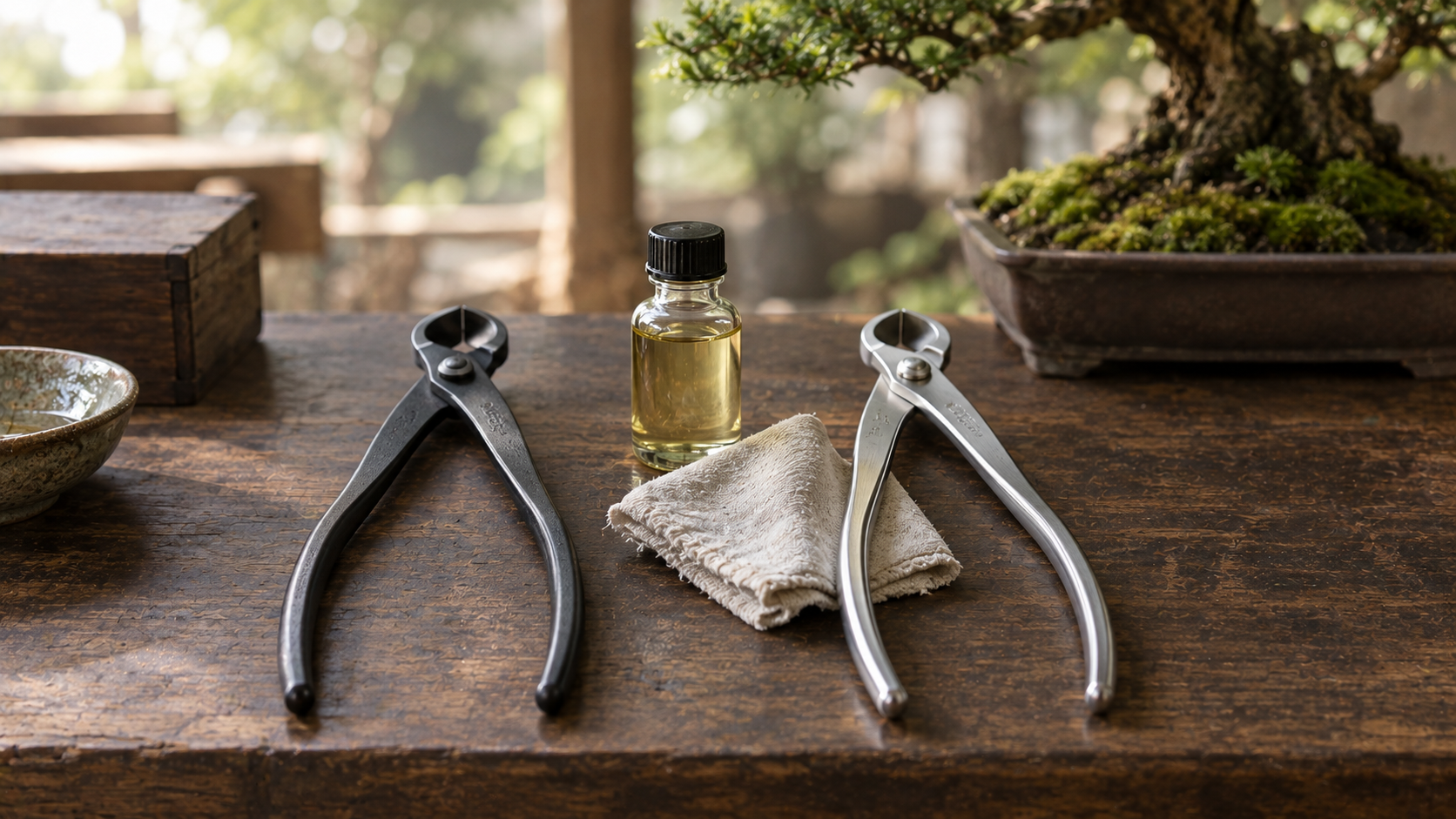
Carbon steel rusts if it’s left wet, dirty or covered in sap. It needs wiping, drying and an occasional coat of oil. Many carbon bonsai tools have a black finish, which helps a little, but the cutting edges are still bare steel.
Stainless steel resists rust much better. It still benefits from cleaning, and it isn’t completely rustproof, but it forgives the occasional forgotten tool left on the bench overnight.
There’s also a middle option. Masakuni’s 8000 series, for example, is described by a retailer as high-carbon steel with a stainless coating that makes it easier to clean and more rust resistant.
2. Sharpness and sharpening
Carbon steel is the traditional choice for Japanese blades because it takes a very keen edge and is generally easier to sharpen at home. Many growers feel carbon tools have a slightly crisper, more precise cut.
Stainless tools from good Japanese makers are also sharp, and for most hobbyists the difference in everyday cutting is small. But many growers find stainless a little harder to resharpen themselves. If you plan to sharpen your own tools, carbon is usually the easier steel to work with.
3. Price
Stainless almost always costs more. Here are Kaneshin prices from Japanese stores, collected while writing our individual tool guides:
- Concave cutter: about ¥9,600–10,400 in carbon vs about ¥19,200 for the stainless No.802
- Wire cutter: about ¥10,600 in carbon vs about ¥21,200 for the stainless No.815
- Shears: about ¥9,600–10,200 in carbon vs about ¥12,900 for the stainless No.827B
So for some tools, stainless roughly doubles the price. For others, like shears, the gap is much smaller.
A few steel-neutral habits that matter more than the material
None of these cost anything, and they make either steel last for decades.
- Wipe tools after every session. Sap and soil damage edges and cause rust.
- Dry them completely. Especially after repotting or watering.
- Oil the edges and joints occasionally. Camellia oil is the traditional choice. Our bonsai tool maintenance guide covers oils, rust erasers and stones.
- Remove light rust early. A rust eraser takes it off before it pits the steel.
- Use each tool only for its job. Damage from misuse matters more than steel type.
- Store tools dry. A damp shed undoes everything else.
Stainless vs carbon steel bonsai tools: comparison table
| Carbon steel | Stainless steel | |
|---|---|---|
| Rust resistance | Low, needs drying and oiling | High, more forgiving |
| Sharpness | Very keen edge | Sharp, many feel slightly less crisp |
| Home sharpening | Generally easier | Many growers find it harder |
| Price (Kaneshin) | Lower | Often 30–100% more |
| Look | Often black finish | Silver, polished |
| Best for | Careful owners, budgets, home sharpeners | Humid climates, wet work, busy growers |
Tool by tool: where stainless is worth it
1. Root cutters – stainless is most worth it here
If there’s one tool where stainless really makes sense, it’s the root cutter. Root cutters spend their life in wet, gritty soil, often for hours during a repotting session. Carbon steel root cutters are perfectly usable, but they’re the tool most likely to rust if you’re not careful.
In our bonsai root cutter guide, Kaneshin’s carbon No.13 / No.13A cost about ¥12,000 each, while the stainless No.812 / No.813 cost about ¥22,100 each.
Carbon pros: much cheaper, easy to sharpen. Stainless pros: handles wet soil and long repotting sessions without rust.
Verdict: Stainless, if you repot often. Carbon is fine for a few trees a year.
2. Concave cutters – carbon for most, stainless for humid climates
The concave cutter is the tool where cut quality matters most, and where many growers like the crisp edge of carbon steel.
In our bonsai concave cutter guide, Kaneshin’s carbon concave cutter is our pick for most people, at about $65–90. The stainless Master Grade No.802 costs about $120–137, and Yagimitsu’s stainless cutter is about $139–149.
Carbon pros: great value, keen edge, easy to sharpen. Stainless pros: low maintenance, good in humid climates.
Verdict: Carbon for most growers. Stainless if you live somewhere humid or know you won’t oil your tools.
3. Wire cutters – usually carbon
Wire cutters don’t touch sap and soil as much as other tools. They mostly cut aluminum and copper wire, which wears the edge in its own way, and many growers sharpen or replace wire cutters less often than cutting tools.
In our bonsai wire cutter guide, Kaneshin’s carbon No.22A costs about ¥10,600, while the stainless No.815 costs about ¥21,200, roughly double.
Carbon pros: half the price, plenty durable. Stainless pros: low maintenance if your hands are often wet.
Verdict: Carbon for most growers. Stainless only if rust has been a real problem for you.
4. Knob cutters – carbon for most people
Knob cutters are used less often than shears or concave cutters, usually for cleaning up stubs and old wounds.
Kaneshin’s carbon knob cutters (No.9, No.10, No.11) cost about ¥10,600 each, while the stainless No.810 is about ¥21,200. Yagimitsu’s stainless knob cutter is around £125 at a UK retailer.
Carbon pros: much cheaper, sharp. Stainless pros: less maintenance.
Verdict: Carbon for most people, since it’s used occasionally. Stainless if you prefer a fully stainless kit.
5. Shears – a close call
Shears are used constantly, often on wet foliage and sappy shoots. They’re also the tool where the price gap is smallest.
Kaneshin’s carbon satsuki shears cost about ¥9,600–10,200, and the stainless No.827B costs about ¥12,900. For a relatively small difference, you get a pair that shrugs off sap and moisture.
Carbon pros: keen edge, easy to sharpen, lots of steel options, including blue steel. Stainless pros: low maintenance for your most-used tool, small price premium.
Verdict: A genuine toss-up. Stainless is great value here if you dislike maintenance. Carbon if you enjoy sharpening or want specialty steel.
6. Jin pliers – usually carbon
Jin pliers mostly handle wire and deadwood, not living tissue, so an ultra-keen edge matters less.
Kaneshin’s carbon No.49 costs about ¥9,300, while the stainless No.818 is about ¥19,200 and the No.819 around £120 in the UK.
Carbon pros: less than half the price, strong and durable. Stainless pros: low maintenance.
Verdict: Carbon for nearly everyone.
Which should you choose? (By situation)
You’re a beginner on a budget: carbon steel for everything. Learn good cleaning habits from day one.
You live somewhere humid or rainy: stainless for shears, concave cutter and root cutter; carbon for the rest.
You repot a lot of trees: stainless root cutter at minimum.
You know you won’t oil your tools: stainless for the tools you use most.
You like sharpening your own tools: carbon throughout.
You want one “buy once” upgrade: a stainless root cutter or stainless shears.
You want the premium look and feel: Masakuni’s coated carbon 8000 series is a middle ground.
A sensible mixed kit
Many experienced growers end up with a mix: carbon concave cutter, wire cutter, knob cutter and jin pliers, plus stainless shears and a stainless root cutter. That puts the extra money where moisture and sap are worst.
How to tell carbon from stainless when shopping
It isn’t always obvious from a photo, so here are a few quick checks.
Look at the finish. Many Japanese carbon steel bonsai tools have a black finish. Stainless tools are usually silver and polished. But this isn’t a perfect rule: some carbon tools are polished, and some coated tools, like Masakuni’s 8000 series, look silver while being carbon steel underneath.
Read the listing carefully. Good retailers state the steel clearly. If a listing only says “steel” or “high-quality steel,” assume it’s carbon unless stated otherwise.
Check the model number. In Kaneshin’s range, many stainless models carry numbers in the 800s, such as the No.802 concave cutter, No.810 knob cutter, No.812 and No.813 root cutters, No.815 wire cutter, No.818 and No.819 pliers, and No.827B shears. Carbon models typically have lower numbers. It’s a useful shortcut, but always confirm with the retailer.
Watch out for “black-coated” tools. Wazakura’s hand-forged tools, for example, are carbon steel (S55C or S58C) with a black coating. The coating helps with rust resistance, but the cutting edge is still carbon steel and needs the same care.
A two-minute care routine for carbon steel bonsai tools
If you choose carbon steel, this simple routine is all it takes to keep it rust-free.
- Wipe off sap and soil with a damp cloth straight after use.
- Dry the tool completely, including the joint and the inside of the jaws.
- Remove any spots of rust with a rust eraser before they spread.
- Apply a drop of camellia oil to the blades and joint, then wipe off the excess.
- Store it in a dry place, ideally in a tool roll so edges don’t knock together.
Do that after each session and carbon steel will last for decades. Skip it regularly and even the best carbon tool will start to pit.
Stainless needs a lighter version of the same routine: wipe, dry, and oil the joint occasionally. It’s less fussy, not maintenance-free.
Does climate really make a difference?
Yes, and it’s one of the most practical ways to decide.
Humid and rainy climates are hardest on carbon steel. If your tools sit in a garden shed or garage where the air is often damp, rust can appear even on clean tools. Stainless makes much more sense here, at least for the tools you use most.
Dry climates are much kinder to carbon steel. With basic cleaning, carbon tools can stay rust-free for years with very little effort.
Coastal areas add salt to the air, which speeds up rust. Stainless is worth considering here, and storing tools indoors helps either way.
If you’re not sure, look at your other garden tools. If your pruners and garden shears rust easily, your carbon bonsai tools will too.
Quick answers to common questions
Is stainless worth it for beginners? Usually not for every tool. Beginners are often on a budget, and carbon steel teaches good care habits early. If you want one stainless tool, make it the root cutter or the shears.
Is carbon steel really sharper? Many growers feel carbon steel gives a slightly crisper cut and holds a very keen edge. For most hobbyists, though, a quality Japanese stainless tool is more than sharp enough, and the difference in everyday use is small.
Can I sharpen stainless tools myself? Yes, but many growers find it takes more effort than carbon. If you plan to sharpen often, carbon is easier. If you rarely sharpen, it matters less.
Will carbon steel tools rust immediately? No. Quality Japanese carbon tools only rust if they’re left wet, dirty or stored in damp conditions. Wiping and drying after use prevents most problems.
What about premium brands like Masakuni? Masakuni’s standard tools are carbon steel, and its 8000 series uses a stainless coating over high-carbon steel. It sits between plain carbon and full stainless in maintenance. Our Kaneshin vs Masakuni comparison covers both brands tool by tool.
Should my whole kit be the same steel? No. Mixing steels is common and sensible. Put your money into stainless where moisture is worst, and save on the rest.
Common stainless vs carbon steel mistakes
Buying carbon and never drying it. Rust is the number one reason good carbon tools wear out early.
Paying for stainless on tools you rarely use. A knob cutter used a few times a year doesn’t need it.
Assuming stainless never rusts. It resists rust, but it still needs cleaning.
Buying cheap “stainless” tools. Soft steel dulls quickly, whatever it’s called.
Over-sharpening. Light, regular honing is better than aggressive sharpening for either steel.
Conclusion: buy carbon where you can, stainless where it counts
When it comes to stainless vs carbon steel bonsai tools, there’s no wrong answer. Carbon steel is sharp, traditional, easier to sharpen and much cheaper. Stainless is more forgiving and makes sense where moisture and sap are constant.
For most growers, the smart approach is a mixed kit: carbon for most tools, stainless for the root cutter and possibly the shears. And whatever you choose, the habit of wiping, drying and oiling after each session matters far more than the steel. A well-kept carbon tool will outlast a neglected stainless one, and both will serve you for many years if you treat them well.
Ready to choose? Compare Japanese concave cutters in both steels, or search Kaneshin stainless bonsai tools on Amazon.