Affiliate disclosure: Some links on this page are affiliate links. If you buy through them, Aribonsai may earn a small commission at no extra cost to you. It doesn’t change what we recommend or how we rank anything.
The dust at the bottom of the bag
A bonsai soil sieve is the least exciting tool on the bench, and one of the most useful.
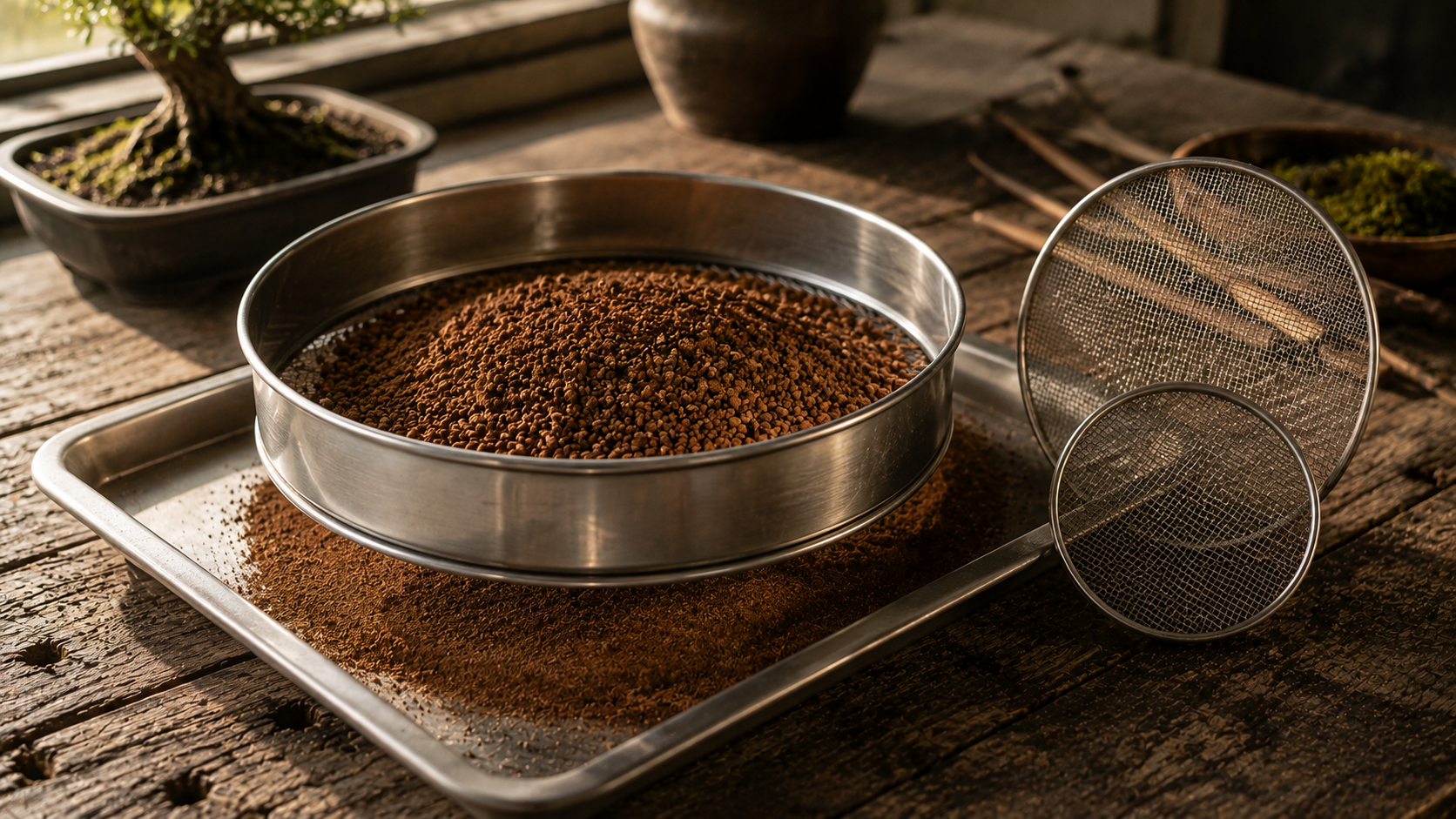
Here’s why. Open a bag of akadama, pumice or lava, and tip it out. Most of it looks great: clean, even grains. But at the bottom there’s always a layer of dust and broken bits. Pour that straight into a pot and it settles between the grains, fills the air gaps, and slowly turns a free-draining mix into something closer to mud.
Sifting fixes that. Shake the soil through a screen, and the dust falls out while the usable grains stay behind. With a few screen sizes, you can also sort soil into small, medium and large grains for different trees.
Then there’s getting the soil into the pot. A regular garden trowel is too big and too clumsy for most bonsai pots. A narrow soil scoop lets you pour soil exactly where you want it, between roots and into the gaps under the trunk, without spilling it across the bench.
In my experience, these two tools make more difference to repotting than most people expect. Not because they’re clever, but because they make the careful way of doing things the easy way.
This guide compares two soil sieve sets and three soil scoop sets, and explains what to look for. We’ve kept it to tools you can buy outside Japan, and noted clearly where each one is made, because a “Japanese” brand name doesn’t always mean a Japanese factory.
Who this bonsai soil sieve guide is NOT for
It’s not for you if you only use pre-sifted, ready-made bonsai soil. Some soils are sold already sifted. You’ll still benefit from a scoop, but a sieve matters less.
It’s not a repotting tutorial. We’ll mention how these tools fit into repotting, but timing, root pruning and aftercare are separate topics.
It’s not about large garden riddles. Big soil riddles for vegetable beds work, but they’re usually too coarse and too large for bonsai soil. A kitchen colander isn’t a great substitute either. The holes are usually too uneven to sort grains by size, though it can remove the worst of the dust in a pinch.
Still here? Let’s go.
How we picked these (3 things that actually matter)
1. Screen sizes that match your soil
This is what makes a bonsai soil sieve useful.
Bonsai soil grains are usually sold in sizes like 1–3mm, 3–5mm and 5–7mm, with larger grains for big trees. A good sieve set has several screens so you can:
- remove dust and fines (anything smaller than about 1–2mm),
- separate small grains for shohin and small pots,
- separate larger grains for bigger trees or the bottom drainage layer.
Some sets give the openings in millimeters. Others use “mesh” numbers, which count holes per inch. As a rough guide, a 4-mesh screen has openings of about 4.75mm, a 5-mesh screen about 4mm, and a 10-mesh screen about 2mm. The higher the mesh number, the finer the screen.
2. Size and build
Smaller sieves (around 210mm, or 8 inches) are easy to handle and store, and fine for a few trees. Larger sieves (around 12 inches) process more soil at once, which helps when you’re repotting several trees in a day.
Stainless steel frames last well outdoors. Check what the screens themselves are made of. Some sets use iron mesh, which can rust if left wet.
3. Scoop size and shape
Soil scoops usually come in sets of three sizes. Small scoops are for shohin and filling tight gaps. Larger scoops move more soil quickly into bigger pots.
Two features are worth looking for:
- A narrow, rounded tip, so you can direct soil precisely between roots.
- A built-in mesh in the larger scoop, which filters a little dust as you pour.
A simple sifting routine
You don’t need a complicated system. This is how most growers use a bonsai soil sieve on repotting day:
- Start with the finest screen. Shake the soil through it over a bucket or tray. Everything that falls through is dust and fines.
- Move up a size if you’re sorting grains. Put what stayed on the first screen through the next screen. The grains that pass through are your small size. The ones that stay behind are your medium or large size.
- Keep each size in its own container. A few buckets or tubs, labeled by size, save a lot of time later.
- Mix only what you need. Blend your sifted components just before potting, so you can adjust the mix for each tree.
- Sift outdoors or over a tray. Akadama dust in particular gets everywhere.
It helps to sift dry soil. Wet soil clumps and clogs the screens, and the fines stick to the larger grains instead of falling through.
What to do with the fines? Don’t throw them straight in the bin. Many growers use the sifted-out dust in ordinary garden beds or containers for non-bonsai plants, where fine particles aren’t a problem. Just keep them out of your bonsai pots.
Prices below are approximate and were checked in October 2026. Stock changes often for these items.
Bonsai soil sieve and scoop comparison table
| Product | Type | Size | Screens / pieces | Material | Approx. price | Best for |
|---|---|---|---|---|---|---|
| Wazakura 3-Piece Soil Sieve Set | Sieve | 210mm | 3 screens: 1mm, 3mm, 5mm | Stainless frame, iron mesh | ~$50 | Small collections, compact storage |
| Bonsai Outlet 12″ Soil Sieve Set | Sieve | About 12″ | 3 screens: 4, 5 and 10 mesh | Stainless frame | ~$24 | Sifting larger batches |
| Japanese Heavy Duty Soil Scoop Set (House of Bonsai) | Scoops | 6.25″ / 6.5″ / 6.75″ | 3 scoops, large with mesh | Stainless, made in Japan | ~$25 + shipping | All-round repotting |
| Kaneshin Stainless Mini Soil Scoops No.1514 | Scoops | Small / medium / large | 3 scoops | Stainless | ~¥4,800 | Small bonsai |
| Wazakura Curved Mini Soil Scoop | Double-ended scoop | 255mm overall | 1 tool, 2 scoop ends | Stainless, made in Japan | ~$25 | Shohin and tight spaces |
Bonsai soil sieve and scoop reviews
1. Wazakura 3-Piece Soil Sieve Set (210mm)
A compact bonsai soil sieve with three interchangeable screens.
Bunton Bonsai lists this set at $49.95. It’s 210mm across and 65mm high, weighs 245g, and comes with screens of 1mm, 3mm and 5mm. The frame is stainless steel and the mesh is iron. It was sold out when we checked.
One thing to note: product listings don’t agree on where it’s made. Some marketplace listings describe it as made in Japan, while Bunton Bonsai lists it as manufactured in China for Wazakura. If origin matters to you, check the listing you buy from.
Pros
- Three useful screen sizes in millimeters
- Compact, light and easy to store
- One frame with interchangeable screens
Cons
- Iron mesh can rust if left wet
- Small diameter means more batches for big repotting days
- Origin varies between listings, and stock can run out
The 1mm screen is the standout feature. It’s fine enough to remove most dust without losing usable grains, which is exactly what you want when sifting akadama for small pots. To keep the iron mesh in good shape, let the screens dry fully before storing them.
Who it’s for: Growers with a small collection who want a compact, easy-to-use bonsai soil sieve.
2. Bonsai Outlet 12″ Soil Sieve Set
A larger bonsai soil sieve for bigger batches.
Bonsai Outlet sells this set for $24. It’s about 12 inches across with a stainless steel frame and three interchangeable screens: 4 mesh, 5 mesh and 10 mesh. The listing describes it as made for sorting aggregates like pumice, lava rock and pine bark by particle size, and for removing dust and fines that can hurt drainage. It doesn’t state the country of origin.
Using our rough conversion, the screens are about 4.75mm, 4mm and 2mm. That’s good for removing fines and separating medium from larger grains, though there’s no very fine screen for shohin soil.
Pros
- Larger diameter for faster sifting
- Lower price than the smaller Wazakura set
- Stainless frame
Cons
- Mesh sizes are fairly coarse for shohin soil
- Origin isn’t stated
- Takes more space to store
In my experience, a bigger sieve is one of those things you don’t think you need until your first big repotting day. Sifting a whole bag through an 8-inch screen, a handful at a time, gets tedious quickly.
Who it’s for: Growers who repot several trees at once and want to sift soil quickly, without spending much.
3. Japanese Stainless Steel Heavy Duty Soil Scoop Set (House of Bonsai)
A practical, Japanese-made scoop set for everyday repotting.
House of Bonsai sells this 3-piece set for $25 before tax, with shipping listed at about $9–9.50. The scoops are 6.25″, 6.5″ and 6.75″ long, made in Japan from stainless steel. The largest has a mesh screen inside to filter out fine dust as you pour.
The retailer describes the tapered, cylindrical shape as easier to grip and less prone to spilling, with a rounded tip for placing soil precisely around the trunk.
Pros
- Made in Japan
- Built-in mesh in the large scoop
- Rounded tip for precise pouring
- Stainless steel, so it won’t rust easily
Cons
- Shipping adds noticeably to the price
- Sizes are close together, so less range than some sets
- Larger trees may still need a bigger scoop
The built-in mesh is a nice touch, but it isn’t a replacement for a proper bonsai soil sieve. It catches a little dust at the last moment, which helps, but sifting the whole batch first still makes the bigger difference.
Who it’s for: Most growers who want one good, Japanese-made scoop set for general repotting.
4. Kaneshin Stainless Mini Soil Scoops, 3-Piece Set (No.1514)
Small scoops for small trees.
Kaneshin’s store lists this stainless 3-piece mini scoop set at about ¥4,800, with individual scoops also sold separately. They’re designed for small bonsai. The listing notes that they’re made outside Japan but produced under the Kaneshin brand.
Kaneshin also lists other scoop options, including black oxide stainless mini scoops, plastic scoops and stainless scoops with mesh, though we couldn’t confirm prices for those.
Pros
- Sized for small pots and shohin
- Stainless steel
- Can buy individual sizes
Cons
- Not made in Japan, despite the Japanese brand
- Sizes aren’t listed on the page
- Shipping from Japan adds cost
Small scoops matter more than they seem with shohin. In a pot only a few centimeters deep, a normal scoop pours far too much soil at once, and it ends up on the bench or piled against the trunk. A small scoop lets you add soil a little at a time and work it in around the roots.
Who it’s for: Shohin growers and anyone working mainly with small or very shallow pots.
5. Wazakura Curved Mini Bonsai Soil Scoop (255mm)
One tool, two scoop ends, designed for precision.
Wazakura’s curved mini scoop is made in Japan from stainless steel. It’s 255mm long overall, with a 125mm handle and scoops of 85mm and 60mm on each end, and it weighs just 60g. It’s listed at $24.99 with free shipping to the US, Canada, the UK and Hong Kong, though it was sold out when we checked.
The angled ends are the point. They’re good for filling tight gaps between roots and the pot wall, which is exactly where larger scoops struggle.
Pros
- Made in Japan
- Two scoop sizes in one tool
- Very light and precise
- Free shipping to several regions
Cons
- Small capacity, so slow for large pots
- Only one tool, not a set
- Stock can run out
It also works well for top dressing, where you only want to add a thin, even layer of fine soil or moss substrate to the surface. The smaller end gives you a lot of control for that kind of finishing work.
Who it’s for: Shohin growers, and anyone who wants a precise scoop alongside a larger set.
Best bonsai soil sieve and scoop by use case
“I have a few trees and want something simple.” Wazakura 3-Piece Soil Sieve Set plus the House of Bonsai scoop set.
“I repot a lot of trees at once.” Bonsai Outlet 12″ Soil Sieve Set for faster sifting.
“I mostly grow shohin.” Wazakura sieve for its fine 1mm screen, plus Kaneshin mini scoops or the Wazakura curved mini scoop.
“I want Japanese-made tools specifically.” House of Bonsai scoop set and Wazakura curved mini scoop, both listed as made in Japan.
“I want the cheapest way to start.” Bonsai Outlet sieve set at $24. Add a scoop set later.
“I already own a sieve and just need better scoops.” House of Bonsai scoop set for general use, plus the Wazakura curved mini scoop for detail work.
Conclusion: sift first, then pour carefully
Here’s the short version, for anyone who skipped straight to the end.
A bonsai soil sieve is the simplest way to keep your soil draining well. Shake out the dust before every repotting, and sort grains by size if you grow trees of different sizes. A good scoop set then lets you place that soil exactly where it’s needed, without spills.
Neither tool is expensive. Together, they make repotting cleaner, faster and kinder to the roots.
If you’re only buying one thing, make it the bonsai soil sieve. Clean, sifted soil helps every tree you repot, every year. A scoop makes the job neater, but you can get by with a spoon for a while. Skipping the sifting step is the one shortcut that tends to show up later, as slow drainage and weaker roots.
If you haven’t chosen your soil yet, our akadama and Japanese bonsai soil guide compares the main options and explains why sifting matters for akadama in particular. And for cutting back roots during repotting, see our root cutter guide.
Ready to choose?