Affiliate disclosure: Some links on this page are affiliate links. If you buy through them, Aribonsai may earn a small commission at no extra cost to you. It doesn’t change what we recommend or how we rank anything.
Why small bonsai pots are harder to buy than they look
Small bonsai have a charm that’s hard to explain until you see a row of them on a bench. A tree you can hold in one hand. A pot no bigger than a teacup. A whole landscape in a few inches.
Then you go looking for the pot.
Search for “mame bonsai pots” or “shohin bonsai pots” and you’ll find two extremes. On one side, cheap, mass-produced pots that look fine in photos and less fine in person. On the other, handmade Japanese pots by named potters that cost more than the tree, sometimes many times more. The middle ground exists, but it’s spread across dozens of shops in different countries, and good small pots tend to sell out quickly.
There’s also a practical problem. Small pots behave differently. They dry out faster, heat up faster in the sun, and leave very little room for mistakes. A pot that looks perfect but has a tiny drainage hole, or no room for a tie-down wire, can make a small tree much harder to keep healthy.
In my experience, the best approach to small pots is to buy in layers: a few inexpensive pots for trees still in development, and one or two good pots for the trees you’re proudest of. This guide is built around that idea. It covers six places to find mame and shohin bonsai pots, from $15 handmade Korean pots to vintage Japanese pieces by famous makers.
Who this mame and shohin bonsai pots guide is NOT for
It’s not for full-size bonsai. If your tree is larger than about 10 inches tall, our Japanese bonsai pots guide covers Tokoname makers in standard sizes.
It’s not for trees that still need to grow a lot. Small pots slow growth. If you’re still thickening a trunk, a bigger container will get you there faster. A small pot is for a tree that’s already close to its final size.
It’s not a deep dive into individual potters. We’ll mention well-known names, but the focus is on where to buy and how to choose.
Still with us? Let’s go.
First, what counts as mame and shohin?
The terms get used loosely, so it helps to be clear.
According to Bonsai Empire, shohin (小品, “a small thing”) generally means a tree under about 10 inches (25 cm) tall, and mame (豆, “bean”) means under about 4 inches (10 cm). Bonsai Empire also notes that no exact rules were ever formulated, and that experts often suggest a shohin should simply be small enough to hold in one hand.
Shohin Bonsai Europe describes mame as the smallest subcategory of shohin, up to about 10 cm, with shohin trees generally reaching about 20 cm measured from the pot rim to the top of the tree.
Pots follow the same rough logic. Shops label things differently, though. One European retailer files pots of 5 to 15 cm under “shohin,” while another labels an 8 cm pot as “mame.” Always check the actual dimensions rather than relying on the label.
How we picked these (3 things that actually matter)
1. Function at a small scale
A small pot still has to do the job of a pot. Look for:
- A drainage hole that’s large enough. In a tiny pot, a small hole can clog easily.
- Room for tie-down wire. Some small pots have separate wire holes; others have one large hole you thread wire through. Either works, as long as the tree can be secured.
- Enough depth for the tree. Very shallow mame pots look elegant, but they hold very little soil and dry out fastest.
2. Quality you can see up close
Small pots are viewed from close range, often at eye level on a display stand. Flaws that disappear on a big pot are obvious on a small one: uneven glaze, rough feet, a lopsided rim. Handmade pots by named potters usually justify their price in the details. Cheaper pots can still be good, but it’s worth looking at clear photos of the actual pot.
3. Price and availability
Good small pots often exist as single, one-off pieces. Many listings show only one in stock, and popular pots sell out. That makes it worth knowing several shops, and being willing to buy when you see a pot you like.
A few small-pot habits that matter more than the pot
None of these cost anything.
- Water more often. Bonsai Empire notes that as pots get smaller, more regular watering and fertilizing is needed. Shohin Bonsai Europe says mame trees demand extra caretaking with watering and detailed pruning.
- Consider a slightly finer soil. On an Australian bonsai forum, an experienced grower suggests protecting trees that dry out first with shade and/or a finer mix. Our soil sieve guide covers how to sort soil by size.
- Protect small pots from midsummer heat. Bonsai Nut members mention shade cloth, partial shade and top dressings like moss as ways to slow drying.
- Keep the tree tied in. Small root balls move easily, and movement damages fine roots.
- Match the pot to the tree, not just the shelf. A pot should suit the tree’s trunk and character.
Mame and shohin bonsai pots comparison table
| Source | Origin of pots | Best for | Approx. price | Notes |
|---|---|---|---|---|
| Herons Bonsai (UK) | Not stated | Budget mame and shohin pots | ~£5–25 | Plastic and ceramic options |
| Wigert’s Bonsai (US) | Korea, China, Japan | Affordable handmade pots | ~$15–28 for many small pots | Korean Miju pots, Chinese etched pots |
| Wazakura | Japan (Banko, Tokoname) | Japanese pots at a mid-range price | ~$33–64 | Free shipping to US, Canada, UK |
| Bonsai Plaza (Europe) | Mostly Japan | Huge selection of named Japanese makers | ~€28–195+ | Thousands of small pots |
| bonsaipots.eu (Europe) | Japan, China | Curated Japanese mame pots | ~€72 for a Shozan mame pot | Small, curated shop |
| Vintage Bigei (Wigert’s, Bonsai Outlet) | Japan | Collector pieces | ~$135–390 | One-of-a-kind |
Prices are approximate, vary by size, maker and exchange rate, and many listings are single pieces. Always check current prices and stock.
The 6 best places to buy mame and shohin bonsai pots, reviewed
1. Herons Bonsai – the budget starting point
If you want to start with small pots without spending much, Herons Bonsai, a UK nursery, has a dedicated mame and shohin pot section.
When we checked, the section listed 33 pots. Ceramic pots ranged from about £10 to £19, including a white crackle glaze square at 7 cm, a blue glazed square at 9 cm, a glazed hexagonal pot at 8.5 cm and an unglazed cascade pot. Several larger rectangular and oval pots around 15.5 to 16 cm come with a drip tray. There were also plastic mame and shohin pots from about £5 to £25, plus tiny mame pots from 2.5 to 5 cm at about £5 each.
The makers and country of origin aren’t stated, so think of these as practical, affordable pots rather than collector pieces. Herons advertises next-day delivery within the UK.
Pros
- Very affordable
- Wide range of tiny sizes
- Plastic options for development
Cons
- Maker and origin not stated
- Best suited to UK buyers
Best for: beginners and UK growers stocking up on inexpensive small pots.
Check mame and shohin pots at Herons Bonsai
2. Wigert’s Bonsai – affordable handmade pots in the US
For US buyers, Wigert’s Bonsai in Florida carries a range of small pots, including some genuinely handmade options at modest prices.
Two stand out. First, handmade Korean pots by Miju, listed as “Handmade Shohin + Mame pots from South Korea.” One we checked measured 2¼ × 2⅜ × 1¼ inches (interior) and cost $15. Second, a set of unglazed etched shohin pots by a Chinese potter, in six shapes from about 3¼ to 5⅛ inches, priced at $25 to $28.
Wigert’s also sells Japanese pots by makers such as Bigei, Koho and Heian Kosen, so it’s one place where you can move from budget to collector level without switching shops. The listings note that pots are packed carefully, shipped insured, and that damage must be reported within 4 days with photos.
Pros
- Handmade pots from about $15
- Shohin-specific sizes with interior measurements listed
- US-based
Cons
- Many pots are one-off pieces
- Selection changes often
Best for: US growers who want handmade small pots without paying Japanese collector prices.
Check Korean pots by Miju at Wigert’s Bonsai
3. Wazakura – Japanese-made small pots at a mid-range price
Wazakura sells Japanese-made bonsai pots in Banko, Tokoname and Shigaraki series, and several of them sit in the shohin size range.
The Banko Series Small Rounded Bonsai Pot in brush white measures 110 × 110 × 75 mm (about 4.3 inches), weighs 255 g and costs $32.99. It’s handmade in Yokkaichi, Mie Prefecture, with white glaze brush strokes and one large hole for drainage. Wazakura suggests it for shohin bonsai and seedlings, with conifers, pines, junipers and flowering or deciduous trees as good matches.
In the Tokoname Series, small pots include a 4.1-inch striped square pot at $53.99 and 5.3-inch rectangular glazed pots at $53.99 to $63.99. Wazakura offers free shipping to the US, Canada and the UK.
One catch: several of these small pots were sold out when we checked, so you may need to watch for restocks.
Pros
- Made in Japan
- Mid-range prices
- Free shipping to the US, Canada and UK
Cons
- Small pots often sold out
- Limited selection of very tiny mame sizes
Best for: growers who want a Japanese-made pot without collector prices.
Check the Banko small rounded pot at Wazakura
*Tip: Use code **ARIBONSAI** at checkout for 10% off at Wazakura.*
4. Bonsai Plaza – the biggest selection of Japanese makers
If you want to browse small pots by named Japanese makers, Bonsai Plaza in Europe is hard to beat for sheer selection.
Its 5 to 15 cm shohin category listed close to 3,000 pots when we checked, with around 1,256 at 5 to 10 cm and 1,726 at 10 to 15 cm. Makers in the filter include Shibakatsu, Yamaaki, Yamafusa, Eime Yozan, Hattori Tomoyuki, Koishiwara, Bunzan, Kakuzan, Tosui and others, plus Chinese and Korean potters.
Examples from the first page give a sense of the range:
- Koishiwara round green, 127 mm: about €28
- Eime Yozan round dark blue, 130 mm: about €60
- Shibakatsu rectangular green, 130 mm: about €85
- Yamafusa oval blue, 137 mm: about €100
- Yamaaki rectangular unglazed, 132 mm: about €160
- Yamaaki Koshosen rectangular unglazed, 140 mm: about €195
Each product shows two prices; the lower one appears to exclude 21% VAT, so check what applies to you at checkout. Shipping costs and times are on a separate page.
Pros
- Enormous selection
- Many well-known Japanese makers
- Easy to filter by size and maker
Cons
- Prices in euros, with VAT to check
- The selection can be overwhelming
Best for: growers who know which makers they like and want to compare many pots.
Browse shohin pots at Bonsai Plaza
5. bonsaipots.eu – a small, curated shop for Japanese mame pots
Sometimes a smaller shop is easier to browse than a huge catalog. bonsaipots.eu is a small online store with Japanese, Chinese and antique pots.
One example is a mame pot by Shozan with a deep, glossy green glaze. It measures 8.2 × 6.8 × 3.7 cm outside and 6.7 × 5.3 × 2.7 cm inside, and costs €72 including VAT. The shop suggests it for small deciduous or flowering bonsai, noting that the green pairs well with orange or red autumn leaves and pale blossoms.
Listing interior measurements is helpful, because with a mame pot the inside is what matters for roots. When we checked, the listing showed only one in stock, which is typical for small handmade pots.
Pros
- Curated Japanese pots
- Interior measurements listed
- Helpful notes on tree pairings
Cons
- Small catalog
- Drainage and shipping details not on the product page
Best for: growers who want a single, carefully chosen Japanese mame pot.
Check the Shozan mame pot at bonsaipots.eu
6. Vintage Bigei pots – the collector’s choice
At the top end, small pots by famous Japanese makers are collectibles in their own right. Bigei is one of the best-known names.
Bonsai Outlet listed several vintage Bigei pots, acquired from a local collector and already in the US. They included 2-inch pots at $155 and $205 (one a cascade pot), and 3-inch pots at $135 to $180, some attributed to Mr. Hirata Atsumi, with unglazed reddish-brown clay, basketweave relief or hand-carved wicker texture. Wigert’s also listed a one-of-a-kind handmade Bigei pot measuring 3⅛ × 3⅛ × 2¼ inches at $390.
These aren’t pots you buy for a tree in development. They’re for a refined tree that deserves a special pot, or for collectors who enjoy the pots themselves.
Pros
- Famous Japanese maker
- Vintage, one-of-a-kind pieces
- Already in the US (at these listings)
Cons
- Expensive for the size
- Single pieces sell quickly
Best for: collectors and growers with a finished tree that deserves the best.
Check vintage Bigei pots at Bonsai Outlet
Which small bonsai pot should you buy? (By situation)
You’re just starting with small trees: inexpensive pots from Herons, or Korean and Chinese pots at Wigert’s.
You’re in the US and want handmade pots on a budget: Miju pots or etched shohin pots at Wigert’s.
You want a Japanese-made pot without collector prices: Wazakura’s Banko and Tokoname series.
You want to compare many named Japanese makers: Bonsai Plaza.
You want one carefully chosen mame pot: bonsaipots.eu.
You have a finished tree and want a collector piece: vintage Bigei.
You just want to browse quickly: you can also search mame bonsai pots on Amazon, though origin and quality vary widely, so read listings carefully.
How to choose the right small pot for your tree
Glazed or unglazed?
A common rule of thumb is that unglazed pots suit conifers like pines and junipers, while glazed pots suit deciduous, flowering and fruiting trees, where the glaze color can echo leaves, flowers or fruit. It’s a guideline, not a law. The Shozan pot above is a good example of glaze matched to autumn color.
Size and depth
A pot that’s slightly too big tends to look better on a small tree than one that’s too small, and it’s easier to keep watered. Very shallow mame pots look elegant, but they hold very little soil.
Shape
Rounded and soft shapes often suit gentle, informal trees. Rectangles and strong angles often suit trees with powerful trunks. Cascade pots are tall and narrow for trees that hang down.
Interior measurements
With small pots, the inside dimensions matter more than the outside. Thick walls can make a pot look bigger than its usable space. Shops like Wigert’s and bonsaipots.eu list interior measurements, which helps.
Caring for trees in small pots
Small pots don’t leave much buffer, so a few habits make a big difference.
Check water daily, sometimes more. In summer heat, small pots can dry out much faster than larger ones. One Bonsai Nut member notes that large training pots dry more slowly than small bonsai pots.
Use shade and shelter in hot weather. Bonsai Nut members mention shade cloth, partial shade and top dressings like moss to slow drying.
Consider an automatic system if you travel. Our automatic watering guide covers timers and drip kits.
Feed regularly. Bonsai Empire notes that smaller pots need more regular fertilizing, too.
Repot carefully. With so little room, the root ball needs to be handled gently and tied in firmly.
In my experience, the people who succeed with mame and shohin aren’t necessarily the most skilled. They’re the ones who check their trees every day.
Displaying small bonsai
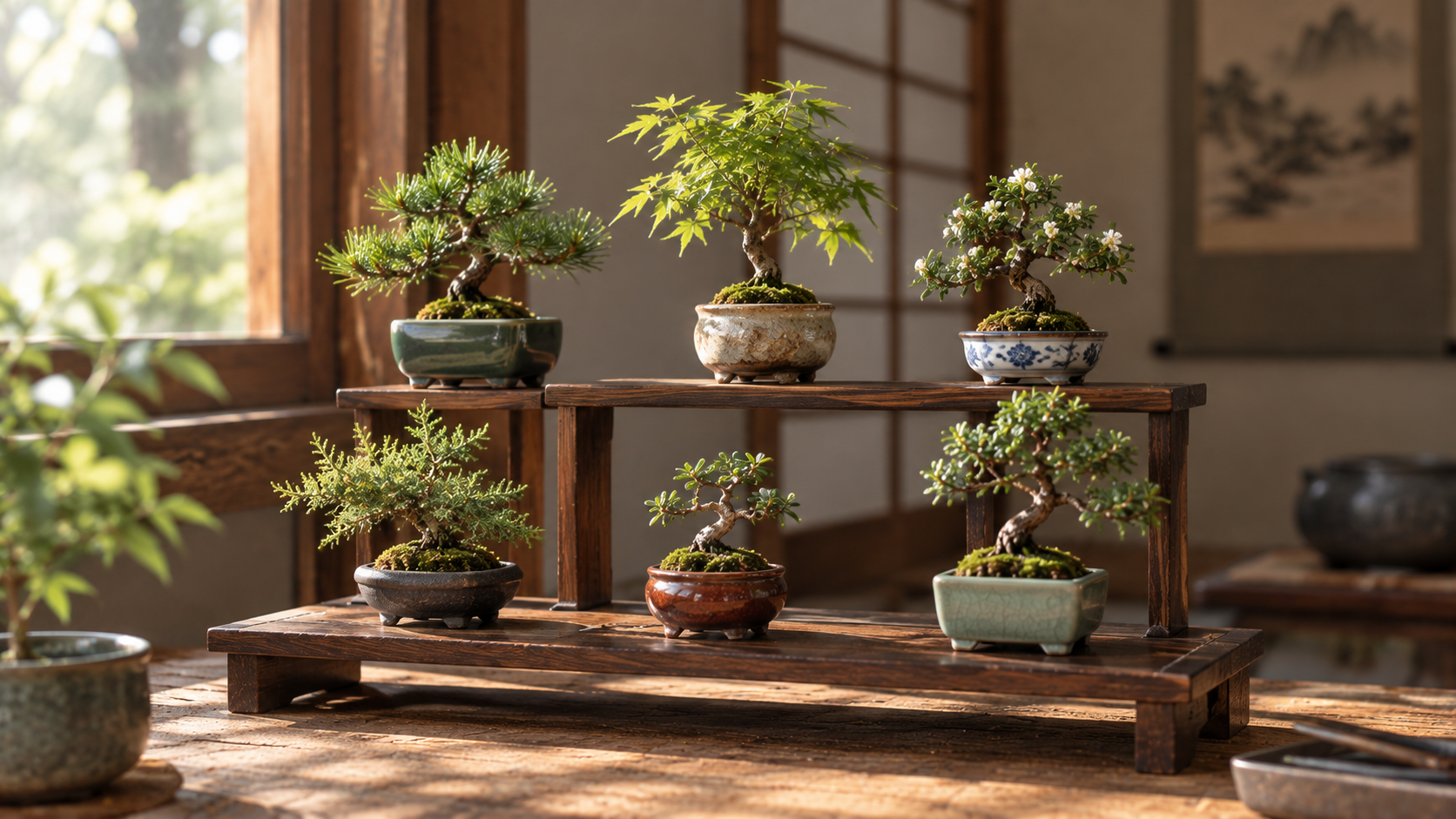
Small bonsai are often displayed in groups on tiered stands, which is part of their appeal. A good pot really shines here, because it’s seen up close and next to other pots. Our bonsai display stands guide covers options from simple tables to Japanese jita boards.
When you display several small trees together, varying pot colors and shapes can make the group more interesting. A glazed pot next to an unglazed one, a round pot next to a rectangle.
Common small-pot mistakes
Moving a tree into a small pot too early. Growth slows dramatically.
Choosing by photo alone. Check dimensions, especially interior measurements.
Ignoring drainage. A tiny hole in a tiny pot can clog.
Forgetting about tie-down. If there’s no way to secure the tree, it will move.
Leaving small pots in full midsummer sun without checking them. They can dry out quickly.
Conclusion: start small, then buy one special pot
Mame and shohin bonsai pots range from a few pounds to several hundred dollars, and the right choice depends on the tree’s stage and how much the pot matters to you.
For most growers, a mix works best. Start with affordable pots from Herons or Wigert’s for trees still developing. Move to Japanese-made pots from Wazakura, Bonsai Plaza or bonsaipots.eu as your trees improve. And save a collector piece like a vintage Bigei for the tree you’re proudest of.
Whatever you choose, remember that small pots need daily attention. Get the watering right, and a small tree in a good pot can be one of the most rewarding things in bonsai.
Ready to find your pot? Browse shohin pots at Bonsai Plaza, or check Korean pots by Miju at Wigert’s.