Affiliate disclosure: Some links on this page are affiliate links. If you buy through them, Aribonsai may earn a small commission at no extra cost to you. It doesn’t change what we recommend or how we rank anything.
Repotting day, and the root ball won’t let go
A bonsai root rake is one of those tools you don’t think you need until you’re halfway through repotting.
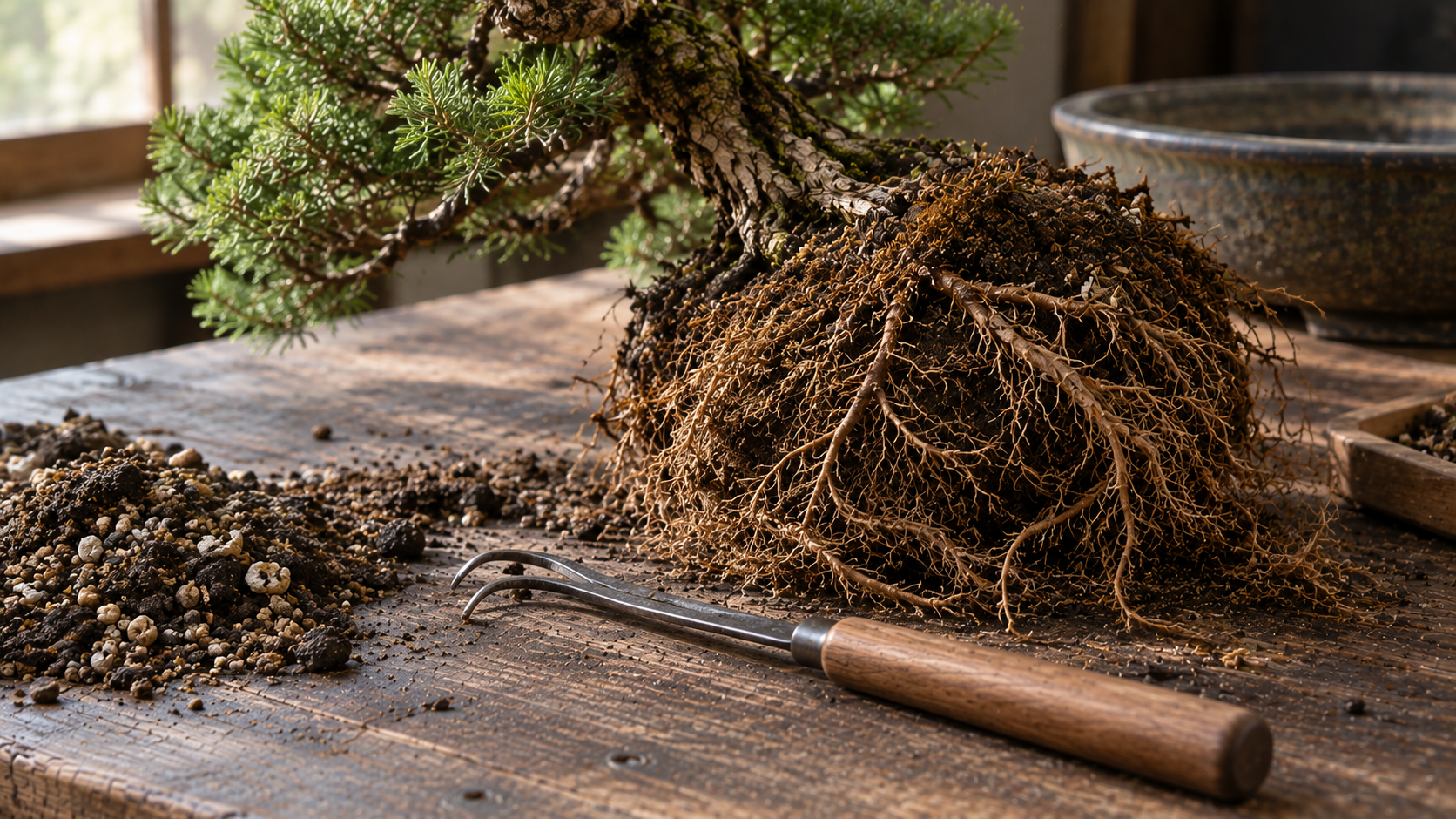
You slide the tree out of its pot. The root ball is a solid block: old soil packed tight, roots circling the bottom, maybe a thick mat where the drainage holes used to be. You poke at it with a chopstick. Nothing much happens. You try your fingers, and tear a few fine roots you were hoping to keep.
That’s where a root rake or root hook comes in. Its curved prongs slip into the soil, catch it, and pull it away from the roots without ripping them. It loosens circling roots so you can see what to trim, and it lets you comb the root ball out evenly before the tree goes into fresh soil.
The confusing part is the variety. There are single-prong hooks, two- and three-prong rakes, small versions for shohin, heavy-duty ones for collected trees, and combo tools with tweezers on the other end. Prices range from a few dollars to around $40.
In my experience, most people do fine with one good rake for years, but the right size makes a real difference. A big rake on a small tree tears roots. A tiny hook on a big root ball takes forever. This guide explains what matters, then compares six root hooks and rakes, mostly Japanese, from budget picks to tools made for compact yamadori root balls.
Who this bonsai root rake guide is NOT for
It’s not for cutting roots. A rake loosens and untangles. To cut thick roots, you need a bonsai root cutter.
It’s not for garden soil cultivation. Garden hand rakes and cultivators are much bigger and rougher. This guide is about tools sized for bonsai root balls.
It’s not a full repotting guide. We’ll cover the tool and good habits, but timing and soil mixes depend on your species and climate.
Still with us? Let’s go.
How we picked these (3 things that actually matter)
1. Number of prongs
This is the main difference between models.
- Single-prong root hooks are precise. They work into tight spaces, around the trunk base and between thick roots. They’re slower on large areas.
- Two-prong hooks are a middle ground: still fairly precise, but faster than a single prong.
- Three-prong rakes cover more area and are faster on large root balls. They’re less precise near the trunk.
Many growers own two: a single-prong hook for detail and a three-prong rake for bulk work.
2. Size and strength
Size should match your trees.
- Small or shohin hooks are gentle and fit tiny root balls.
- Standard hooks (around 16–21 cm long) suit most bonsai.
- Heavy-duty rakes are for compact old root balls, nursery stock and yamadori (collected trees), where the soil can be almost as hard as clay.
A rake that’s too strong and too big will tear fine roots on a small tree. One that’s too weak can bend on a packed root ball.
3. Material and handle
You’ll see carbon steel, cast iron and stainless steel prongs. Carbon steel and cast iron are strong but need drying after use. Stainless resists rust, which helps because root rakes spend their life in wet soil.
Handles are either wood or all-metal. Wooden handles are comfortable and grippy. All-metal tools are easier to wash. A good tool should have a solid connection between prongs and handle, so it doesn’t twist when you pull.
A few root rake habits that matter more than the brand
None of these cost anything.
- Work from the outside in. Start at the edges and bottom of the root ball, and move inward gradually.
- Pull outward and downward. Comb in the direction the roots grow, away from the trunk.
- Let the soil dry a little first. Very wet soil clumps and drags roots. Slightly dry soil falls away more easily. Just don’t let the fine roots dry out.
- Use light pressure. Kaneshin’s own guidance for its root hook is to pull gently, because excessive pressure can damage roots.
- Switch tools near the trunk. Use a single-prong hook or chopstick in tight areas.
- Keep the roots moist. Mist the exposed roots or cover them while you work, especially on warm or windy days.
- Clean the tool after repotting. Old soil and moisture lead to rust.
Bonsai root rake comparison table
| Tool | Prongs | Length | Material | Best for | Origin | Approx. price |
|---|---|---|---|---|---|---|
| Bonsai Tonight Root Hooks & Rakes | 1–3 (several models) | Varies | Steel / stainless options | Choosing the right size | Japan | ~$15 |
| Kaneshin 2 Prong Root Hook | 2 | 6.3 in (16 cm) | Carbon steel, poplar handle | All-round repotting | Japan | ~$40 |
| Three Prong Root Hook, Wood Handle | 3 | 8.25 in (21 cm) | Cast iron, wood handle | Faster work on bigger root balls | Japan | ~$27 |
| Single Prong Root Hook, Wood Handle | 1 | 8.25 in (21 cm) | Cast iron, wood handle | Detail work near the trunk | Japan | ~$22 |
| Kaneshin 3-Hook Repotting Rake | 3 | 210 mm | Not stated | Compact root balls, yamadori | Japan | ~€27 (EU) |
| Root Rake + Tweezers Combo | 3 + tweezers | ~220 mm | Not stated | Budget backup | China | ~€7 (EU) |
Prices are approximate and vary by country and seller. Always check the current price before buying.
The 6 best bonsai root rakes, reviewed
1. Bonsai Tonight Root Hooks & Rakes – best range to choose from
If you’re not sure which size or shape you need, Bonsai Tonight’s range is a good place to start. It’s made in Japan, and it includes almost every common style in one place.
The listing includes a standard root hook, a shohin root hook, steel and heavy-duty steel versions, a heavy-duty stainless version, a wood-handled hook, a root rake and a heavy-duty root rake. Bonsai Tonight notes that the root rake is useful for working on the bottom of the root ball, and that larger hooks and rakes speed up work on larger trees.
The starting price is around $15. The listing doesn’t give detailed specs for every model, so if you need exact lengths or prong counts, it’s worth contacting the shop.
Pros
- Made in Japan
- Wide range of sizes, including shohin and heavy-duty
- Stainless option available
- Affordable starting price
Cons
- Detailed specs aren’t listed for each model
- Price varies by model
Best for: anyone who wants to pick a Japanese rake in exactly the right size.
Check root hooks and rakes at Bonsai Tonight
2. Kaneshin 2 Prong Root Hook – the best all-round bonsai root rake
Kaneshin is one of the most trusted Japanese bonsai tool makers, and this two-prong hook is a lovely everyday tool.
It’s 6.3 inches long and weighs 2.7 oz. The prongs are carbon steel, the handle is poplar, and a metal tang runs through the handle so it doesn’t loosen or twist. Niwaki describes it as handmade in Japan, for loosening old soil and gently separating delicate roots during repotting.
Two prongs is a sensible middle ground. It’s faster than a single hook, but still precise enough to work close to the trunk on most trees. At around $40, it’s the priciest tool here, but you’re paying for build quality that should last for decades.
Because the prongs are carbon steel, wipe them dry after use. Our bonsai tool maintenance guide covers simple rust prevention.
Pros
- Handmade in Japan by Kaneshin
- Two prongs balance speed and precision
- Solid tang construction that won’t twist
- Comfortable wooden handle
Cons
- Carbon steel needs drying to avoid rust
- Highest price on this list
Best for: growers who want one high-quality root rake for most trees.
Check the Kaneshin 2 Prong Root Hook at Niwaki
3. Three Prong Root Hook with Wood Handle – best for bigger root balls
This is the classic three-prong bonsai root rake, sold in the US by Bonsai Learning Center.
It’s made in Japan, with cast iron prongs and a wooden handle that has an anti-slip grip. It’s 8.25 inches long overall, with a 3-inch hook, which gives it good reach on larger root balls. Bonsai Learning Center describes it as a tool for baring and separating roots during transplanting and repotting.
Three prongs make quick work of the outer layers of soil. Switch to a single hook or chopstick when you get close to the trunk.
Pros
- Made in Japan
- Three prongs cover more area quickly
- Anti-slip wooden handle
- Good reach on larger trees
Cons
- Less precise near the trunk
- Cast iron should be dried after use
Best for: medium and large trees with dense root balls.
Check the Three Prong Root Hook at Bonsai Learning Center
4. Single Prong Root Hook with Wood Handle – best for detail work
The single-prong version of the tool above is the precision partner.
It’s made in Japan, with one strong cast iron prong, a 2.25-inch hook and an 8.25-inch overall length. The wooden handle has the same anti-slip grip.
A single prong is the tool for tight spots: under the trunk, between thick surface roots, and in small pots where a three-prong rake would tear more than it loosens. It’s also useful for teasing out circling roots one at a time so you can decide what to keep.
Pros
- Precise in tight spaces
- Strong single prong
- Made in Japan
- Pairs well with a three-prong rake
Cons
- Slow on large areas
- Cast iron needs drying after use
Best for: shohin, small pots, and detail work near the trunk.
Check the Single Prong Root Hook at Bonsai Learning Center
5. Kaneshin 3-Hook Repotting Rake (210 mm) – best for yamadori and tough root balls
This Kaneshin rake is aimed at a specific job: breaking up very compact root balls.
It’s a 210 mm, three-hook tool that Laos Garden describes as highly robust and perfect for the most compact root balls. It’s intended mainly for pre-bonsai and yamadori, where you’re often dealing with heavy, old soil, field clay or roots packed into a nursery container.
The listing doesn’t state the material, and it’s easier to find in Europe than in the US. But if you work with collected trees or raw nursery stock, a heavy-duty rake like this saves a lot of time and effort.
Pros
- Made in Japan by Kaneshin
- Built for compact, heavy root balls
- Ideal for yamadori and nursery stock
Cons
- Too strong for small, delicate trees
- Material not stated
- Harder to find in the US
Best for: advanced growers working with collected trees and pre-bonsai.
Check the Kaneshin 3-Hook Rake at Laos Garden
6. Root Rake + Tweezers Combo – best budget backup
This is the cheap, practical option, and we’re including it because many people want a spare tool without spending much.
It’s a two-in-one tool about 220 mm long, with a three-prong rake on one end and fine tweezers on the other. Mistral Bonsai, which sells it in Europe, says it’s made in China. The rake combs roots and removes old soil, and the tweezers pull weeds, debris and small roots near the trunk.
It won’t feel like a Japanese tool, and the material isn’t stated. But at under €10, it’s a reasonable spare for a club workshop, a second workstation, or a beginner who isn’t sure yet how much repotting they’ll do.
Pros
- Very inexpensive
- Rake and tweezers in one tool
- Good spare or beginner tool
Cons
- Made in China, not Japan
- Material and durability not stated
- Less comfortable for long sessions
Best for: beginners on a tight budget, or as a spare.
Check the combo tool at Mistral Bonsai · Search bonsai root rakes on Amazon
Which bonsai root rake should you buy? (By use case)
You want one tool for most repotting: Kaneshin 2 Prong Root Hook.
You want to choose the exact size for your trees: Bonsai Tonight’s root hooks and rakes.
You have medium to large trees with dense root balls: Three Prong Root Hook with Wood Handle.
You grow shohin or work in small pots: Single Prong Root Hook, or the shohin hook from Bonsai Tonight.
You work with yamadori or raw nursery stock: Kaneshin 3-Hook Repotting Rake.
You’re on a tight budget or need a spare: the Root Rake + Tweezers Combo.
You want a “pro” repotting setup: a three-prong rake for bulk work, a single-prong hook for detail, a root cutter for thick roots, and a soil sieve to prepare fresh soil.
A simple two-tool setup
Most growers are well served by two tools: a three-prong (or two-prong) rake for the outer root ball, and a single-prong hook for the area near the trunk. Add a chopstick for working fresh soil in around the roots, and you’re ready for most repotting jobs.
Where a root rake fits in the repotting process
It helps to see where the rake actually comes in.
- Remove the tree from the pot. Cut any wires holding it in, and run a knife around the edge if it’s stuck.
- Rake the bottom and sides. This is where the rake does most of its work. Comb out circling roots and old soil from the outside in.
- Work toward the trunk carefully. Switch to a single hook or chopstick near the base.
- Trim the roots. Once the roots are combed out, you can see which long or thick roots to cut back.
- Prepare fresh soil. Sift it to remove dust. Many growers use Japanese akadama as part of their mix.
- Repot and work in the soil. Use a chopstick to settle soil around the roots, then water thoroughly.
How much soil you remove depends on the species, the tree’s health and the time of year. Some trees tolerate heavy root work; others don’t. If you’re not sure, it’s safer to remove less.
How to care for a bonsai root rake
Root rakes spend their working life in wet soil, so a little care goes a long way.
- Wash off soil after use. Dried soil is abrasive and holds moisture against the steel.
- Dry it completely. Especially carbon steel and cast iron.
- Oil it lightly before storage. A thin coat of tool oil prevents rust between repotting seasons.
- Check the prongs. If a prong is bent, gently straighten it before it snags roots.
- Keep wooden handles dry. Don’t leave the tool sitting in water or wet soil.
Common bonsai root rake mistakes
Pulling too hard. Heavy pressure tears fine roots. Let the prongs do the work.
Starting at the trunk. Always start at the edges and bottom, then work inward.
Using one size for everything. A big rake is too rough for shohin. A tiny hook is too slow on big trees.
Letting roots dry out. Exposed fine roots can dry quickly. Mist them or work in the shade.
Forgetting the tool after repotting. A rake left with wet soil on it will rust quickly.
Conclusion: a simple tool that makes repotting gentler
A bonsai root rake isn’t a glamorous tool, but it changes how repotting feels. Instead of picking at a hard root ball and tearing roots, you comb it out cleanly, see exactly what you’re working with, and give the tree a better start in fresh soil.
For most people, the Kaneshin 2 Prong Root Hook is the best single tool: handmade in Japan, balanced and built to last. If you’d rather start cheaper, Bonsai Tonight’s Japanese hooks and rakes give you plenty of size options. And if you work with collected trees, a heavy-duty Kaneshin rake is worth adding.
Whichever you choose, start from the outside, use light pressure, and keep the roots moist.
Ready for repotting season? Check the Kaneshin 2 Prong Root Hook at Niwaki, or browse Japanese root hooks and rakes at Bonsai Tonight.