Affiliate disclosure: Some links on this page are affiliate links. If you buy through them, Aribonsai may earn a small commission at no extra cost to you. It doesn’t change what we recommend or how we rank anything.
The tree is finished. Now where does it go?
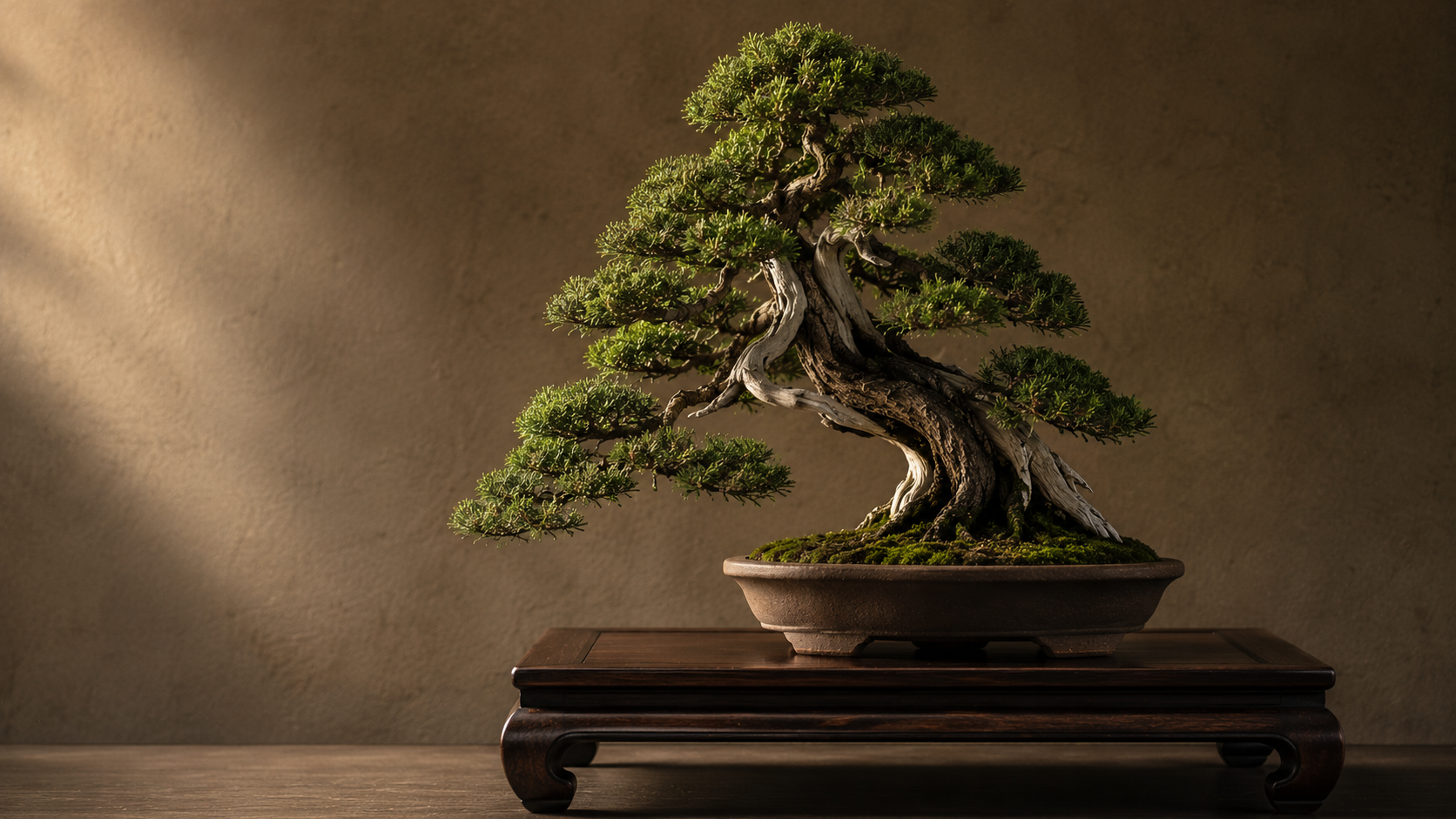
A bonsai display stand is the last piece of a finished tree, and the one most people forget.
You spend years on a tree. You wire it, prune it, repot it into the right pot. Then you bring it inside for guests, or into a show, and set it straight down on a shelf or a tablecloth. Somehow it looks smaller than it does on the bench, and a little unfinished.
In Japan, a tree on display almost always sits on something: a wooden table with legs (a shoku), a thin wooden board (a jita), or a slab of natural wood. The stand lifts the tree, separates it from its surroundings, and frames it. It’s the same idea as putting a picture in a frame rather than taping it to the wall.
The confusing part is the range. A simple bonsai display stand can cost under $20. A handmade Japanese jita board can cost several hundred euros. And many of the nicest pieces are one-offs, sold secondhand, with no clear information about who made them or where.
In my experience, the most common mistake isn’t buying a cheap stand. It’s buying one that’s the wrong size or style for the tree. This guide explains what to look for, then compares six options, from simple everyday stands to Japanese handcrafted boards.
Who this bonsai display stand guide is NOT for
It’s not for you if you’re looking for a work turntable. Stands for working on a tree are a different tool. Our bonsai turntable guide covers those.
It’s not about outdoor benches. Benches for keeping a collection outside are a separate project. Display stands are mainly for showing a tree indoors or at an exhibition.
It’s not a full guide to formal display. Japanese display (with scrolls, accent plants and tokonoma alcoves) has its own traditions. We’ll touch on the basics, but this guide is about choosing the stand itself.
Still with us? Let’s go.
How we picked these (3 things that actually matter)
1. Table or board
There are two main kinds of bonsai display stand.
- Shoku (display tables) have legs and lift the tree noticeably. They suit most upright trees and give a more formal look. Taller versions are used for cascade trees, where the trunk hangs below the pot.
- Jita (display boards) are thin, flat boards or natural slabs. They lift the tree only slightly and give a quieter, more natural feel. They’re popular for shohin, literati trees and informal displays.
Neither is better. It depends on the tree and the feeling you want to create.
2. Size and proportion
This is where most mistakes happen.
A display stand should be a little larger than the pot, so there’s a visible margin all around. Too small and the pot looks like it’s about to fall off. Too large and the tree looks lost on it. Height matters too: a tall stand under a small, delicate tree can feel top-heavy.
A simple approach is to bring the potted tree with you, or measure the pot carefully, and choose a stand that leaves a modest border on every side.
3. Style, finish and origin
As a general convention, darker, more formal tables with straight legs tend to suit conifers and formal upright trees. Lighter, softer shapes and natural slabs often suit deciduous and informal trees. These aren’t strict rules, just a useful starting point.
Origin is worth checking carefully. Some stands are clearly labeled as made in Japan. Many others are “imported” with no country listed. And many nice pieces are handmade by makers outside Japan. We’ve labeled each one as clearly as we can.
A few display habits that make any stand look better
None of these cost anything, and they make a bigger difference than an expensive stand.
- Clean the pot first. Wipe away soil, water marks and white mineral deposits. A clean pot on a modest stand looks better than a dirty pot on a beautiful one.
- Tidy the soil surface. A light top dressing or a little moss makes the whole display feel finished.
- Place the tree slightly off-center if it leans. Many growers set the pot a little toward the side opposite the tree’s main movement, so the tree feels balanced on the stand.
- Keep the background plain. A neutral wall behind the tree lets the tree, pot and stand be seen clearly.
- Protect the stand from water. Water the tree well before bringing it inside, let it drain fully, and put it back on the stand only once the pot has stopped dripping.
Looking after wooden stands. Display stands are furniture, not garden tools. Keep them indoors, out of direct sun and away from standing water. Wipe up spills straight away. Lacquered and varnished finishes in particular can mark or cloud if water sits on them, which is one reason many growers keep a small cloth or mat handy for watering days.
Prices below are approximate and were checked in October 2026. Many display stands are one-of-a-kind, so exact listings change often.
Bonsai display stand comparison table
| Stand | Type | Size | Material | Origin | Approx. price | Best for |
|---|---|---|---|---|---|---|
| Wazakura Small Wooden Plant & Bonsai Stand | Small table | 12.8 × 12.8 × 6.3cm | Scorched plywood | Made in Japan | ~$15 | Mame and desk display |
| Eastern Leaf Rosewood Display Stand | Table | 11″ × 8″ | Rosewood | Not listed | ~$49 | Everyday indoor display |
| Bonsai Outlet Cascade Display Stand (No. 010) | Tall table | Not listed | Dark wood, polished round top | Imported, country not listed | ~$28–40 | Cascade and semi-cascade trees |
| Maillot handcrafted exhibition tables | Table | ~16–30cm | Lacquered wood | Handcrafted in Europe (country not stated) | ~€28–45 | European readers, shows |
| Maillot Japanese jita boards | Board | ~15–40cm | Varnished wood / fruitwood | Made in Japan or Japanese handcrafted | ~€220–375 | Special trees, exhibitions |
| Vintage Japanese-made slabs (secondhand) | Slab / board | Varies | Varies | Listed as Japanese made | ~$128 + shipping (example) | Collectors, unique pieces |
Bonsai display stand reviews
1. Wazakura Small Wooden Plant & Bonsai Stand
The simplest and cheapest way to get a Japanese-made stand.
Wazakura’s small stand is 12.8 × 12.8cm and 6.3cm tall, made in Japan from lightly scorched plywood with a dark finish that still shows the wood grain. It holds up to 3kg and assembles by sliding the two legs together and adding the top. It’s listed at $14.99, with free shipping to the US, UK, Canada, the EU and other regions, though it was sold out when we checked.
It’s designed for succulents, mini bonsai and small pots on a desk, shelf or windowsill. It’s not a show stand, but it’s a nice everyday way to lift a mame tree off a flat surface.
Pros
- Made in Japan at a very low price
- Simple, modern look
- Free shipping to several regions
Cons
- Only suits very small trees (3kg max)
- Plywood rather than solid wood
- Often out of stock
Who it’s for: Mame and small shohin growers who want a simple, inexpensive stand for everyday display at home.
2. Eastern Leaf Rosewood Display Stand (11″ × 8″)
An affordable, classic-looking bonsai display stand for everyday use.
Eastern Leaf sells an 11″ × 8″ rosewood display stand for $49, describing it as an “ultrasleek rosewood stand.” The listing doesn’t state the country of origin.
This is the kind of stand most people start with: a small, dark wooden table that lifts a medium tree and gives it a more finished look indoors. It’s a big step up from setting a pot straight on a shelf.
Pros
- Affordable for a solid wood stand
- Classic dark look suits many trees
- Easy to buy in the US
Cons
- Origin isn’t listed
- One size only
- Not a specialist exhibition piece
Before ordering, check the size against your pot. An 11″ × 8″ top suits a pot a little smaller than that on each side. If your pot is close to 11 inches long, this bonsai display stand will be too small, and you’ll want something larger.
Who it’s for: Anyone who wants a good-looking, affordable stand for displaying a medium tree indoors.
3. Bonsai Outlet Cascade Bonsai Display Stand (No. 010)
A taller stand for trees that hang down.
Bonsai Outlet sells this cascade display stand from $27.95 to $39.95, depending on the option. It’s dark wood with a polished circular top. The store describes its stands generally as “handcrafted, imported,” without naming a country.
Cascade and semi-cascade trees need height, because the trunk falls below the rim of the pot. On a low table, the tip of the cascade ends up touching the surface. A tall, narrow stand solves that and lets the tree’s shape read properly.
In my experience, a cascade on the right tall stand looks completely different from the same tree on a shelf. It’s one of the cases where the stand really changes how the tree is seen.
Pros
- Gives cascade trees the height they need
- Affordable
- Polished round top suits round pots
Cons
- Size isn’t clearly listed
- Origin isn’t stated
- Only suited to cascade-style trees
Because the size isn’t clearly listed, measure your pot and check the options carefully before ordering. A cascade stand needs a top wide enough to hold the pot securely, since tall stands are less forgiving if a pot hangs over the edge.
Who it’s for: Anyone displaying a cascade or semi-cascade bonsai.
4. Maillot Handcrafted Exhibition Tables
A good-value option for readers in Europe.
French retailer Maillot sells a series of lacquered wooden exhibition tables, handcrafted by a named maker, in sizes from about 162 × 162mm up to 300 × 205mm and heights of about 32–70mm. Prices run from about €28 to €45. The page doesn’t state the country of origin.
These are simple, well-proportioned tables at a reasonable price, in several sizes. That makes it easier to find one that fits your pot properly, which matters more than anything else.
Pros
- Several sizes to match different pots
- Handcrafted by a named maker
- Reasonable prices
- Convenient for European buyers
Cons
- Not Japanese-made
- Shipping outside Europe may be expensive
- Limited information on wood type
Who it’s for: European growers looking for affordable, handcrafted tables in a range of different sizes.
5. Maillot Japanese Jita Boards
Japanese handcrafted boards for special trees.
Maillot also sells a small range of Japanese jita boards. Two are listed as “Made in Japan,” in solid varnished wood with sculpted edges: about 29 × 21cm (€265) and 38 × 28cm (€270). Five more are described as Japanese handcrafted, made of varnished fruitwood with carved edges and signed by a Japanese maker, in sizes from about 150 × 120mm (€220) to 405 × 270mm (€348), with some at €375. Several are one-of-a-kind.
These are display pieces for trees that deserve them: exhibition trees, a favorite shohin, or a literati tree that needs something quiet underneath.
Pros
- Clearly Japanese-made or Japanese handcrafted
- One-of-a-kind pieces with carved edges
- Range of sizes, including small ones for shohin
Cons
- Expensive
- One-offs sell quickly
- Shipping from France adds cost outside Europe
Who it’s for: Serious growers and collectors who want a genuine Japanese jita for exhibition or a special tree.
6. Vintage Japanese-Made Slabs (Secondhand)
Where many unique pieces come from.
A lot of beautiful Japanese display slabs and stands are sold secondhand, often by collectors. As an example, one eBay listing from a US seller offers a “Japanese Made Slab Jitta” for shohin, about 6 inches long, at $128 or best offer plus $15.85 shipping. The seller notes the pieces are unsigned and that any small defects are shown in the photos.
This route can turn up genuinely special pieces. The trade-off is that information is often limited. Material, exact size and maker may not be listed.
Pros
- Unique, often older Japanese pieces
- Sometimes better value than new handmade boards
- Good for finding something distinctive
Cons
- Limited information on maker and material
- Condition varies, so photos matter
- Returns can be less straightforward
If you go this way, ask the seller for measurements and extra photos before buying, especially of the underside and any cracks. A slab that looks perfect from above can have a split or warp that only shows from the side.
Who it’s for: Collectors who enjoy searching for one-of-a-kind display pieces.
Best bonsai display stand by use case
“I have a mame or tiny shohin on my desk.” Wazakura Small Wooden Stand.
“I want one affordable stand for indoor display.” Eastern Leaf Rosewood Display Stand.
“I have a cascade tree.” Bonsai Outlet Cascade Display Stand.
“I’m in Europe and need a stand that fits my pot.” Maillot handcrafted exhibition tables.
“I’m showing a special tree and want a Japanese jita.” Maillot Japanese jita boards.
“I like hunting for unique pieces.” Vintage Japanese-made slabs, checked carefully from photos.
Conclusion: choosing a bonsai display stand that fits
Here’s the short version.
A bonsai display stand is how a finished tree becomes a finished display. Start with size: choose a stand slightly larger than the pot, with a margin all around. Then think about style: a table for most upright trees, a tall stand for cascades, and a board or slab for shohin and informal trees.
If you only have one bonsai display stand, choose a simple, dark, medium-sized table. It will suit more trees than a highly decorative piece, and you can move it from tree to tree as different ones come into their best season.
You don’t need an expensive stand to make a difference. A simple, well-proportioned table already does most of the work. Save the handcrafted Japanese pieces for the trees, and the occasions, that deserve them.
And the stand works best with the right pot on top. Our Japanese bonsai pots guide covers how to choose a pot that suits the tree.
Ready to choose?