Affiliate disclosure: Some links on this page are affiliate links. If you buy through them, Aribonsai may earn a small commission at no extra cost to you. It doesn’t change what we recommend or how we rank anything.
When your cutters aren’t enough
Sooner or later, every bonsai grower hits a branch that’s too thick to cut.
You line up your concave cutter, squeeze, and nothing happens. Or worse, it bites halfway and you start twisting the handles. That’s how good tools get damaged, and how trees end up with crushed, torn wounds that take years to heal.
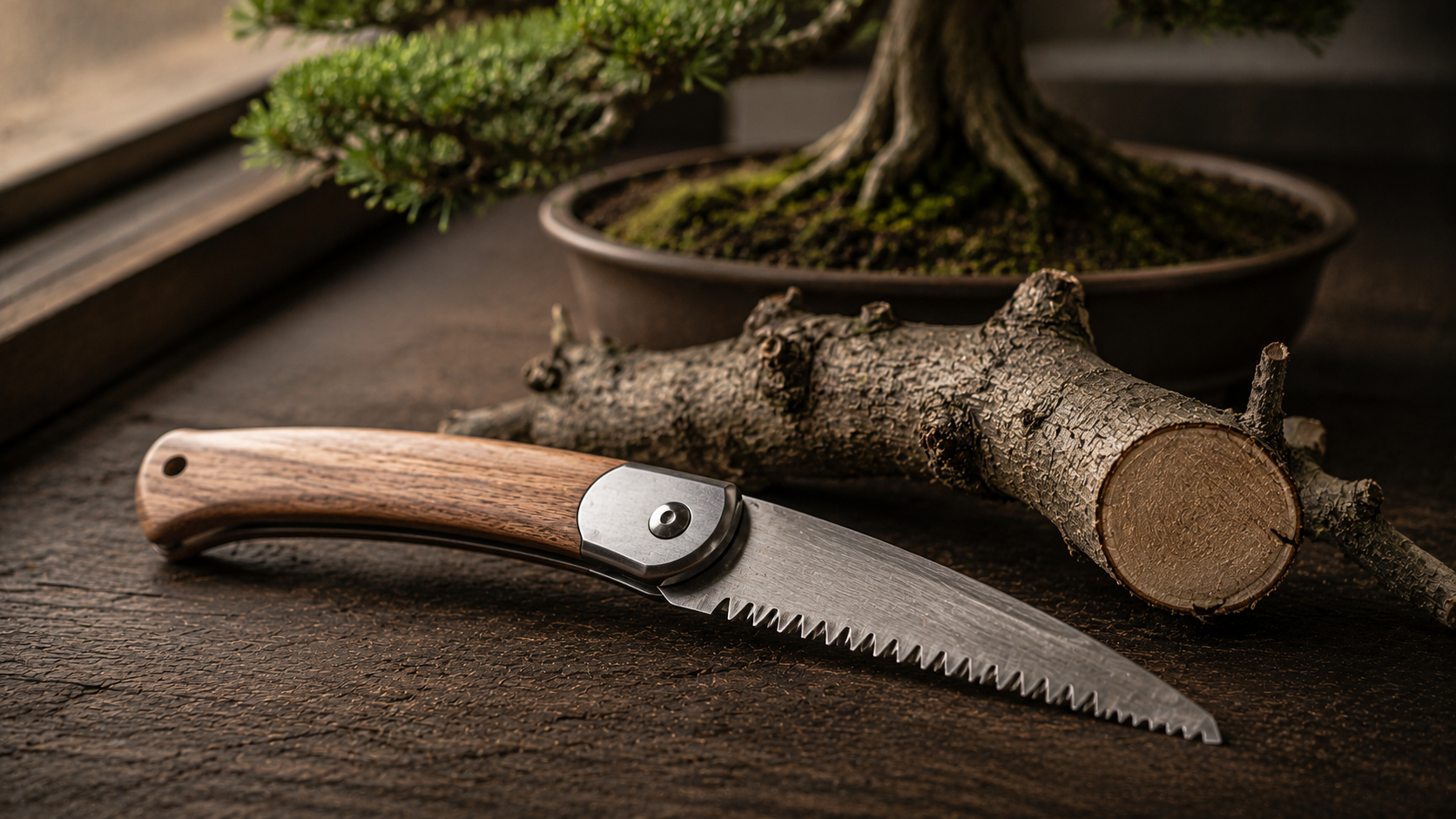
That’s what a bonsai saw is for. It handles the thick branches, trunk chops and stubborn roots that cutters shouldn’t be asked to do. And because Japanese saws cut on the pull stroke, they leave a clean, controlled cut, even in tight spaces between branches.
The problem is choice. Search for a “bonsai saw” and you’ll find tiny folding saws, ikebana saws, general garden pruning saws, and big saws made for tree surgeons. Some are clearly made in Japan, some aren’t, and the blade lengths range from about 10 cm to over 20 cm.
In my experience, the most common mistake is buying a saw that’s too big. A large pruning saw is great in the garden, but it won’t fit between the branches of a small tree. This guide explains what actually matters, then compares six Japanese folding saws, from compact bonsai-specific models to bigger saws for heavy work.
Who this bonsai saw guide is NOT for
It’s not for carving deadwood. Saws make straight cuts. If you want to create jin and shari, you’ll need carving tools, and our bonsai jin pliers guide covers the hand tools for that.
It’s not for air-layering tools. Some Japanese makers sell special saws and rasps for air layering. Those are a different tool with a different job.
It’s not for landscape tree work. If you’re cutting down garden trees or large limbs, you need a full-size pruning saw. This guide is about saws sized for bonsai.
Still with us? Let’s go.
How we picked these (3 things that actually matter)
1. Blade length and shape
This is the big one.
- Short blades (about 10–13 cm) fit between branches and are easy to control. They’re ideal for most bonsai work, especially on smaller trees.
- Medium blades (about 15–18 cm) cut faster and handle thicker wood, but need a bit more room.
- Long blades (20 cm and up) are for heavy work: trunk chops, collected trees, big roots. They’re overkill for most everyday bonsai jobs.
Shape matters too. A narrow blade reaches tight spots more easily. A slightly curved blade can pull itself into the cut. Some bonsai saws have an angled blade, which helps with awkward positions.
2. Tooth size
Finer teeth give a smoother cut but work more slowly. Coarser teeth cut faster but leave a rougher surface.
For bonsai, smooth is usually better. A clean cut heals more neatly, and it’s easier to tidy with a knife or concave cutter afterward. That’s why most bonsai-specific saws use fine teeth, while general pruning saws often use medium or coarse teeth.
3. Folding, locking and quality
Almost every saw here folds, which protects the blade and your hands. Check that it locks firmly open, because a blade that wobbles makes control harder.
Origin and steel matter too. Japanese saw makers are known for impulse-hardened teeth and high-carbon steel blades. Some Japanese saws also offer replacement blades, which means you can keep the handle for years. We’ve noted where we could confirm origin and details.
A few bonsai saw habits that matter more than the brand
None of these cost anything.
- Let the pull stroke do the work. Japanese saws cut when you pull. Pushing hard just bends the blade.
- Use light pressure. A sharp saw needs very little force. Pressing hard makes the cut wander.
- Cut long, then refine. Many growers leave a short stub with the saw, then clean it up with a concave cutter or knob cutter. It’s safer than trying to make a perfect flush cut in one go.
- Support the branch. Hold or support heavy branches so they don’t tear bark as they fall.
- Undercut first on bigger limbs. A small cut on the underside first helps stop bark tearing.
- Clean the blade after use. Sap builds up quickly on saw teeth. Wipe it off, dry the blade, and oil it before storing.
- Seal big wounds. After a large cut, many growers use a cut paste to protect the wound.
Bonsai saw comparison table
| Saw | Blade length | Teeth | Best for | Origin | Approx. price |
|---|---|---|---|---|---|
| Kaneshin Bonsai Saw | ~10–11 cm | Fine | Everyday bonsai work | Japan | ~$25–36 |
| Kaneshin Narrow Folding Saw (KN84D) | 15.5 cm | Fine | Tight spots, awkward angles | Japan | ~€42 (EU) |
| ARS IK-10-R | ~12.7 cm (5 in) | Fine | Small trees, precise cuts | Japan | ~$30 |
| Silky Pocketboy 130 | 13 cm | Medium | All-round use, faster cutting | Japan | ~$25–45 |
| Wazakura Bonsai Folding Saw | 25 cm overall | Fine | Value Japanese pick | Japan (Miki) | ~£30 (UK) |
| Silky Gomboy 210 | 21 cm | Medium | Trunk chops, collected trees | Japan | ~$64 |
Prices are approximate and vary by country and seller. Always check the current price before buying.
The 6 best bonsai saws, reviewed
1. Kaneshin Bonsai Saw – the standard choice for most people
Kaneshin is one of the best-known Japanese bonsai tool makers, and its small folding saw is the one you’ll see in a lot of bonsai tool rolls.
The blade is short, around 10 cm (Niwaki lists 100 mm, and Wigert’s lists 108 mm). It cuts on the pull stroke with fine teeth, which leave a clean surface. Niwaki describes the blade as impact-hardened carbon steel with a rust-resistant coating and beech handles, and the whole saw weighs under 60 g. Folded, it fits in a pocket.
Because the blade is short, it’s not the fastest saw for very thick wood. But for the cuts most bonsai growers make, it’s easy to control and fits where bigger saws can’t.
Pros
- Sized specifically for bonsai
- Fine teeth leave a clean cut
- Very light and compact
- Made in Japan by a well-known bonsai brand
Cons
- Short blade is slow on very thick branches
- Replacement blade availability isn’t clearly listed
Best for: almost everyone, especially if you want one dedicated bonsai saw.
Check the Kaneshin saw at Wigert’s Bonsai · Check it at Niwaki
2. Kaneshin Narrow Folding Saw (KN84D) – best for tight spots
This is Kaneshin’s longer, narrower option. The blade is 155 mm, and it’s set at a slightly inclined angle, which Laos Garden says helps it reach difficult areas of the tree.
That combination is useful on dense trees, where a branch you want to remove is surrounded by others. The narrow blade slips into small gaps, and the angle makes it easier to keep the saw straight without hitting nearby branches.
It’s easier to find in Europe than in the US. If you’re in North America, check bonsai specialty shops or search for the model number.
Pros
- Narrow blade reaches tight spaces
- Angled design helps in awkward positions
- Longer than the standard Kaneshin saw, so it cuts faster
Cons
- Harder to find in the US
- Pricier than the basic Kaneshin model
Best for: growers with dense, mature trees who need to reach inside the canopy.
Check the Kaneshin KN84D at Laos Garden
3. ARS IK-10-R – best compact saw for small trees
ARS is a Japanese maker of pruning tools, and this compact folding saw is sold for ikebana and bonsai. The blade is 5 inches long and straight, with fine teeth designed for clean, precise cuts on delicate plants. It weighs about 0.31 lb.
It’s a good fit for smaller trees and shohin, where you need precision more than speed. Gemplers lists it at around $30 in the US.
ARS also makes a larger bonsai folding saw with a 7-inch blade, which Bonsai Learning Center sells. That one is a good step up if you want more cutting power from the same brand.
Pros
- Compact and precise
- Fine teeth for clean cuts
- Reasonably priced and easy to find in the US
- Larger ARS model available if you need more length
Cons
- Small blade is slow on thick wood
- Less bonsai-specific branding than Kaneshin
Best for: shohin and small-tree growers who want a precise, affordable saw.
Check the ARS IK-10-R at Gemplers · Check the 7-inch ARS bonsai saw at Bonsai Learning Center
4. Silky Pocketboy 130 – best all-rounder for faster cuts
Silky is one of the best-known Japanese saw brands, popular with arborists, gardeners and hikers. The Pocketboy also comes up in bonsai forums as a recommended saw for branch cutting.
The 130 mm version has a slightly curved blade with medium teeth. That makes it faster than the fine-toothed bonsai saws, but the cut is a little rougher. The blade opens to two positions and locks in place, so it’s comfortable to use at different angles. A longer 170 mm version is also available.
It’s a great choice if you also do garden pruning, or if you want one saw that handles both bonsai and general tree work.
Pros
- Faster cutting than fine-tooth bonsai saws
- Locks in two positions
- Trusted Japanese saw brand
- Useful beyond bonsai
Cons
- Medium teeth leave a rougher surface, so plan to clean up the cut
- Slightly bulkier than bonsai-specific saws
Best for: growers who want one versatile saw for bonsai and garden work.
Search Silky Pocketboy on Amazon
5. Wazakura Bonsai Folding Saw – best value Japanese pick
Wazakura is a Japanese brand of garden and bonsai tools, and this folding saw is made in Miki, Hyogo, a region famous for blade making.
The saw is 25 cm long when open and 14.5 cm folded. It uses an SK5 steel blade with finely sharpened teeth and a natural birch handle. The maker positions it for both bonsai branch pruning and general garden maintenance, and it’s light enough to keep in a tool bag.
At around £30 in the UK, it’s an affordable way to get a Japanese-made saw. It was listed as sold out at Made In Japan UK when we checked, so check other sellers too.
Pros
- Made in Miki, a traditional Japanese blade-making region
- SK5 steel with fine teeth
- Good value
- Natural wood handle
Cons
- Blade length on its own isn’t clearly listed
- Stock varies by seller
Best for: beginners and value-minded growers who want a Japanese-made saw.
Check the Wazakura saw at Made In Japan UK · Search Wazakura bonsai saw on Amazon
6. Silky Gomboy 210 – best for trunk chops and heavy work
This is the “big gun” of the list. The Silky Gomboy 210 has an 8.3-inch high-carbon steel blade with medium teeth. It’s made for real pruning work, not delicate trimming.
You won’t use it every week. But if you work on collected trees, raw nursery stock, or big trunk chops, a small saw quickly becomes frustrating. The Gomboy gets through thick wood much faster. It weighs about 0.7 lb.
It’s also the most expensive saw on this list, at around $64 in the US. For most hobbyists, it’s a second saw, not a first.
Pros
- Cuts thick wood quickly
- Strong high-carbon steel blade
- Excellent for collected trees and nursery stock
- Replacement blades are sold separately
Cons
- Too big for fine work inside a tree
- Medium teeth leave a rougher cut
- Highest price here
Best for: advanced growers working with collected trees, big trunk chops or heavy root work.
Check the Silky Gomboy 210 at Knife Country USA · Search Silky Gomboy on Amazon
Which bonsai saw should you buy? (By use case)
You want one bonsai saw for most jobs: Kaneshin Bonsai Saw. It’s the standard choice for a reason.
You grow shohin or small trees: ARS IK-10-R. Compact, precise and affordable.
Your trees are dense and hard to reach inside: Kaneshin Narrow Folding Saw (KN84D).
You want one saw for bonsai and garden pruning: Silky Pocketboy 130.
You’re on a budget but still want a Japanese saw: Wazakura Bonsai Folding Saw.
You work on collected trees or big nursery stock: Silky Gomboy 210, paired with a small bonsai saw for detail work.
You’re cutting thick roots during repotting: a small saw works well for big roots that are too thick for a root cutter. A medium-tooth saw like the Pocketboy handles soil and grit a little better than a fine-tooth one.
A simple two-saw setup
If you’re serious about bonsai, two saws cover almost everything: a small fine-toothed bonsai saw (like the Kaneshin or ARS) for detail work, and a larger saw (like the Pocketboy or Gomboy) for heavy cuts. Most growers start with the small one and only add the big one when they start working with raw material.
How to care for a bonsai saw
A good Japanese saw lasts a long time if you treat it well.
- Wipe off sap after every use. Sap hardens quickly and makes the teeth less effective.
- Dry the blade completely. Moisture causes rust, especially on carbon steel.
- Oil it before storage. A light coat of tool oil protects the blade. Our bonsai tool maintenance guide covers oils and rust erasers.
- Don’t cut wire, stone or metal. Hard materials damage the teeth quickly.
- Store it folded. It protects the teeth and your fingers.
- Replace the blade when it’s dull. Japanese saw teeth are usually hardened and hard to sharpen at home. If your saw takes replacement blades, that’s often the easiest option.
Common bonsai saw mistakes
Using cutters on wood that’s too thick. It damages both the tool and the tree. If it doesn’t cut easily, switch to a saw.
Pushing instead of pulling. Japanese saws cut on the pull. Pushing bends the blade.
Trying to make a flush cut in one go. Leave a little stub, then refine with a cutter.
Buying a saw that’s too big. It won’t fit inside the tree, and you’ll end up hitting other branches.
Forgetting to clean the blade. Sap and moisture shorten a saw’s life more than anything else.
Conclusion: start small, then add power
A bonsai saw isn’t an exciting tool. But it protects your cutters, and it gives you clean cuts on branches that would otherwise end up crushed or torn.
For most people, the Kaneshin Bonsai Saw is the right first choice: small, precise and made for bonsai. If you grow small trees, the ARS IK-10-R is a great alternative. And once you start working with collected trees or big nursery stock, adding a larger saw like the Silky Gomboy 210 makes heavy cuts much easier.
Whichever you choose, use light pressure, let the pull stroke do the work, and clean up the cut afterward. That’s what turns a big cut into a scar nobody notices.
Ready to upgrade your toolkit? Check the Kaneshin bonsai saw at Wigert’s Bonsai, or compare Silky saws on Amazon before your next big pruning session.