Affiliate disclosure: Some links on this page are affiliate links. If you buy through them, Aribonsai may earn a small commission at no extra cost to you. It doesn’t change what we recommend or how we rank anything.
The weekend away that worries every bonsai grower
Bonsai growers have a running joke: you don’t own your trees, they own you.
In summer, a small pot of fast-draining soil can dry out in a single hot afternoon. Miss one day of watering and a tree you’ve worked on for years can be badly damaged. So the moment you plan a weekend away, a work trip or a summer holiday, the same question comes up: who’s going to water the trees?
A bonsai automatic watering system is the usual answer. A timer on the tap, some tubing, and either drippers or fine spray heads can keep a bench watered while you’re gone, or simply take the pressure off on busy days.
But bonsai aren’t easy to automate. Pots are shallow, soil is loose and drains fast, and trees on the same bench can have very different needs. Experienced growers warn that standard drippers can send water straight down through bonsai soil, leaving parts of the root ball dry. And any system can fail at the worst possible moment.
In my experience, the people who are happiest with automatic watering treat it as a backup, not a replacement for checking their trees. This guide explains what matters, then compares six options, from a simple hose timer to drip kits, misting heads and a no-electricity watering system.
Who this bonsai automatic watering system guide is NOT for
It’s not for indoor tropical bonsai on a windowsill. Most of these systems are designed for outdoor taps and benches.
It’s not for people who never check their trees. Automation helps, but every experienced grower we read stresses daily checks in hot weather.
It’s not a replacement for a good watering can. You’ll still hand-water newly repotted trees, freshly collected material and anything that needs extra care. Our bonsai watering can guide covers those.
Still with us? Let’s go.
How we picked these (3 things that actually matter)
1. Drip or mist
These are the two main approaches, and bonsai growers disagree about which is better.
- Drip systems run a small tube to each pot, ending in an adjustable dripper. They’re water-efficient and easy to set up for a few pots. The concern with bonsai is that loose, fast-draining soil lets water run straight down, so a single dripper may only wet part of the root ball.
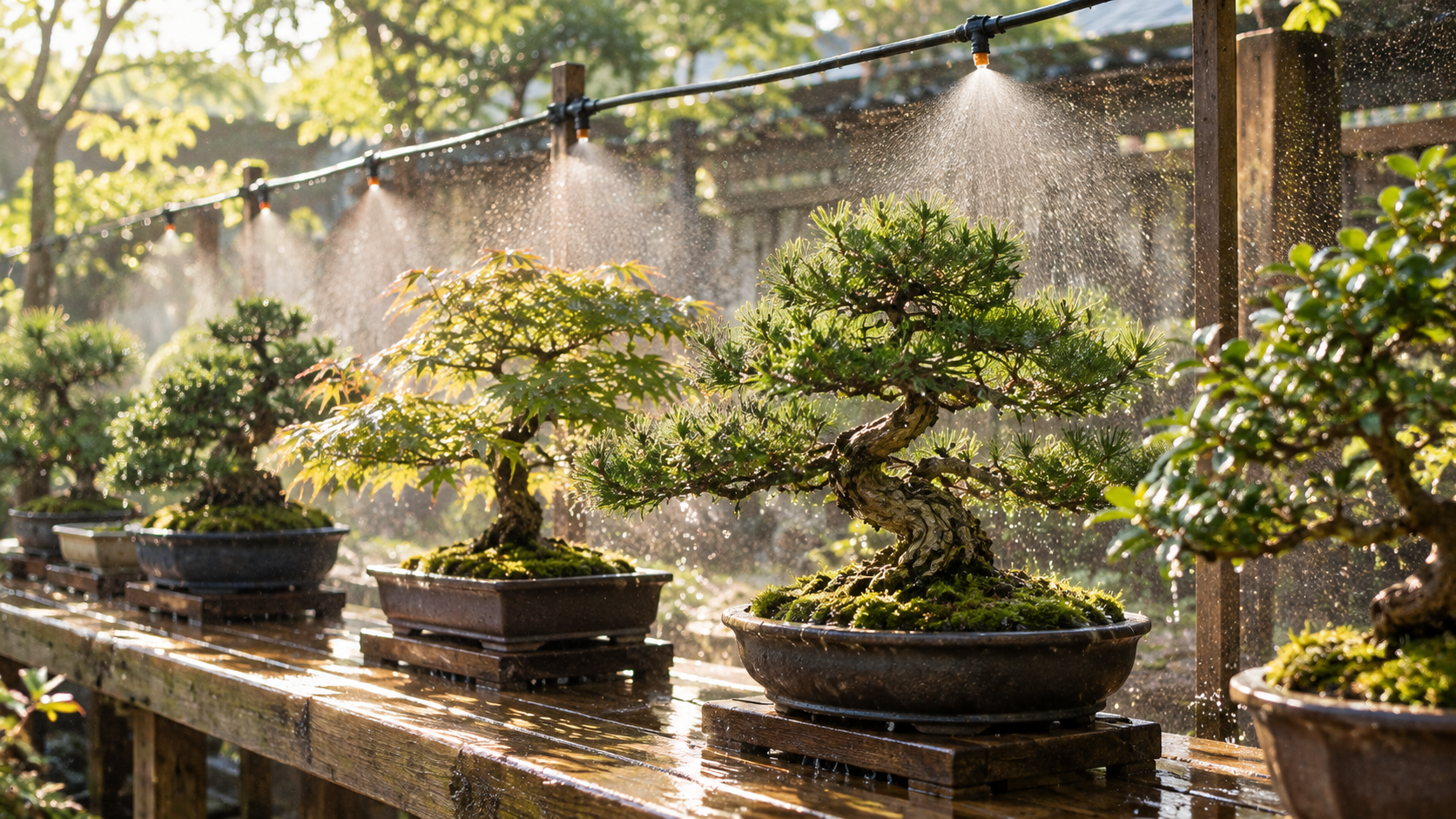
- Mist or fine-spray systems use small spray heads on risers above or around the bench. They cover many trees at once without a tube to every pot. One long-time grower describes standard drippers and spray stakes as doing a poor job with bonsai, and recommends fine-spray heads spaced along the bench instead.
On bonsai forums, many hobbyists use misting for whole benches, especially when traveling, and drip for larger pots or landscape plants.
2. Timer reliability
The timer is the heart of any system. Battery hose timers are cheap and easy, but they can fail if the battery runs low. One experienced grower recommends a hardwired irrigation timer with a solenoid valve for serious collections, and forum members suggest using two timers on one outlet for redundancy.
For a few trees and a short trip, a good battery timer is usually fine. For a large collection or long absences, reliability is worth paying for.
3. Your soil, wind and trees
Fast-draining bonsai soils, like akadama and pumice mixes, need longer or more frequent watering than garden soil. Our akadama guide explains how these soils behave.
Wind matters too. Mist blows away easily on exposed benches. And trees with very different needs, like a thirsty maple and a drought-tolerant juniper, may need separate zones or careful placement.
A few automatic watering habits that matter more than the system
None of these cost anything.
- Test it before you leave. Run the system for a week while you’re home and check every pot.
- Check that water reaches the whole root ball. Lift a pot or check the soil after a cycle.
- Group trees by water needs. Thirsty trees together, drought-tolerant trees together.
- Add a filter. Small drippers and mist heads clog easily. A fine filter helps.
- Hand-water new and weak trees. Recently repotted or collected trees need closer attention.
- Ask someone to look in. Even with automation, a neighbor checking once or twice is cheap insurance.
- Use moss or a surface layer. It helps the soil surface stay moist between cycles. Our bonsai moss guide covers the options.
Bonsai automatic watering system comparison table
| Product | Type | Best for | Coverage | Approx. price |
|---|---|---|---|---|
| Orbit 62061N Hose Timer | Single-zone hose timer | The base of any system | Whatever it’s connected to | ~$35 |
| Rain Bird Patio Drip Kit (RPATIOKIT) | Drip kit | A few pots on a patio | Up to 10 planters | ~$30 |
| Gardena Micro-Drip Starter Set | Drip kit | UK and EU growers | 5 pots, expandable to 15 | ~£24 (UK) |
| Fine-spray / mist heads | Overhead spray | Whole benches | Many trees | Varies |
| Blumat drip system | No-electricity drip | Larger pots without power | Varies | Varies |
| Hardwired timer + solenoid valve | Pro setup | Large collections | Whole garden | Higher |
Prices are approximate and vary by retailer and region. Always check the current price before buying.
The 6 best bonsai automatic watering options, reviewed
1. Orbit 62061N Hose Faucet Timer – the simplest place to start
Every automatic watering setup needs a timer, and a single-zone hose timer is the easiest way to get one.
The Orbit 62061N is an electronic single-zone timer that screws onto an outdoor tap. You then connect a hose, drip kit or misting line to it. US hardware retailers list it at around $35.
On its own, it doesn’t water anything. But combined with a drip kit or spray heads, it turns a manual setup into an automatic one. Use fresh batteries before any trip, and test it at home first.
Pros
- Affordable and widely available in the US
- Works with drip kits, misters and hoses
- Easy to install on an outdoor tap
Cons
- Battery-powered, so check batteries regularly
- Single zone only
- Not a complete system on its own
Best for: anyone setting up their first automatic watering system.
Search Orbit hose faucet timers on Amazon
2. Rain Bird Patio Drip Kit (RPATIOKIT) – best drip kit for a few pots
If you have a handful of bonsai on a patio or balcony, a small drip kit is the easiest way to water each pot.
Rain Bird’s 10-Planter Patio Drip Irrigation Watering Kit is designed to water up to 10 planters and is listed at around $30. Kits like this run tubing from a tap to each pot, ending in a dripper you place on the soil.
For bonsai, place the dripper away from the trunk, and consider using two drippers on larger pots so water spreads more evenly through the loose soil. Pair it with a hose timer to automate it.
Pros
- Affordable
- Waters each pot individually
- Water-efficient
Cons
- Drippers may only wet part of a bonsai root ball
- Tubing to every pot looks cluttered
- Needs a separate timer
Best for: small collections on patios and balconies.
Search Rain Bird patio drip kit on Amazon
3. Gardena Micro-Drip Starter Set – best drip kit for UK and EU growers
Gardena is a German brand, and its Micro-Drip system is widely available in Europe. The terrace and balcony starter set waters five pots and can be expanded to 15.
It includes a master unit, 10 m of supply pipe, five adjustable drip heads (each rated 0–10 liters per hour), T-pieces, pipe pegs and an end cap. It was listed at around £24, although one UK retailer had delisted it when we checked. Gardena also sells separate water computers that connect to the system for scheduled watering.
Adjustable drippers are useful for bonsai, because you can give thirsty trees more water and drought-tolerant trees less.
Pros
- Adjustable flow on each dripper
- Expandable from 5 to 15 pots
- Compatible with Gardena timers
- Widely available in Europe
Cons
- Same drip limitations in loose bonsai soil
- Timer sold separately
- Stock varies by retailer
Best for: European growers with a small to medium collection.
Search Gardena Micro-Drip starter set on Amazon
4. Fine-spray and mist heads – best for whole benches
Many experienced growers prefer overhead fine spray to drip for bonsai benches.
One long-time grower describes using standard drip tubing with fine-spray heads on short risers spaced about every three feet, running for an hour or more around midday in hot weather, with water pressure around 30 psi or higher to avoid dry spots. On forums, others mention products like Antelco’s fine mist sprayers angled downward to resist wind, and spray heads designed to cover pots evenly.
The advantages are clear: no tube to every pot, and every tree on the bench gets water. The downsides are more water use, wind drift, and wet foliage, which some growers worry can encourage fungal problems.
Pros
- Covers many trees at once
- No tubing to each pot
- Popular among experienced hobbyists
Cons
- Uses more water
- Wind can blow mist away
- Needs good pressure and filtration
Best for: growers with a full bench of trees.
Search fine mist sprayer heads for drip irrigation on Amazon
5. Blumat drip system – best option without electricity or timers
Blumat is an Austrian watering system that works differently from everything else here. Instead of a timer, each pot gets a ceramic sensor cone pushed into the soil. As the soil dries, the cone lets water flow from a supply line or reservoir; when the soil is moist, it slows or stops.
That makes it attractive for places without power or a programmable tap, and for trees with different water needs, since each cone responds to its own pot.
The catch for bonsai is pot depth. Many bonsai pots are very shallow, so the cone may not fit well, and loose bonsai soil behaves differently from potting compost. It’s best suited to deeper pots, pre-bonsai in training containers, or larger trees. Test it carefully before relying on it.
Pros
- No electricity or timer needed
- Each pot responds to its own moisture level
- Good for trees with different needs
Cons
- Cones may not suit shallow bonsai pots
- Needs careful setup and testing
- Less common in bonsai use
Best for: pre-bonsai, deeper pots and setups without power.
Search Blumat drip system on Amazon
6. Hardwired timer with solenoid valve – the serious collector’s setup
For large collections, many experienced growers move beyond battery hose timers.
One long-time grower recommends a hardwired irrigation timer with a 24V solenoid valve, plus a fine-mesh filter (around 60 mesh), because battery timers can be unreliable. Forum members running bigger collections describe multi-zone timers, two solenoid valves for redundancy, and even flow sensors that alert them if water flow falls outside a set range.
It’s more work and money to set up, and often worth asking an irrigation installer for help. But if you have dozens of trees and travel in summer, reliability matters more than anything else.
Pros
- Most reliable option
- Multiple zones for different trees
- Can add alerts and redundancy
Cons
- Higher cost
- More complex to install
- Overkill for a few trees
Best for: large collections and growers who travel often.
Search irrigation controllers on Amazon
Which bonsai automatic watering system should you buy? (By situation)
You have a few trees and go away for weekends: a hose timer plus a small drip kit.
You’re in the UK or Europe: a Gardena Micro-Drip set with a Gardena timer.
You have a full bench of trees: fine-spray or mist heads on a timer.
You have no outdoor power or programmable tap: a Blumat system for deeper pots.
You have a large collection and travel often: a hardwired timer, solenoid valves and a filter, ideally with redundancy.
You only need help on hot days: a simple timer and a mist line to supplement hand watering.
A good beginner setup
For most hobbyists, the simplest reliable setup is a hose timer, a small drip kit with two drippers on larger pots, and a filter. Test it for a week before any trip.
How to set up automatic watering for bonsai
- Group your trees. Put trees with similar water needs together.
- Install the timer on your outdoor tap.
- Add a filter to protect drippers or mist heads.
- Run the tubing along the bench.
- Position drippers or spray heads so water reaches the whole soil surface.
- Set the schedule. Start with your normal hand-watering frequency.
- Test for several days. Check pots after each cycle and adjust.
- Check again before you leave. Fresh batteries, clean filters, no leaks.
Fertilizing with an automatic watering system
Some systems allow fertilizer injection. But with overhead mist or spray, much of the fertilizer ends up off the pots. One experienced grower prefers to feed by hand rather than through the system. Many bonsai growers also use slow-release organic fertilizers on the soil surface, which keep working regardless of how you water. Our bonsai fertilizer guide covers those.
Common bonsai automatic watering mistakes
Trusting the system completely. Systems fail. Ask someone to check in if you’re away.
Not testing before a trip. Always run it for several days while you’re home.
One dripper on a big pot. Water may only reach part of the root ball.
Ignoring wind. Mist can blow away on exposed benches.
Forgetting the filter. Clogged drippers are a common cause of dry pots.
Old batteries. Replace them before every trip.
Conclusion: automate, but keep checking
A bonsai automatic watering system can take a lot of stress out of summer, especially if you travel or work long hours. But it works best as a backup, not a replacement for your own eyes.
For a few trees, a simple hose timer and a small drip kit is enough. For a full bench, fine-spray heads on a timer are popular with experienced growers. And for large collections, a hardwired timer with solenoid valves and a filter is the reliable choice.
Test any system before you depend on it, group trees by their needs, and if you’re away for long, ask someone to look in.
Ready to automate? Search Orbit hose timers on Amazon, or compare small drip kits for your bench.