Affiliate disclosure: Some links on this page are affiliate links. If you buy through them, Aribonsai may earn a small commission at no extra cost to you. It doesn’t change what we recommend or how we rank anything.
You made the big cut. Now what?
Bonsai cut paste is one of those supplies nobody thinks about until the moment they need it.
You’ve just removed a thick branch with a concave cutter. The cut is clean, the tree looks better already, and then you notice the wound. It’s wet. It’s bigger than you expected. And on a small tree, a scar that size is going to be visible for years.
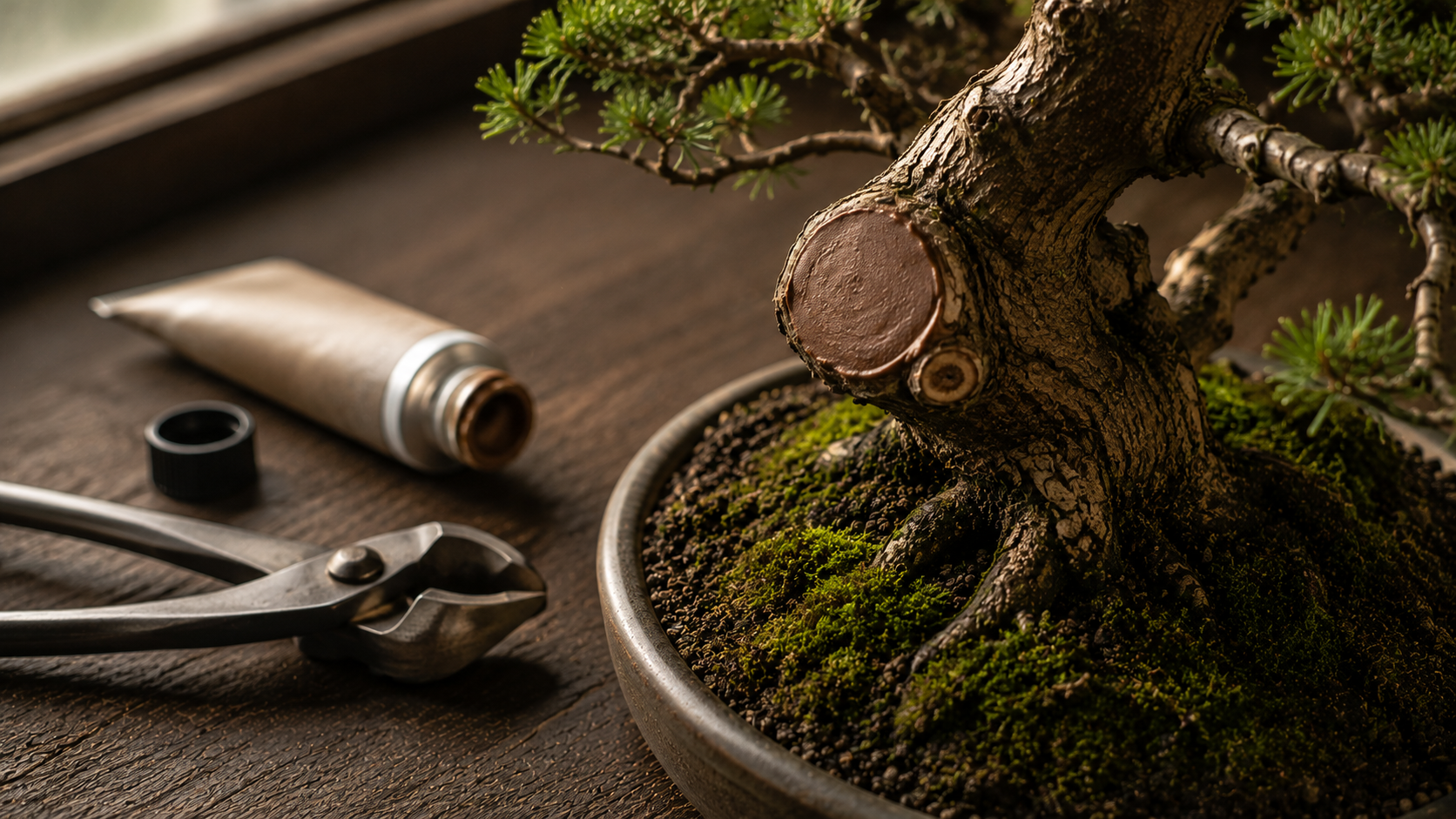
That’s the job of a bonsai cut paste. It covers the fresh wound, keeps it from drying out and cracking, and helps the tree roll a smooth callus over the cut. On a landscape tree, a scar doesn’t matter much. On a bonsai, where every inch of trunk is on show, it matters a lot.
The tricky part is that “cut paste” isn’t one product. There are soft putties you press on with your fingers, liquid sealers you brush on, pastes that stay soft for a year, and ones that dry hard. Some contain fungicides. Some are made for specific trees, like junipers or azaleas. And the names don’t help: Kiyonal, Kiyonaru, Cut Paste Hi, Top Jin M, Callus Mate, Kirikuchi-Naoru.
In my experience, most people buy whichever tube their local shop has, then wonder why it cracked, or why it looks bright orange on a dark pine. This guide sorts out the main types, then compares six bonsai cut paste options, from everyday all-rounders to species-specific Japanese sealers.
Who this bonsai cut paste guide is NOT for
It’s not for landscape or orchard trees. Many arborists advise against wound dressings on garden trees and prefer to let them seal naturally. Bonsai is a different situation, because the goal is a clean, nearly invisible scar on a small trunk. This guide is written for bonsai only.
It’s not a pest or disease treatment guide. Some of these pastes contain fungicides or insecticides, but they’re wound sealers, not cures. If a tree is already sick, a paste won’t fix it.
It’s not for people who never make big cuts. If you only pinch shoots and trim twigs, you can probably skip paste for now. It becomes important once you start removing branches, carving, or doing heavy root work.
Still here? Let’s go.
How we picked these (3 things that actually matter)
1. Putty or liquid
This is the main choice, and it affects everything else.
- Putty (clay-type) cut paste is thick and soft, a bit like modeling clay. You roll a small piece between your fingers and press it into the wound. It’s best on large cuts and hollows, and most types stay soft for a long time, so they flex as the tree grows.
- Liquid (or semi-liquid) cut paste comes in a tube or bottle, sometimes with a brush. It spreads thinly and gets into small cuts easily. Some liquids stay slightly soft; others dry hard.
As a general rule, retailers recommend putty for big wounds and liquid for both large and small ones. Many serious hobbyists keep one of each.
2. Soft-setting or hard-setting
This matters more than people expect.
A bonsai cut paste that stays soft (or semi-dry) is less likely to crack as the callus grows underneath. A paste that dries hard forms a tougher shell, which some growers prefer for certain species, but it can split as the wound edges swell. Several of the Japanese products below are designed to stay tacky for a while for exactly this reason.
There’s also the question of what’s inside. Some pastes include fungicides or insecticides. That’s useful protection, but it also means you should read the label, keep it away from kids, and check that the product can be legally shipped to your country.
3. Color and the species you grow
Color sounds cosmetic, but on a bonsai it’s practical. A bright paste on a dark trunk draws the eye straight to the wound for months.
Japanese makers have responded with species-specific products. There are pastes colored for juniper and pine bark, pastes designed for satsuki azaleas, and formulas aimed at deciduous trees. You don’t need one for every species, but if most of your collection is one type, a matched paste is a nice upgrade.
A few cut paste habits that matter more than the brand
None of these cost anything, and they make a bigger difference than switching products.
- Cut cleanly first. Paste works best on a clean, sharp cut. A ragged wound heals poorly no matter what you cover it with. A sharp bonsai concave cutter or knob cutter does half the work.
- Clean up the edges. Many growers tidy the bark edges around a big cut with a sharp knife before applying paste, so the callus has a smooth line to grow from.
- Seal soon after cutting. Most manufacturers say to apply paste to fresh wounds. Waiting a few days lets the exposed wood dry out.
- Cover the edge, not just the middle. The living layer just under the bark, at the edge of the wound, is what heals. Make sure the paste covers it.
- Keep it thin with liquids. Thick globs of liquid paste can crack. Some makers recommend just 1–2 mm.
- Wet your finger. Several Japanese pastes suggest smoothing the surface with a damp finger, which keeps it neat and stops it sticking to you.
- Check it after a few months. If the paste has split as the callus grows, add a little more.
Bonsai cut paste comparison table
| Product | Type | Sets | Best for | Typical size | Approx. price |
|---|---|---|---|---|---|
| Kiyonal | Liquid / soft paste (green) | Semi-dry, flexible | All-round everyday use | 100 g tube | ~$15–40, varies by seller |
| Cut Paste Hi | Putty (brown or gray) | Stays soft | Large cuts, hollows, carving | 190 g / 500 g tub | ~$15–16 |
| Callus Mate | Paste (dark brown) | Quick-drying | Junipers, pines, satsuki | 100 g / 150 g tube | ~€14 (EU) |
| Top Jin M | Liquid (orange) | Dries hard | Azaleas, deciduous, tropicals | Tube / 200 ml | ~$20 |
| Kirikuchi-Naoru | Liquid (green) or putty | Liquid dries hard | Hard-to-heal trees like quince | Varies | Check seller |
| Lac Balsam | Paste, “artificial bark” | Hardens | Root wounds, budget backup | 150–200 g tube | ~€7 (EU) |
Prices are approximate and vary a lot between countries and sellers. Always check the current price before you buy.
The 6 best bonsai cut paste options, reviewed
1. Kiyonal – the all-rounder most people should start with
If you only buy one bonsai cut paste, Kiyonal is the usual answer. It’s a Japanese wound paste sold by bonsai shops across Europe and the US, and you’ll also see it spelled “Kiyonaru.”
It’s a green paste with a little tack. Retailers describe it as quick-drying on the surface but staying semi-dry for a while, which helps prevent cracking. The paste contains insecticides and fungicides, and it’s designed to fall off by itself once the callus has formed, so you don’t have to remove it.
The standard 100 g tube is the common size. Larger sizes are also sold, mostly in Europe. Some sellers also offer a related product, Kiyonal Ace, but descriptions vary, so check the listing if you see it.
Pros
- Works on most species and wound sizes
- Flexible, semi-dry finish that resists cracking
- Falls away naturally as the wound heals
- Widely available outside Japan
Cons
- Green color can stand out on dark bark
- Prices vary a lot between sellers
- Contains pesticides, so check shipping rules where you live
Best for: beginners and anyone who wants one reliable tube for everything.
Check Kiyonal at Bonsai Plaza · Search Kiyonal on Amazon
2. Cut Paste Hi (putty) – best for big wounds and carving
This is the classic Japanese clay-type cut paste, the one that comes in a round tub rather than a tube. US retailers like Bonsai Tonight and Wigert’s Bonsai list it, usually just as “Cut Paste.”
It’s an all-purpose brown putty with a soft, plasticine-like texture. You pinch off a piece, roll it, and press it over the wound. Wigert’s describes it as keeping the cut area soft and protected for a year or longer. It’s often sold in two colors: a green-lid version with a brown tint, and a white-lid version with a gray tint, so you can match darker or lighter bark.
Because it’s thick, it’s especially good for large branch removals, fresh hollows and carved areas. For small cuts, most retailers point you to a liquid sealer instead.
Pros
- Excellent for big wounds and filling hollows
- Stays soft for a long time, so it flexes with the callus
- Two colors for dark and light bark
- Good value for the amount you get
Cons
- Too bulky for small, neat cuts
- Can look obvious on a show tree until it’s trimmed back or covered
Best for: anyone doing serious branch removal, trunk chops or carving.
Check Cut Paste at Wigert’s Bonsai · Check Cut Paste at Bonsai Tonight
3. Callus Mate – best for junipers, pines and satsuki
Callus Mate is a Japanese wound paste made with darker bark in mind. The juniper version is a dark brown paste, and the product description says it’s especially unobtrusive on satsuki and conifers like pine and shimpaku.
It dries quickly, sticks well, and helps stop sap bleeding. Like Kiyonal, it contains insecticides and fungicides. The suggested method is to apply it to a clean wound and smooth it with a wet finger. The color darkens over time, so it blends in even more as the months pass.
It’s sold in 100 g and 150 g tubes. In Europe, the 150 g tube is around €14 at Bonsai Plaza; in the US, Bonsai Tonight lists Callus Mate among its sealers.
Pros
- Dark color blends well on conifers and satsuki
- Quick-drying with good adhesion
- Darkens with time, so the wound fades from view
Cons
- More specialized than an all-rounder
- Not as easy to find in the US as Kiyonal
Best for: juniper, pine and satsuki growers who are tired of bright green wounds.
Check Callus Mate at Bonsai Plaza · Check sealers at Bonsai Tonight
4. Top Jin M – best medicated liquid for azaleas and deciduous trees
Top Jin M is a bright orange liquid sealer from Japan. It’s one of the more “medicated” options: Bonsai Tonight notes that it contains thiophanate-methyl, a fungicide, and that it’s often used on azaleas and tropical plants.
It dries hard and forms what sellers describe as a rain-resistant, antibacterial film. Besides pruning cuts, it’s also used on wounds from sunburn, frost damage or wire marks. A semi-liquid 200 ml version is sold in Europe and is recommended especially for deciduous trees.
The big downside is the color. Bright orange on a trunk is very visible, so it’s better suited to areas that won’t be on display, or to trees where protection matters more than looks.
Pros
- Includes a fungicide for extra protection
- Hard, rain-resistant film
- Works on many types of wounds, not just cuts
- Popular for azaleas and tropicals
Cons
- Bright orange, so it’s very noticeable
- Hard-setting formula can crack as the callus swells
- Contains a fungicide, so check local rules before ordering
Best for: azalea, deciduous and tropical growers who want a medicated sealer.
Check Top Jin M at Bonsai Learning Center · Search Top Jin M on Amazon
5. Kirikuchi-Naoru – the niche pick for hard-to-heal trees
The name roughly means “cut-surface healer,” and it’s a niche product most Western hobbyists haven’t tried. It comes in two forms: a green liquid and a putty.
The liquid is the interesting one. According to Bonsai Tonight, it dries hard and heals wounds quickly, but it can produce a thick callus. That’s why it’s often used on species that are slow or difficult to heal, such as quince. The putty version is suggested for conifers and deciduous species.
This isn’t a first purchase. But if you grow flowering quince, or other species where wounds tend to stay open for a long time, it’s worth knowing about.
Pros
- Fast healing on stubborn species
- Available in both liquid and putty forms
- A specialist option most collections don’t have
Cons
- Thick callus can be a problem where you want a flat scar
- Harder to find; price and sizes vary by seller
Best for: advanced growers with quince or other slow-healing trees.
Check sealers at Bonsai Tonight
6. Lac Balsam – the Western backup for roots and budget use
Lac Balsam isn’t Japanese. It’s a European wound dressing sold for general tree care, and it’s included here because many bonsai growers already own a tube, and because it’s cheap.
It works like an artificial bark. It hardens after application, which bonsai.de says makes it well suited to wounds in the root area. For trunk and branch wounds, the same retailer only partly recommends it, because it doesn’t stay elastic and can crack and fall off as the tree grows. The tube comes in 150–200 g sizes, and some versions include a brush.
In practice, that makes it a decent backup: useful for root work during repotting, or as a cheap sealer while you wait for a Japanese paste to arrive. It’s not the best choice for a visible trunk wound on a show tree.
Pros
- Inexpensive and easy to find in Europe and North America
- Good for root wounds
- Some tubes come with a brush
Cons
- Hardens and isn’t flexible, so it can crack on trunks
- Not designed specifically for bonsai
Best for: root wounds during repotting, or a budget backup tube.
Check Lac Balsam at TreeStuff · Search Lac Balsam on Amazon
Which bonsai cut paste should you buy? (By use case)
You’re new and want one tube: Kiyonal. It handles most wounds on most species, stays flexible, and falls away when the job is done.
You’re about to remove a big branch or chop a trunk: Cut Paste Hi (putty). Pair it with Kiyonal for the smaller cuts.
Your collection is mostly junipers and pines: Callus Mate. The dark color makes a real difference on a conifer you’d like to show.
You grow satsuki azaleas: Callus Mate is designed with satsuki bark in mind. Top Jin M is the medicated alternative if you don’t mind the orange.
You grow azaleas, deciduous or tropical trees and want extra protection: Top Jin M.
You have quince or other trees that heal slowly: Kirikuchi-Naoru liquid, used carefully on cuts where a slightly thicker callus is acceptable.
You’re repotting and cutting thick roots: Lac Balsam or a putty-type paste works well for root wounds. Our bonsai root cutter guide covers the tools for that job.
You want a “pro” kit: Many experienced growers keep three sealers on hand: a putty for big wounds, an all-round liquid like Kiyonal, and one species-matched paste for their main trees.
A simple starter combination
If you’re building your first kit, one tube of Kiyonal and one small tub of putty-type cut paste will cover almost every situation. Add a species-specific paste later, once you know which trees you grow most. If you’re still putting together your basic tools, our bonsai starter tool set guide is a good place to start.
How to store bonsai cut paste so it lasts
A tube or tub of bonsai cut paste usually lasts a long time, because you only use small amounts. But it can dry out if you’re careless.
- Close it tightly after every use. Air is the main reason pastes harden in the container.
- Keep it cool and dry. Most makers recommend a cool, dry place, away from direct sun.
- Keep it away from children and pets. Many of these pastes contain fungicides or insecticides.
- Wipe the nozzle or lid. Dried paste around the opening makes it hard to close properly next time.
- Wrap putty if needed. If the tub lid doesn’t seal well, some growers wrap the putty in plastic film inside the tub.
Common bonsai cut paste mistakes
These come up again and again in bonsai forums and clubs.
Using liquid on a huge hollow. Liquid paste is great for clean cuts, but a deep hollow needs putty to fill it.
Piling on too much. A thick layer of a hard-setting paste is more likely to crack. Thin, even coverage is usually better.
Covering the whole bark, not the wound. Paste should cover the wound and its edges, not large areas of healthy bark.
Choosing color last. On a show tree, a bright paste is visible for a long time. Think about color before you buy.
Forgetting to check. As the callus grows, many pastes split. A quick check every few months lets you top them up.
Conclusion: start simple, then match your trees
Bonsai cut paste isn’t a glamorous purchase. But once you start making big cuts, it’s one of the cheapest ways to protect years of work, and the difference between a smooth, rolled-over scar and an ugly crack.
For most people, Kiyonal is the right place to start. Add a putty-type Cut Paste Hi when you start removing larger branches or carving. And if your collection leans toward junipers, pines or satsuki, Callus Mate is a small upgrade that makes wounds much less noticeable.
Remember that no bonsai cut paste can save a rough cut. Sharp tools and clean technique come first. The paste is the finishing step.
Ready to stock up? Check Kiyonal at Bonsai Plaza, or compare putty-type cut paste at Wigert’s Bonsai, and keep a tube next to your cutters before your next big pruning session.