Tag: Wazakura

  • Wazakura vs Kaneshin: Which Japanese Bonsai Tools Are Worth Your Money, Tool by Tool

    Wazakura vs Kaneshin: Which Japanese Bonsai Tools Are Worth Your Money, Tool by Tool

    Affiliate disclosure: Some links on this page are affiliate links. If you buy through them, Aribonsai may earn a small commission at no extra cost to you. It doesn’t change what we recommend or how we rank anything. Wazakura has also given us a discount code for readers, which we share below.


    Two Japanese brands, one budget

    Once you’ve decided to buy proper Japanese bonsai tools, the choice often comes down to two names.

    Kaneshin is the brand everyone recommends. It’s been around for over a century, it’s stocked by bonsai shops across the US and Europe, and nearly every forum thread about tools mentions it.

    Wazakura is the newer name. Its tools are made by workshops in Sanjo and Miki, two of Japan’s best-known metalworking towns, and they’re usually cheaper. But there’s less history to go on.

    So which one should you buy? The honest answer is that it depends on the tool. In some categories, the gap between them is small and Wazakura’s lower price wins. In others, Kaneshin’s wider range of sizes and steels is worth paying for.

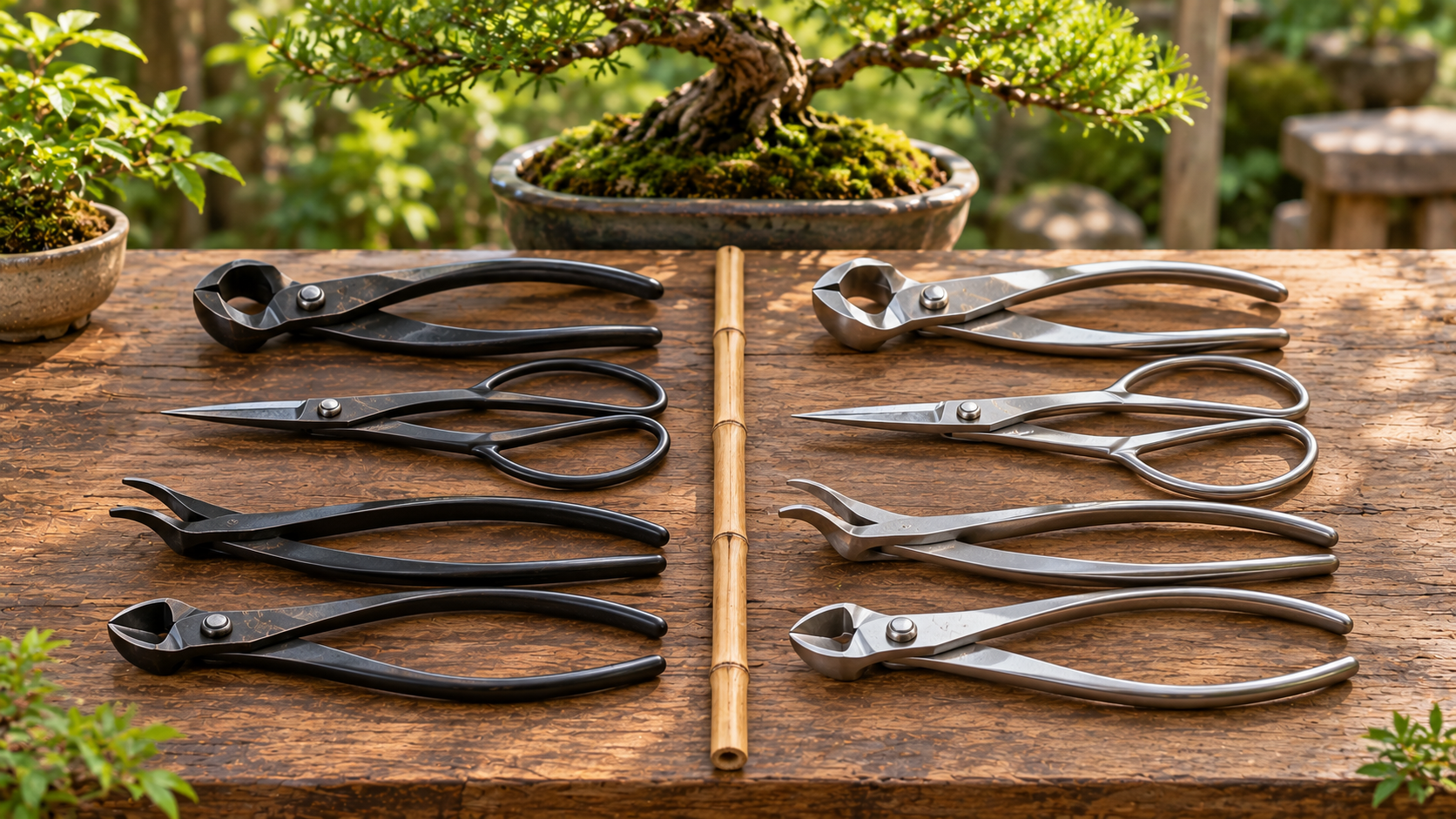
    In my experience, the most useful way to compare brands is tool by tool, not brand by brand. That’s what this guide does. It puts Wazakura and Kaneshin side by side for six common bonsai tools, with prices, sizes and a clear verdict for each.


    Who this Wazakura vs Kaneshin guide is NOT for

    It’s not about premium collector tools. If you’re deciding between Kaneshin and Masakuni, our Kaneshin vs Masakuni comparison covers that.

    It’s not for people who only want stainless steel. Most Wazakura cutters are carbon steel, so the comparison is mainly carbon vs carbon.

    It’s not for budget tool sets. Both brands are proper Japanese tools. If you want a full set for under $50, neither fits.

    Still with us? Let’s go.


    How we compared them (3 things that actually matter)

    1. Price for the same job

    We compared Wazakura’s own store prices with Kaneshin prices from Bonsai Outlet, a US bonsai retailer. That keeps things fair: both are prices a US buyer could actually pay. Wazakura offers free shipping to the US, Canada, the UK, the EU and some other regions, though import tax may still apply.

    On Bonsai Nut, one member puts standard-steel Wazakura tools at about $30 to $45, with stainless versions about $20 to $30 more.

    2. Range of sizes and steels

    This is Kaneshin’s biggest advantage. Kaneshin sells many tools in several sizes and steel grades: plain carbon, traditional white and blue steel, plated finishes and stainless. Wazakura mostly offers one size of each tool, usually in carbon steel. Our stainless vs carbon steel guide explains why that matters.

    3. Track record and availability

    Kaneshin is listed among Gifu Prefecture’s cutlery makers, and several retailers describe it as handcrafting tools in Japan since 1919. It has decades of forum feedback. One long-time owner on Bonsai Nut feels quality has slipped “a little bit” over the years, but it remains widely recommended.

    Wazakura says its cutters are made at a Sanjo workshop founded in 1912, run by a third-generation family of blacksmiths. But the brand itself has a much shorter track record in the West, and its stock sells out often. Early feedback is positive; one new buyer on Bonsai Nut noted that Wazakura’s concave cutters meet very tightly.

    A few habits that matter more than the brand

    None of these cost anything.

    • Oil carbon steel after use. Both brands’ carbon tools will rust if left wet.
    • Stay within each tool’s cutting range. Forcing a cutter damages any brand.
    • Use the right tool for the job. Don’t cut wire with shears.
    • Buy the tools you’ll actually use first. A concave cutter and scissors cover most early work.

    Wazakura vs Kaneshin comparison table

    ToolWazakuraKaneshin (Bonsai Outlet)Price gapVerdict
    Concave cutter200mm, 190g, $59.99No. 3a, $74.95~$15Wazakura for value
    Knob cutter210mm, 230g, $59.99No. 11 (210mm, ~250g), $64.95~$5Close; Kaneshin for sizes
    Wire cutter195mm, 220g, $55.99No. 511 (200mm, 260g), $67.95~$12Wazakura for value
    Jin pliers210mm, 230g, $45.99No. 48A (180mm), $54.95~$9Depends on size
    ScissorsSatsuki 180mm, 84g, $39.99No. 40E, $64.95~$25Wazakura for value
    Root cutter210mm, 274g, $59.99210mm carbon, 370g+—Wazakura for weight

    Wazakura prices are from its own store; Kaneshin prices are from Bonsai Outlet. Both were checked between September and November and may change. Many Wazakura items sell out, so check stock. Use code ARIBONSAI for 10% off at Wazakura.


    Wazakura vs Kaneshin, tool by tool

    1. Concave cutter – Wazakura for value

    The concave cutter is the most important tool for structural pruning, so it’s where many people start.

    Wazakura: The Hand Forged Concave Branch Cutter is S55C carbon steel with a black coating, 200mm long with 25mm blades, 190g, and cuts branches of about 8–13mm. It’s $59.99, though it was sold out when we checked in November.

    Kaneshin: Bonsai Outlet lists the No. 3a concave cutter at $74.95. Kaneshin also makes concave cutters in several sizes, a spherical version, and stainless models such as the No. 802, which costs roughly double the carbon version.

    Verdict: For a first concave cutter, Wazakura offers Japanese quality for about $15 less. If you want a specific size, a spherical jaw or stainless steel, Kaneshin has the options. Our concave cutter guide compares both in more detail.

    Wazakura pros: lower price, light, free shipping to several regions. Kaneshin pros: more sizes, stainless and spherical options, easy to buy locally.

    Check the Wazakura Concave Cutter →


    2. Knob cutter – close, but Kaneshin wins on choice

    Knob cutters remove stubs and knobs, leaving a hollow that heals flat.

    Wazakura: The Hand Forged Knob Cutter is S55C carbon steel with a black coating, 210mm long with a 15mm blade, 230g, at $59.99. There’s also an asymmetrical-handle version at the same price, which Wazakura says gives a more balanced grip.

    Kaneshin: Bonsai Outlet lists the No. 11 knob cutter at $64.95. Kaneshin’s carbon knob cutters come in 150mm (No. 9), 175mm (No. 10) and 210mm (No. 11), with thinner-bladed “B” versions and stainless models too. The No. 11 weighs around 250g.

    Verdict: At 210mm, the two are very close in price and weight. But Wazakura only offers one size, and 210mm is on the large side for shohin. If you want a smaller knob cutter, Kaneshin is the choice.

    Wazakura pros: slightly cheaper, asymmetrical handle option. Kaneshin pros: three sizes, thinner-bladed and stainless versions.

    Check the Wazakura Knob Cutter →


    3. Wire cutter – Wazakura for value

    A proper wire cutter cuts wire close to the bark without damaging it.

    Wazakura: The Hand Forged Wire Cutter is S55C carbon steel with a black coating, 195mm long with a 12mm blade, 220g, at $55.99. Reviewers mention it handles up to roughly gauge 4 copper wire comfortably, though Wazakura doesn’t state an official capacity. It’s also sold in a set with pliers.

    Kaneshin: Bonsai Outlet lists the No. 511 wire cutter at $67.95. It’s 200mm and 260g. Kaneshin also offers smaller carbon wire cutters (down to a compact 120mm No. 18) and stainless models such as the No. 814 and No. 815.

    Verdict: For an all-round wire cutter, Wazakura is about $12 cheaper and slightly lighter. If you need a small cutter for fine wire on shohin, or stainless steel, Kaneshin’s range is better. More in our wire cutter guide.

    Wazakura pros: lower price, lighter, set with pliers available. Kaneshin pros: many sizes, stainless options.

    Check the Wazakura Wire Cutter →


    4. Jin pliers – depends on the size you want

    Jin pliers are used for applying and removing wire, and for stripping bark on deadwood.

    Wazakura: The Hand Forged Wire & Jin Pliers are S55C carbon steel with a black coating, 210mm long and 230g, at $45.99. The ends are rounded to protect the tree, and the handles are designed to reduce hand fatigue.

    Kaneshin: Bonsai Outlet lists the No. 48A jin pliers at $54.95. Kaneshin’s pliers come in several sizes, including the 180mm No. 48A and the long-handled 230mm No. 49, plus stainless No. 818 (180mm) and No. 819 (215mm).

    Verdict: Wazakura’s 210mm pair is a good all-round size at a lower price. Kaneshin’s range lets you choose a shorter pair for small trees or a long-handled pair for extra leverage.

    Wazakura pros: lower price, good middle size. Kaneshin pros: short, long and stainless options.

    Check the Wazakura Wire & Jin Pliers →


    5. Scissors – Wazakura for value, Kaneshin for variety

    Scissors are the tool you’ll use most often.

    Wazakura: The Satsuki Bonsai Scissors are S58C black carbon steel, 180mm with a 40mm blade, and very light at 84g, for $39.99. A Yasugi Steel version (YCS3, 103g) costs $45.99.

    Kaneshin: Bonsai Outlet lists Kaneshin Bonsai Shears (No. 40E) at $64.95, Bud Shears (No. 34G) at $64.95 and Bowed Shears (No. 36D) at $94.95. Kaneshin offers many shapes and steels.

    Verdict: Wazakura’s scissors are about $25 cheaper and among the lightest Japanese scissors we’ve seen. Kaneshin offers far more shapes, which matters if you want a specific style of shear. Our bonsai shears guide covers both.

    Wazakura pros: much cheaper, very light, Yasugi upgrade for about $6 more. Kaneshin pros: many shapes and steels, easy to buy locally.

    Check the Wazakura Satsuki Bonsai Scissors →


    6. Root cutter – Wazakura for weight

    A root cutter makes repotting easier and doubles as a heavy-duty cutter.

    Wazakura: The Hand Forged Root Cutter is S55C carbon steel with a black coating, 210mm (225mm overall) and 274g, at $59.99. Wazakura describes it as for root pruning, thick branches and splitting thinner trunks.

    Kaneshin: Kaneshin’s 210mm carbon root cutter weighs 370g or more, and the brand also offers other sizes and stainless versions.

    Verdict: Wazakura’s root cutter is noticeably lighter, which helps on long repotting days. Kaneshin offers more sizes and stainless options, which suit wet, gritty root work.

    Wazakura pros: much lighter, low price. Kaneshin pros: more sizes, stainless available.

    Check the Wazakura Root Cutter →


    What about tool sets?

    Both brands sell sets, but they’re aimed at different people.

    Wazakura 3PCS Starter Kit ($69.99): satsuki scissors, stainless tweezers with a rake end and a bonsai broom. It’s for trimming and tidying, with no branch cutter. Good for beginners and gifts.

    Kaneshin 8-Piece Tool Set with Case ($379.95 at Bonsai Outlet): a complete set for serious growers, with a case.

    If you’re new, the Wazakura kit plus a concave cutter is a much cheaper start. If you want a full, matched set from one brand, Kaneshin’s is the more complete option. Our bonsai starter tool sets guide compares more options.


    What the price gap looks like across a real kit

    Single-tool differences of $5 to $25 don’t sound like much. But most growers end up buying several tools, so it’s worth adding them up. Using the prices in our table:

    KitWazakuraWazakura with ARIBONSAI (10% off)Kaneshin (Bonsai Outlet)
    Starter pair (concave cutter + scissors)$99.98~$89.98$139.90
    Wiring pair (wire cutter + jin pliers)$101.98~$91.78$122.90
    Core five (concave, knob, wire cutter, jin pliers, scissors)$261.95~$235.76$327.75

    Totals are before any shipping or import tax. Wazakura offers free shipping to several regions; Bonsai Outlet’s shipping costs depend on your order.

    For the core five tools, the difference is roughly $65 before the discount code, and over $90 with it. That’s enough to buy a good root cutter or a handmade pot.

    On the other hand, the Kaneshin kit gives you more choice: you could swap any of those tools for a different size or a stainless version, which you can’t do with Wazakura.


    Which brand should you buy? (By situation)

    You’re buying your first Japanese tools: Wazakura. The lower prices make it easier to start.

    You want one tool of each type at a fair price: Wazakura.

    You want a specific size, especially for shohin: Kaneshin.

    You want stainless steel: Kaneshin.

    You want to buy locally with easy returns: Kaneshin, which is widely stocked in the US.

    You want the longest track record: Kaneshin.

    You do long sessions and want lighter tools: Wazakura, especially for scissors and root cutters.

    Mixing brands is completely normal

    You don’t have to pick one. A sensible combination is Wazakura for scissors, wire cutter and jin pliers, where it’s cheaper and lighter, and Kaneshin for a stainless or smaller tool where you need a specific size or steel.


    Buying tips for each brand

    Wazakura:

    • Use code ARIBONSAI for 10% off.
    • Check stock; popular tools sell out.
    • Look at bundles, like the wire cutter and pliers set.
    • Check import tax for your country.

    Kaneshin:

    • Check model numbers carefully; they can be confusing across shops.
    • Compare US retailer prices with Japanese export stores.
    • Decide on carbon or stainless before you buy.

    Quick answers to common questions

    Is Wazakura really made in Japan? Its core cutters are listed as made in Sanjo, Niigata, and its saw and chisel kit in Miki, Hyogo. One soil sieve set has been listed by a US retailer as made in China for Wazakura, so check the listing for non-cutting items.

    Is Kaneshin better quality? It has a much longer track record and more options. Wazakura is newer, so there’s simply less long-term feedback to judge it by yet.

    Can I buy Wazakura locally? Mostly through its own store and Amazon, with free shipping to several regions.


    Common mistakes when comparing tool brands

    Comparing only the brand name. Size and steel matter just as much.

    Assuming the more expensive tool is always better for you. The extra cost may buy options you don’t need.

    Ignoring weight. A lighter tool can make a big difference on long sessions.

    Forgetting maintenance. Carbon steel needs oiling, whichever brand you choose.


    Conclusion: Wazakura for value, Kaneshin for choice

    Wazakura and Kaneshin are both genuine Japanese tool brands, and both will make cleaner cuts than a cheap set.

    Wazakura is the better value in most categories: concave cutters, wire cutters, scissors and jin pliers all cost less, and several of its tools are lighter. Its trade-offs are a shorter track record, mostly one size of each tool, mostly carbon steel and frequent sell-outs.

    Kaneshin costs more, but gives you a wider range of sizes and steels, decades of feedback and easy local availability.

    For most hobbyists buying their first proper tools, Wazakura is the smarter starting point. As your needs get more specific, adding a Kaneshin tool or two makes a lot of sense.

    Ready to choose? Shop Wazakura bonsai tools → and use code ARIBONSAI for 10% off, or check Kaneshin at Bonsai Outlet →.
  • Wazakura Bonsai Tools Review: Are These Affordable Japanese Tools Worth It? (Plus 10% Off)

    Wazakura Bonsai Tools Review: Are These Affordable Japanese Tools Worth It? (Plus 10% Off)

    Affiliate disclosure: Some links on this page are affiliate links. If you buy through them, Aribonsai may earn a small commission at no extra cost to you. It doesn’t change what we recommend or how we rank anything. Wazakura has also given us a discount code for readers, which we share below.


    The gap between cheap tools and “real” Japanese tools

    Most people start bonsai with a cheap tool set. It does the job for a while. Then the scissors start crushing shoots instead of cutting them, the concave cutter leaves a ragged wound, and you start reading forum threads about Japanese tools.

    That’s when the prices hit. A single Kaneshin cutter can cost more than your whole first set. Masakuni costs more again. It’s easy to feel stuck between tools that don’t cut cleanly and tools that feel like a big commitment.

    Wazakura sits right in that gap. It’s a Japanese brand selling tools made by workshops in Sanjo and Miki, two of Japan’s best-known metalworking towns, at prices much closer to mid-range imports than to the big names.

    We’ve included Wazakura in a lot of our buying guides on this site, from concave cutters and shears to saws, tweezers and starter kits. In my experience, it’s the brand we end up recommending most often to people buying their first proper Japanese tool. This review pulls all of that together: what Wazakura does well, where it falls short, which tools are worth buying, and how to save 10% if you decide to order.


    Who this Wazakura review is NOT for

    It’s not for collectors. If you want a lifetime premium tool with decades of professional history behind it, look at Masakuni or Kaneshin’s higher steel grades. Our Kaneshin vs Masakuni comparison covers both.

    It’s not for people who want stainless steel across the board. Most of Wazakura’s core cutters are carbon steel. That means a little more care.

    It’s not for people who need a tool this week. Wazakura’s stock sells out often. If you need something urgently, a local retailer may be a safer bet.

    Still with us? Let’s go.


    How we judged Wazakura (3 things that actually matter)

    1. Is it really made in Japan?

    This is the first question many people ask about a brand they haven’t heard of. Wazakura says its cutters are made at a Sanjo workshop in Niigata Prefecture, run by a third-generation family of blacksmiths and founded in 1912. Its own article describes each pair taking 50 to 60 processes and 5 or 6 people, with Yasugi steel named as the preferred material. Several other Wazakura tools, including its folding saw and chisel kit, come from Miki in Hyogo, another traditional blade-making region.

    One honest note: not every product is described the same way everywhere. When we looked at Wazakura’s 3-piece soil sieve set, one US retailer listed it as manufactured in China for Wazakura, while some marketplace listings said Japan. For the core cutting tools, the listings consistently say Sanjo.

    2. Price for what you get

    Wazakura’s main cutters were mostly priced between about $40 and $60 when we checked, with free shipping to the US, Canada, the UK, the EU and some other regions from its own store. Import tax may still apply depending on where you live.

    On Bonsai Nut, one member puts standard-steel Wazakura tools at about $30 to $45, with stainless versions about $20 to $30 more. Either way, that’s well below Kaneshin’s typical US retail prices. Bonsai Outlet, for example, lists Kaneshin’s No. 3a concave cutter at $74.95.

    3. How the tools actually perform

    Wazakura has less long-term history on forums than Kaneshin or Masakuni. That’s the main trade-off. But early feedback is positive. One new buyer on Bonsai Nut noted that the concave cutters meet very tightly, which is exactly what you want from a cutter. Reviewers of the wire cutter mention it handles up to roughly gauge 4 copper wire comfortably.

    A few habits that matter more than the brand

    None of these cost anything.

    • Dry and oil carbon steel tools after use. Most Wazakura cutters are carbon steel. Our tool maintenance guide covers what you need.
    • Stay inside the cutting range. The concave cutter is rated for about 8–13mm. Forcing thicker branches can damage any cutter.
    • Don’t cut wire with scissors or cutters. Use the wire cutter for wire.
    • Buy the tools you’ll use first. A good concave cutter and a pair of scissors cover most early work.

    Wazakura bonsai tools comparison table

    ToolSteelSize / weightPrice when checkedBest for
    Concave Branch CutterS55C carbon, black coated200mm, 190g$59.99First serious cutter
    Satsuki ScissorsS58C carbon180mm, 84g$39.99Everyday trimming
    Yasugi Steel Satsuki ScissorsYCS3 Yasugi steel180mm, 103g$45.99Better edge retention
    Wire CutterS55C carbon, black coated195mm, 220g$55.99Wiring and removing wire
    Wire & Jin PliersS55C carbon, black coated210mm, 230g$45.99Wire application, jin work
    Root CutterS55C carbon, black coated210mm, 274g$59.99Repotting and thick branches
    3PCS Starter KitCarbon scissors + stainless tweezersScissors, tweezers, broom$69.99Beginners and gifts

    Prices are from Wazakura’s own store when we checked in September to November and may change. Many items sell out, so always check current stock. Use code ARIBONSAI for 10% off.


    The best Wazakura bonsai tools, reviewed

    1. Hand Forged Concave Branch Cutter 8″ (200mm) – the one to buy first

    If you only buy one Wazakura tool, make it this one. A concave cutter is the tool that most clearly separates cheap sets from good ones, because a clean, slightly hollow cut heals far better than a crushed one.

    It’s hand-forged in Sanjo from S55C carbon steel with a black coating. It’s 200mm long with 25mm blades, weighs 190g and has a stated cutting range of about 8–13mm (5/16″ to 1/2″). Wazakura says the blade is thinned to the limit of the steel to cut regrowth cleanly. It’s $59.99 on Wazakura’s store, though it was showing as sold out when we checked in November.

    We picked it as the most accessible entry point in our concave cutter guide.

    Pros

    • Japanese-made at a mid-range price
    • Light at 190g
    • Free shipping to several regions

    Cons

    • 8–13mm range is limiting on thick branches
    • Carbon steel needs oiling
    • Often sold out

    Best for: anyone upgrading from a cheap cutter.

    Check the Wazakura Concave Branch Cutter →


    2. Satsuki Bonsai Scissors (180mm) – the light everyday pair

    Scissors are the tool you’ll pick up most, so comfort matters. Wazakura’s satsuki scissors are S58C black carbon steel, 180mm overall with a 40mm blade, and weigh just 84g. At $39.99, they were the cheapest real Japanese shears in our bonsai shears guide, and the lightest.

    The upgrade: Wazakura also makes a Yasugi Steel version in YCS3 alloy tool steel, 180mm with a 45mm blade and 103g, for $45.99. Wazakura describes the steel as “extra strong, wear-resistant and long-lasting sharp.” Given the small price gap, the Yasugi version is close to a free upgrade if you’re already ordering.

    Pros

    • Very light and comfortable
    • Low price for Japanese scissors
    • Yasugi upgrade for only about $6 more

    Cons

    • Plain carbon version needs regular oiling
    • Fewer long-term reviews than bigger brands

    Best for: everyday trimming, and anyone buying their first Japanese scissors.

    Check the Wazakura Satsuki Bonsai Scissors →


    3. Hand Forged Bonsai Wire Cutter (195mm) – a real wire cutter without the big price

    If you wire trees, a proper wire cutter is worth having. It cuts close to the bark without damaging it, which regular pliers can’t do.

    Wazakura’s wire cutter is S55C carbon steel with a black coating, 195mm long with a 12mm blade, and 220g. At $55.99, it was the cheapest dedicated Japanese wire cutter in our wire cutter guide. The ends are rounded to protect bark, and reviewers say it handles up to roughly gauge 4 copper wire comfortably, though Wazakura doesn’t state an official capacity. It’s also sold in a two-tool set with pliers.

    Pros

    • Low price for a Japanese wire cutter
    • Rounded ends protect bark
    • Available as a set with pliers

    Cons

    • Only one size
    • Carbon steel needs care

    Best for: anyone starting serious wiring work.

    Check the Wazakura Wire Cutter →


    4. Hand Forged Wire & Jin Pliers (210mm) – a sensible first pair

    Jin pliers are used for applying and removing wire and for stripping bark on deadwood. Wazakura’s pair is S55C carbon steel with a black coating, 210mm long and 230g, hand-forged in Sanjo. It’s $45.99.

    Wazakura describes it as being for shaping training wire, styling and safely removing wire. The ends are rounded to protect the tree, and the handles are designed to reduce hand fatigue. At 210mm, it has enough leverage for most wire without being clumsy around smaller trees.

    Pros

    • Low price for Japanese jin pliers
    • Good all-round length
    • Rounded, bark-friendly ends

    Cons

    • Only one size
    • Less long-term feedback than bigger brands

    Best for: your first pair of jin pliers, or a backup pair.

    Check the Wazakura Wire & Jin Pliers →


    5. Hand Forged Bonsai Root Cutter (210mm) – the repotting workhorse

    A root cutter makes repotting much easier, and it doubles as a heavy-duty cutter for thick branches.

    Wazakura’s root cutter is S55C carbon steel with a black coating, 210mm (225mm overall) and 274g, for $59.99. Wazakura describes it as a dual-purpose tool for root pruning, trimming thick branches and splitting thinner trunks, and quotes the maker, Yusuke Ogawa, saying it works “for thick branches, root processing, and jin work.”

    At 274g, it’s lighter than Kaneshin’s 210mm carbon model, which weighs 370g or more. That makes it easier to use for long repotting sessions.

    Pros

    • Low price for a Japanese root cutter
    • Light for its size
    • Useful for roots, thick branches and jin

    Cons

    • Carbon steel needs drying after wet repotting work
    • Only one size

    Best for: growers who repot several trees a year.

    Check the Wazakura Root Cutter →


    6. 3PCS Bonsai Starter Kit – the easiest first purchase

    If you’re new to bonsai, or buying a gift, this is the simplest way into Wazakura.

    For $69.99, you get satsuki bonsai scissors in S58C black carbon steel, stainless steel tweezers with a rake end, and a bonsai broom for cleaning soil surfaces. It’s made in Sanjo. It was the lowest-priced set in our bonsai starter tool sets guide by a wide margin.

    Notice what’s missing: there’s no concave cutter or wire cutter. This kit is for trimming and tidying, not structural pruning. That’s fine for a first year, but you’ll want a concave cutter later.

    Pros

    • Low price for three Japanese tools
    • Covers everyday tasks
    • Good gift

    Cons

    • No branch cutter
    • Mixed steels mean two care routines

    Best for: beginners with their first one or two trees, and gifts.

    Check the Wazakura 3PCS Starter Kit →


    Other Wazakura products worth knowing about

    Wazakura sells more than cutters. A few we’ve covered in other guides:

    • Bonsai Folding Saw: made in Miki with an SK5 carbon steel blade, 250mm open and 145mm folded, for $29.99.
    • 3-piece chisel kit: a V-parting chisel, a skew chisel and a round gouge from a Miki workshop, for carving jin and shari.
    • Tokoname pots: small handmade pots, with recent listings from about $53.99 to $69.99.
    • Training wire: brown or black aluminum from 1mm to 6mm at $19.99 per 150g, and annealed copper at $29.99 per 300g.
    • Curved mini soil scoop: stainless steel, made in Japan, $24.99.

    Most of these were sold out at some point when we checked, which says something about how quickly Wazakura’s stock moves.


    Which Wazakura tool should you buy? (By situation)

    You’re brand new to bonsai: the 3PCS Starter Kit.

    You already have cheap tools and want one real upgrade: the Concave Branch Cutter.

    You trim a lot and want comfort: the Satsuki Scissors, or the Yasugi Steel version.

    You’ve started wiring: the Wire Cutter and Wire & Jin Pliers, ideally as a set.

    You repot several trees each spring: the Root Cutter.

    You’re buying a gift: the Starter Kit, or the scissors.

    You want premium tools for life: Wazakura may not be for you. Look at Kaneshin or Masakuni.


    Wazakura vs Kaneshin: is it worth paying more?

    Kaneshin is the brand Wazakura is most often compared with. The differences are fairly simple.

    Price. Wazakura’s core tools are usually cheaper. Its concave cutter was $59.99, compared with $74.95 for Kaneshin’s No. 3a at Bonsai Outlet.

    Range. Kaneshin offers many more sizes and steel grades, including stainless and traditional white and blue steels. Wazakura mostly offers one size of each tool in carbon steel.

    Track record. Kaneshin has decades of forum history. Wazakura’s is much shorter.

    Availability. Kaneshin is widely stocked by Western retailers. Wazakura sells mainly through its own store, Amazon and some retailers, and stock runs out often.

    If you want one good tool of each type at a fair price, Wazakura makes a lot of sense. If you want a specific size or steel, or a long track record, Kaneshin is the safer choice.


    Tips for ordering from Wazakura

    1. Use code ARIBONSAI at checkout for 10% off.
    2. Check stock before planning a project. Popular items sell out.
    3. Look at bundles. The wire cutter and pliers set, and 2-piece cutter and scissors sets, can be good value.
    4. Check import tax. Free shipping doesn’t always mean no duties.
    5. Order oil at the same time if you don’t already have it. Most Wazakura cutters are carbon steel.

    Common mistakes with affordable Japanese tools

    Treating carbon steel like stainless. Leaving tools wet leads to rust.

    Using a concave cutter on branches that are too thick. Stay within the rated range.

    Buying a full set before you need it. Start with the tools you’ll actually use.

    Comparing only on price. Size and steel matter too.


    Conclusion: the best first step into Japanese tools

    Wazakura isn’t trying to be Masakuni. It’s a sensible step up from cheap tools: Japanese-made cutters from Sanjo and Miki, mostly in carbon steel, at prices that make your first real tools feel like a reasonable purchase rather than a big one.

    The trade-offs are real. There’s less long-term track record than the big names, only one size of most tools, and stock that sells out. But for most hobbyists, a Wazakura concave cutter and a pair of satsuki scissors will cover the majority of everyday work, and cut far more cleanly than a generic set.

    Look after the steel, stay within each tool’s limits, and these tools should serve you well.

    Ready to upgrade? Shop Wazakura bonsai tools → and use code ARIBONSAI for 10% off, or start with the Wazakura Concave Branch Cutter →.