Affiliate disclosure: Some links on this page are affiliate links. If you buy through them, Aribonsai may earn a small commission at no extra cost to you. It doesn’t change what we recommend or how we rank anything.
Why summer sun can undo a year of work
Most bonsai love sun. That’s what makes summer tricky.
A tree that grew happily all spring can look tired by mid-July. Leaf edges turn brown and crispy. Maples scorch. Small pots dry out by early afternoon. In a hot spell, a tree can go from fine to struggling in a day or two, and the damage often isn’t obvious until it’s done.
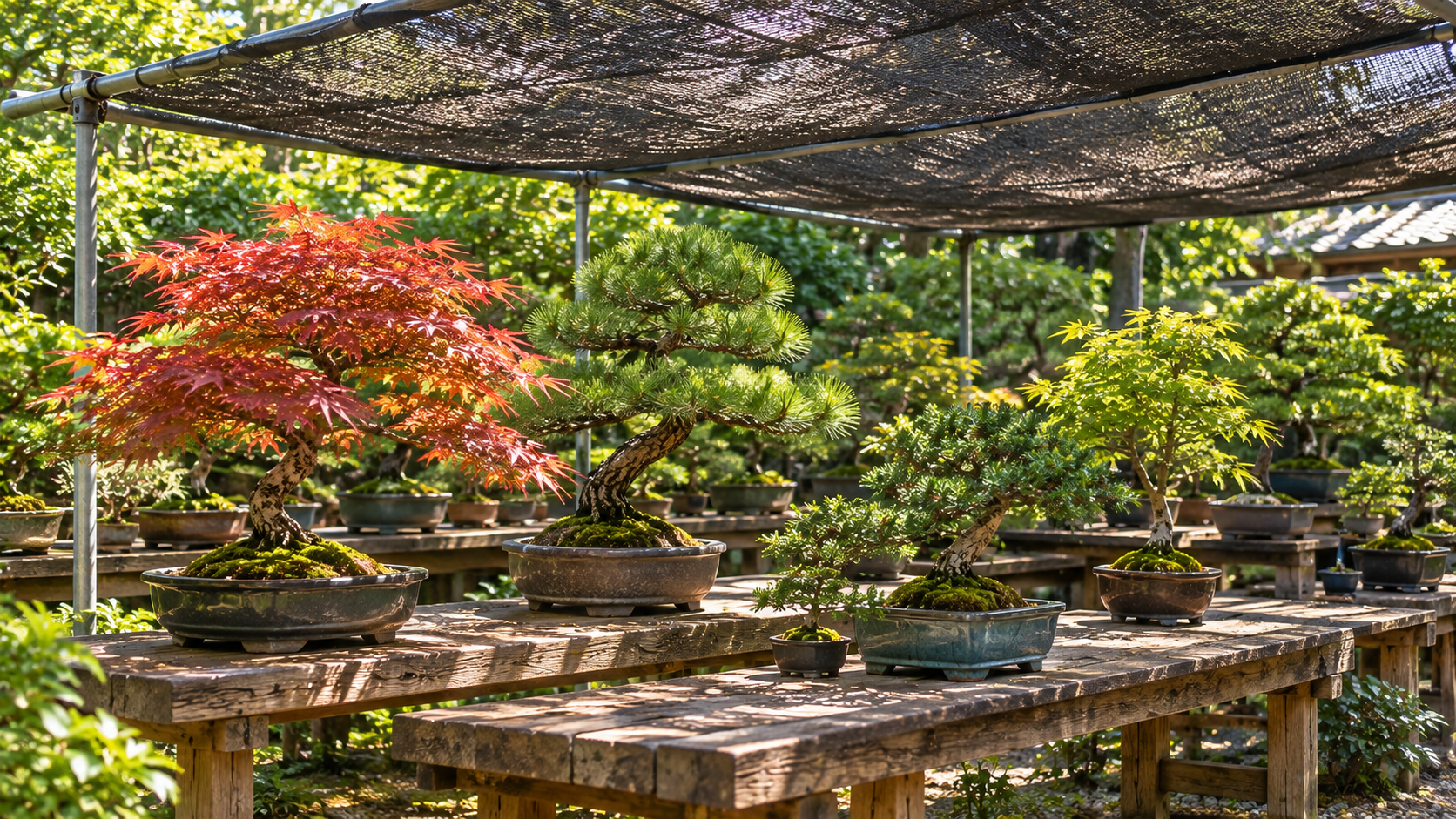
Shade cloth is the simplest fix. A sheet of knitted fabric over your benches cuts the strongest light and heat, reduces water loss, and gives sensitive trees a break during the hottest part of the day.
The problem is choosing it. Shade cloth comes in percentages from 30% to 90%, in black, white, green and reflective aluminum, in knitted and woven types, and in bulk rolls or ready-made panels. And too much shade can be almost as bad as too little.
In my experience, the most common mistake isn’t using the wrong brand. It’s using too much shade, or putting it up and forgetting to take it down. This guide explains what percentage to choose, compares six shade cloths and setups, and covers how to put them up without having the wind take them away.
Who this bonsai shade cloth guide is NOT for
It’s not for indoor bonsai. If your trees live indoors, light is usually the problem, not too much of it. Different products apply.
It’s not for cool, cloudy climates where your trees never scorch. If your trees are fine in full sun all summer, you may not need shade cloth at all.
It’s not about winter protection. For cold weather, see our bonsai winter protection guide.
Still with us? Let’s go.
How we picked these (3 things that actually matter)
1. The right shade percentage
Shade cloth is labeled by how much light it blocks. A 30% cloth blocks about 30% of the light; a 50% cloth about half.
For bonsai, lighter is usually better than heavier. On Bonsai Nut, one grower warns that “the more shade the longer and leggier your new growth will be,” and says they’ve seen trees decline under 75% shade kept on all the time. On the Bonsai Mirai forum, a Las Vegas grower who uses 50% in extreme heat says, “I would not go above 50% or 60% especially if its not too hot.”
What growers report using varies with climate:
- Pacific Northwest: one Bonsai Mirai forum member recalls Ryan recommending 30%, and the Las Vegas grower notes that sun there is less intense.
- Seattle: one Bonsai Nut grower uses 40% over mostly deciduous trees once temperatures reach the upper 80s°F, with conifers in full or morning sun.
- San Antonio: another uses 30% for most species and 50% for Japanese maples and a Brazilian raintree, with no leaf burn.
- Las Vegas: 50% once temperatures pass about 95–100°F.
For most growers, 30% to 50% is the range to look at.
2. Color and material
Black is the standard, durable and economical choice. According to Pro Fabric Supply’s shade cloth selector, white reflects heat and diffuses light, so it runs cooler underneath. Reflective aluminized cloth like Aluminet reflects sunlight and heat.
Construction matters too. Pro Fabric Supply explains that knitted shade cloth uses a lock-stitch construction, so cut edges don’t unravel, and it’s lighter and more tear-resistant than woven cloth, which frays when cut and needs hemming. For bonsai benches, knitted cloth is usually the easier choice.
3. How you’ll put it up
The best cloth is useless if it blows away. Think about the frame, how you’ll attach the cloth, and whether you’ll want to take it down on cloudy days or at the end of summer.
A few summer habits that matter more than the cloth
None of these cost anything.
- Water and pots first. One Bonsai Nut grower recommends managing heat with watering and suitable pots before adding more shade.
- Shade the sensitive trees, not everything. Deciduous trees and seedlings often need shade in hot climates; conifers and larger pots may stay in full sun.
- Don’t move shaded trees straight into full sun. Leaves adapted to shade can burn if suddenly exposed.
- Use top dressing to slow drying. Bonsai Nut members mention moss as a top dressing. Our bonsai moss guide covers options.
- Take shade cloth down in strong wind. Growers report torn cloths.
Bonsai shade cloth comparison table
| Option | Shade level | Best for | Approx. price | Notes |
|---|---|---|---|---|
| Black knitted shade cloth (Be Cool Solutions) | 50% (other levels available) | Most benches | ~$1.50/ft (6 ft wide), $65 min custom cut | 8-year prorated UV warranty |
| Coolaroo Garden Cover | 30–50% | Small setups, easy to find | Varies by size and retailer | Knitted HDPE |
| White shade cloth | Various | Hot climates, cooler shade | Varies | Reflects heat |
| Aluminet reflective cloth | 50% (other levels available) | Very hot climates | ~$7.25/ft (14 ft wide) | Check outdoor suitability |
| DIY frame (conduit or steel pipe) | Any cloth | Permanent bench shade | Low to moderate | Needs proper anchoring |
| Natural shade and placement | Varies | Small collections | Free | Morning sun, afternoon shade |
Prices are approximate and vary by size, retailer and shipping. Always check current prices.
The 6 best bonsai shade cloth options, reviewed
1. Black knitted shade cloth – the dependable standard
If you want one shade cloth that works for most bonsai benches, a black knitted cloth around 30% to 50% is the usual choice.
A good example is Be Cool Solutions 50% Black Tape Knit Shade Cloth, sold in bulk at Greenhouse Megastore. It’s knitted high-density polyethylene with a lock-stitch design that the listing says resists rips, tears and fraying. It’s sold by the linear foot in widths from 6 to 32 feet, starting at $1.50 per foot for the 6-foot width, with a $65 minimum for custom-cut pieces. It can be cut with sharp scissors and attached with snap grommets or zip ties, and it carries an 8-year prorated warranty against UV degradation.
Black is economical and durable, and it’s what most nurseries use.
Pros
- Affordable per foot
- Cut to size without fraying
- Long UV warranty
- Many widths
Cons
- $65 minimum for custom cuts
- Absorbs more heat than white or reflective cloth
- Ships in about 3 weeks
Best for: most growers with a bench or two.
Check black knitted shade cloth at Greenhouse Megastore
2. Coolaroo Garden Cover – the easy-to-find option
If you just want something you can pick up at a hardware store or order online, Coolaroo is one of the most widely available brands.
Coolaroo says most of its shade fabrics are knitted HDPE, and its Garden Cover fabrics come in 30% to 50%. It describes the 30% version as suiting seedlings and herbs that need gentle light, and the 50% version as suiting heat-sensitive plants and helping reduce water loss in hot conditions. Coolaroo also says its color pigments are infused into the yarn rather than applied as a coating, which it claims keeps colors fade-resistant.
It’s sold through major retailers in pre-cut rolls, which is handy for a small setup.
Pros
- Easy to find
- Plant-specific 30% and 50% options
- Pre-cut rolls
Cons
- Less flexible sizing than bulk cloth
- Prices vary by retailer
Best for: beginners and small collections.
Search Coolaroo shade cloth on Amazon
3. White shade cloth – cooler shade for hot climates
White shade cloth is less common, but worth considering if heat is your main problem.
According to Pro Fabric Supply, white reflects heat and diffuses light, so it runs cooler underneath than darker cloth, which suits situations where you want even light without heat buildup. On Bonsai Nut, one commenter answering a question about shade cloth simply said, “I would just go with white.” Another Bonsai Nut member mentions using layers of white cheesecloth to moderate pot temperature.
Pros
- Runs cooler underneath
- Diffuses light evenly
Cons
- Shows dirt more
- Less widely sold than black
Best for: hot climates where heat, not just light, is the problem.
Search white shade cloth on Amazon
4. Aluminet reflective shade cloth – for very hot climates
Aluminet is a reflective shade cloth with aluminized fibers. Instead of absorbing heat like black cloth, it reflects sunlight and heat.
Greenhouse Megastore sells Be Cool Solutions 50% Aluminet Tape Knit Shade Cloth made from metalized HDPE, at $7.25 per foot for the 14-foot width. The listing says the aluminized fibers reflect sunlight and heat in summer and help retain heat in winter, and it carries a 5-year prorated warranty against UV degradation.
One important note: this specific bulk listing says it’s meant for indoor use, as a ceiling under greenhouse roofs or a movable thermal screen. If you want reflective cloth outdoors over open benches, check that the product you buy is rated for outdoor use.
Pros
- Reflects heat as well as light
- Knitted, so cut edges don’t unravel
Cons
- Much more expensive than black cloth
- This bulk version is listed for indoor use
Best for: very hot climates and growers with greenhouses or covered structures.
Check Aluminet shade cloth at Greenhouse Megastore
5. DIY shade frame – the permanent bench solution
Shade cloth needs something to hang on. For a permanent setup, many growers build a simple frame over their benches.
On the Bonsai Mirai forum, growers describe several approaches:
- Wooden posts. One suggests four 10- or 12-foot 4×4 posts in the ground with 30% cloth on top.
- Steel pipe. One grower used black structural steel pipe after a PVC frame failed, saying the wind “picked the whole dang thing up” even with rebar in the posts. He slid the pipe over rebar driven into the ground and held the cloth with plastic greenhouse shade-cloth clips, so he can slide it back on cloudy days.
- Electrical conduit. Another suggests conduit and fittings, which are stiffer and heavier than PVC, anchored with stakes set at opposing angles to resist uplift.
- Fence-mounted. One grower used a fence for support, with wire cable to take the load and conduit for rigidity.
On Bonsai Nut, a similar thread suggests burying short sleeves in the ground so poles can slide in and out, making the frame removable.
Pros
- Permanent, solid solution
- Can be built to fit your benches exactly
- Removable designs possible
Cons
- Takes time to build
- Needs proper anchoring against wind
- PVC may not be strong enough
Best for: growers with a permanent bench area and windy summers.
Search shade cloth clips on Amazon
6. Natural shade and smart placement – the free option
Sometimes the best shade isn’t cloth at all.
Bonsai Nut members mention partial shade from lattice overhead, or a spot that’s shaded for part of the day. One Seattle grower keeps conifers in full or morning sun while deciduous trees get shade. Morning sun with afternoon shade is a common approach for sensitive trees.
There’s one caution. A Bonsai Nut poster notes that a spot next to a fence can trap heat if airflow is poor, so shade isn’t always cooler if the air can’t move.
Pros
- Free
- No structure needed
- Easy to adjust by moving trees
Cons
- Depends on your yard
- Harder with many trees
- Fences can trap heat
Best for: small collections and growers with a naturally shaded spot.
Which bonsai shade cloth should you buy? (By situation)
You have one or two benches and want something reliable: black knitted shade cloth at 30% to 50%.
You want something quick and easy to find: Coolaroo Garden Cover.
You live somewhere very hot: white shade cloth, or outdoor-rated reflective cloth.
You have a greenhouse or covered structure: Aluminet.
You want a permanent, solid setup: a DIY frame with steel pipe or conduit.
You have a small collection: try natural shade and smart placement first.
You grow maples or other delicate deciduous trees: these usually benefit most from shade in hot weather.
How to put up shade cloth over bonsai
- Choose the percentage. Start lighter (30% to 40%) unless you’re in a very hot climate.
- Measure your benches, adding a little extra so the cloth covers trees as the sun moves.
- Build or choose a frame. Steel pipe or conduit is sturdier than PVC.
- Anchor it well. Use rebar, stakes at opposing angles or concrete footings.
- Attach the cloth with grommets, clips or zip ties. Clips make it easy to slide the cloth back.
- Support large pieces. Greenhouse Megastore notes that pieces over 100 square feet may need a center cable.
- Watch your trees for leggy growth or leaf burn, and adjust.
When to put shade cloth up and take it down
Growers time it differently depending on climate. On the Bonsai Mirai forum, the Las Vegas grower puts up 50% cloth as soon as temperatures pass about 95–100°F and uses it all summer. On Bonsai Nut, some growers keep shade on from late spring to late fall, while one in a very hot climate puts it up once days exceed 40°C (104°F) and keeps it until near leaf drop, because shaded leaves burn in direct sun.
A good rule: put shade up before the first real heat wave, not after you see scorched leaves. And when you take it down, do it gradually if you can, because leaves adapted to shade can burn in sudden full sun.
Shade is only part of summer care
Shade cloth helps, but it doesn’t replace good watering. On the Bonsai Mirai forum, one grower notes that in summer heat, roots can “steam cook” quickly. Others mention watering several times a day or using automated systems.
- Water deeply and often. Our bonsai watering can guide covers good options.
- Automate if you travel. Our automatic watering guide covers timers and drip kits.
- Watch small pots. They dry out fastest.
- Check each tree. One grower found misting helped some trees but not others.
Common bonsai shade cloth mistakes
Using too much shade. Heavy shade leads to long, leggy growth.
Putting it up too late. Leaf scorch is hard to undo.
Building a flimsy frame. Wind can lift PVC structures.
Leaving it up in strong wind. Cloths can tear.
Moving trees suddenly from shade to full sun. Leaves can burn.
Shading everything equally. Conifers often prefer more sun than maples.
Conclusion: a little shade goes a long way
The right bonsai shade cloth can be the difference between trees that sail through summer and trees that look scorched by August.
For most growers, a black knitted cloth at 30% to 50% is the simplest, most dependable choice. Coolaroo is easy to find for small setups, white cloth runs cooler in hot climates, and reflective cloth like Aluminet suits greenhouses and very hot areas. Whatever you choose, give it a sturdy frame, and remember that less shade is often better than more.
Watch your trees, water well, and adjust as summer goes on.
Ready to shade your benches? Check black knitted shade cloth at Greenhouse Megastore, or search Coolaroo shade cloth on Amazon.