Affiliate disclosure: Some links on this page are affiliate links. If you buy through them, Aribonsai may earn a small commission at no extra cost to you. It doesn’t change what we recommend or how we rank anything.
Why does every show tree have that green carpet?
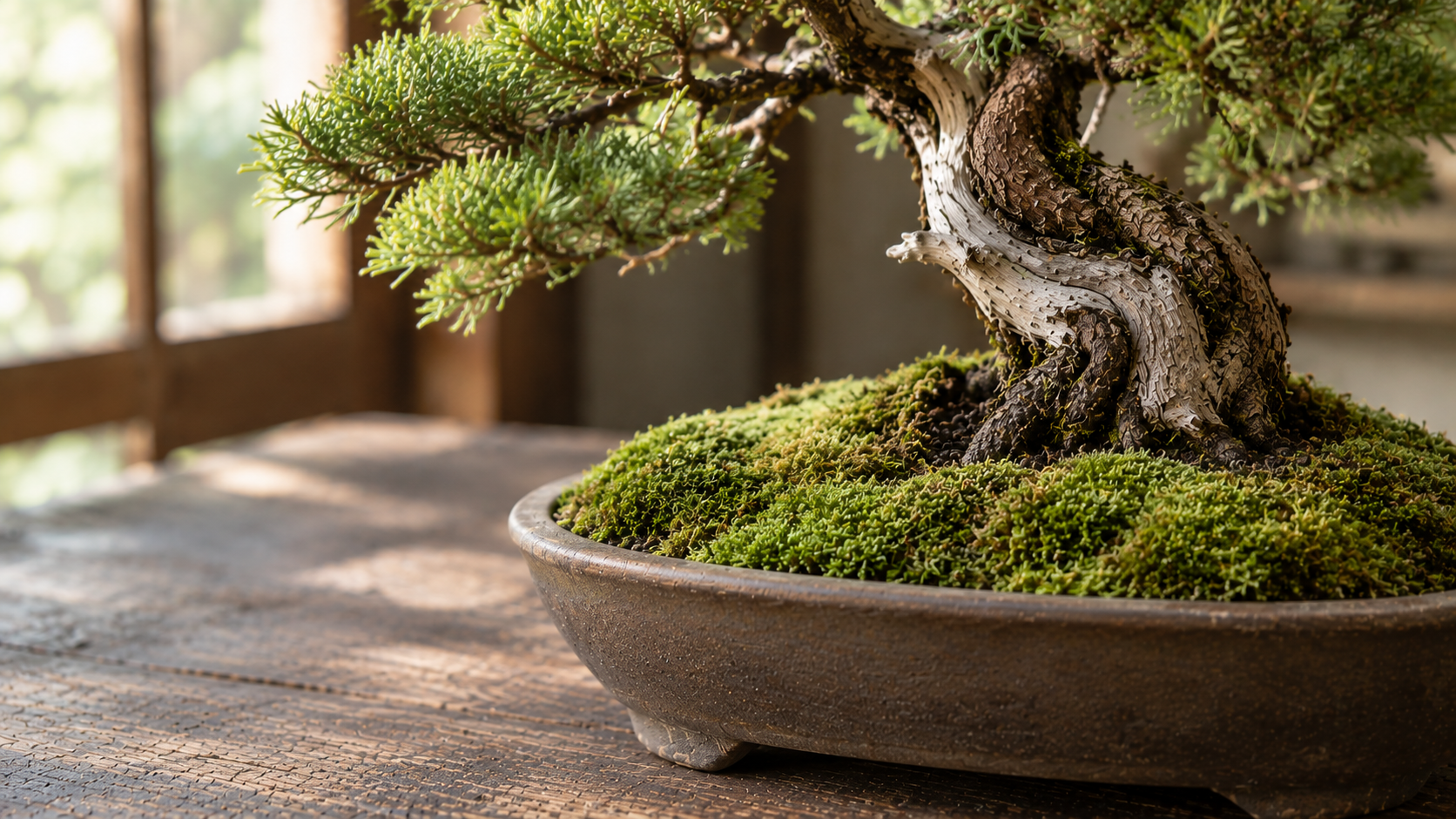
Look at photos from any major bonsai exhibition and you’ll notice the same thing. The soil is almost never visible. Instead, there’s a low, even carpet of moss that makes the tree look like it’s growing on an old hillside rather than in a pot.
Bonsai moss isn’t just decoration, though. A good moss layer helps keep the soil surface from drying out too fast, stops heavy watering from washing soil away, and keeps birds from digging through the pot. And on a newly repotted tree, it can help hold the surface together while the roots settle.
The trouble is that moss is surprisingly hard to get right. You lay down a nice sheet, and two weeks later it’s brown. Or it grows so well that it creeps up the trunk and holds water against the bark. Or it simply looks wrong, like a piece of carpet dropped on top of the soil.
In my experience, most moss problems come down to choosing the wrong type for the conditions. Shade moss in full sun burns. Thick sheet moss on a fast-draining pot dries out. This guide explains what matters, then compares six bonsai moss options, from Japanese mountain moss to live moss you can grow in sun.
Who this bonsai moss guide is NOT for
It’s not about air layering. Long-fibered sphagnum is also used to wrap air layers. That’s a different job. Here, we’re talking about moss for the soil surface.
It’s not about terrariums. Indoor terrarium moss lives in high humidity. Most bonsai live outdoors, in wind and sun, which is a very different environment.
It’s not for people who want zero maintenance. Moss needs moisture and the right light. If your trees are in a hot, dry spot and you can’t water often, a bare soil surface or a thin sphagnum layer may suit you better.
Still with us? Let’s go.
How we picked these (3 things that actually matter)
1. Sun or shade
This is the most important question.
Many mosses naturally grow in shade, on forest floors or the north side of rocks. Put them on a bonsai bench in full sun and they quickly dry out and brown. Others, often collected from sidewalks, rooftops and rock surfaces, handle sun and drying much better.
Bonsai growers have long noticed this. Many recommend collecting moss from sunny, hard surfaces like concrete, brick or stone, because those conditions are closer to a bonsai pot than a shady forest floor.
2. Sheets, fragments or a top dressing
Moss comes in different forms, and each suits a different use.
- Live sheets or squares give instant coverage. They’re great before a show. But laying large plates of moss on the surface often looks unnatural, and some growers find that placed moss doesn’t last as well as moss grown in place.
- Fragments, crumbled or sieved moss are sprinkled on the soil and grow into a carpet over a few weeks. It’s slower, but the result often looks and lasts better.
- Top dressings like Japanese mountain moss or sieved sphagnum aren’t always about a green carpet. They mainly hold moisture at the surface.
3. Your species and your soil
Moss affects the root zone. A thick, wet moss layer keeps the surface damp for longer, which some trees love and others don’t. Bonsai Tonight notes, for example, that Japanese mountain moss may acidify the root environment slightly more than white sphagnum, which suits acid-loving satsuki azaleas.
Think about your soil too. If you use fast-draining akadama mixes, a thin moss or sphagnum layer helps the surface stay moist between waterings. Our akadama and Japanese bonsai soil guide explains how these soils behave.
A few moss habits that matter more than the product
None of these cost anything.
- Keep moss off the trunk base. Moss growing up the trunk keeps bark wet. Leave a small gap around the base.
- Use tweezers to place it. Pressing small pieces of moss into the soil surface with bonsai tweezers gives a much more natural result than laying big sheets.
- Water it in. After applying moss, water gently so it settles, then water the tree as usual.
- Mist new moss daily. Fresh moss needs moisture to establish.
- Thin it if it gets too thick. A dense moss mat can block water from reaching the roots.
- Remove it when repotting. Old moss can be reused, or crumbled and grown again.
- Watch out for weeds. Collected moss can carry weed seeds. Pull them early.
Bonsai moss comparison table
| Moss | Type | Light | Best for | Origin | Approx. price |
|---|---|---|---|---|---|
| Mountain Moss (Yamagoke) | Top dressing | Varies | Satsuki azaleas, moisture | Imported from Japan | ~$8 (2 L) |
| Besgrow NZ Sphagnum | Sieved sphagnum | Any | Moisture layer, moss base | New Zealand | Varies |
| Sun Tolerant Moss Clumps | Live moss | Sun | Outdoor bonsai in sun | US seller | From ~$35 |
| Racomitrium Sun Moss | Live moss | Sun | Japanese-style carpet | US seller | Check price |
| Sheet Moss (Hypnum) | Live sheets | Shade | Quick display coverage | US seller | From ~$14 |
| Kyoto Moss Spores | Spores | Partial shade | Experimenting | Not stated | Varies |
Prices are approximate and vary by seller and season. Always check the current price before you buy.
The 6 best bonsai moss options, reviewed
1. Mountain Moss (Yamagoke) – the classic Japanese top dressing
If you grow satsuki azaleas, this is the one you’ll hear about most. Bonsai Tonight calls Japanese mountain moss, or yamagoke, the go-to top dressing for satsuki bonsai.
It’s imported from Japan and sold in 2-liter and 8-liter bags, from about $8. You spread it over the soil surface, where it helps keep moisture near the top so trees don’t dry out. Azalea growers like that it knits together into a protective layer on the surface.
Bonsai Tonight also notes that mountain moss may acidify the root environment slightly more than white sphagnum. That’s a good thing for satsuki and other acid-loving plants. For other species, many growers prefer sphagnum.
Bonsai Tonight only ships within the US, so growers elsewhere will need to look for Japanese mountain moss from a local bonsai shop.
Pros
- Imported from Japan
- Traditional choice for satsuki azaleas
- Knits into a protective surface layer
- Inexpensive
Cons
- Slightly acidifying, which won’t suit every species
- US shipping only from this seller
Best for: satsuki and azalea growers, and anyone who wants a traditional Japanese top dressing.
Check Mountain Moss at Bonsai Tonight
2. Besgrow New Zealand Sphagnum – the best base for any moss layer
Sphagnum isn’t the green carpet you see at shows, but it’s the quiet workhorse underneath many of them.
New Zealand sphagnum, often sold under the Besgrow Spagmoss name, is harvested from New Zealand’s West Coast and sold dry in compressed blocks. Bonsai growers use it in a few ways. Sieved finely, it makes a thin layer that holds moisture at the surface. Long-fibered sphagnum can hold soil in place on uneven surfaces. And many growers mix shredded sphagnum with crumbled live moss and sprinkle it on, so the moss has something moist to grow into.
On bonsai forums, some growers describe sphagnum as the most important part of the mix for function, with live moss added for looks.
Availability varies. One US retailer we checked had paused dry-goods shipments to the US, so check a few sellers.
Pros
- Holds moisture at the soil surface
- Helps live moss establish
- Works on almost any species
- Sold dry, so it stores well
Cons
- Not a green carpet on its own
- Availability varies by country and seller
- Needs sieving or shredding for top dressing
Best for: every grower, as a moisture layer or a base for growing moss.
Search Besgrow sphagnum moss on Amazon
3. Sun Tolerant Moss Clumps – best live moss for sunny benches
Most bonsai live in sun for much of the day, which is exactly where many mosses fail. Moss Acres, a US live moss grower, sells a moss specifically for those conditions: Sun Tolerant Moss Clumps (Bryum caespiticium), from around $35.
Bryum is the kind of moss you often see growing in sidewalk cracks and on sunny walls, which is why it suits a bonsai pot. Clumps can be broken into small pieces and pressed into the soil surface, where they spread into a low, natural-looking cover.
Moss Acres also lists a “Moss for Bonsai” bundle and other sun-tolerant options, so it’s worth browsing its bonsai section.
Pros
- Chosen for sun tolerance
- Low, fine texture suits bonsai
- Clumps break up easily for natural placement
- From a specialist moss grower
Cons
- More expensive than collecting your own
- Still needs regular moisture to establish
Best for: outdoor bonsai in sunny spots.
Check moss for bonsai at Moss Acres
4. Racomitrium Sun Moss – the Japanese-style carpet
Racomitrium is the moss genus behind many of the soft, gray-green carpets associated with Japanese moss gardens, where it’s often called sunagoke. It’s popular in Japan because it handles sun and drying better than many mosses, then greens up quickly when it gets wet.
Moss Acres sells a Racomitrium Sun Moss square, about 13 by 13 inches, alongside its other live mosses. A square gives you enough to break into pieces for several trees.
Because it changes color with moisture, it can look silvery when dry and bright green after watering. Some growers love that changing look; others prefer a moss that stays green.
Pros
- Classic Japanese moss garden look
- Good tolerance of sun and drying
- Greens up quickly after watering
Cons
- Looks gray-green when dry
- Price and stock vary
Best for: growers who want a Japanese-style moss carpet on sunny trees.
Check Racomitrium moss at Moss Acres
5. Sheet Moss (Hypnum) – best for quick display coverage
Sometimes you just need the soil covered by Saturday. That’s what sheet moss is for.
Moss Acres sells live Sheet Moss (Hypnum imponens) from around $14. It comes in flat mats you can cut and lay on the soil for instant green coverage, which makes it popular for displays and tray landscapes.
The catch is light. Sheet moss generally prefers shade and steady moisture, so on a sunny bench it may brown quickly. It also tends to look like a “plate” laid on top unless you tear it into irregular pieces and press them in. Many growers use it for shows and photos, then remove or replace it afterward.
If you’re preparing for a show, combine it with a well-chosen bonsai display stand for a finished look.
Pros
- Instant coverage
- Easy to cut and shape
- Affordable
Cons
- Prefers shade
- Can look unnatural if laid in large sheets
- May not last long in sun
Best for: shows, photos, and trees kept in shade.
Check Sheet Moss at Moss Acres
6. Kyoto Moss Spores – for patient experimenters only
The idea is appealing: sprinkle spores, and a velvety Kyoto garden moss appears. Joshua Roth sells Kyoto Moss Spores for bonsai, saikei and tray landscapes, with each pack covering up to about 3 square feet.
The reality is less certain. Customer feedback describes it as fairly temperamental, and at least one grower reported it didn’t grow in their climate. On the Bonsai Mirai forum, one experienced member’s advice was blunt: don’t bother with Kyoto moss, and use local species instead.
We’ve included it because people often ask about it. It can work, but it’s slow and unpredictable compared with the other options here.
Pros
- Designed for bonsai and tray landscapes
- Covers a fair area
- Fun if you enjoy experimenting
Cons
- Slow and unpredictable
- Mixed feedback from growers
- Origin of the spores not stated
Best for: patient growers who enjoy experimenting.
Search Kyoto Moss Spores on Amazon
The free option: grow your own bonsai moss
Before you buy anything, it’s worth knowing that many experienced growers never buy moss at all.
A common method shared on bonsai forums goes like this:
- Collect moss from sunny, hard surfaces. Sidewalks, brick paths, walls and rocks are good sources. Only collect where you have permission.
- Dry and crumble it. Let it dry, then crumble or rub it through a screen. Some growers blend it.
- Mix with sieved sphagnum. Many use a mix of moss and shredded sphagnum, roughly half and half or a little more moss.
- Sprinkle on the soil. Apply a thin, even layer.
- Mist regularly. With daily moisture, growers report new growth within a few weeks.
One forum member even added a little sumi ink to the sphagnum, and reported lush growth afterward. It’s an experiment, not a proven method, but an interesting one. A soil sieve works well for preparing both the moss and the sphagnum.
Which bonsai moss should you buy? (By situation)
You grow satsuki azaleas: Mountain Moss (Yamagoke).
You want a moisture layer for any tree: sieved New Zealand sphagnum.
Your trees sit in full sun: Sun Tolerant Moss Clumps or Racomitrium.
You want a Japanese moss garden look: Racomitrium Sun Moss.
You need coverage fast for a show: Sheet Moss, torn into irregular pieces.
You enjoy experiments: Kyoto Moss Spores.
You want the most natural result for free: collect local moss and mix it with sphagnum.
You’ve just repotted: a thin layer of sieved sphagnum helps keep the surface moist and hold fresh soil in place. Our bonsai repotting supplies guide covers the rest of what you’ll need.
How to keep bonsai moss healthy
- Water regularly. Moss dries out faster than the soil beneath it.
- Match moss to light. If moss keeps browning, it’s probably getting more sun than it likes.
- Expect summer dieback. Many growers report moss browning in hot summers, then recovering when cooler, wetter weather returns.
- Don’t let it get too thick. Thin it out if it forms a dense mat that blocks water.
- Keep it away from the trunk. Bark that stays wet can suffer.
- Remove weeds early. They’re much easier to pull when small.
Common bonsai moss mistakes
Laying big sheets on top. It looks unnatural and often doesn’t last. Small, irregular pieces work better.
Using shade moss in full sun. It browns quickly. Choose sun-tolerant moss for sunny benches.
Covering the trunk base. Leave a gap so the bark can dry.
Letting moss block watering. A thick mat can shed water. Check that water reaches the soil.
Expecting instant results from spores or crumbled moss. Growing moss takes weeks, sometimes longer.
Conclusion: choose moss for your conditions, not the photo
Bonsai moss is one of the easiest ways to make a tree look finished, and it genuinely helps the soil surface stay moist. But the right moss depends on your light, your species and how much time you have.
For satsuki growers, Japanese mountain moss is the traditional choice. For almost everyone else, a thin layer of sieved sphagnum mixed with sun-tolerant live moss gives the most natural, long-lasting result. And if you only need coverage for a show, sheet moss will do the job quickly.
Start small, place it with tweezers, keep it moist, and let it grow into the pot rather than sitting on top.
Ready to finish your trees? Check Mountain Moss at Bonsai Tonight, or browse live moss for bonsai at Moss Acres.