Affiliate disclosure: Some links on this page are affiliate links. If you buy through them, Aribonsai may earn a small commission at no extra cost to you. It doesn’t change what we recommend or how we rank anything.
The tool you don’t think you need, until you try wiring without it
Here’s a scene a lot of growers know.
You’re wiring a branch. The wire’s on, the bend looks right, and now you just need to finish the end. So you grab the wire with your fingers and try to twist it tight. It slips. You try again. Your fingertips start to hurt. Eventually you go and find some hardware-store pliers, which do the job, but the ridged jaws chew into the bark when you get close to the trunk.
Or it’s a few months later, and the wire needs to come off. Some people cut it all off in short pieces. Others unwind it carefully. Either way, there’s a lot of fiddly gripping and pulling involved.
And then there’s deadwood. If you’ve ever tried to create a jin (a stripped, bleached branch stub) on a juniper or pine, you’ll know you need something that can grip a thin strip of bark or wood and pull it away cleanly.
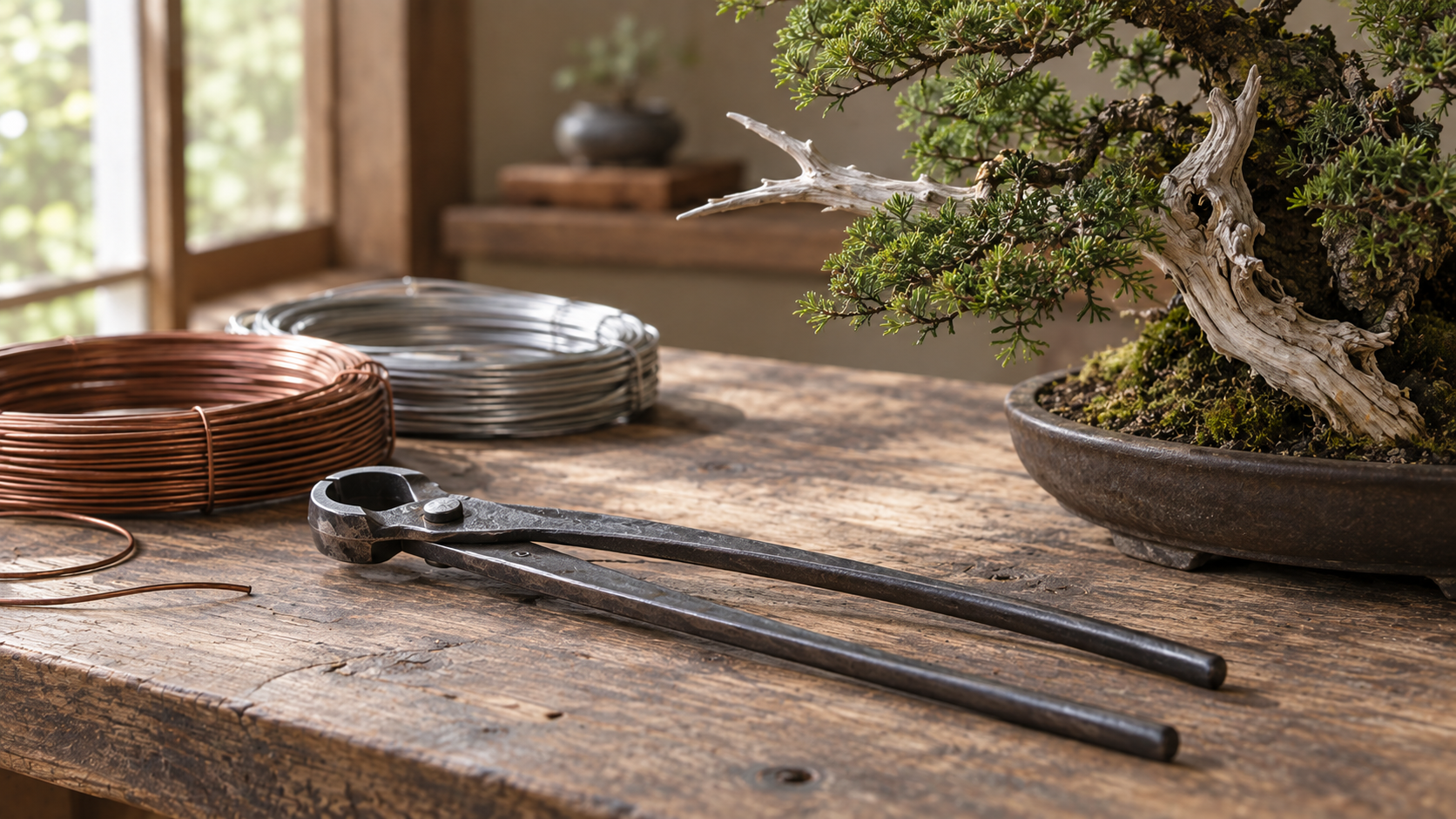
That’s what jin pliers are for. In Japanese they’re often called yattoko. Retailers describe them as tools for twisting, winding and removing wire, and for creating jins by tearing.
What they actually do on the bench
It helps to be specific, because “pliers” sounds like a hardware tool, and these are used in a few different ways.
- Finishing wire ends. After wrapping a branch, you grip the end of the wire and give it a final twist so it sits tight and doesn’t spring loose.
- Tightening as you go. On longer runs of wire, a small twist here and there helps the wire hold the branch where you want it.
- Removing wire. When it’s time to take wire off, you can grip and unwind it, which avoids leaving dozens of short cut pieces stuck in the foliage. Long-handled pliers make this much easier on wire that has started to bite in.
- Making jins. For deadwood, the pliers grip the bark and fibers of a branch so you can peel and tear them away, leaving a more natural-looking stub than a clean cut would.
Most people use them for the first three far more often than the last one. Jin work is the reason they’re called jin pliers, but wiring is where they earn their keep.
In my experience, this is the tool that gets added to a kit later than it should. People buy cutters and shears first, then wonder why wiring feels so awkward. Once you have a decent pair, it’s hard to go back.
Who this article is NOT for
It’s not for you if you rarely wire. If you do most of your styling by pruning, a pair of jin pliers will spend a lot of time in the drawer.
It’s not for you if you want a wire cutter. Jin pliers grip, twist and pull. For snipping wire close to the bark, you want a dedicated cutter. Our bonsai wire cutter guide covers those.
It’s not a deadwood carving guide. Jin pliers are one part of creating deadwood. Power tools, carving knives and gravers are a separate topic, and carving on a live tree needs care and experience.
Still here? Let’s get into it.
How we picked these (3 things that actually matter)
1. Length and leverage
Jin pliers come in a range of sizes, usually around 170mm to 230mm.
- Shorter pliers (around 170–180mm) are easier to use inside small or dense trees and on fine wire. They’re a good match for shohin and for careful work.
- Longer pliers (around 210–230mm) give you more leverage. That helps when you’re twisting thick wire, pulling off heavy wire that’s been on for a while, or tearing tougher material for a jin.
One UK retailer notes that Kaneshin’s long-handle No.49 is particularly useful for removing heavy twisted wire and offers more leverage than smaller versions. That’s the general pattern across brands: longer pliers do the heavy work more easily.
2. Weight and grip
You’ll often hold jin pliers for a long time, especially during a wiring session. Weight matters more than you’d expect. A light pair is comfortable for finishing dozens of wire ends. A heavier pair feels more solid when you’re pulling hard.
Grip shape matters too. Most Japanese jin pliers have rounded or smooth jaws designed not to chew up bark, which is a big part of why they’re better than hardware-store pliers.
One small but useful note from a retailer: on Kaneshin’s No.49, force should only be applied in line with the handles, not twisted sideways. That’s good advice for any pliers. They’re strong in one direction, not every direction.
3. Carbon or stainless
Same choice as with every bonsai tool.
Carbon steel costs less and is perfectly fine for pliers, as long as you wipe and oil them now and then. Stainless steel handles moisture better but costs roughly twice as much.
Pliers don’t have a cutting edge to keep sharp in the same way cutters do, so rust is the main concern. The pivot is the part to watch. If it gets stiff or gritty, the pliers become tiring to use. A wipe after each session and a drop of oil on the pivot now and then keeps the action smooth for years. If you wire outdoors, in a humid climate, or just tend to leave tools lying around, stainless might be worth it.
Prices below are approximate and were checked in October 2026. Yen prices are from Japanese stores before international shipping.
Comparison table
| Jin pliers | Steel | Length | Weight | Approx. price | Best for |
|---|---|---|---|---|---|
| Wazakura Hand Forged Wire & Jin Pliers | S55C carbon (black coated) | 210mm | 230g | ~$46 | First pair, general wiring |
| Kaneshin Bonsai Pliers No.49 | Carbon | 230mm | ~305g (incl. packing) | ~¥9,300 (about $60); ~£44 at a UK retailer | Leverage, heavy wire, jin tearing |
| Kaneshin Stainless Pliers No.818 / No.819 | Stainless | 180 / 215mm | ~202g (No.818, incl. packing) | ~¥19,200 (No.818); ~£120 (No.819, UK) | Low maintenance |
| Masakuni Jin Pliers No.0017 | Carbon | 200mm | 190g | ~¥11,800 (about $78) | Light, premium everyday pair |
| Masakuni Jin Pliers No.0117 (L) | Carbon | 220mm | 230g | ~¥14,800 (about $97) | Premium pair with more reach |
Individual reviews
1. Wazakura Hand Forged Bonsai Wire and Jin Pliers (210mm)
The cheapest real Japanese jin pliers on this list, and a sensible first pair.
It’s S55C carbon steel with a black coating, 210mm long and 230g, hand-forged in Sanjo, Niigata. Wazakura sells it for $45.99, with free shipping to the US, Canada, the UK, the EU and other regions. Import tax may still apply.
Wazakura describes it as being for shaping training wire, styling, and safely removing wire. The ends are rounded to protect the tree, and the handles are designed to reduce hand fatigue during long sessions.
At 210mm, it sits in the middle of the size range. It has enough leverage for most wire, without being clumsy in smaller trees.
Pros
- Lowest price for Japanese-made jin pliers here
- Free shipping to several regions
- Good all-round length
- Rounded ends that are kind to bark
Cons
- Only one size
- Carbon steel, so it needs occasional oiling
- Less long-term feedback than Kaneshin or Masakuni
Who it’s for: Anyone buying their first pair of jin pliers, especially if they already order other tools from Wazakura. It’s also a sensible backup pair to keep in a second tool roll.
2. Kaneshin Bonsai Pliers No.49 (230mm)
The classic long-handled jin pliers.
Kaneshin’s No.49 is 230mm long and weighs about 305g including packing. On a Japanese tool store it’s about ¥9,300, though it was marked as sold out when we checked. Kaizen Bonsai in the UK lists it at £43.95, describing it as SK steel and as useful for “creating deadwood jins by tearing or wire work,” especially for removing heavy twisted wire. It’s also part of Kaneshin’s 8-piece tool set, which we covered in our starter tool sets guide.
Kaneshin also lists other pliers in smaller sizes, including No.48A (180mm), No.50A (175mm) and No.49B (210mm). We couldn’t confirm current prices for those, so we’ve kept them out of the table. But if 230mm feels too long for your trees, it’s worth knowing they exist.
In my experience, long-handled pliers like the No.49 are the ones people reach for when wire has bitten in a little and needs some real force to unwind. The extra length makes that much less of a struggle.
Pros
- Long handles for real leverage
- Well-suited to heavy wire and jin work
- Reasonable price for a Kaneshin tool
- Smaller sizes available within the same brand
Cons
- Heavier and longer than you need for fine work
- Stock can be patchy at Japanese stores
- Carbon steel, so it needs basic care
Who it’s for: Growers who wire medium to large trees, remove a lot of thick wire, or do jin work.
3. Kaneshin Stainless Pliers No.818 (180mm) / No.819 (215mm)
The stainless option, in two sizes.
The No.818 is 180mm and about 202g including packing, at around ¥19,200 on a Japanese tool store. The No.819 is the larger 215mm version, listed at £120 by a UK retailer. Both are described as being for twisting, winding and removing wire.
That’s roughly double the carbon price. You’re paying for rust resistance. Wiring often happens with damp hands, outdoors, or right after watering, so pliers do get wet more than you might think.
The 180mm No.818 is also a nice size for smaller trees. It’s lighter and easier to handle in tight spaces than the 230mm No.49.
Pros
- Stainless steel, much better in damp conditions
- Two useful sizes
- The 180mm version is good for shohin and fine wiring
- Same Kaneshin build quality
Cons
- About twice the price of the carbon No.49
- UK and Japanese prices vary a lot
- Mostly sold direct from Japan or in the UK
Who it’s for: Growers in humid climates, people who wire outdoors a lot, or anyone tired of keeping carbon steel tools oiled.
4. Masakuni Jin Pliers No.0017 (200mm)
A light, premium everyday pair.
The No.0017 is 200mm and just 190g, listed at about ¥11,800 on a Japanese export store. That’s lighter than every other pair on this list, despite being a mid-length tool.
As with Masakuni’s knob cutters, the price is closer to Kaneshin than most people expect. You’re not paying collector prices here. You’re paying a bit more for Masakuni’s finish and feel.
In my experience, weight is one of the things you notice most with pliers once a wiring session goes past half an hour. A lighter pair just tires your hand out less.
Pros
- The lightest pair on this list
- Mid-length size that handles most jobs
- Masakuni build quality at a reasonable price
- Comfortable for long wiring sessions
Cons
- Carbon steel, so it needs the usual care
- Less leverage than longer pliers for very heavy wire
- Harder to buy outside Japan
Who it’s for: Intermediate and advanced growers who wire often and value comfort over raw leverage.
5. Masakuni Jin Pliers No.0117 (L) (220mm)
The larger Masakuni option.
The No.0117 (L) is 220mm and 230g, at about ¥14,800 on a Japanese export store. It’s longer than the No.0017 but still the same weight as Wazakura’s 210mm pliers, and lighter than Kaneshin’s 230mm No.49.
So it gives you most of the reach of a long-handled pair without much extra weight. That’s a nice balance for growers who work on a mix of tree sizes.
Pros
- Longer reach than the No.0017 for heavier wire
- Still fairly light for its length
- Masakuni finish and reputation
- A good single pair if you want premium and versatile
Cons
- The most expensive carbon pair on this list
- Carbon steel, so it needs basic care
- Harder to buy outside Japan
Who it’s for: Growers who want one premium pair that can handle both everyday wiring and heavier work. If you can only justify one Masakuni pair, this is probably the more flexible of the two, unless most of your trees are small.
Recommendation by use case
“I’ve never owned jin pliers and want a good first pair.” Wazakura Hand Forged Wire & Jin Pliers. About $46, a sensible 210mm length, and free shipping to several regions.
“I wire bigger trees and remove a lot of heavy wire.” Kaneshin No.49. Long handles, plenty of leverage.
“I want to start making jins on junipers or pines.” Kaneshin No.49 for its leverage when tearing. Masakuni No.0117 (L) if you want a lighter premium option.
“I mostly work on small trees and fine wire.” Kaneshin No.818 (180mm stainless), or Masakuni No.0017 if you prefer carbon steel.
“I wire outdoors in a humid climate.” Kaneshin No.818 or No.819 stainless.
“I want the most comfortable pair for long sessions.” Masakuni No.0017. At 190g, it’s the lightest here.
Conclusion: get the leverage right, and your hands will thank you
Here’s the short version.
Jin pliers aren’t flashy, but they make wiring faster, easier on your fingers, and kinder to the bark. If you wire regularly, they’re one of the most useful tools you can add after a concave cutter and shears.
Pick the length based on the wire you use most. Shorter for fine work and small trees. Longer for heavy wire, big trees and jin work. Go stainless if your tools get wet a lot, and carbon if you don’t mind a quick wipe and some oil now and then.
If you’re unsure about size, it’s hard to go wrong with something around 200–210mm. That’s long enough for most wire, short enough for most trees, and it’s where the Wazakura and the Masakuni No.0017 both sit. You can always add a longer or shorter pair later once you know where your first one falls short.
And remember: pliers grip and pull, they don’t cut. Pair them with a proper wire cutter, and wiring gets a lot less frustrating.
Ready to pick a pair?