Affiliate disclosure: Some links on this page are affiliate links. If you buy through them, Aribonsai may earn a small commission at no extra cost to you. It doesn’t change what we recommend or how we rank anything.
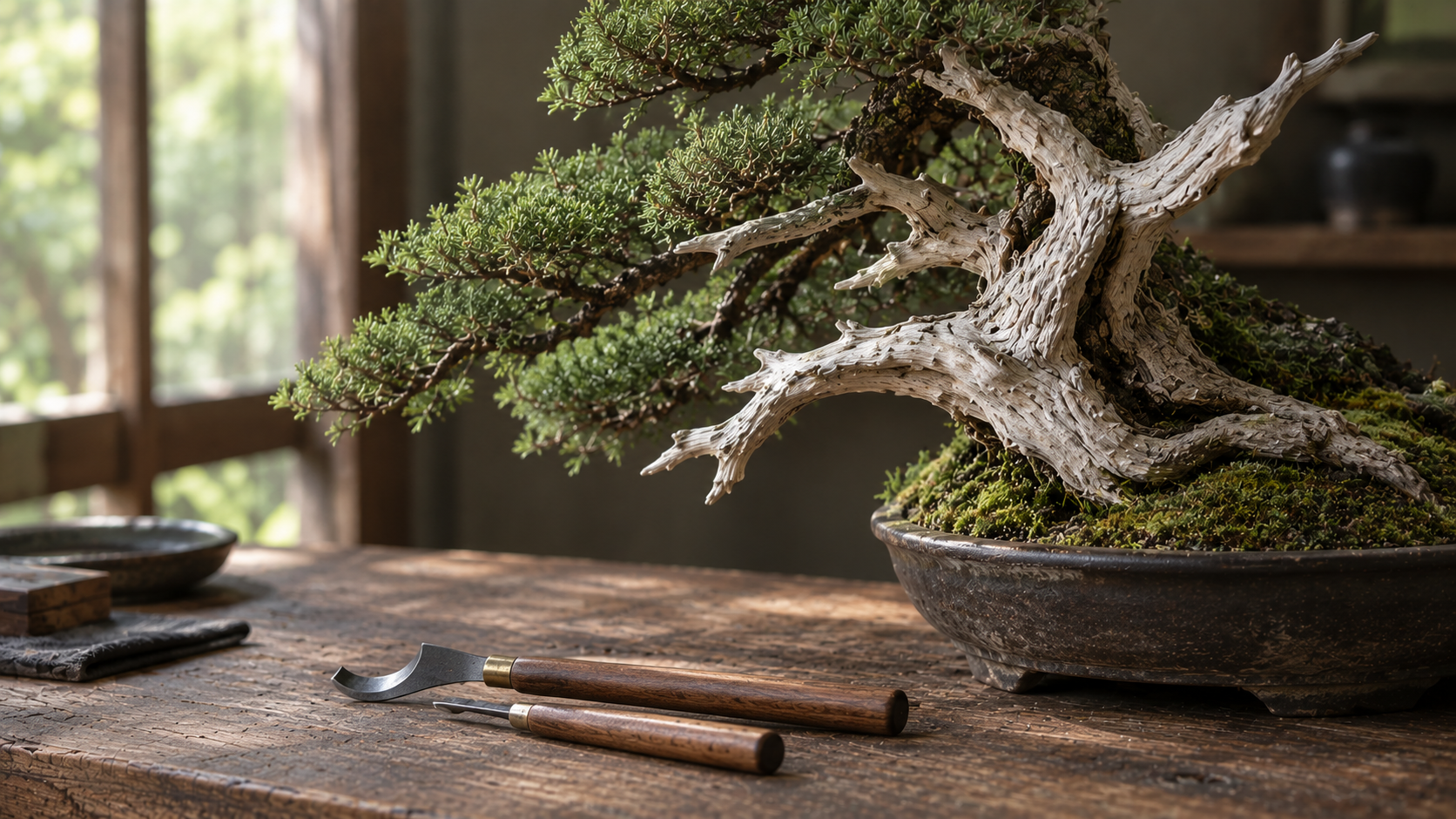
Deadwood is where bonsai starts to look old
Bonsai carving tools are what turn a stub into a story.
Look at almost any famous juniper or pine and you’ll see deadwood: bleached jin at the branch tips, long shari running down the trunk, hollows and grain that make the tree look like it’s survived a century on a mountainside. That character doesn’t happen by accident. Most of it is carved.
The trouble is that carving looks intimidating from the outside. Do you need a power tool? A set of chisels? Special Japanese knives? And how do you avoid ending up with something that looks gouged rather than weathered?
The good news is you can start small. A single jin knife and a little patience will take you surprisingly far. Power carving comes later, if at all.
In my experience, the people who struggle most with deadwood aren’t the ones with cheap tools. They’re the ones who reach for the biggest tool first and remove too much wood in one go. This guide explains what actually matters, then compares six bonsai carving tools, from simple Japanese jin knives to rotary bits for heavy work.
Who this bonsai carving tools guide is NOT for
It’s not for wiring or stripping small branches. For peeling bark off thin jin and crushing fibers, bonsai jin pliers are usually the better tool. Carving tools come in when you’re shaping wood, not just stripping it.
It’s not a full power-carving guide. We’ll cover the basics and one rotary option, but serious power carving (die grinders, chainsaw wheels) is a separate skill with real safety risks.
It’s not for general woodworking. Some of these tools look like woodworking chisels, but this guide is about using them on living trees and deadwood.
Still with us? Let’s go.
How we picked these (3 things that actually matter)
1. Hand tools or power tools
This is the big decision.
- Hand carving tools (jin knives, gouges, chisels, draw knives) are quiet, cheap and very controllable. They’re best for stripping bark, defining the lifeline, and refining detail. They’re slow on large areas.
- Power carving tools (rotary bits in a Dremel-type tool or die grinder) remove wood quickly. They’re best for big trunks, hollows and heavy shaping. They’re also much easier to overdo, and they need eye protection, gloves and practice.
Most experienced carvers use both. On bonsai forums, a common pattern is power tools for rough shaping, and hand tools and scrapers for the final detail that makes deadwood look natural.
2. Blade shape and job
Each hand tool has a job.
- Jin knives remove bark and mark the edge between living and dead tissue (the lifeline).
- Gouges (U-shaped blades) scoop out grooves and hollows.
- V-parting tools cut sharp grooves that follow the grain.
- Draw knives pull long strips of wood and bark, useful for making jin.
- Skew chisels clean up flat areas and edges.
You don’t need all of them. Start with a jin knife, then add a gouge or two as you need them.
3. Steel, sharpness and origin
Sharp tools are safer than dull ones, because you use less force. Look for tools that come pre-sharpened, and check whether the blade is stainless (rust-resistant) or carbon steel (often easier to sharpen, but needs oiling).
Origin varies. Several tools here are made in Japan by bonsai specialists. Others are sold under bonsai brands without a clear country of origin. We’ve labeled each one as clearly as we can.
A few carving habits that matter more than the tool
None of these cost anything.
- Carve less than you think. You can always remove more wood. You can’t put it back.
- Follow the grain. Natural deadwood splits and weathers along the grain. Carving against it looks artificial.
- Protect the lifeline. Never carve into the living strip of bark that feeds the branch above. Mark it clearly before you start.
- Tear, don’t just cut. Many carvers pull fibers with pliers after cutting, so the wood looks broken by nature rather than sliced.
- Work on dry deadwood where possible. Several Japanese tool makers describe their jin and shari tools as ideal for dry wood.
- Finish before you treat. Lime sulfur and other deadwood treatments go on after carving, not before.
- Practice on scrap. A dead branch from the garden is a free place to learn how each tool behaves.
Bonsai carving tools comparison table
| Tool | Type | Best for | Origin | Approx. price |
|---|---|---|---|---|
| Kikuwa Jin Knife (2281 / 2282) | Hand, jin knife | Stripping bark, lifelines | Japan | ~$28 |
| Kaneshin Jin & Shari Tip (190 mm) | Hand, jin tool | Debarking, pulling jin | Japan | ~€39 (EU) |
| Japanese gouges & draw knife (Bonsai Tonight) | Hand, gouges/knives | Grooves, hollows, long jin | Japan | Check current price |
| Wazakura 3-Piece Chisel Kit | Hand, chisels | Grooves and detail on a budget | Japan (Miki) | Check current price |
| Ryuga Hand Carving Tools | Hand, scrapers | Jin, shari and flaky bark | Not stated | ~£7.50 each / £80 set of 6 (UK) |
| Rotary shapers for Dremel-type tools | Power, rotary bits | Hollows and heavy shaping | Not stated | ~€26–100 per bit (EU) |
Prices are approximate and vary by country and seller. Always check the current price before you buy.
The 6 best bonsai carving tools, reviewed
1. Kikuwa Jin Knife – the best first carving tool
If you buy one carving tool, make it a jin knife. And Kikuwa’s jin knives, sold in the US by Bonsai Tonight, are a very good place to start.
They’re made in Japan, double-sided and come pre-sharpened. The 8.25-inch models have stainless steel blades, so they resist rust, which matters when you’re working on wet bark. Bonsai Tonight describes them as tools for removing bark completely, defining the lifeline, and creating deadwood.
There are two versions: a standard jin knife (2281) and a narrow-tip version (2282). The narrow tip is better in tight areas and for fine lifeline work. Longer 10-inch versions are also listed.
Pros
- Made in Japan, pre-sharpened
- Stainless steel blade resists rust
- Standard and narrow-tip options
- Affordable for a Japanese specialist tool
Cons
- Slow on large areas of wood
- Sharp double-sided blade needs careful handling
Best for: beginners and anyone starting jin and shari work.
Check the Kikuwa Jin Knife at Bonsai Tonight
2. Kaneshin Jin & Shari Tip – best Japanese debarking tool
Kaneshin is one of the best-known Japanese bonsai tool makers, and its jin and shari tools are aimed at experienced growers.
The 190 mm Jin & Shari Tip has a blade designed to pull and debark branches when creating jin. The seller describes it as ideal for working on dry bonsai wood and labels it a professional tool for experts. There’s also a 260 mm wide-blade version for larger areas, though it was out of stock when we checked.
It’s easier to find in Europe than in the US, at around €39.
Pros
- Made in Japan by a leading bonsai tool brand
- Designed specifically for jin and shari
- Wide-blade version available for bigger trees
Cons
- Harder to find in the US
- More specialized than a standard jin knife
Best for: experienced growers who already use Kaneshin tools and want a dedicated deadwood tool.
Check the Kaneshin Jin & Shari Tip at Pollice Verde
3. Japanese gouges, carving knives and draw knife – best for building a real kit
Once you’ve used a jin knife for a while, you’ll want tools that can shape wood, not just strip bark. Bonsai Tonight sells a range of Japanese-made hand carving tools for this.
The range includes spoon gouges (rounded and pointed tips), curved and pointed carving knives, and a draw knife. The gouges scoop out grooves and hollows. The pointed knife can strip upper bark layers while leaving live tissue below, if used carefully. The draw knife pulls long strips of wood and can be used to create jin.
All of them come pre-sharpened. Bonsai Tonight also offers a discounted basic carving kit if you’d rather not choose tool by tool.
Pros
- Made in Japan
- Covers grooves, hollows and long jin
- Pre-sharpened
- Starter kit available
Cons
- Buying several tools adds up
- Takes practice to learn which tool does what
Best for: intermediate growers ready to go beyond a single jin knife.
Check carving tools at Bonsai Tonight
4. Wazakura 3-Piece Chisel Kit – best value Japanese chisel set
Wazakura is a Japanese brand of bonsai and garden tools, and this kit comes from an artisan workshop in Miki, Hyogo, a region known for blade making.
The set includes three tools: a V-parting chisel with a 90-degree triangular blade, a single-bevel skew chisel, and a round gouge. Together, they cover the main hand-carving jobs: sharp grooves along the grain, cleaning edges and flat areas, and scooping out rounded hollows.
It’s a good way to try several carving shapes without buying each tool separately. Prices vary between sellers, so compare before you buy.
Pros
- Made in Miki, Japan
- Three useful shapes in one kit
- Good value for Japanese-made tools
Cons
- Smaller than professional gouges, so better for detail than heavy work
- Availability and price vary by seller
Best for: beginners and value-minded growers who want a small Japanese chisel set.
Search the Wazakura bonsai chisel kit on Amazon
5. Ryuga Hand Carving Tools – budget scrapers for jin, shari and bark
Ryuga is a bonsai tool brand sold by several European retailers. Its hand carving tools are inexpensive and practical, though the listings we checked don’t state where they’re made.
Bonsai4me sells a single 160 mm Ryuga carving tool, described as great for making jin and shari and for peeling off flaky bark, for around £7.50. A set of six 160 mm tools with wooden handles is also available for about £80, and longer 190–195 mm versions are listed too.
They’re a low-risk way to try hand carving, or to add a few extra shapes to a kit.
Pros
- Very affordable single tools
- Set of six available
- Useful for jin, shari and flaky bark
Cons
- Origin and steel not stated
- Mainly sold in Europe and the UK
Best for: budget-conscious growers, especially in the UK and Europe.
Check Ryuga carving tools at Bonsai4me
6. Rotary shapers for Dremel-type tools – best for heavy shaping (advanced)
At some point, hand tools become slow. If you’re working on a big collected juniper or hollowing a thick trunk, rotary carving bits are how most carvers speed things up.
Bonsai specialty shops sell a wide range of these. Bonsai.de, for example, lists milling heads and shapers with 3 mm shanks (for Dremel-type rotary tools) and 6 mm shanks (for larger tools), at roughly €26–100 per bit. Some are described for use with “the Dremel and similar tools.” Brush wheels in brass, steel and horsehair are also sold for cleaning and finishing deadwood.
On bonsai forums, experienced carvers often describe a Dremel as a detail tool and a die grinder as the tool for heavier work, with a strong warning to practice on scrap wood first. Power tools remove wood very fast, and they can kick back.
Pros
- Much faster than hand tools
- Wide range of shapes and sizes
- Brush wheels help finish deadwood
Cons
- Easy to overdo and leave tool marks
- Needs eye protection, gloves, and dust protection
- Origin of most bits isn’t stated
- You also need the rotary tool itself
Best for: advanced growers working on large trunks, hollows and collected trees.
Check carving bits at Bonsai.de · Search rotary carving bits on Amazon
Which bonsai carving tools should you buy? (By use case)
You’re new to deadwood: Kikuwa Jin Knife. Add a pair of jin pliers and you can make convincing jin on most branches.
You want a Japanese tool for debarking: Kaneshin Jin & Shari Tip.
You’re ready to carve grooves and hollows: Japanese gouges and a draw knife from Bonsai Tonight, or the starter kit.
You want a small Japanese chisel set on a budget: Wazakura 3-Piece Chisel Kit.
You’re in the UK or Europe and want cheap tools to experiment with: Ryuga hand carving tools.
You’re working on big collected trees: Rotary shapers in a Dremel-type tool or die grinder, followed by hand tools for refinement.
You want a “pro” setup: A jin knife, two or three gouges, jin pliers, and a rotary tool with a few bits. That covers almost every deadwood job.
A simple starter kit
For most growers, a sensible first kit is a jin knife, a pair of jin pliers and one small gouge. That’s enough to make jin, define shari, and add a little texture. Add power tools only once you’re comfortable with hand carving and have a tree that really needs them. If you’re still building your basic toolkit, our bonsai starter tool set guide is a good place to begin.
How to care for bonsai carving tools
Carving tools take a lot of punishment. A few habits keep them sharp and safe.
- Clean off sap and debris after every session. Sap dulls blades and attracts rust.
- Dry and oil carbon steel blades. Even stainless blades benefit from a wipe and a light coat of oil. Our bonsai tool maintenance guide covers oils, rust erasers and sharpening stones.
- Hone little and often. A few strokes on a fine stone keeps an edge much better than occasional heavy sharpening.
- Protect the edges. Store tools in a roll or with blade covers so they don’t knock against each other.
- Clean rotary bits. Resin and wood fibers clog bits. A brass brush helps.
Common bonsai carving mistakes
Carving too much, too soon. The most common mistake by far. Take a little, step back, look, then decide.
Cutting into the lifeline. A slip with a sharp tool can kill a branch. Mark the lifeline and keep your tools away from it.
Leaving tool marks. Smooth, regular cuts look man-made. Tear fibers and follow the grain for a more natural finish.
Using power tools without protection. Eye protection is not optional. Wood chips and broken bits travel fast.
Treating deadwood before you’re finished. Finish carving first, then apply lime sulfur or other treatments.
Conclusion: start with a knife, earn the power tools
Bonsai carving tools can look like a big investment, but you don’t need a full kit to start. A good Japanese jin knife and a pair of jin pliers will handle most early deadwood work and teach you how wood behaves.
For most people, the Kikuwa Jin Knife is the right first tool. Add Japanese gouges or the Wazakura chisel kit as you start shaping grooves and hollows. And if you eventually take on big collected trees, rotary bits will save hours, as long as you use them carefully and finish by hand.
Whichever tools you choose, go slowly, follow the grain and protect the lifeline. Good deadwood isn’t about how much wood you remove. It’s about making the tree look like nature did it.
Ready to start carving? Check the Kikuwa Jin Knife at Bonsai Tonight, or browse Japanese carving tools before your next deadwood session.