Affiliate disclosure: Some links on this page are affiliate links. If you buy through them, Aribonsai may earn a small commission at no extra cost to you. It doesn’t change what we recommend or how we rank anything.
The last tool you use, and the first one people forget
Every bonsai session ends the same way. You’ve pruned, wired or repotted, and now there’s soil on the rim of the pot, bits of bark in the moss, cut leaves on the bench, and dust everywhere.
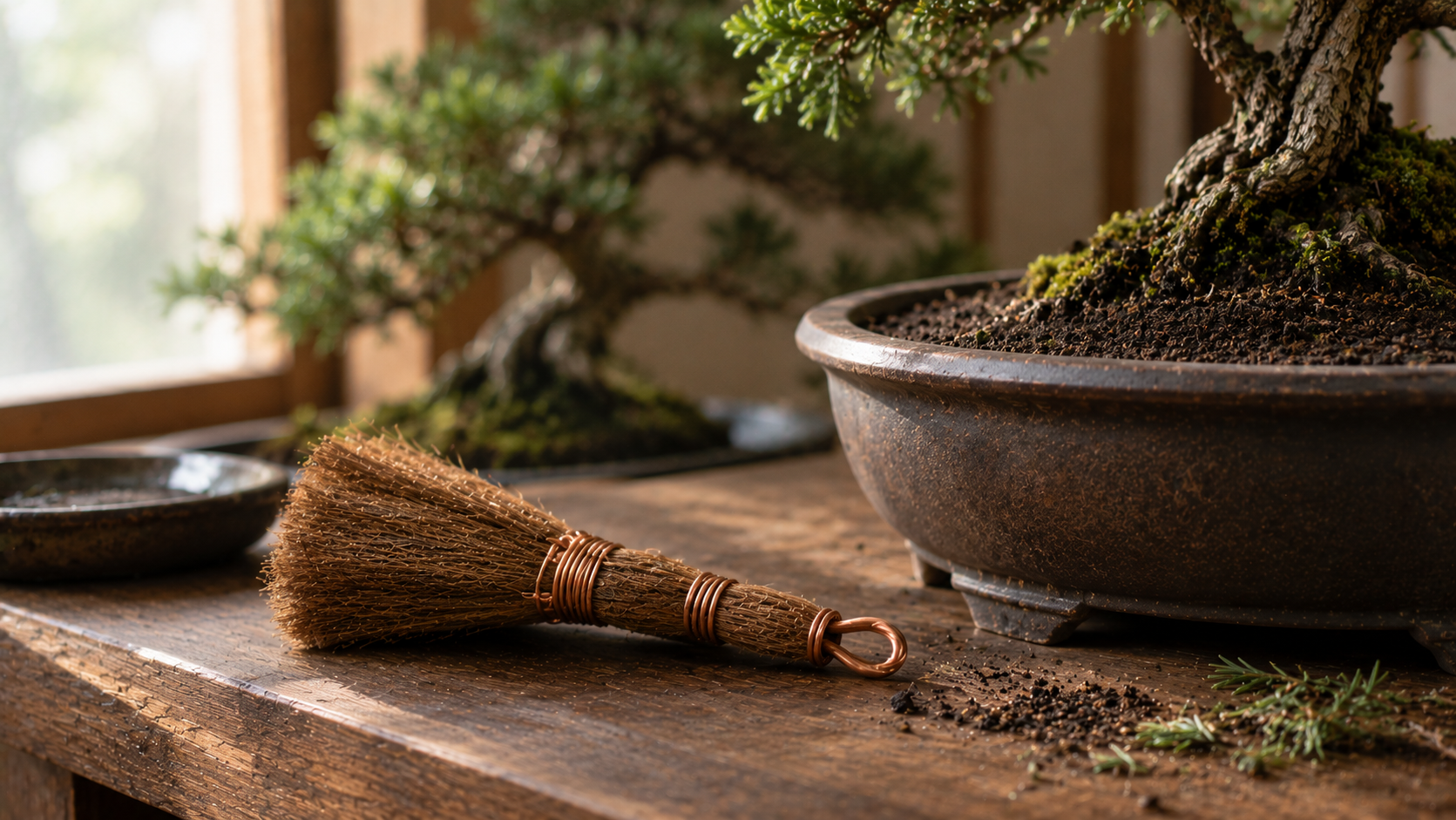
That’s where a bonsai brush comes in. It might seem like the least important tool in the kit, but it’s the one that turns a messy work session into a tree you’d actually want to display. A soft palm-fiber broom tidies the soil surface without disturbing moss. A small nylon brush cleans trunks and branches. And a stiff brass brush brings out the texture of deadwood.
Japanese bonsai growers have used natural-fiber brushes for generations. Shuro, the fiber of the hemp palm, is especially valued: tough, springy and gentle enough not to scratch. You’ll still find handmade shuro brushes from Japanese craftsmen today.
The confusing part is that “bonsai brush” can mean very different tools, from a soft broom for soil to a stiff wire brush for deadwood. Use the wrong one in the wrong place and you can damage living bark.
In my experience, most growers only need two brushes: one soft broom for soil and benches, and one bark brush for trunks or deadwood. This guide explains the difference, then compares six Japanese brushes, from shuro palm brooms to Kaneshin’s brass deadwood brushes.
Who this bonsai brush guide is NOT for
It’s not about paintbrushes for lime sulfur. Applying deadwood treatments uses small artist’s brushes. Our lime sulfur for bonsai guide covers that.
It’s not about cleaning tools. Rust erasers and cleaning blocks for blades are covered in our bonsai tool maintenance guide.
It’s not for carving. Brushes clean and finish deadwood; they don’t shape it.
Still with us? Let’s go.
How we picked these (3 things that actually matter)
1. Soft broom or bark brush
There are two families of bonsai brushes.
- Soft brooms (hemp, shuro palm, coir) are for soil surfaces, pot rims, moss and work benches. They sweep without digging into the soil or tearing moss.
- Bark brushes (nylon, brass, wire) are for trunks, branches and deadwood. They remove dirt, loose bark, algae and old debris.
2. Bristle stiffness
For bark brushes, stiffness is everything.
- Soft nylon is safe for living bark, including delicate trunks like azaleas and deciduous trees.
- Brass is stiffer and best for deadwood. Herons warns its brass brush should not be used on live bark.
- Stiff wire or stainless steel is the most aggressive, for heavy deadwood cleaning and tight spots.
Using a stiff brush on living bark can damage it, so always match the brush to the job.
3. Material and craftsmanship
Natural shuro (hemp palm) fiber brushes are a traditional Japanese craft. Some are handmade in regions known for hemp palm products, such as Wakayama. They’re durable, flexible and don’t scratch.
Kaneshin, the well-known Japanese bonsai tool maker, also makes a range of bark brushes in nylon, brass and stainless steel.
A few brushing habits that matter more than the brush
None of these cost anything.
- Brush when soil is dry. Wet soil smears instead of sweeping.
- Sweep away from the trunk. Move debris outward toward the pot edge.
- Go gently on moss. Light strokes tidy it; hard strokes tear it. Our bonsai moss guide covers moss care.
- Test bark brushes on a small area first.
- Brush along the grain of deadwood, not across it.
- Keep brushes clean and dry. Shake out soil and let natural fibers dry after use.
Bonsai brush comparison table
| Brush | Type | Material | Best for | Origin | Approx. price |
|---|---|---|---|---|---|
| Wigert’s Japanese Hemp Bonsai Brush | Soft broom | Hemp | Soil and bench cleanup | Japan | ~$14 |
| Niwaki Shuro Brush | Soft broom | Shuro palm fiber, copper wire | Soil, moss, pot surfaces | Japan | ~£12 (UK) |
| Shokunin Store Premium Shuro Brush | Soft broom | Shuro palm fiber, copper wire | Handmade quality | Wakayama, Japan | ~$21 |
| Kaneshin Nylon Curved Brush (156B) | Bark brush | Soft nylon | Living bark, cleaning tools | Japan | ~$8 |
| Kaneshin Japanese Brushes (brass/wire) | Bark brush | Brass, wire, stainless | Deadwood, jin and shari | Japan | ~$12–15 |
| Herons Brass Deadwood Cleaning Brush | Bark brush | Brass | Deadwood (UK) | Not stated | ~£15 (UK) |
Prices are approximate and vary by retailer. Always check the current price before buying.
The 6 best bonsai brushes, reviewed
1. Wigert’s Japanese Hemp Bonsai Brush – the best everyday broom
If you want one soft brush for cleaning up after work, this is an easy, affordable choice.
Wigert’s Bonsai sells a premium-quality hemp brush made in Japan. It’s 5½ inches long, a comfortable size for sweeping soil off pot rims and clearing the work area after repotting. Wigert’s lists it at around $14 and notes it has many uses.
It’s small enough to get around the base of a tree and soft enough not to disturb the soil surface.
Pros
- Made in Japan
- Compact and easy to handle
- Great for soil and bench cleanup
- Affordable
Cons
- Not for cleaning bark or deadwood
- Small for very large benches
Best for: everyday cleanup after pruning and repotting.
Check the Japanese Hemp Bonsai Brush at Wigert’s
2. Niwaki Shuro Brush – the classic shuro palm broom
Shuro brushes are a Japanese classic, and Niwaki’s version is a popular one in the UK and Europe.
It’s made in Japan from natural palm fibers of Trachycarpus fortunei, the hemp palm, bound with copper wire. At 170 × 90 mm, it has an angled shape that allows both broad sweeps and precise strokes. Made In Japan UK lists it at around £12, though it was sold out when we checked.
The retailer suggests it for gentle sweeping of bonsai, potted plants and delicate moss-like ground covers.
Pros
- Traditional shuro palm fiber
- Made in Japan
- Angled shape for precision
- Gentle on moss
Cons
- Stock varies
- Mainly sold in the UK and Europe
Best for: growers who want a traditional Japanese broom for soil and moss.
Check the Niwaki Shuro Brush at Made In Japan UK
3. Shokunin Store Premium Shuro Brush – best handmade option
If you appreciate craftsmanship, this is the shuro brush to choose.
The Shokunin Store’s premium brush is made in Wakayama, south of Osaka, a region known for hemp palm products, by skilled local craftsmen. It’s made from hemp palm fiber bound with copper wire, measures 11 × 22 × 3 cm and weighs about 0.1 kg. It’s designed to brush bark, twigs and soil from the base of bonsai trees, and costs around $21.
It’s a lovely example of a traditional Japanese craft, and a thoughtful gift for a bonsai grower.
Pros
- Handmade in Wakayama, Japan
- Traditional shuro palm fiber
- Larger size for broader sweeping
- Makes a nice gift
Cons
- More expensive than basic brooms
- Too large for very tight spaces
Best for: growers who value traditional Japanese craftsmanship.
Check the Premium Shuro Brush at Shokunin Store
4. Kaneshin Nylon Curved Brush (156B) – best for living bark
For cleaning trunks and branches on living trees, you need a soft brush, and Kaneshin’s curved nylon brush is an inexpensive, reliable option.
It’s made in Japan by Kaneshin, 10 inches long, with soft nylon bristles. Bonsai Tonight lists uses including brushing azalea trunks and branches, brushing deciduous trunks and branches, cleaning deadwood, and removing sap and debris from tweezers. It costs around $8.
Nylon is the softest of the bark brush materials, so it’s the safest choice for living bark.
Pros
- Soft enough for living bark
- Made in Japan by Kaneshin
- Very affordable
- Useful for cleaning tools too
Cons
- Too soft for heavy deadwood cleaning
Best for: azaleas, deciduous trees and gentle trunk cleaning.
Check the Kaneshin Nylon Curved Brush at Bonsai Tonight
5. Kaneshin Japanese Brushes (brass, wire, stainless) – best for deadwood
For jin and shari, a stiffer brush brings out texture and removes loose fibers and old debris.
Wigert’s sells a range of Kaneshin brushes imported from Japan, at about $12–15 each:
- Soft Nylon for live areas on the trunk and branches.
- Single Stiff Brass for deadwood.
- Double Stiff Brass, a very stiff brush for jin and shari.
- Soft Wire for both deadwood and living areas.
- Triangle Wire, made of stainless steel, for tight spots.
This range lets you match the stiffness exactly to the job. After carving, a brass brush is a good way to clean up surfaces before treating deadwood. Our bonsai carving tools guide covers the carving stage.
Pros
- Made in Japan by Kaneshin
- Several stiffness levels
- Triangle brush for tight spots
- Affordable
Cons
- Stiff brushes can damage living bark
- Individual sizes not listed
Best for: deadwood cleaning on junipers and pines.
Check Kaneshin brushes at Wigert’s Bonsai
6. Herons Brass Deadwood Cleaning Brush – the UK option for deadwood
For UK growers, Herons Bonsai sells a brass cleaning brush for around £15.
Herons describes it as a stronger style of cleaning brush with brass bristles, designed for effective cleaning of deadwood and jins, and warns that it should not be used on live bark. The listing doesn’t give dimensions or origin.
It’s a simple, practical choice if you’re in the UK and want a dedicated deadwood brush. Herons also sells a nylon cleaning brush for softer work.
Pros
- Strong brass bristles for deadwood
- Clear guidance on use
- Easy to buy in the UK
Cons
- Not for live bark
- Origin and size not stated
Best for: UK growers cleaning jin and shari.
Check the Brass Cleaning Brush at Herons
Which bonsai brush should you buy? (By job)
Cleaning soil and the bench after repotting: Wigert’s Japanese Hemp Brush.
Tidying moss and the soil surface for display: Niwaki Shuro Brush.
You want a handmade traditional brush, or a gift: Shokunin Store Premium Shuro Brush.
Cleaning living bark on azaleas or deciduous trees: Kaneshin Nylon Curved Brush.
Cleaning jin and shari: Kaneshin brass brushes, or Herons Brass Brush in the UK.
Reaching into tight spots on deadwood: Kaneshin Triangle Wire brush.
A simple two-brush kit
For most growers, two brushes cover nearly everything: a soft shuro or hemp broom for soil, moss and benches, and a Kaneshin nylon brush for trunks and tools. Add a brass brush only if you work on deadwood. If you’re putting together a repotting kit, our bonsai repotting supplies guide covers the rest.
What is shuro, and why do Japanese growers like it?
Shuro is the Japanese name for the hemp palm, Trachycarpus fortunei, and for the brown fiber that grows around its trunk. For a long time, this fiber has been used in Japan to make brooms, scrubbing brushes and rope, because it’s strong, springy and naturally resistant to water.
For bonsai, those qualities are ideal. A shuro brush is stiff enough to sweep soil and debris efficiently, but soft and flexible enough not to scratch pots or tear moss. It doesn’t shed plastic bristles, and with basic care it lasts a long time.
Many shuro brushes are still made by hand, with the fibers bundled and bound tightly with copper wire. The Shokunin Store notes that its brush is made in Wakayama, a region known for hemp palm products. If you enjoy using traditional Japanese tools alongside your Kaneshin or Masakuni cutters, a shuro bonsai brush fits right in.
Brushes for indoor bonsai
Indoor trees need cleaning too, often more than outdoor ones, because dust settles on leaves and the soil surface.
A soft shuro or hemp broom is perfect for tidying the soil and the tray around an indoor tree without making a mess. For dusty leaves on trees like ficus, a soft nylon brush or gentle rinse in the sink usually works better than a stiff brush. Avoid brass and wire brushes on indoor tropical trees, since their bark is usually living and easily marked.
How to clean a bonsai before display
- Remove fallen leaves and debris by hand or with tweezers.
- Sweep the soil surface gently with a soft broom, away from the trunk.
- Clean the pot rim and sides with the broom or a damp cloth.
- Brush the trunk with a soft nylon brush to remove dust and algae.
- Clean deadwood with a brass brush, along the grain.
- Tidy moss with light strokes.
- Wipe the pot for a final finish.
How to care for bonsai brushes
- Shake out soil and debris after each use.
- Let natural-fiber brushes dry in the air before storing.
- Keep brass and wire brushes dry to prevent corrosion.
- Store brushes separately from cutting tools so bristles don’t get crushed.
- Replace worn brushes. Bent bristles brush unevenly and can scratch.
Common bonsai brush mistakes
Using a brass or wire brush on living bark. It can damage the tree.
Sweeping wet soil. It smears and compacts the surface.
Brushing moss too hard. It tears moss away from the soil.
Brushing across deadwood grain. It can leave unnatural scratches.
Using one brush for everything. Soil, bark and deadwood each need a different brush.
Conclusion: two simple brushes, a much tidier tree
A bonsai brush is a small, inexpensive tool that makes a big difference to how your trees look. A soft Japanese hemp or shuro broom keeps soil, moss and benches tidy, and a Kaneshin nylon brush cleans living bark gently. If you work on deadwood, a brass brush adds the finishing touch.
For most growers, Wigert’s hemp brush and Kaneshin’s nylon brush are the perfect starting pair. For craftsmanship or a gift, a handmade Wakayama shuro brush is hard to beat.
Brush gently, match the brush to the job, and your trees will always be ready for display. It’s a small habit, but a clean pot, tidy moss and well-kept bark are often what separate a good-looking bonsai from a truly finished one.
Ready to tidy up? Check the Japanese Hemp Bonsai Brush at Wigert’s, or check Kaneshin brushes.