Affiliate disclosure: Some links on this page are affiliate links. If you buy through them, Aribonsai may earn a small commission at no extra cost to you. It doesn’t change what we recommend or how we rank anything.
When wire just isn’t strong enough
Every bonsai grower eventually meets a branch that wire can’t move.
It might be a thick pine branch that needs to come down 30 degrees. A collected juniper trunk that’s ramrod straight. A first branch that’s been growing upward for ten years. You wrap it with the thickest wire you own, pull, and nothing happens, except maybe a worrying creak.
That’s the job of a bonsai branch bender. Jacks, benders and splitters let you apply slow, controlled force to wood that’s far too thick for wire alone. Used carefully, they can make the kind of dramatic movement that turns raw material into a real bonsai.
They’re also some of the riskiest tools in bonsai. Too much force, too fast, and branches crack or snap. Hooks can dig into bark and leave scars that take years to heal. And some species simply don’t tolerate heavy bending.
In my experience, the people who succeed with heavy bends aren’t the ones with the strongest tools. They’re the ones who prepare the branch well, bend slowly, and stop when the wood tells them to. This guide explains what matters, then compares six options, from Japanese Kikuwa jacks and a Kaneshin trunk splitter to a full bending kit and a low-cost DIY approach.
Who this bonsai branch bender guide is NOT for
It’s not for beginners on their first tree. Heavy bending is an advanced technique. If you’re still learning wiring, start with our bonsai wire guide.
It’s not for most deciduous trees. On bonsai forums, experienced growers point out that dramatic bending is mainly done on conifers, whose wood is more pliable. Older deciduous wood tends to be brittle, and big changes are often made by cutting back and growing new branches instead.
It’s not for small branches. If wire can move it, use wire. Benders are for when it can’t.
Still with us? Let’s go.
How we picked these (3 things that actually matter)
1. Type of tool
There are three main kinds of heavy-bending tools.
- Jacks use a threaded rod to push or pull gradually. They’re the most controllable option and are used on thick trunks and branches. They’re also the most expensive.
- Branch benders and clamps usually have hooks at each end and a screw in the middle that presses the branch down. They’re simpler, but the hooks can damage bark if not padded.
- Trunk splitters don’t bend anything themselves. They make controlled splits in thick wood so it becomes flexible enough to bend with wire or a jack.
2. Capacity and size
A tool that’s too small won’t move the branch. One that’s too big is clumsy on a smaller tree and harder to position without hitting other branches.
Jacks are sold in sizes, usually described by their length range and how far they extend. Match the tool to the thickness and length of the branch, and think about where you can anchor it.
3. Protection and control
The best bonsai branch bender is useless if it scars the tree. Look at how the tool contacts the bark, and plan to pad every contact point.
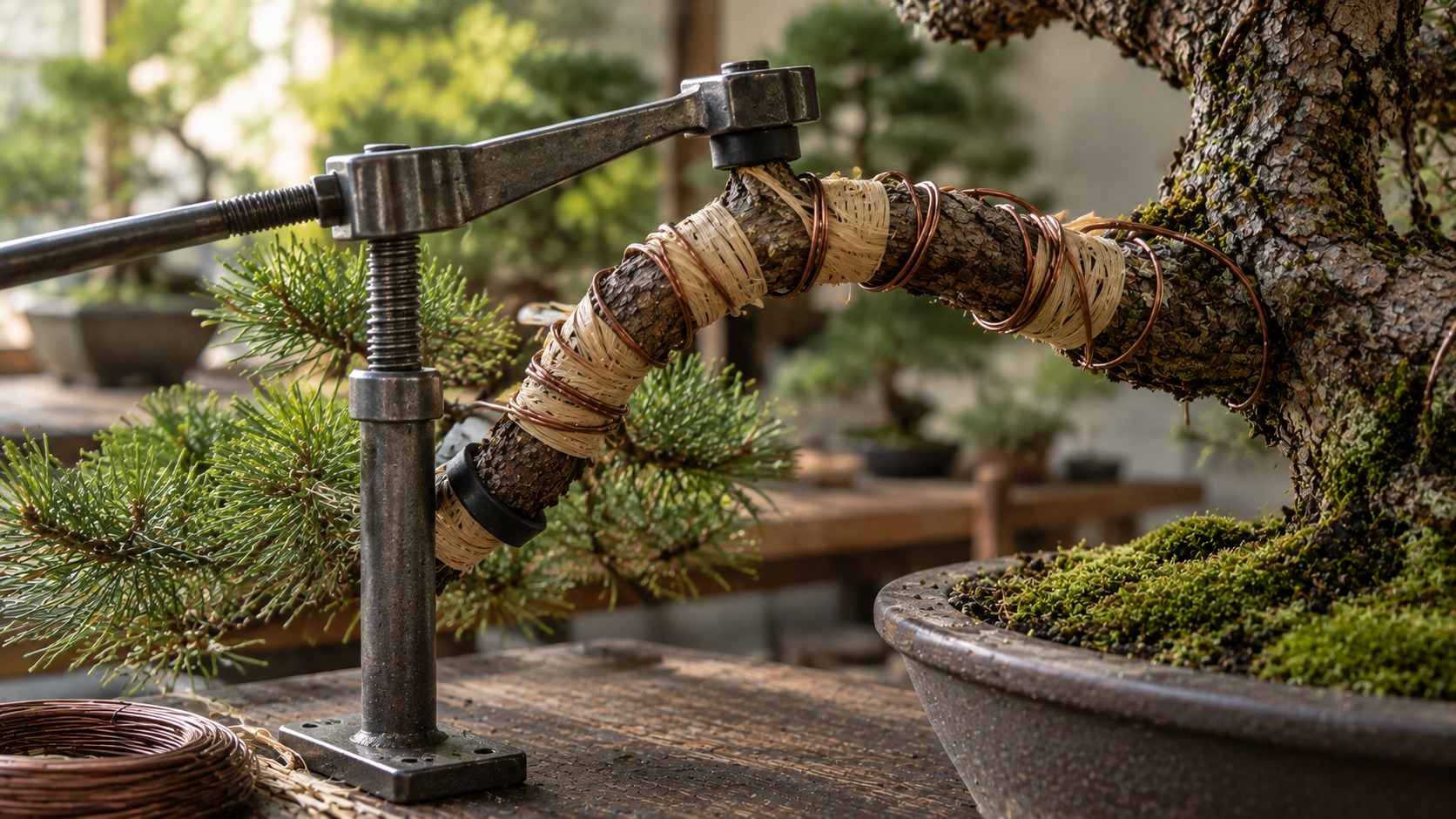
Bonsai Tonight’s jack tutorial, for example, covers sharp contact edges with rubber hose secured by small copper wires, and protects guy wires with tubing so they don’t cut into the trunk. Many growers also wrap the branch in raffia and wire before bending, to support it and reduce the risk of cracking.
A few heavy-bending habits that matter more than the tool
None of these cost anything.
- Bend slowly. Turn the jack a little, then pause. Fast bends crack wood.
- Listen. Small cracking sounds mean stop, check, and maybe come back another day.
- Pad every contact point. Rubber hose, raffia or several layers of tape.
- Support the branch first. Wrapping with raffia and wiring the branch helps hold it together under stress.
- Bend at the right time. Many growers prefer late winter to early spring for heavy bends, when the tree is about to grow and heal. Check the right timing for your species.
- Take up slack as you go. Tightening guy wires during the bend helps the branch hold its new position.
- Be patient. A heavy bend can take a growing season or more to set.
Bonsai branch bender comparison table
| Tool | Type | Best for | Origin | Approx. price |
|---|---|---|---|---|
| Kikuwa Bonsai Jack, Small (2472) | Threaded jack | Most heavy bends | Japan | ~$125 |
| Kikuwa Bonsai Jack, Medium (2476) | Threaded jack | Larger trunks and branches | Japan | ~$145 |
| Kaneshin Trunk Branch Splitter | Splitter | Making thick wood bendable | Japan | ~$140 |
| Herons Large Branch Bending Kit | Kit (bender, clamp, splitter, raffia, wire) | Getting everything at once (UK) | Not stated | ~£95 (UK) |
| XL Branch Bender (Love My Bonsai) | Screw bender | Budget heavy bending | Not stated | ~$90 |
| Guy wires, rebar and clamps | DIY | Low cost, flexible setups | Varies | Low |
Prices are approximate and vary by country and seller. Always check the current price before buying.
The 6 best bonsai branch benders, reviewed
1. Kikuwa Bonsai Jack, Small (2472) – the best all-round jack
If you’re going to buy one serious bending tool, this is it. Bonsai Tonight, which sells it in the US, calls it “the original bonsai jack for heavy bending.”
It’s made in Japan by Kikuwa. The small jack runs from 14.75 inches to 21.5 inches, extending by 7 inches. You bend by turning a threaded rod, which moves the arms gradually and gives you fine control. The tip rotates 360 degrees, so you can set anchor points in many different positions, and an Allen wrench is included.
At around $125, it’s a real investment. But a jack gives you something no other tool does: the ability to bend a little today, stop, and continue next week, all with precise, gradual pressure.
Pros
- Made in Japan by Kikuwa
- Very controllable threaded action
- 360-degree rotating tip for flexible anchoring
- Suits most heavy bends on bonsai
Cons
- Expensive
- Takes practice to rig safely
Best for: serious growers working on conifers and thick branches.
Check the Kikuwa Small Jack at Bonsai Tonight
2. Kikuwa Bonsai Jack, Medium (2476) – for bigger trunks
The medium version of the same tool is for larger material. It runs from 15 inches to 23.5 inches, extending by 8.25 inches. Like the small jack, it’s made in Japan and bends by turning a threaded rod.
The extra reach and extension help on larger collected trees and thick trunks, where you need more distance between anchor points or more travel to make the bend. At around $145, it’s slightly more expensive than the small jack.
Bonsai Tonight’s tutorial on using a jack is well worth reading before your first bend. It covers anchoring to a root with wire, padding the jack’s contact points with rubber hose, protecting guy wires with tubing, and taking up slack as you go. In its example, the bend took about one to two hours, with frequent pauses to inspect.
Pros
- More reach and extension for big material
- Same Japanese build quality
- Precise, gradual control
Cons
- Overkill for medium-sized trees
- Highest price among the jacks
Best for: advanced growers working with large collected trees and thick trunks.
Check the Kikuwa Medium Jack at Bonsai Tonight · Read Bonsai Tonight’s jack tutorial
3. Kaneshin Trunk Branch Splitter – best for making thick wood bendable
Sometimes a branch is simply too stiff to bend, even with a jack. A trunk splitter solves that.
Kaneshin’s splitter makes controlled splits in the branches and trunks of small to medium trees. The splits soften the wood so it can be bent into shape, usually with heavy wire or a jack. Niwaki describes it as 8.3 inches long, carbon steel, handmade in Japan, and weighing 5.2 oz.
It’s important to understand what it isn’t. Niwaki is clear that it’s not a cutting tool and should never be used to sever a branch or trunk. It’s a precision tool for a specific job.
Splitting is an advanced technique. After splitting, growers typically wrap the area with raffia and wire to hold it together while it bends and heals. Any exposed wounds benefit from sealing; our bonsai cut paste guide covers the options.
Pros
- Handmade in Japan by Kaneshin
- Makes very stiff wood bendable
- Precise, controlled splits
Cons
- Advanced technique with real risk
- Expensive for a specialized tool
- Carbon steel needs care to avoid rust
Best for: experienced growers making dramatic trunk and branch changes.
Check the Kaneshin Trunk Branch Splitter at Niwaki
4. Herons Large Branch Bending Kit – best all-in-one kit for UK growers
If you’re in the UK and want everything for heavy bending in one box, Herons Bonsai sells a large branch bending kit for around £95.
It includes a 430 mm heavy-duty branch bender, a 195 mm branch and trunk bending clamp, a 270 mm trunk splitter, 50 g of raffia and 500 g of 5 mm wire. That covers the main pieces of a heavy-bending setup: tools to apply force, a splitter for stiff wood, and raffia and wire to protect and support the branch.
The listing doesn’t state where the tools are made, and it was marked as limited stock when we checked.
Pros
- Everything you need in one kit
- Includes raffia and heavy wire
- Good value compared with buying separately
Cons
- Origin not stated
- Mainly available in the UK
- Limited stock
Best for: UK growers getting into heavy bending for the first time.
Check the Large Branch Bending Kit at Herons
5. XL Branch Bender – the budget screw-type option
If a Japanese jack is out of budget, a simpler screw-type branch bender is the next step down.
Monster Gardens sells an XL branch bender from Love My Bonsai, sized at 7 by 7 inches, for about $90. Tools like this typically have hooks at each end and a central screw that presses the branch into a curve.
The listing doesn’t state the material or country of origin, and it was backordered when we checked. Be aware of how these tools work, too. On bonsai forums, experienced growers note that the outer hooks can damage bark as the middle is cranked down, and one reported serious scarring on a maple. Pad the hooks heavily, and use them mainly on conifers.
Pros
- Cheaper than a Japanese jack
- Simple to use
- Large size for thick branches
Cons
- Hooks can scar bark without heavy padding
- Origin and material not stated
- Less precise than a threaded jack
Best for: budget-conscious growers bending conifer branches, with good padding.
Check the XL Branch Bender at Monster Gardens
6. Guy wires, rebar and clamps – the low-cost DIY approach
You don’t always need a dedicated tool. Many experienced growers make heavy bends with simple materials.
On bonsai forums, a common recommendation is a rebar lever: a piece of steel rod tied along the branch and extending past it, then pulled down by a well-placed guy wire. One experienced grower describes this as far more effective and far less intrusive than a branch bender for moving large branches. Others use ordinary trigger clamps from a hardware store as a cheap alternative to a bonsai bender.
Guy wires on their own also work well for lowering branches gradually. Anchor them to the pot or a root, protect the bark where the wire touches, and tighten them a little at a time. A good pair of bonsai jin pliers makes tightening much easier.
Pros
- Very low cost
- Flexible, adaptable setups
- Often gentler on bark than hooked benders
Cons
- Takes more planning and practice
- Less precise than a jack
- Rigging can look messy during training
Best for: growers on a budget, and anyone who wants a gentler approach.
Search trigger clamps on Amazon · Search bonsai raffia on Amazon
Which bonsai branch bender should you buy? (By situation)
You want one serious bending tool: Kikuwa Bonsai Jack, Small.
You work with large collected trees: Kikuwa Bonsai Jack, Medium.
Your branch or trunk is too stiff to bend at all: Kaneshin Trunk Branch Splitter, followed by raffia, wire and a jack.
You’re in the UK and want everything at once: Herons Large Branch Bending Kit.
You’re on a budget: XL Branch Bender with heavy padding, or the DIY guy wire and rebar approach.
You want the gentlest method: guy wires and a rebar lever, tightened gradually over time.
You grow deciduous trees: consider cutting back and growing new branches instead of heavy bending.
A typical heavy-bending setup
For a big conifer bend, many growers use a combination: raffia wrapped around the branch, heavy wire over the raffia, a jack or bender to apply force slowly, and guy wires to hold the new position once the bend is made.
How to prepare a branch for a heavy bend
- Choose the right time. Many growers bend heavily in late winter or early spring. Check what suits your species.
- Make sure the tree is healthy. Only bend vigorous trees. A weak tree may not recover from heavy work.
- Wrap with raffia. Soak the raffia, then wrap it tightly around the branch. It supports the outer layers of wood and bark.
- Wire over the raffia. Heavy wire adds support and helps hold the bend.
- Pad contact points. Rubber hose or extra raffia wherever a tool or guy wire touches.
- Bend slowly. Small turns, frequent pauses, listen for cracks.
- Secure the position. Use guy wires to hold the bend, then remove the jack or bender.
- Protect and wait. Keep the tree out of strong wind and harsh sun while it recovers.
Common bonsai branch bender mistakes
Bending too fast. The single biggest cause of snapped branches.
Skipping padding. Bare hooks and wires can scar bark badly.
Bending brittle wood. Old deciduous wood and dead branches often snap.
Removing support too early. A heavy bend can take a growing season or more to set.
Forgetting about the pot. Heavy bends put force on the root ball and pot. Anchor carefully and protect the pot rim.
Conclusion: slow force, good preparation
A bonsai branch bender lets you make movements that wire alone can’t. But it’s not about strength. It’s about control, preparation and patience.
For most serious growers, the Kikuwa Small Jack is the best single tool: Japanese-made, precise and versatile. If wood is too stiff, Kaneshin’s Trunk Branch Splitter makes it workable. And if you’re on a budget, guy wires and a rebar lever can achieve surprisingly big changes with very little money.
Whichever you choose, wrap the branch, pad every contact point, bend a little at a time, and stop when the wood tells you to.
Ready to move that branch? Check the Kikuwa Bonsai Jack at Bonsai Tonight, or check the Kaneshin Trunk Branch Splitter at Niwaki.